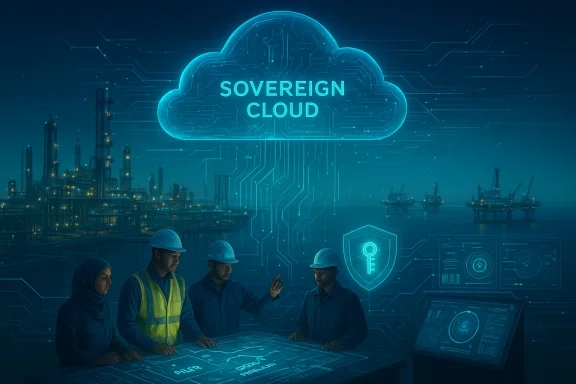
Aramco’s announcement that it has signed a non‑binding Memorandum of Understanding (MoU) with Microsoft to “explore a series of digital initiatives” marks a major, explicit step toward scaling industrial AI, sovereign‑ready cloud infrastructure, and large‑scale digital skilling across Saudi Arabia’s energy and industrial sectors. The public statements from both companies make clear this is about more than pilot projects: it aims to move AI from experiments into core operations while coupling that technical push with workforce development and a marketplace approach to industrial AI intellectual property. For a country pursuing Vision 2030‑era diversification and digital leadership, the deal underscores how cloud platform vendors, national champions, and global tech firms are re‑shaping the contours of energy‑sector digitization — with big potential upside and significant governance, security, and economic tradeoffs to manage.
The MoU, signed in Dhahran and announced by Aramco on February 12, 2026, frames the partnership around four primary themes: digital sovereignty and data residency, operational efficiency and digital infrastructure, an industry alliance framework, and industrial AI IP co‑innovation. Both parties also emphasized a parallel skilling agenda — a commitment to accelerate capabilities in AI engineering, cybersecurity, data governance, and product management across the Kingdom. Microsoft positioned the collaboration as complementary to its broader Saudi investments, including datacenter expansion and national skilling programs.
This is not a transactional “cloud contract” alone. The language used — sovereign controls, co‑innovation, marketplace for industrial AI — signals intent to build an ecosystem where local partners, integrators, and Aramco’s operational domain expertise intersect with Microsoft’s Azure platform, enterprise AI tooling, and global partner network.
Where public materials are thin, caution is required. The MoU does not disclose monetary value, exact project timelines, or binding procurement commitments. Likewise, terms like “sovereign‑ready” can cover a wide range of technical architectures (from contractual assurances to sovereign cloud overlays to dedicated on‑premises systems). Those implementation details remain to be made explicit in follow‑on agreements.
Success will depend on the hard work that follows: rigorous model risk management, carefully architected sovereign controls, transparent IP and data arrangements, and skilling that leads to durable employment and operational capability. Without those things, the initiative risks producing glossy pilots, limited local value capture, and heightened exposure to cyber and systemic risks.
If Aramco and Microsoft follow through with accountable, measurable pilots and publish clear governance frameworks, the partnership could become a blueprint for how large industrial firms operationalize AI responsibly at scale. If they do not, it will be another example of grand statements yielding modest operational change. The difference will be found not in press releases but in the specifics: the contracts signed, the architectures chosen, the audits completed, and the humans actually placed into new, AI‑enabled roles.
Source: Health & Safety International Aramco and Microsoft partner to accelerate industrial AI and digital talent in Saudi Arabia
 Background
The MoU, signed in Dhahran and announced by Aramco on February 12, 2026, frames the partnership around four primary themes: digital sovereignty and data residency, operational efficiency and digital infrastructure, an industry alliance framework, and industrial AI IP co‑innovation. Both parties also emphasized a parallel skilling agenda — a commitment to accelerate capabilities in AI engineering, cybersecurity, data governance, and product management across the Kingdom. Microsoft positioned the collaboration as complementary to its broader Saudi investments, including datacenter expansion and national skilling programs.This is not a transactional “cloud contract” alone. The language used — sovereign controls, co‑innovation, marketplace for industrial AI — signals intent to build an ecosystem where local partners, integrators, and Aramco’s operational domain expertise intersect with Microsoft’s Azure platform, enterprise AI tooling, and global partner network.
Why this matters now
Saudi Arabia’s strategy is clear: translate oil‑era capital into technology capability and industrial competitiveness. The Aramco–Microsoft MoU comes against a backdrop of multiple concurrent initiatives across the Kingdom:- Large national AI ventures and funds have accelerated capital into infrastructure, models, and regional AI companies.
- Cloud providers are expanding physical presence in the region; Microsoft has publicized plans for a Saudi datacenter region and has articulated ambitions to support local workloads with “sovereign‑ready” configurations.
- Global consultancies and systems integrators (from Accenture to PwC and regional players) are running complementary training and center‑of‑excellence programs to populate the talent pipeline.
What the MoU actually commits to
It is important to be precise: the released document is a non‑binding MoU rather than a procurement contract. That matters legally and financially — MoUs set intent and scope but do not guarantee specific deployments, budgets, or timelines. The MoU’s stated areas of exploration include:- Digital sovereignty and data residency: building roadmaps for deploying Azure‑based solutions with enhanced sovereign controls to align with national data residency rules and Aramco’s internal governance needs.
- Operational efficiency & digital infrastructure: streamlining digital frameworks to support global operations and enabling low‑latency, resilient platforms for operational workloads.
- Industry alliance framework: scoping collaboration with Saudi integrators and industrial partners to accelerate AI adoption across the local industrial value chain.
- Industrial AI IP co‑innovation: exploring co‑development and potential commercialization of operational AI systems and the creation of a marketplace to share and distribute industrial AI solutions.
Confirming the facts: what’s verified, and by whom
Multiple primary sources confirm the claim that Aramco and Microsoft signed an MoU focused on industrial AI and skilling. Aramco’s official announcement details the MoU and quotes senior Aramco executives emphasizing operational scale and governance. Microsoft’s regional communications and recent statements on Saudi investments (including datacenter expansion and national skilling commitments) corroborate the firm’s parallel priorities: cloud footprint growth, sovereign‑ready infrastructure, and large‑scale AI training programs.Where public materials are thin, caution is required. The MoU does not disclose monetary value, exact project timelines, or binding procurement commitments. Likewise, terms like “sovereign‑ready” can cover a wide range of technical architectures (from contractual assurances to sovereign cloud overlays to dedicated on‑premises systems). Those implementation details remain to be made explicit in follow‑on agreements.
The strategic case: strengths and potential benefits
- Industrial scale and practical impact
- Aramco’s industrial footprint (upstream, downstream, chemicals, shipping, and logistics) creates exceptional opportunities to apply AI to asset optimization, predictive maintenance, process control, and emissions reduction. If industrial AI reliably reduces unplanned downtime and energy waste, the economic returns could be material.
- Faster path from pilot to production
- Historically, many industrial AI proofs‑of‑concept stall at pilot scale. Combining Aramco’s domain expertise and operations data with Microsoft’s platform and enterprise productization capabilities could accelerate the transition to productionalized AI — provided governance and integration are handled correctly.
- Talent development anchored to commercial demand
- Pairing practical, on‑the‑job AI upskilling with real industrial problems creates stronger learning outcomes than classroom‑only programs. Embedding training into living Aramco problems improves retention and raises the odds of productive local capability.
- Potential for a regional industrial AI marketplace
- Co‑developing IP and establishing mechanisms to commercialize industrial AI could make Saudi Arabia a hub for industrial AI solutions tailored to petrochemical, water treatment, and heavy manufacturing use cases common across the MENA region.
- Alignment with national policy goals
- The partnership dovetails with Vision 2030 priorities — diversifying the economy, building digital and AI talent, and localizing high‑value technology work.
The risks and unresolved governance questions
While the upside is significant, the announcement also surfaces a set of risks that require active mitigation:- Data sovereignty vs. platform economics: “Sovereign‑ready” cloud can mean many things: contractual commitments, onshore datacenters, encryption and key custody models, or physically isolated cloud regions. Achieving genuine sovereignty while retaining the operational economies of hyperscale cloud requires careful architecture choices and robust legal arrangements. The MoU language leaves many details open, and those details will determine whether the Kingdom can avoid vendor lock‑in while maintaining legal and regulatory control.
- Operational safety and model risk: AI models used in process control or predictive maintenance carry systemic risk if they fail or degrade silently. In safety‑critical industrial settings, model validation, change control, explainability, and human oversight are not optional. There is limited public detail to date on the lifecycle governance Aramco and Microsoft will require for models deployed in operations.
- Cybersecurity and supply‑chain exposure: Integrating cloud‑based AI into operational technology (OT) networks can expand the attack surface. Secure gateways, strict segmentation between IT and OT, and continuous validation are essential. Cloud vendors bring strong security practices, but joint responsibility models — and third‑party dependencies — create complexity that must be explicitly managed.
- Workforce disruption and promises vs. reality: Large‑scale skilling commitments frequently boast ambitious targets, but the real challenge is job redesign — integrating trained people into meaningful roles that influence operations and productization. Without clear pathways (certification, role reclassification, retention incentives), skilling can generate certificates with little operational impact.
- IP ownership and local capture: Co‑innovation promises can run into thorny disputes over ownership of models, data‑driven improvements, and commercialization rights. Clarity on revenue‑sharing, export controls, and licensing arrangements will determine whether the intellectual capital benefits local industry or primarily strengthens external vendors’ portfolios.
- Geopolitical and public‑policy scrutiny: Given the strategic nature of national energy infrastructure, regulatory bodies and international partners will scrutinize cross‑border data flows and dual‑use AI capabilities. The partnership must navigate export control regimes, privacy frameworks, and multilateral expectations about AI governance.
Technical guardrails that must be prioritized
To move from a marketing MoU to safe, resilient, and productive deployments, stakeholders should adopt the following technical and governance guardrails as baseline requirements:- Model Risk Management for Industrial AI
- Mandatory model validation cycles, adversarial testing, and continuous monitoring of performance drift.
- Clear thresholds for human intervention and rollback procedures.
- Data Governance and Provenance
- Data lineage, classification, and consent models that separate operational secrets from analytics datasets.
- Strong cryptographic controls and explicit key custody arrangements for onshore vs. off‑shore storage.
- Hybrid Architecture with Sovereign Controls
- Hybrid cloud architectures (onshore datacenter region + Azure backbone) or dedicated sovereign enclaves where necessary.
- Hardware security modules (HSMs), customer‑managed keys, and deployment patterns that avoid unilateral access by third parties.
- OT/IT Segmentation
- Strict network segmentation, just‑in‑time access controls, and air‑gap strategies where appropriate to protect safety‑critical systems.
- Explainability and Human‑in‑the‑Loop
- Deploy explainable models for decisions affecting safety or regulatory compliance.
- Keep operators fully empowered to override model outputs and require explainable audit trails for automated decisions.
- Open Red‑Team Testing and Independent Audits
- Regular external audits, penetration tests, and scenario‑based red teaming to detect emergent vulnerabilities before they cause incidents.
- Clear IP and Commercial Terms
- Transparent agreements on model ownership, derivative rights, and commercialization terms that protect local value capture.
How the partnership fits into the broader Saudi AI ecosystem
The Aramco–Microsoft MoU is not a standalone development; it sits within a fast‑moving regional ecosystem:- Saudi authorities, sovereign development funds, and national AI ventures have been actively investing in AI infrastructure and companies seeking to localize models, data centers, and human capital.
- Global cloud providers are racing to provide onshore datacenters and “sovereign‑ready” offerings, which together enable faster low‑latency industrial AI deployments.
- Independent consultancies and integrators are running centers of excellence, accelerators, and training cohorts focused on practical AI application and governance.
Economic and strategic implications
- Exportable industrial AI services
- If Aramco and local partners develop reusable, packaged industrial AI offerings, Saudi Arabia could export software and consulting services tailored to oil, gas, and chemicals markets across the MENA region and beyond.
- Productivity and decarbonization co‑benefits
- Realized productivity gains from AI‑driven asset optimization can drive both cost savings and lower emissions. At scale, these efficiency gains can materially affect national competitiveness.
- National capability and autonomy
- The degree to which AI expertise, model IP, and operational control are retained locally will shape long‑term strategic autonomy. If local institutions capture meaningful IP and create exportable talent, the net national benefit is higher.
- Vendor dynamics and competition
- The MoU positions Microsoft strongly in the industrial cloud space in Saudi Arabia. How other cloud and AI vendors respond, and how national procurement rules and sovereignty preferences shape choices, will materially influence market structure.
Practical scenarios: where industrial AI will likely be applied first
- Predictive maintenance and reliability engineering
- Reduce unplanned downtime by applying anomaly detection and remaining useful life models to rotating equipment and process control assets.
- Process optimization and energy efficiency
- Use AI to tune process control loops, optimize furnace and reactor conditions, and minimize emissions while maintaining throughput.
- Digital twin simulation
- Combine sensor data with physics‑based models and learned surrogates to create real‑time digital twins for planning and emergency response.
- Supply chain and logistics optimization
- AI can optimize crude and product flows, shipping logistics, and inventory positions across global operations.
- Environmental monitoring and regulatory compliance
- Automated monitoring of emissions, flaring, and effluent streams with near‑real‑time analytics to meet reporting obligations and improve sustainability metrics.
What success looks like — and how to measure it
A realistic success framework should include both technical KPIs and socio‑economic outcomes:- Technical KPIs
- Reduction in unplanned downtime (hours/year) attributable to AI interventions.
- Percent improvement in equipment availability and process efficiency.
- Mean time to detect (MTTD) and mean time to respond (MTTR) for AI‑driven alerts.
- Governance KPIs
- Percentage of industrial models with documented validation and monitoring plans.
- Number of third‑party security and model governance audits completed.
- Talent and economic KPIs
- Number of Saudi nationals certified in AI engineering and integrated into operational roles.
- Commercial revenue generated from any co‑developed industrial AI IP exported outside the company or country.
- Social KPIs
- Metrics on job redesign and worker transition support (reskilling placements, career pathways).
- Evidence of gender inclusion and equitable access in skilling programs.
Practical recommendations for Aramco, Microsoft, and regulators
- Translate MoU language into binding pilot criteria and success gates.
- Create timebound pilot agreements with explicit KPIs, safety acceptance tests, and financial clarity.
- Publish a model governance charter and incident response playbook.
- Transparency about governance will build trust with regulators, customers, and the public.
- Prioritize hybrid architectures for sensitive workloads.
- Where sovereignty or real‑time constraints matter, use onshore regions or sovereign enclaves with customer‑managed keys.
- Make the skilling pipeline measurable and tied to roles.
- Certificates must map to defined job families, demonstrable assessment, and placement programs.
- Insist on shared ownership rules for co‑developed IP that ensure local capture.
- Licensing terms should enable Saudi commercialization while recognizing the need for external commercialization channels.
- Embed independent review and audits.
- Contract external auditors for both security and model safety, and publish non‑sensitive summaries of findings to reinforce public trust.
A realistic timeline and what to watch next
Expect the immediate months after the MoU to produce a sequence of concrete actions if the partnership is to move forward meaningfully:- Detailed project scoping and pilot selection (0–6 months)
- Technical architecture decisions — datacenter choices, sovereign controls (3–12 months)
- Pilot deployments in low‑risk domains like predictive maintenance (6–18 months)
- Expansion to higher‑risk production controls with strict governance (12–36 months)
- Commercialization and broader industry alliance formation (18–48 months)
Final assessment
The Aramco–Microsoft MoU is a consequential development for industrial AI in Saudi Arabia — one that could accelerate the Kingdom’s ambitions to bind advanced digital tools to its industrial backbone. The strengths are clear: domain expertise, platform capability, and a national imperative to upskill talent. But the announcement is an opening move, not a guarantee of outcomes.Success will depend on the hard work that follows: rigorous model risk management, carefully architected sovereign controls, transparent IP and data arrangements, and skilling that leads to durable employment and operational capability. Without those things, the initiative risks producing glossy pilots, limited local value capture, and heightened exposure to cyber and systemic risks.
If Aramco and Microsoft follow through with accountable, measurable pilots and publish clear governance frameworks, the partnership could become a blueprint for how large industrial firms operationalize AI responsibly at scale. If they do not, it will be another example of grand statements yielding modest operational change. The difference will be found not in press releases but in the specifics: the contracts signed, the architectures chosen, the audits completed, and the humans actually placed into new, AI‑enabled roles.
Source: Health & Safety International Aramco and Microsoft partner to accelerate industrial AI and digital talent in Saudi Arabia