• Thread Author
Aramco’s non‑binding Memorandum of Understanding with Microsoft signals a concrete push to move industrial artificial intelligence from pilot projects into core operations, pairing Saudi Arabia’s oil‑and‑gas titan with one of the world’s largest cloud and AI platforms to pursue sovereign‑ready cloud architectures, operational AI use cases, and a large‑scale digital skills pipeline.

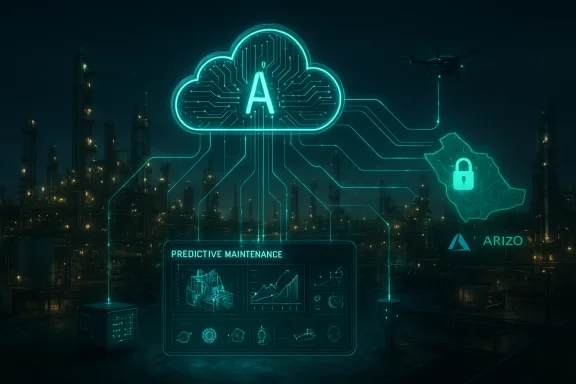
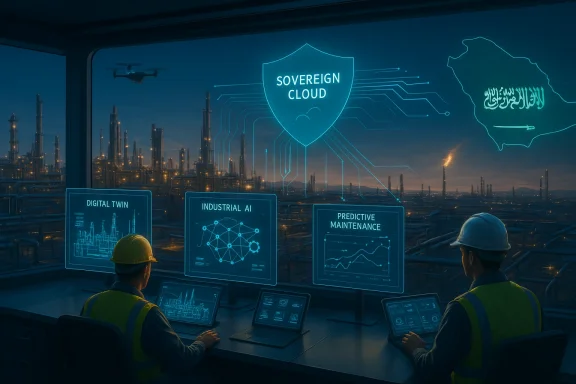
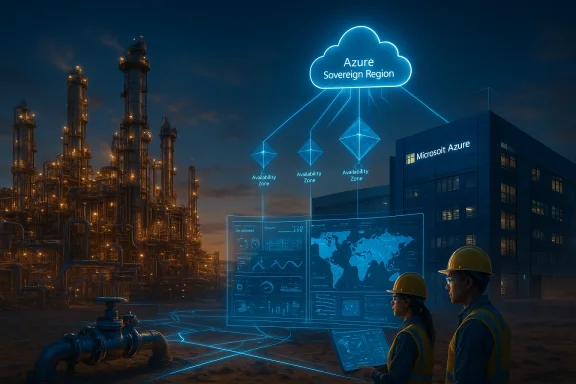
Industrial complex at night with Azure cloud and holographic sovereign region dashboards.Background and immediate significance​

The MoU, announced in official statements and reported by major outlets today, frames a multi‑year collaboration aimed at accelerating Aramco’s industrial AI adoption, strengthening digital sovereignty, modernizing operational infrastructure, and scaling workforce skills. The agreement is explicitly non‑binding and will proceed under the usual regulatory and commercial due diligence, but it formalizes a roadmap to test and potentially deploy Microsoft Azure‑based industrial solutions across Aramco’s global operations.
This move is the latest chapter in a multi‑year relationship between Aramco and Microsoft following earlier joint work on edge and distributed cloud architectures in Saudi Arabia—deployments that married Armada’s Galleon edge data centers and management software with Azure tooling to support low‑latency, site‑level AI workloads. That prior collaboration established a working technical baseline which this MoU seeks to expand into co‑innovation, commercialization, and talent initiatives.
Taken together with Microsoft’s public confirmation that a Saudi Arabia Azure datacenter region will be available to customers from Q4 2026, the MoU frames a practical pathway for Aramco to retain more control over where sensitive industrial data is processed while also leveraging cloud scale. The availability of a local Microsoft region—designed with three availability zones for enterprise resilience—matters for regulated industrial workloads that require local processing and lower latency.

What the MoU covers — an itemized read​

The public summary of the MoU outlines five principal areas of collaboration. Each area carries operational and strategic implications for how Aramco will approach industrial AI.
  • Digital sovereignty and data residency — The MoU explicitly contemplates a roadmap for deploying solutions on Microsoft cloud infrastructure with sovereign controls to meet national data residency and regulatory requirements. That language signals attention to the Kingdom’s Personal Data Protection Law, sectoral rules, and sovereign security objectives.
  • Operational efficiency and digital infrastructure — Aramco intends to explore Azure‑based solutions aimed at improving asset management, predictive maintenance, process optimization, and other industrial use cases that can reduce operating cost and increase uptime. The aim is to transition from proofs‑of‑concept to production‑grade systems that run reliably at scale.
  • Industry alliance framework — The MoU scopes engagements with local systems integrators, technology partners, and Saudi industrial collaborators. That suggests a broad‑based ecosystem approach rather than a 1:1 vendor model, and it aligns with the Kingdom’s focus on industrial localization and supply‑chain participation.
  • Industrial AI IP co‑innovation — Aramco and Microsoft will explore co‑development and potential commercialization of operational AI systems for the energy sector, including the possibility of a global marketplace for industrial AI solutions that could showcase Saudi capabilities internationally. This is a strategic step to convert internal know‑how into tradable IP.
  • Digital and technical skills development — The MoU includes programs to accelerate training in AI engineering, cybersecurity, data governance, and product management, with measurable outcomes. The intent is to scale local talent so Aramco and its partners can operate and govern AI systems responsibly. Microsoft has an existing footprint of cloud and AI training programs in the Kingdom, and the MoU looks to expand that remit within Aramco’s workforce and supplier base.

Why this matters: the technical and sovereignty angle​

Industrial AI for an operator the size of Aramco involves processing petabytes of telemetry and engineering data from pipelines, refineries, drilling operations, and supply logistics. For many of these workloads, low latency, predictable availability, and strict data‑control measures are prerequisites before AI can be trusted to act on or advise critical control systems.
Microsoft’s announced Saudi Arabia region—designed with three availability zones and enterprise resilience features—creates a practical infrastructure layer that can host these production workloads. That regional availability reduces cross‑border latency and simplifies legal compliance because data can be stored and processed inside the Kingdom while still leveraging Microsoft’s broader management, identity, and security controls where appropriate. Analysts familiar with the rollout emphasize that the initial service surface for new Azure regions typically focuses on core IaaS, identity, and management primitives first, with specialized AI runtimes and platform services phased in later—meaning Aramco will likely adopt a staged migration strategy.
From a sovereignty perspective, Microsoft’s "sovereign‑ready" posture—described in its regional announcements and industry analysis—does not necessarily equate to an exclusive or isolated national cloud but rather to a configurable stack that can satisfy in‑country processing and regulatory reporting needs while remaining able to interoperate with global services where permitted. This hybrid posture is important for large regulated enterprises that must balance national requirements with the efficiencies of global cloud platforms.

Practical industrial use cases that matter​

If Aramco and Microsoft follow through, the following use cases are likely near‑term priorities because they deliver measurable operational impact and are already proven by other major operators.
  • Predictive maintenance and anomaly detection for rotating equipment, compressors, and pumps—reducing unplanned downtime and maintenance costs.
  • Real‑time safety monitoring and anomaly detection using edge inference to supplement human supervision in high‑risk zones.
  • Production optimization using AI agents to tune process parameters for emissions and throughput targets.
  • Integrated supply‑chain forecasting that links field operations telemetry to logistics and downstream planning.
  • Digital twin orchestration for planning and scenario testing using faster model training and inference at scale.
These are not speculative ideas; industrial operators worldwide have demonstrated measurable gains from similar Azure and NVIDIA‑accelerated AI deployments. The value for Aramco would be building these models at global scale and locally embedding them into operational workflows—with strong governance and validation.

Commercial and strategic implications​

For Aramco:
  • The MoU provides a path to modernize operational IT and OT stacks without having to build every layer in‑house. Co‑innovation and IP commercialization could position Aramco as both a purchaser and a supplier of industrial AI solutions globally.
  • A focus on sovereign controls helps Aramco reconcile national compliance and corporate security while still using hyperscale capabilities.
For Microsoft:
  • A deeper relationship with Aramco cements Microsoft’s role as a strategic cloud partner in the Kingdom’s energy sector and accelerates adoption of Azure industrial offerings.
  • It positions Microsoft to showcase sovereign‑ready solutions and regional datacenter economics—useful commercial proof points for other governments and regulated industries in the Middle East.
For the Kingdom:
  • The collaboration aligns with Vision 2030 goals by aiming to convert industrial scale AI into jobs, upskilling programs, and exportable IP. If successful, it can accelerate the Kingdom’s industrial competitiveness and localization initiatives.

Governance, security, and risk — a sober reality check​

The MoU’s ambitions are real, but large industrial AI projects multiply certain risks that require explicit mitigation strategies. Below are the key concerns and recommended governance guardrails.
  • Data governance and provenance — Industrial models depend on high‑quality, labeled telemetry. Aramco must publish clear policies for data lineage, retention, and model retraining cadence. Without rigorous data governance, models drift and decisions become unreliable.
  • Cybersecurity of OT environments — Connecting control systems to cloud services raises attack surface concerns. Segmented architectures, strong identity controls, and OT‑specific intrusion detection are non‑negotiable. The industry has repeatedly shown that OT cyber incidents can cause physical harm; ensuring resilient, air‑gapped fallback operations is essential.
  • Vendor lock‑in and portability — Deep engineering into a single cloud stack creates economic dependency and builds migration complexity. Aramco should define clear portability targets (open formats, containerized runtimes, hardware abstraction layers) to preserve strategic options.
  • IP ownership and commercial terms — Co‑innovation that leads to commercial products must clarify ownership, royalties, export controls and liability. For dual‑use industrial IP, export restrictions and national security reviews may apply.
  • Model validation and safety certification — Operational AI that influences plant controls must pass strict validation. Independent audits, white‑box testing, digital twin simulation, and staged rollouts (shadow mode → advisory mode → closed‑loop control) are best practices.
  • Workforce transition and ethics — Scaling AI can change job roles and responsibilities. Skills programs outlined in the MoU are necessary but insufficient on their own; Aramco should commit to measurable retraining targets, career transition pathways, and human‑in‑the‑loop governance for critical decisions.

Where the MoU can create real value — and where it cannot​

The most credible near‑term value lies in improving situational awareness, maintenance scheduling, and decision support systems—domains where AI augments human expertise and where performance gains are measurable. Co‑innovation around industrial AI toolkits also offers longer‑term commercial upside because sector‑specific models and feature sets are valuable and often scarce.
However, the MoU is not a short‑cut to autonomous plants or fully automated drilling operations. Realistic timelines for certified, closed‑loop AI control that interacts directly with physical processes remain multi‑year efforts with heavy validation and regulatory requirements. Further, measurable ROI will depend on disciplined data engineering, integration with legacy systems, and change management at scale.

The talent dimension: promises and pitfalls​

The MoU includes commitments to skill building in AI engineering, cybersecurity, data governance, and product management—areas where the Kingdom needs scale if Vision 2030’s industrial ambitions are to be realized. Microsoft already runs training programs across Saudi Arabia, and local initiatives such as Microsoft‑backed academies are part of the ecosystem that can supply trained engineers and cloud operators.
But meaningful workforce transformation requires more than online certificates. To deliver operational capability, the program must combine:
  • Intensive, hands‑on apprenticeships inside Aramco operational environments.
  • Multi‑disciplinary curricula that bridge OT engineering and data science.
  • Measurable placement metrics, progression pathways, and continuing professional education tied to real project milestones.
Absent these, upskilling promises risk becoming nominal tick‑box outcomes rather than durable capacity building. Aramco and Microsoft will need transparent KPIs for participant graduation, placement in operational roles, and demonstrable improvements in operational maturity.

Regulatory and geopolitical factors to watch​

  • Regulatory approvals and standards — The MoU is non‑binding and will need to evolve into contractual agreements that pass national security, banking, and sectoral reviews. Saudi regulators’ interpretation of data residency, critical infrastructure protection, and industrial safety will shape implementation timelines.
  • Export controls and IP regimes — Industrial AI often uses specialist hardware (GPUs, NPUs) and software with export constraints. Any commercialization outside the Kingdom must comply with international export controls and licensing regimes.
  • Geopolitical sensitivity — Energy infrastructure is geopolitically sensitive. Third‑party access or cross‑border replication of certain models may trigger national security scrutiny. Clear protocols and legal structures will be essential.
  • Competition and local ecosystem — Other global and regional cloud providers, as well as local sovereign cloud initiatives, will compete for contracts and talent. Aramco’s alliance model suggests it will attempt to distribute opportunity across Saudi integrators and suppliers—an approach that serves national industrial policy if executed inclusively.

Implementation roadmap — sensible milestones to expect​

For readers tracking delivery rather than announcements, the likely sequence looks like this:
  • Regulatory and commercial agreements (0–6 months): moving from MoU to binding contracts and pilot statements of work.
  • Pilot deployments (6–18 months): targeted industrial AI pilots at select facilities, run in shadow/advisory mode with human oversight.
  • Platform and sovereign controls rollout (12–24 months): configuring Azure services to meet residency and governance specs; deploying regional connectivity and identity frameworks.
  • Scale and co‑innovation (24–48 months): expand use cases across sites, harden operational integrations, and begin commercializing select IP if permitted.
  • Talent scale‑up and ecosystem maturity (ongoing): certified academies, apprenticeship programs, and supplier enablement to sustain operations.
Microsoft’s public timeline for the Saudi region (customer availability in Q4 2026) is a concrete calendar anchor: many organizations will treat that date as the earliest practical point to move production AI workloads that require local hosting. However, regional rollout windows are subject to regulatory certification and service phasing, so organizations should treat the date as a target not an immutable deadline.

Competitive context and precedent​

Aramco’s outreach is part of a broader surge of hyperscaler investment in the Gulf and the Middle East. Other hyperscalers and equipment vendors have pursued sovereign‑ready options and local regions to meet similar regulatory and latency requirements. Microsoft’s strategy—pairing local datacenter availability with sovereignty features and partner ecosystems—is a model being replicated in neighboring countries as governments demand in‑country processing for critical workloads. That competitive dynamic intensifies the need for robust contracting, talent development, and IP clarity.

Bottom line: opportunity and caution in equal measure​

Aramco’s MoU with Microsoft is an important, pragmatic signal that industrial AI is moving from experimentation toward production at scale—backed by a major cloud provider and coupled with a plan for sovereign readiness and skills development. If executed with disciplined governance, clear data‑provenance practices, and a staged validation approach, the partnership can deliver measurable operational efficiency gains and accelerate the Kingdom’s industrial ambitions.
At the same time, the deal raises legitimate questions about vendor dependency, operational cyber‑risk, precise IP ownership, and the depth of workforce transformation. The MoU is a starting line, not an end state; success will be measured by whether Aramco and Microsoft can convert the agreement into robust, audited implementations that demonstrably improve safety, availability, and competitiveness—while creating real career pathways and protecting national security interests.

What to watch next​

  • Movement from non‑binding MoU to definitive contracts and pilot SOWs (public notices or procurement filings).
  • Published technical architecture for sovereign controls and data residency that clarifies where functions like model training, inference, and log processing will run.
  • The first production‑grade industrial AI pilot outcomes and independent audits that report on safety and ROI.
  • Enrollment and placement metrics from any joint training academies or apprenticeship programs.
  • Microsoft’s regional service availability milestones tied to Q4 2026 and the phased availability of Azure AI platform services.
Each of these items will reveal whether the MoU becomes a replicable blueprint for responsible, sovereign‑ready industrial AI in other sectors and countries—or remains primarily a strategic statement.

Conclusion
The Aramco‑Microsoft MoU is a realistic, multi‑faceted play that recognizes how industrial AI at scale depends on cloud infrastructure, local regulatory alignment, and human capital as much as on advanced models. The partnership’s success will depend on disciplined engineering, transparent governance, and measurable educational outcomes that move beyond press releases and into sustained operational improvements. If Aramco and Microsoft can align technical architecture, sovereign requirements, and a credible skills pipeline, the collaboration could become a reference case for how large industrial firms adopt AI responsibly—provided the inherent risks are addressed head‑on and with public transparency.

Source: Aramco Aramco signs MoU with Microsoft to help advance industrial AI and digital talent transformation
 

Aramco’s non‑binding Memorandum of Understanding with Microsoft marks a deliberate push to move industrial artificial intelligence from pilots into core operational systems, pairing Saudi Arabia’s energy giant with one of the world’s largest cloud and AI platforms to accelerate production‑grade AI, strengthen digital sovereignty, and scale workforce skills across the Kingdom.

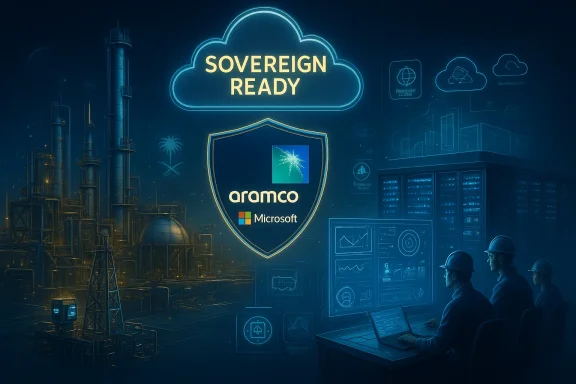
Neon cloud and shield symbolize cloud security for Aramco and Microsoft above an offshore oil rig.Background and overview​

Aramco announced the MoU on February 12, 2026, positioning the agreement as an extension of an already active relationship with Microsoft that will focus on deploying Azure‑based industrial AI solutions, building sovereign‑aware cloud strategies, and expanding skills programs for thousands of Saudi learners.
Microsoft has concurrently confirmed that its Saudi Arabia East Azure datacenter region — built with three availability zones — is expected to be available for customers to run workloads from Q4 2026, providing a concrete infrastructure anchor for the kinds of in‑country, low‑latency AI workloads Aramco is targeting.
Taken together, the announcements frame a two‑track push: (1) technical and operational work to shift verified industrial AI models into live, OT‑adjacent environments; and (2) ecosystem and talent investments aimed at converting AI pilots into domestic capabilities and potential exportable IP. This combination speaks directly to Saudi Vision 2030 goals of economic diversification and local capability building.

What the MoU actually covers​

Aramco’s public summary lists several discrete focus areas that shape where Microsoft and Aramco will concentrate early joint work:
  • Digital sovereignty and data residency — explore a roadmap for deploying Azure solutions with sovereign controls to meet Saudi regulatory and residency requirements.
  • Operational efficiency and digital infrastructure — assess Azure‑powered improvements for upstream, downstream, and chemicals operations, with attention to moving from proofs‑of‑concept to production systems.
  • Industry alliance and localization — involve local systems integrators and Saudi technology partners to broaden AI adoption across industry value chains.
  • Industrial AI co‑innovation & commercialization — explore co‑developing IP and possibly creating a marketplace for energy‑sector AI tools that could be sold internationally.
  • Skills and workforce development — scale training and apprenticeships in AI engineering, cybersecurity, data governance, and product development.
These areas are broad by design: the MoU is intentionally non‑binding and frames a roadmap rather than delivering specific contractual commitments or budgets. That structure is typical for strategic partnerships that will be translated into pilot SOWs and commercial contracts if initial pilots meet technical, regulatory, and security gates.

Why the sovereign‑ready angle matters​

For industrial AI in critical infrastructures such as oil, gas, and petrochemicals, three technical attributes are repeatedly decisive: low latency, data locality, and stringent governance. Running model training and inference across borders — or relying on off‑shore control planes — can be incompatible with national regulations and enterprise risk appetites for mission‑critical control systems.
Microsoft’s Saudi datacenter region — designed with three availability zones and a “sovereign‑ready” posture — reduces cross‑border latency and simplifies legal compliance by offering customers the ability to keep storage and compute inside Saudi Arabia while still leveraging Microsoft’s global management, identity, and security ecosystem. That makes Azure a practical platform for scaled industrial AI where residency and regulatory clarity are prerequisites.
But “sovereign‑ready” is not the same as an isolated, closed‑national cloud: Microsoft’s model is a configurable stack that supports in‑country compute and governance while maintaining allowed interoperation with global services. For Aramco, reconciling local control with access to hyperscale AI services is likely to be a central architectural and contractual challenge.

Technical and operational implications for Aramco​

Aramco’s operations generate massive volumes of time‑series telemetry, engineering data, geoscience models, and process control information. Bringing Azure and industrial AI into that environment implies several practical technical workstreams:
  • Modernize data pipelines to deliver high‑quality, labeled telemetry for model training, validation, and retraining.
  • Deploy edge inference and distributed compute (so models can act with low latency at remote facilities) while preserving centralized governance and model lifecycle controls.
  • Adopt containerized and hardware‑abstraction runtimes to preserve portability and reduce single‑vendor lock‑in risk.
  • Integrate AI outputs into human workflows via advisory layers before moving to any closed‑loop control scenarios.
These are not theoretical aims; Aramco, Armada, and Microsoft have already collaborated on edge deployments — notably using Armada’s Galleon edge infrastructure combined with Azure tools — showing that the partners can operationalize low‑latency site‑level AI today. The challenge is scaling from targeted pilots into reliable, auditable production fleets.

Likely near‑term industrial use cases​

If the MoU proceeds to operational pilots, expect Aramco to prioritize cases that are both high‑value and amenable to human‑in‑the‑loop governance:
  • Predictive maintenance for rotating equipment and compressors to cut unplanned downtime.
  • Process optimization and emissions control where AI augments control room decision‑making.
  • Real‑time safety monitoring using edge inference to flag anomalies in hazardous zones.
  • Digital twins and scenario testing to accelerate planning and asset simulations.
  • Integrated supply‑chain forecasting linking field telemetry to downstream logistics.
These use cases align with proven Azure + industrial AI deployments at other operators and offer measurable ROI and safety benefits when implemented with rigorous data governance.

Skills, talent and the Microsoft playbook​

Microsoft is already intensifying skilling commitments in Saudi Arabia and announced ambitious targets — including helping up to three million people acquire AI skills by 2030 through expanded programs and educator initiatives. Those national‑scale training commitments are a clear complement to the Aramco MoU’s workforce focus.
For Aramco, the practical demands go beyond certificates. Operational AI requires multidisciplinary teams that blend OT engineering, AI model development, systems integration, cyber‑security, and product delivery. To be effective, training programs must include:
  • Apprenticeships embedded inside operating facilities for hands‑on OT exposure.
  • Joint certification programs aligned to Aramco’s production tooling, security standards, and governance processes.
  • Measurable KPIs for placement, progression, and operational impact rather than only enrollment counts.
Absent that operational depth, skilling risks devolving into cosmetic metrics. The MoU acknowledges scale training, but execution quality will determine whether thousands of trained learners translate into a resilient industrial AI workforce.

Industrial AI IP and commercialization — opportunity and complexity​

One of the MoU’s most strategic elements is the idea of co‑developing commercial industrial AI IP and potentially creating a marketplace for operational tools tailored to energy. If Aramco and Microsoft deliver repeatable, sector‑specific models and packaged solutions, Saudi‑developed IP could become an exportable product — turning internal operational maturity into economic value aligned with Vision 2030.
Yet commercializing industrial AI carries several legal and policy complexities:
  • Who owns jointly developed models and datasets — Aramco, Microsoft, or joint entities?
  • How will royalties, export controls, and national security reviews apply to dual‑use IP?
  • Which liability frameworks govern decisions made by models in advisory or closed‑loop modes?
These questions must be answered in detailed commercial agreements; a headline MoU simply cannot resolve them. Aramco’s position as an operator and potential vendor creates both upside and regulatory scrutiny.

Security, governance and operational risk — a sober reality check​

Industrial AI projects amplify three core risks that require disciplined governance:
  • Data provenance and model drift — Without clear lineage, quality assurance, and retraining cadence, operational models degrade and can produce misleading recommendations.
  • OT cyber‑risk — Extending cloud connectivity to operational technology increases the attack surface. Segmented architectures, OT‑aware intrusion detection, and resilient fallback procedures are non‑negotiable.
  • Validation and safety certification — Any AI that influences plant controls must pass staged validation (shadow → advisory → closed‑loop) with independent audits, simulation testing, and operational certification.
Aramco and Microsoft have signaled awareness of these risks in public statements; the next test will be whether pilots include transparent, auditable validation processes and independent safety reviews. Without them, attempts to hasten closed‑loop automation could create unacceptable safety and production risks.

Commercial and geopolitical implications​

Aramco’s deepening ties with major U.S. cloud providers (Microsoft among them) are part of a broader pattern of hyperscaler engagement in the Gulf. Several strategic implications deserve attention:
  • For Microsoft: deepening engagement with Aramco cements Azure’s role in Gulf energy markets and provides a marquee customer for the Saudi Azure region — a valuable commercial proof point that could sway other regulated industries toward Azure.
  • For Aramco: partnering with a hyperscaler accelerates modernization without building every layer in‑house, but it also creates dependence risks that must be managed through portability, open formats, and contract clarity.
  • For Saudi Arabia: the deal aligns with Vision 2030’s industrialization and localization goals, but it also raises policy choices about how exportable AI IP is handled and how sovereignty is legally enforced.
Competition is already fierce: other hyperscalers and local providers are vying for regional workloads, and multi‑cloud strategies will likely remain a pragmatic mitigation against vendor lock‑in for large customers.

Roadmap — realistic timing and what to watch​

The MoU is a starting point. For readers tracking delivery rather than announcements, a pragmatic timeline to expect is:
  • Regulatory and commercial agreements (0–6 months): transition from MoU to binding SOWs and pilot contracts.
  • Pilot deployments (6–18 months): targeted industrial AI pilots in shadow/advisory mode with human oversight and independent validation.
  • Platform & sovereign controls rollout (12–24 months): configure Azure services and regional connectivity, apply residency controls, and validate compliance.
  • Scale and co‑innovation (24–48 months): expand use cases, harden operational integrations, and begin commercializing permitted IP.
  • Talent and ecosystem maturity (ongoing): ramp certified academies, apprenticeship pipelines, and supplier enablement.
Microsoft’s public date that the Saudi Azure region will accept customer workloads from Q4 2026 is a concrete calendar anchor — but it should be treated as a target, not a guarantee, because phased service availability, regulatory certification, and commercial readiness will influence actual timelines.
Watch for the following signals of progress (or warning signs):
  • Public release of pilot results with independent audit or third‑party verification.
  • Detailed technical architecture documents specifying where training, inference, and logs will reside.
  • Binding commercial agreements that clarify IP ownership, liability, and export constraints.
  • Clear KPIs for training programs (graduation, placement, operational performance improvements).
  • Evidence of robust OT segmentation and safety certification for any model that affects control systems.

Strengths, realistic promise, and where caution is needed​

Strengths and credible upside
  • Scale and capability: Aramco has the data, assets, and capital to make industrial AI meaningful at scale; Microsoft brings cloud infrastructure, platform services, and global enterprise governance experience — a compelling technical match.
  • Sovereignty‑aware infrastructure: a local Azure region reduces friction for regulated workloads and aligns with national policy goals.
  • Skilling and ecosystem: Microsoft’s large‑scale training programs, if focused on operational depth, can accelerate the pool of AI engineers and OT‑aware practitioners the Kingdom needs.
Risks and unresolved gaps
  • Non‑binding status: the MoU is not a delivery contract. Real value will depend on how SOWs, SLAs, and governance frameworks are negotiated.
  • Vendor dependency: deep integration into a single hyperscaler without clear portability safeguards risks lock‑in and negotiating leverage over time.
  • Operational safety and cyber risk: connecting OT to cloud increases attack surfaces; rigorous OT‑specific security and fallback operations are essential and must be demonstrably in place before any closed‑loop control.
  • IP and regulatory friction: commercialization of industrial AI will bump into export controls, IP allocation issues, and possible national security scrutiny that can delay or restrict global commercialization.

What this means for the wider market​

If Aramco and Microsoft convert this MoU into credible, audited production use cases and demonstrable ROI, the partnership could become a playbook for other large industrial operators seeking sovereign‑aware AI scale: partner with a hyperscaler that can provide in‑country compute, build rigorous governance and validation gates, and invest in deep, operationally relevant skilling.
For competitors and partner ecosystems, the MoU raises the bar for localized cloud offerings and emphasizes the importance of partner ecosystems that can tie cloud services to OT realities. Local integrators, telcos, and regional cloud providers are likely to see new opportunities as Aramco aims to involve Saudi suppliers — provided the procurement model is genuinely inclusive.

Conclusion​

Aramco’s MoU with Microsoft is a plausible, pragmatic next step toward operationalizing industrial AI at scale in the energy sector — a move that aligns with Saudi Arabia’s Vision 2030 ambitions to build domestic digital capability and exportable IP. The partnership combines Aramco’s operational scale with Microsoft’s cloud and skilling apparatus, and the planned Saudi Azure region (targeted for customer workloads in Q4 2026) provides an essential technical foundation for in‑country AI deployments.
That said, the path from MoU to measurable, safe, and sovereign AI is filled with necessary rigour: binding contracts that clarify IP and liability, staged validation for any operational AI, transparent governance for data provenance and model drift, and deep, hands‑on workforce programs that produce operational capability rather than ceremonial certificates. If those ingredients are present and implemented transparently, Aramco and Microsoft could set a credible industrial AI reference case. If they are absent, the MoU risks remaining a strategic gesture rather than a durable transformation.
What happens next will depend on the technical architectures Aramco and Microsoft publish, the first independent pilot results, the content and enforceability of subsequent contracts, and the Kingdom’s regulatory posture on sovereign data and export controls. Those milestones — not the announcement itself — will determine whether this partnership becomes a blueprint for responsible industrial AI or a high‑profile intent that falls short of operational impact.

Source: Bitget Aramco and Microsoft Expand Industrial AI Initiatives in Saudi Arabia | Bitget News
 

Saudi Aramco and Microsoft have taken a formal—but non-binding—step toward scaling industrial artificial intelligence across the Kingdom by signing a Memorandum of Understanding that centers on Azure-based deployments, sovereign-ready infrastructure, and large-scale workforce skilling. The MoU frames a two-track strategy: accelerate the technical migration of validated AI into operational environments while building local capabilities, governance controls, and commercial models to export Saudi industrial AI expertise. What looks like another corporate press release at first glance is, in fact, a strategically timed move that intersects cloud geopolitics, operational technology (OT) safety, and Saudi Arabia’s Vision 2030 economic diversification goals.

Three workers in hard hats and high-visibility vests monitor holographic analytics in a control room.Background​

Aramco’s announcement on February 12, 2026, describes a non-binding Memorandum of Understanding with Microsoft to explore a series of digital initiatives designed to “accelerate industrial AI adoption, enhance digital capabilities, and strengthen workforce development” inside Saudi Arabia. The document highlights four priority areas: digital sovereignty and data residency; operational efficiency and digital infrastructure; an industry alliance framework to broaden AI adoption across the industrial value chain; and industrial AI IP co-innovation to develop and commercialize domain-specific operational systems.
This latest MoU builds on an already active relationship. Over the last two years Aramco, Microsoft, and regional partners have trialed and piloted edge-first, Azure-enabled systems—deploying distributed cloud nodes and industrial edge stacks to process OT telemetry and vision workloads close to sensors and control systems. Microsoft has concurrently confirmed plans to open a Saudi Azure datacenter region with multiple availability zones scheduled to be available for customer workloads later in 2026, which provides a concrete infrastructure anchor for the kinds of low-latency, sovereign-aware AI workloads the MoU references.
Taken together, these developments illustrate a deliberate pivot from experimentation to production. The emphasis now is on moving AI models out of isolated pilots and into mission-critical processes—pipeline monitoring, predictive maintenance, safety vision systems, process optimization—while wrapping those deployments in governance, data-residency, and skills programs intended to make the capability sustainable and locally owned.

Why this matters: industrial AI at scale is different​

Industrial AI is not consumer chatbots or simple analytics; it is AI that interfaces with heavy machinery, process controls, and safety-critical systems. Moving industrial AI to scale changes the stakes dramatically.
  • Industrial AI systems must tolerate real-time constraints and high-reliability requirements.
  • They demand robust OT‑grade security and strict isolation from enterprise IT when necessary.
  • They frequently need local processing at the edge to meet latency and resilience needs.
  • They must comply with data residency and sovereignty regimes that vary by country and industry.
  • Failures carry physical safety and environmental consequences in addition to economic impacts.
A MoU that explicitly pairs cloud-scale AI capability (Azure) with sovereign-ready controls and edge-first deployments signals a pragmatic recognition of those differences. It admits that large cloud providers must operate differently when their platforms are asked to support refineries, pipelines, and chemical plants rather than web applications.

The technical contours: Azure, edge, and sovereign controls​

Azure as the platform anchor​

Microsoft’s cloud stack is the stated basis for the partnership. That matters because deploying industrial AI at scale typically depends on a handful of capabilities:
  • High-performance compute for large model inference and training.
  • Low-latency edge compute to process streaming sensor and camera data.
  • Fleet management tools that let operators deploy, monitor, and update models across thousands of sites.
  • Strong identity, access, and key-/policy-management to enforce governance.
  • Data governance and residency features that allow control over where data is stored and processed.
Microsoft’s public roadmap for the region and earlier collaborations with Aramco show a pattern: combine Azure hyperscale services with managed edge components (Azure IoT, Azure Arc, and localized Azure instances) to give operators both the scale and the control they need.

Edge and industrial distributed cloud​

A repeated theme in the earlier rollouts with Aramco (and related partners) is the industrial distributed cloud: small, ruggedized compute nodes at site locations (sometimes called “Galleon” units in prior deployments) that run an edge stack for real-time tasks. These nodes reduce latency for vision and sensor workloads, limit the volume of raw telemetry sent to central clouds, and provide a resiliency layer when connectivity to hyperscale regions is intermittent.
From a systems design perspective, this hybrid model is sensible: use edge units for deterministic control loops and on-site safety, and use centralized cloud for heavy analytics, model training, and cross-site optimization. The MoU’s language on “sovereign-ready digital infrastructure” implies a desire for the latter centralization to still respect national controls, while enabling global-class AI services.

Data residency and digital sovereignty​

One of the four named priorities is “digital sovereignty and data residency.” In plain terms, Aramco wants to ensure that sensitive operational and telemetry data remains under Saudi‑approved controls. For Microsoft, that means building deployment patterns that can enforce residency requirements, offer encryption and key control options, and integrate with local regulation.
This is not just a legal checkbox. For energy companies, telemetry metadata, production profiles, and equipment performance data are both commercially valuable and strategically sensitive. Ensuring that those assets can be analyzed with modern AI while remaining within political and legal boundaries is essential to large-scale adoption.

Workforce and capability building: more than vendor training​

A repeated line in the announcement is the focus on skills development—AI engineering, cybersecurity, data governance, and product management. That’s not lip service. For industrial AI to move from pilots to production, three workforce shifts are necessary:
  • OT engineers must be comfortable collaborating with data scientists and software engineers.
  • Data engineers need to understand signal quality, sampling constraints, and the physical realities of sensors and actuators.
  • Governance teams must be able to translate national policy and corporate risk tolerance into operational policies and immutable controls.
If the partnership delivers measurable and credentialed training at scale, it could create a pipeline of practitioners capable of sustaining local industrial AI deployments. That aligns with Saudi Arabia’s Vision 2030 by aiming to generate local expertise and reduce dependency on expatriate technical labor.

Commercial and strategic dimensions​

Co‑innovation and IP creation​

The MoU highlights exploring industrial AI IP co-innovation and creating a global marketplace for industrial AI solutions. For Aramco, this represents an attempt to convert internal operational know-how into commercializable products and services, potentially exporting Saudi-developed AI tools to other operators worldwide.
For Microsoft, the upside is strengthened foothold in a strategically important sector and a showcase customer whose scale and operational complexity can validate Azure’s industrial portfolio. Co-developed IP also raises questions about ownership models, licensing, and revenue sharing—critical negotiation points that typically follow a non-binding MoU.

Vendor dynamics and multi-cloud posture​

Aramco’s corporate disclosures show it has engaged multiple cloud and technology firms (including previous MoUs with NVIDIA, AWS-related collaborations, and other strategic partners). At the enterprise level, energy firms often prefer a multi-vendor architecture to mitigate lock‑in risk and leverage best-of-breed components. The present MoU doesn’t foreclose multi-cloud strategies, but it does deepen Aramco’s technical and commercial relationship with Microsoft—exactly the sort of dynamic that requires careful contract design and exit planning.

Critical benefits​

  • Operational efficiency: Industrial AI can reduce unplanned downtime, optimize throughput, and improve safety monitoring—delivering measurable OPEX gains when models are reliably deployed and maintained.
  • Resilience and intelligence at the edge: Edge-first architectures support real-time interventions, reducing latency and dependency on continuous connectivity.
  • Sovereign control: Roadmaps that embed data residency and sovereign controls make modern cloud AI politically and legally acceptable for sensitive national assets.
  • Workforce modernization: Scaled skilling programs can create local AI engineering talent and reduce long-term talent gaps.
  • Commercialization of industrial IP: Co-innovation can turn in-house operational methods into exportable, revenue-generating software and services.
These benefits are concrete and, when realized, can materially alter the economics of large industrial operators.

Risks and open questions​

The headline optimism hides a set of practical and strategic risks that are often under-emphasized in corporate communications.

1. Non‑binding is non‑committal​

A Memorandum of Understanding is the beginning of talks, not the end. It maps intent, not obligations. Timelines, budgets, and detailed governance arrangements remain to be negotiated. The industry must treat MoUs as directional, not deterministic.

2. Vendor lock‑in and migration risk​

Deep integration with a single cloud provider’s proprietary services raises long-term portability concerns. If core operational workflows, device-routing logic, and model-serving runtime are tightly coupled to a vendor’s platform, switching becomes expensive and risky—especially when safety-critical processes are involved.

3. OT risk and safety assurance​

AI errors in industrial settings can cause physical harm. The transfer of models from lab conditions into noisy, adversarial, or poorly instrumented plant environments is fraught. Companies must invest in rigorous model validation, runtime monitoring, explainability, and roll-back mechanisms—areas where industrial practices are still nascent.

4. Data governance and geopolitical exposure​

Even with data residency promises, the reality of global cloud providers operating across legal regimes can create exposure. Governments might ask for access under certain legal frameworks; cross-border data flow restrictions can complicate collaborative R&D that benefits from distributed datasets. These political and legal vectors must be mitigated contractually and technically.

5. Intellectual property and revenue-sharing friction​

Co‑innovation raises immediate questions: who owns models trained on Aramco’s operational data? What rights does Microsoft have to productize co-developed solutions? How will revenue from an IP marketplace be split? Clear answers are mandatory to avoid value capture disputes later.

6. Workforce displacement and capability mismatch​

Upskilling is necessary, but it doesn’t automatically replace expertise lost to automation. If AI replaces routine operator tasks without robust reskilling, there’s a risk of social and operational disruption. Measuring outcomes—certified skills, placement rates, project-readiness—will be critical to validate the skilling claims.

Governance and security — the hard engineering work​

For industrial AI to be safe, secure, and trustworthy, several engineering and governance practices must be non-negotiable:
  • Zero‑trust identity and role separation between enterprise IT and OT control planes.
  • Immutable logging and tamper-evident audit trails for model updates and policy changes.
  • Model lifecycle management with staged deployments, continuous monitoring, and safety rollbacks.
  • Explainability and deterministic fallbacks for mission-critical decisions.
  • Robust incident response that blends cybersecurity, OT safety, and regulatory reporting.
The MoU’s emphasis on "trusted governance" is encouraging, but translating governance talk into robust, auditable engineering is the real test.

Geopolitics and strategic positioning​

Saudi Arabia’s Vision 2030 places heavy emphasis on economic diversification. Advanced digital capabilities—particularly industrial AI that can be packaged and exported—are a clear fit. For Microsoft, deeper engagement in the Kingdom cements a strategic partnership in a region rapidly investing in sovereign cloud and AI infrastructure.
But geopolitics complicates matters. Energy infrastructure is strategically sensitive; collocating critical operational intelligence with a foreign cloud provider invites scrutiny. Negotiations must account for cross-border legal demands, national security exceptions, and the potential for geopolitical frictions that could affect data flows or service continuity.

What success would look like​

If the MoU progresses into binding agreements and operational programs, success will be measurable across multiple axes:
  • Operational metrics: demonstrable reductions in unplanned downtime, improved process yields, or validated safety improvements attributable to deployed AI.
  • Sovereignty controls: contractual and technical enforcement of data residency, keys, and auditability, with independent attestation.
  • Talent outcomes: certified cohorts of Saudi AI engineers and data practitioners employed in industrial roles.
  • Commercialization: a pipeline of co-developed industrial solutions packaged for export with clear IP and revenue models.
  • Resilience: architectures that maintain safety-critical functions during cloud outages through robust edge autonomy.
Absent measurable outcomes against these dimensions, the MoU risks becoming another rhetorical milestone rather than a durable industrial transformation.

How operators, integrators, and regulators should prepare​

For industrial operators and system integrators planning to engage with or emulate the Aramco–Microsoft approach, a pragmatic checklist helps translate ambition into practice:
  • Map sensitive datasets and classify by regulatory and strategic importance.
  • Define explicit model acceptance criteria and operational testing regimes before any production rollout.
  • Establish contractual guardrails for data residency, key management, and incident escalation.
  • Architect with edge-first resilience—ensure critical loops can operate independently of the central cloud.
  • Invest in joint OT‑IT training programs that produce practitioners who understand both control systems and data science.
  • Negotiate IP and commercialization terms up front, with clear rules for derivative products and marketplace participation.
Regulators should work with industry to harmonize data residency frameworks and create certification pathways for industrial AI solutions so that operators and vendors can adopt technology without legal ambiguity.

The near-term roadmap: realistic expectations​

Expect a phased approach. The immediate months after the MoU will likely see:
  • Joint roadmaps and pilots expanding existing proofs‑of‑concept into controlled production trials.
  • Governance frameworks drafted and piloted at a small number of sites.
  • Skills programs rolled out to cohorts tied to specific project milestones.
  • Infrastructure work aligning with the expected availability of localized Azure capacities and continued edge deployments.
Large-scale rollouts across Aramco’s global footprint will take longer. Operational validation, regulatory clearances, and commercial model development are multi-quarter efforts.

Final assessment: pragmatic optimism with caveats​

The Aramco–Microsoft MoU is a strategically sensible next step for both organizations. It aligns vendor capabilities with a customer that has both the appetite and the scale to operationalize industrial AI. The explicit emphasis on sovereign-ready infrastructure and skills is aligned with practical constraints and national priorities.
However, the road from MoU to measurable transformation is long and full of technical, legal, and commercial perils. The critical issues are not whether Aramco can use Azure to run AI models—that is already technically possible—but whether the partnership will lock in the right governance, rights, and local capabilities to make those models safe, portable, and nationally beneficial.
If Aramco and Microsoft can convert this intent into binding contracts with rigorous safety engineering, clear IP rules, demonstrable talent outcomes, and resilient hybrid architectures, the initiative could become a global reference for how large industrials adopt AI responsibly. If, instead, the effort stalls at pilot scale or becomes an unbalanced commercial arrangement, the headline will read like a missed opportunity—another ambitious plan that did not de-risk the complexity of operational AI at scale.
Either way, the announcement is a visible marker of the broader industry shift: industrial enterprises are no longer experimenting with AI as a curiosity. They are engineering it into the fabric of critical operations—and that demands a new level of technical discipline, contractual clarity, and national-level strategy.

Source: kuna.net.kw https://www.kuna.net.kw/ArticleDetails.aspx?id=3274700&language=en
 

Aramco and Microsoft have signed a non-binding Memorandum of Understanding (MoU) to explore a large-scale push into industrial AI, cloud-enabled operations, and targeted digital skills development across Saudi Arabia — a move that could accelerate Aramco’s transformation into an AI-driven industrial operator while amplifying Microsoft’s sovereign-ready cloud footprint in the Kingdom.

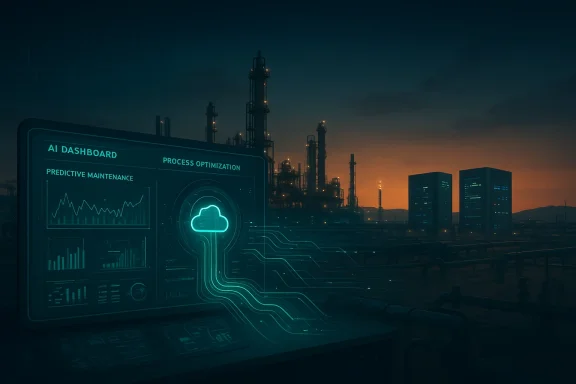
AI dashboard overlay on an industrial plant at dusk, showing process optimization and predictive maintenance.Background​

Aramco’s February 12, 2026 MoU with Microsoft builds on years of collaboration between the two companies and on a broader wave of partnerships Aramco has pursued with global technology vendors to modernize oil-and-gas operations. The agreement is framed around four headline objectives: digital sovereignty and data residency, operational efficiency and digital infrastructure, an industry alliance framework, and industrial AI IP co‑innovation. The MoU also explicitly links the partnership to workforce development — with programs that target AI engineering, cybersecurity, data governance, and product management skills across the Saudi talent pool.
This deal comes at a pivotal moment. Microsoft is actively expanding cloud infrastructure in Saudi Arabia — committing a multi‑availability‑zone Azure region and rolling out national skilling programs intended to train millions of people in AI and cloud competencies. Meanwhile, Aramco has been pursuing industrial distributed cloud and edge initiatives, experimenting with on‑site AI compute, edge data centers, and industrial IoT deployments that bring compute and analytics closer to oilfield and refinery operations. The MoU signals a step from pilot projects and R&D into strategic exploration of production deployments and commercial models.

What the MoU actually says — and what it means​

Key areas covered​

The MoU outlines several specific focus areas:
  • Digital Sovereignty and Data Residency: a roadmap to deploy Microsoft cloud solutions augmented with “sovereign controls” to meet national data residency and governance requirements.
  • Operational Efficiency & Digital Infrastructure: initiatives to streamline and optimize digital frameworks across Aramco’s global operations.
  • Industry Alliance Framework: scoping partnerships with Saudi technology integrators, systems integrators, and industrial collaborators to scale AI across the domestic industrial value chain.
  • Industrial AI IP Co‑innovation: exploratory work to co‑develop, commercialize, and possibly host a marketplace for industrial AI solutions that could both serve Aramco’s operations and be exported as Saudi industrial IP.
In parallel, the companies will “explore programs” to accelerate digital and technical skills across the Kingdom, focusing on measurable outcomes for areas such as AI engineering, cybersecurity, and data governance.

What “non‑binding MoU” means in practice​

It’s important to be precise: this is a non‑binding MoU, not a final contract. That means the partnership described is at the scoping and planning stage. The language suggests ambitions — potentially large ambitions — but not committed procurement timelines, volumes, or contractual guarantees. Expect follow‑up agreements, pilot programs, and formal contracts to define concrete deliverables, timelines, procurement values, and legal responsibilities.

Technical context: cloud, edge, and industrial AI​

Azure, sovereign controls, and on‑prem/edge hybrids​

The MoU centers on deploying AI-enabled industrial solutions “built on Microsoft Azure” with enhanced sovereign controls. That phrase covers several distinct technical patterns that have been evolving in the industry:
  • Public cloud with data residency safeguards: running services in a local Azure region or in a cloud region configured to comply with Saudi data residency laws.
  • Sovereign or trust boundaries: additional governance, access control, and contractual measures to satisfy national security and legal requirements.
  • Distributed and edge cloud: pushing compute and AI inference close to industrial processes — for example, through local data centers, replicated edge nodes, or managed “Azure Arc/Azure Stack” style solutions that let operators run Azure services on hardware outside Microsoft’s standard cloud footprint.
Aramco has previously piloted industrial distributed cloud and edge computing projects, integrating Azure services with local edge platforms to support low‑latency AI use cases. The MoU suggests scaling those experiments into broader operational contexts.

Industrial AI workloads and their demands​

Industrial AI in oil and gas typically spans:
  • Real‑time monitoring and anomaly detection for rotating equipment and pipelines.
  • Predictive maintenance models trained on historical sensor and operations data.
  • Process‑optimization algorithms for refineries, control rooms, and drilling operations.
  • Generative AI usage for engineering assistance, documentation, and decision support (often within strict governance and safety boundaries).
These workloads have specific infrastructure needs: deterministic latency, high‑throughput telemetry ingestion, model explainability and governance, secure model lifecycle management, and edge‑enabled inference. Integrating cloud‑scale model training (often GPU‑accelerated) with edge inference and industrial control systems is non‑trivial and requires careful systems engineering and strong cybersecurity controls.

Strengths and strategic positives​

1. A pragmatic path to scale industrial AI​

Aramco has already moved beyond proof‑of‑concepts in multiple AI and edge initiatives. Partnering with a hyperscaler that offers both large‑scale cloud training infrastructure and hybrid/edge solutions creates an end‑to‑end option for scaling AI from pilot to production. That makes the MoU a logical next step for operationalizing AI at scale.

2. Sovereign‑ready infrastructure aligns with national priorities​

Saudi Arabia’s Vision 2030 emphasizes digital sovereignty, local capability building, and economic diversification. Microsoft’s investments in a local Azure region with multiple availability zones, plus initiatives for sovereign cloud services, fit Aramco’s stated data residency and governance priorities. This alignment can accelerate regulatory approvals and enable broader public‑private collaboration.

3. Workforce development as a force multiplier​

The MoU’s emphasis on skilling — targeted to AI engineering, cybersecurity, and data governance — is a practical lever for long‑term success. Building local talent reduces reliance on imported expertise, increases the chances of sustainable in‑country innovation, and supports the commercialization of Saudi industrial IP.

4. Potential to export industrial IP and commercial models​

Co‑developing industrial AI IP and establishing a marketplace for solutions could position Saudi firms as exporters of domain‑specific AI — an outcome that aligns with national ambitions to grow high‑value technology exports. For Aramco, commercializing operational insights into software and services could create new non‑commodity revenue streams.

Risks, limitations, and unanswered questions​

1. Vendor lock‑in and commercial dependency​

Deploying critical industrial systems on a single hyperscaler — even with sovereign controls — raises long‑term dependency risks. Over time, deep integration of control systems, data pipelines, and model governance into a single cloud ecosystem can make it difficult and expensive to diversify vendors or move workloads on‑premise. The MoU does not yet disclose multi‑cloud strategy, portability guarantees, or open standards commitments, which are essential to mitigate lock‑in.

2. Sovereignty and control are easier said than done​

“Digital sovereignty” is often used as an umbrella term that means different things to different stakeholders. Achieving true sovereignty requires a combination of:
  • Local physical infrastructure (local data centers and controlled access).
  • Clear contractual controls over data access and legal governance.
  • Local skill sets to manage, audit, and evolve systems without external dependence.
The MoU signals intent to pursue sovereign controls, but the technical and legal details — who controls keys, where backups live, how cross‑border incident response is managed — are not yet public.

3. Security in industrial environments remains a hard problem​

Industrial control systems (ICS) and operational technology (OT) have unique risk profiles: legacy protocols, extended lifecycles, and in some cases, air‑gapped design assumptions. Integrating these systems with cloud and AI exposes attack surfaces that must be managed with industrial‑grade security practices. The MoU references cybersecurity training and governance but does not publish detailed architectures, zero‑trust plans, or independent audit commitments.

4. Data governance, IP ownership, and commercialization complexity​

The MoU contemplates co‑developing industrial AI and commercializing it through a marketplace. That raises immediate questions:
  • Who holds IP rights for models trained on Aramco’s industrial data?
  • How will revenue be shared for jointly commercialized products?
  • What legal and regulatory guardrails will protect operational secrecy while permitting commercialization?
Absent detailed agreements, there’s a real risk of disputes or constrained commercialization due to unclear ownership and licensing.

5. Environmental and cost dynamics for large‑scale AI​

Training large industrial AI models — especially at GPU scale — consumes significant power and incurs substantial costs. For an energy company, environmental optics might seem less sensitive, but operational cost, lifecycle energy consumption, and sustainability trade‑offs still matter. The MoU does not yet articulate energy‑efficiency targets, model lifecycle costing, or carbon‑aware AI practices.

6. Execution risk and the “pilot trap”​

The energy industry is littered with promising digital pilots that never achieved full operational scale because of integration complexity, funding cycles, or shifting priorities. Moving from pilot to stable, regulated production requires governance, change management, and demonstrable ROI — all of which Aramco and Microsoft will need to define with measurable KPIs and timelines.

What success would look like — and how to measure it​

For this MoU to yield tangible impact, the partners should commit to clear success criteria. Practical, measurable outcomes could include:
  • Operational metrics:
  • Percentage reduction in unplanned downtime across targeted facilities.
  • Percentage improvement in energy efficiency or process yield (with baselines).
  • Deployment metrics:
  • Number of production‑grade industrial AI models deployed across assets.
  • Number of edge sites running hybrid Azure services with defined SLAs.
  • Sovereignty and governance metrics:
  • Demonstrable in‑country data residency for critical telemetry and model artifacts.
  • Independent third‑party audits of access controls and governance.
  • Workforce outcomes:
  • Number of Saudi nationals certified in AI engineering, cybersecurity, and data governance with time‑bound targets.
  • Percentage of Aramco AI roles filled by locally trained talent.
  • Commercialization and IP:
  • Number of co‑developed solutions listed on a marketplace and revenue generated.
  • Clear licensing terms and IP split for each co‑developed product.
These measurable outcomes would convert a high‑level MoU into accountable programs and signal seriousness to regulators, partners, and investors.

Geopolitical and regulatory considerations​

National security and export controls​

Energy infrastructure is a strategic national asset. Any cloud and AI integration must be scrutinized for implications under national security and export control frameworks. Data flows, cross‑border backups, and third‑party access all raise red flags for policymakers. The MoU’s focus on sovereign controls appears aimed at preempting these concerns, but specifics will matter — especially in how incident response and law‑enforcement access are governed.

Supply chain and trade tensions​

Global technology supply chains remain politically sensitive. Hardware sourcing for AI — GPUs, NPUs, and edge compute modules — often involves multi‑jurisdictional supply chains that can be subject to export controls or sanctions. Aramco’s strategy to localize certain manufacturing and co‑innovate could mitigate some risks, but supply chain resilience must be designed into any industrial AI rollout.

Data privacy and worker protections​

AI systems that monitor worker behavior, generate insights from personnel data, or automate decision‑making can raise privacy and labor concerns. Robust data governance models and clear privacy protections for employees will be essential to avoid regulatory or reputational backlash.

Practical implementation considerations​

Architecture patterns likely to be used​

  • Hybrid cloud with local Azure region for primary data residency, connected to Microsoft’s global Azure backbone for large‑scale model training.
  • Edge nodes (rack or micro‑data centers) for low‑latency inference and safety‑critical use cases, managed via hybrid management tools.
  • Azure Arc/Azure Stack (or equivalent) to provide consistent management, policy, and security controls across cloud and edge.
  • Federated model registries and MLOps pipelines to manage model lineage, validation, and deployment lifecycle across sites.

Integration with industrial systems​

Successful integration requires adherence to industrial protocols (OPC UA, Modbus, PROFINET, etc.), strong change management in control rooms, and phased rollouts that include human‑in‑the‑loop safeguards for safety‑critical decisions.

Cybersecurity posture​

  • Zero‑trust network design extended to OT networks.
  • Hardware security modules (HSMs) and strict key management for encryption and access controls.
  • Role‑based access control (RBAC) and separation of duties between IT, OT, and cloud operations.
  • Regular red‑teaming and independent vulnerability assessments.

Industry and market implications​

For other energy companies​

If Aramco and Microsoft succeed in operationalizing industrial AI at scale with sovereign controls, the model could become a reference architecture for other national oil companies and large industrial firms seeking to reconcile hyperscaler capability with sovereignty requirements.

For technology ecosystem in Saudi Arabia​

The “industry alliance framework” and marketplace aspiration could catalyze a domestic ecosystem of integrators, startups, and training providers — if the MoU results in real procurement and co‑innovation projects. That could accelerate localization of high‑value tech jobs and create exportable industrial software.

For Microsoft​

This partnership strengthens Microsoft’s position in the Middle East as a sovereign‑ready cloud provider and expands Azure’s credibility for industrial workloads. Success will also hinge on Microsoft’s ability to handle sensitive operational data and provide guarantees that meet national security and enterprise governance needs.

Recommendations for stakeholders​

  • Aramco should articulate clear, public KPIs and roadmaps for pilots, governance, and IP arrangements to build trust with regulators and partners.
  • Microsoft should commit to portability, open standards, and transparent governance mechanisms to reduce lock‑in concerns and address sovereignty questions.
  • Regulators should demand third‑party audits of access, governance, and incident response procedures before approving production rollouts on cloud platforms.
  • Industry integrators and local vendors should negotiate concrete roles in the alliance framework so domestic capacity is genuinely built, not sidelined.
  • Worker‑facing governance should be published: privacy safeguards, transparency on where and how worker data is used, and human oversight rules for any automated controls.

Conclusion​

The Aramco–Microsoft MoU is a significant strategic signal: it pairs one of the world’s most consequential industrial companies with a hyperscaler that is actively building sovereign‑ready cloud capacity and large‑scale AI skilling programs in Saudi Arabia. The potential upside is substantial — improved operational efficiency, a pathway to commercialize industrial AI IP, and accelerated local capability building aligned to Vision 2030.
But the deal is, for now, an intent to explore. Real impact will depend on execution: the ability to translate the MoU into binding agreements with clear KPIs, robust sovereign controls, balanced IP and commercial terms, multi‑vendor interoperability, and demonstrable workforce outcomes. Absent those details, the MoU risks joining a long list of high‑profile pilot programs that never achieve full operational scale.
For Aramco and Microsoft, the opportunity is clear: to set a global reference for responsible, sovereign‑aware industrial AI that scales safely and sustainably. The challenge will be equally clear — aligning technology, law, governance, and talent at the scale required to transform a national industry without trading away resilience or control. Only the next set of concrete contracts, architectures, and audited deployments will tell whether this partnership becomes a template for industrial AI success or a promising if incomplete blueprint.

Source: صحيفة مال https://maaal.com/en/news/details/aramco-signs-mou-with-mic/
 

Saudi Aramco’s memorandum of understanding with Microsoft — announced alongside a Boston Consulting Group study showing that roughly four in ten Saudi organizations now qualify as AI Leaders — marks a decisive moment in the Kingdom’s industrial and national push to move artificial intelligence from experimental pilots into large-scale, operational reality.

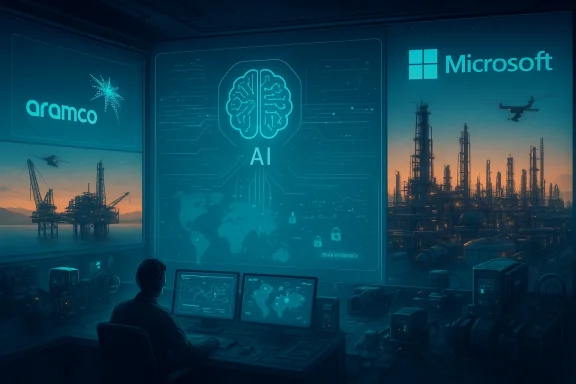
Microsoft Azure data center beside an industrial refinery, featuring drones, robotic arms, and holographic clouds.Background​

Saudi Arabia’s push to integrate AI at scale has for several years been a pillar of Vision 2030. That strategy pairs massive public investment, national data and cloud initiatives, and a determined policy focus on skills and digital infrastructure. Two recent developments crystallize how public- and private-sector momentum is converging: a non-binding MoU between Saudi Aramco and Microsoft to advance industrial AI deployment and workforce development, and a Boston Consulting Group (BCG) regional study that benchmarked AI maturity across the GCC and found rapid progress — including that a significant share of Saudi organizations are now classified as AI Leaders.
Taken together, these items are not incidental press releases. They are symptoms of an ecosystem reaching a new phase: heavy investment in cloud and compute, targeted upskilling programs, and public-sector interventions that simultaneously raise demand and lower friction for enterprise adoption. But the transition from demonstration to durable value requires deliberate choices on governance, infrastructure, vendor relationships, talent, and risk control. This article dissects the MoU and the BCG findings, explains why they matter, surfaces the practical risks, and lays out what companies and policymakers must prioritize to convert momentum into sustainable industrial advantage.

What the Aramco–Microsoft MoU actually covers​

The MoU signed between Saudi Aramco and Microsoft is explicitly exploratory and non-binding, but it maps to four clear pillars:
  • Digital sovereignty and data residency: a roadmap to deploy cloud solutions in ways that meet Saudi national requirements for data residency and sovereignty controls.
  • Operational efficiency and digital infrastructure: pilot-to-production strategies intended to embed AI in core industrial processes to improve safety, maintenance, and throughput.
  • Industry alliance and ecosystem development: engagement with local integrators, technology partners, and Saudi-focused industry collaborators to scale solutions across suppliers and the industrial value chain.
  • Industrial AI IP co-innovation and commercialization: joint exploration of co-developed AI solutions and potential commercialization, including a marketplace for industrial AI capabilities.
The statement also foregrounds workforce skilling — from AI engineering and data governance to cybersecurity and product management — as a measurable objective of the partnership. That emphasis aligns with Microsoft’s broader announcements of expanded skilling commitments in Saudi Arabia and its planned datacenter region capacity planned for local customer workloads.
Why the MoU matters in practical terms
  • It signals an intent to move industrial AI from pilots into operations, not merely to run proof-of-concepts.
  • It ties industrial digitalization to sovereign concerns — a crucial local constraint that shapes how multinational cloud providers operate in the Kingdom.
  • It creates a pathway for private-sector suppliers and integrators to scale industrial AI use cases using Azure-compatible stacks and partner ecosystems.
Taken together, the MoU frames a practical approach: use a global cloud provider’s platform and ecosystem but shape deployments around Saudi regulatory and sovereignty requirements, and couple that with a concrete skilling pipeline to create in-country capacity.

The BCG picture: Saudi and GCC AI maturity in context​

BCG’s regional study — a deep-dive of the GCC slice of their broader Build for the Future program — presents a snapshot with two headline takeaways: the GCC has rapidly closed the AI maturity gap with global peers, and a meaningful cohort of organizations has transitioned from experimentation into the “Scaling” and “Future-built” categories.
Key signals from the study worth underscoring:
  • Approximately 39% of GCC organizations qualify as AI Leaders, closely matching the global average.
  • Saudi organizations were reported to be strong performers relative to the region, with a substantial share in the Scaling category (the stage where pilots become enterprise programs).
  • BCG found material financial differences: AI Leaders in the region report significantly higher total shareholder returns and EBIT margins than laggards.
  • AI Leaders dedicate higher percentages of IT budgets to AI (a mid-single-digit share) and plan meaningfully larger upskilling efforts than laggards.
  • Emerging tech such as agentic AI is already being trialed across a sizeable portion of organizations, and BCG projects this subcategory of AI value to grow materially in the coming years.
Why this matters: BCG’s analysis ties maturity to measurable business outcomes (returns, margins, revenue impact) and highlights that investment and organizational change — not just technology adoption — are the levers that separate leaders from laggards.

Why Aramco–Microsoft fits into a larger strategic picture​

Aramco is not entering this conversation as a passive buyer of cloud services. Over recent years, Aramco has invested in internal AI capability, proprietary industrial AI models, edge networks, and even partnerships related to high-performance compute and hardware. The company’s recent announcements about accelerated AI deployments and MoUs with chip and cloud vendors show a two-track strategy:
  • Build internal industrial AI know-how and proprietary solutions for core upstream and downstream processes.
  • Bring in external partners to accelerate scale and commercialize capabilities regionally and globally.
Microsoft brings three capabilities to the table that match Aramco’s needs:
  • Scale and enterprise-class cloud services with emerging sovereign deployment models.
  • An established global ecosystem for enterprise AI partners, integrators, and certified solution providers — useful for industrial rollouts across the supply chain.
  • Large-scale skilling programs that can be localized to meet the Kingdom’s workforce-development goals.
A pragmatic interpretation: Aramco gains a partner that can help operationalize AI at scale while preserving the ability to meet sovereign constraints; Microsoft gains a high-profile industrial anchor customer in a market that is rapidly investing in cloud regions and AI-ready infrastructure.

Strengths and near-term opportunities​

  • A credible pathway from pilot to production
  • The emphasis on operational efficiency and “industrial AI IP co-innovation” suggests Aramco is aiming to standardize and productize use cases rather than leave them fragmented. Scaling common use cases (predictive maintenance, drilling optimization, process optimization) across thousands of assets multiplies ROI.
  • Data sovereignty aligned to industry needs
  • By explicitly addressing data residency and “sovereign-ready” infrastructure, the MoU reduces one of the most consequential practical barriers to cloud adoption for regulated industrial data.
  • Workforce lift at scale
  • Microsoft’s pledge to expand skilling in the Kingdom — and Aramco’s existing internal skilling initiatives — together create a larger pipeline of AI practitioners, which is essential for sustaining operations and building local industrial AI IP.
  • Ecosystem effects and commercialization potential
  • A joint marketplace or co-innovation framework could accelerate the commercialization of industrial AI solutions built for the energy and heavy industries globally — exporting Saudi technical competence along with software.
  • Public-sector momentum amplifies private gains
  • The BCG analysis highlights that GCC public bodies are often ahead in AI maturity. That advanced public-sector adoption raises the baseline for procurement, regulatory clarity, and cross-sector data initiatives — all favorable to private-sector scale.

Risks, trade-offs, and red flags​

  • Vendor lock-in and strategic dependence
  • A deep operational tie to any single cloud provider can create dependency risks: migration costs, negotiated governance limits, and strategic lock-in that affect future negotiating leverage. Industrial operators should design exit and hybrid strategies.
  • Sovereignty vs. capability trade-offs
  • Sovereign controls frequently add latency, cost, and complexity. Over-prescriptive sovereignty requirements that preclude hybrid, multi-cloud or global development workflows could slow innovation or raise the cost of advanced model training and collaboration.
  • Pilot purgatory and measurement gaps
  • BCG and other analyses repeatedly warn about organizations stuck in pilot phases due to unclear value metrics, weak governance, or misaligned operating models. Without rigorous KPIs and cross-functional ownership, large investments risk producing limited enterprise value.
  • Talent scarcity and skewed capacity
  • Upskilling programs are necessary but not sufficient. The market for senior AI engineers, MLOps experts, and industrial data scientists is global and tight. Saudi organizations competing for senior talent will face wage and retention pressure unless pathways for career development and domestic training scale rapidly.
  • Infrastructure constraints — GPUs, latency, and cost
  • High-end compute and GPU capacity remains a bottleneck for training large models and running agentic AI at scale. Local datacenters reduce latency but do not automatically deliver the ultra-scale compute required for some model-development workflows, which can still necessitate remote cloud capacity and complex data governance trade-offs.
  • Operational risk and safety
  • Embedding AI into industrial control systems raises safety, compliance, and auditability concerns. Model robustness, explainability, and fail-safe engineering must be central design criteria — not afterthoughts.
  • Geopolitical and regulatory uncertainty
  • Long-term partnerships with Western cloud vendors carry geopolitical risk — sanctions, export controls, or shifting regulatory regimes could introduce unplanned constraints on technology transfer, cross-border data flows, or supplier relationships.

The governance and responsible-AI imperative​

A repeated theme in BCG’s work and in most enterprise AI playbooks is that organizational change — not just code — underpins value. For industrial AI, governance must extend across four domains:
  • Technical governance: MLOps, model lifecycle management, monitoring for drift, and rigorous validation for safety-critical use cases.
  • Data governance and sovereignty: Clear policies for data residency, lineage, access control, and anonymization where applicable.
  • Ethical and regulatory governance: Standards and guardrails for explainability, fairness (where relevant), and compliance with emerging national and international AI regulations.
  • Commercial governance: IP ownership, revenue-sharing for co-developed models, and contractual protections for operational continuity.
Arguably, the BCG findings that leaders are more likely to have “AI-first operating models” and stronger governance directly reflect that governance is a multiplier of technology investment.

Practical recommendations for industrial enterprises and policymakers​

For industrial organizations (operators, EPC firms, and suppliers):
  • Build a clear, measurable use-case portfolio that prioritizes high-value, high-feasibility deployments (safety, uptime, energy efficiency).
  • Adopt an AI-first operating model with accountable business owners, cross-functional teams, and measurement frameworks that link AI outcomes to P&L metrics.
  • Design hybrid and multi-cloud architectures from the start to avoid lock-in and preserve flexibility for advanced model training.
  • Invest in MLOps and model observability; instrument models for reliability and safety before scaling.
  • Prioritize internal upskilling and targeted hiring; pair global senior hires with robust local mentoring and career pathways.
For technology vendors and integrators:
  • Offer sovereign-ready, transparent deployment options and clear SLAs for industrial workloads.
  • Build co-development and IP arrangements that are fair, auditable, and enable local talent development.
  • Deliver industry-focused MLOps toolchains that integrate with legacy control systems while providing safety guarantees.
For policymakers:
  • Create balanced data residency frameworks that preserve privacy and sovereignty goals while enabling hybrid compute models for innovation.
  • Support public-private skilling pipelines and accredited curricula that align to industrial needs.
  • Incentivize industrial R&D and the creation of local AI IP through grants and procurement programs that reward real-world outcomes.
  • Promote standardized safety and audit frameworks for AI in industrial control systems.

What success looks like — and a cautionary timeline​

Success is not merely the formation of MoUs or the presence of local datacenters. It is the observable transformation of operating metrics: fewer unplanned outages, measurable increases in throughput, predictable OPEX reductions, safer operations, and demonstrable new revenue lines from AI-enabled services.
Short-term (12–24 months):
  • Establish repeatable, audited production deployments for a handful of high-value use cases (e.g., anomaly detection across rotating equipment).
  • Operate hybrid workflows that combine local, sovereign data processing with remote model training under clear governance.
Medium-term (24–48 months):
  • Scale dozens to hundreds of industrial AI deployments across the asset base with robust MLOps and observability.
  • Demonstrate measurable P&L impact and spin out commercial AI modules to partners and suppliers.
Long-term (48+ months):
  • Build indigenous industrial AI IP and a domestic ecosystem of integrators, tool vendors, and talent that exports capabilities globally.
A critical caveat: absent disciplined governance and clear measurement, organizations will accumulate expensive infrastructure without corresponding value — a trap BCG repeatedly warns against. That is the central operational risk with any major cloud/AI partnership: the tools are powerful, but impact depends on organizational design.

Final assessment: opportunity tempered by management complexity​

The Aramco–Microsoft MoU is a necessary, pragmatic step for industrial digitalization in Saudi Arabia. It aligns a global platform provider’s strengths — cloud scale, partner ecosystems, and skilling programs — with a domestic industrial anchor that already has meaningful AI ambitions and operational scale. That combination can accelerate the shift from pilot projects to enterprise impact.
BCG’s regional findings give that strategy context: the GCC — and Saudi organizations in particular — are making measurable progress toward AI maturity, and the commercial upside for leaders is demonstrable. But the difference between pilots and sustainable value lies less in headline partnerships and more in organizational execution: governance, talent pipelines, responsible-AI practices, hybrid architecture, and pragmatic measurement.
If Saudi enterprises and public actors treat the Aramco–Microsoft MoU as a starting point for disciplined, enterprise-class transformation — not a silver-bullet procurement — the Kingdom stands to institutionalize powerful industrial advantages. If they treat it mainly as an infrastructure and PR milestone, the risk is high-cost infrastructure with limited business impact.
The good news is that both the MoU and BCG’s benchmarking point to the right ingredients being in place: capital, political will, talent programs, and global partners. Converting those inputs into sustained industrial leadership is now a test of execution, governance, and strategically designed ecosystems — a test the Kingdom appears ready to take, but which will require careful stewardship if the promise of large-scale industrial AI is to become a long-term reality.

Source: Asharq Al-awsat - English Saudi Aramco, Microsoft Sign MoU to Advance AI in Industrial Sector, Transform Digital Capabilities
 

Aramco’s announcement on February 12, 2026 that it has signed a non‑binding Memorandum of Understanding (MoU) with Microsoft to expand industrial artificial intelligence (AI) across its operations represents a deliberate pivot from experimentation to large‑scale, cloud‑anchored deployment — one that promises faster operational decisioning, broader skills development inside the Kingdom, and the possibility of commercializing Saudi‑developed industrial AI. The deal frames four priority pillars — digital sovereignty and data residency, operational efficiency and digital infrastructure, an industry alliance framework, and industrial AI IP co‑innovation — and signals both companies’ intent to move AI from pilot projects into mission‑critical systems while wrapping deployments in governance, training, and local partnership models.

Oil refinery with glowing blue cloud and holographic dashboard, a worker monitors on-site.Background​

Why this matters now​

Aramco is not a startup chasing marginal productivity gains; it is one of the world’s largest integrated energy and chemicals companies, with operations that span upstream production, midstream logistics, refining, and chemical manufacturing. Over the past decade Aramco has steadily increased its investments in digital systems — from advanced sensors and edge telemetry to predictive analytics and digital twins. What changes with the February 2026 MoU is the emphasis on deploying industrial AI at scale and doing so in a manner that explicitly addresses sovereign controls and workforce development.
Microsoft’s participation is also consequential. Microsoft has invested heavily in regional cloud infrastructure and has been explicit about building “sovereign‑ready” capabilities that meet national data residency and governance requirements. The company has completed construction of a Saudi Arabia datacenter region and expects availability of multiple availability zones to support local workloads in 2026 — a concrete infrastructure anchor for low‑latency, industrial AI workloads that Aramco references as critical for real‑time operational systems.

The announced priorities, in plain terms​

  • Digital sovereignty and data residency: a roadmap to host sensitive operational data under controls required by Saudi regulators and Aramco’s own governance frameworks.
  • Operational efficiency and digital infrastructure: consolidating fragmented digital systems into a coherent, cloud‑enabled platform capable of running AI models in production.
  • Industry alliance framework: involving local integrators and technology partners to build an industrial AI ecosystem inside the Kingdom.
  • Industrial AI IP co‑innovation: exploring joint development, commercialization, and possibly a marketplace for sector‑specific operational AI.
These priorities reflect both commercial logic (scale efficient AI services) and political reality (data governance and local skills).

What the MoU actually is — and what it isn’t​

Non‑binding but strategically significant​

The MoU is explicitly non‑binding. That means it sets a framework for exploration and potential projects rather than committing either party to defined financial or operational obligations. However, framing matters: when two organizations of this size publicly agree to coordinate around technical roadmaps, skills programs, and sovereign controls, they create a de‑facto signal to the market — to technology integrators, talent programs, chip suppliers, and regulators — that larger investments and product roadmaps may follow.

Pilots to production: the hard transition​

A recurring theme in industrial AI is that many organizations have dozens of pilots that never reach durable production. The MoU’s language repeatedly highlights the objective of moving AI “from pilots into core operations.” That is a complex technical and organizational shift that requires:
  • Robust model governance and validation
  • Production data pipelines and real‑time telemetry
  • Resilient edge infrastructure for low latency
  • Incident response processes for AI‑influenced control loops
  • Clear bounds on model authority in safety‑critical contexts
Saying it and executing it are different tasks. The MoU lays groundwork but execution will require tight program governance.

Technical implications: architecture, infrastructure, and AI model lifecycle​

Cloud + edge hybrid architectures​

Aramco operates geographically distributed assets — offshore platforms, desert production fields, refineries, and chemical plants — where latency, connectivity, and safety requirements vary widely. The only practical architecture for industrial AI at scale is a hybrid model:
  • Edge compute for low‑latency control loops, vision inference, and preprocessing.
  • Regional cloud (Azure) for orchestration, heavy model inference, long‑term storage, and model training/updates.
  • Centralized governance planes that control data residency, encryption, identity, and audit.
Microsoft’s regional Azure buildout in Saudi Arabia and its stated “sovereign‑ready” controls give Aramco a plausible vendor path for that hybrid architecture. But technical success will hinge on well‑engineered edge stacks, predictable connectivity, and the ability to push tightly versioned models to remote assets.

Industrial AI use cases with immediate ROI​

Industrial AI is not a monolith. The highest‑value uses — and those most likely to move to production first — are:
  • Predictive maintenance: using sensor time‑series and anomaly detection to predict equipment failure before it happens, reducing unplanned downtime.
  • Process optimization: closed‑loop optimizers that tune refinery processes for energy efficiency, yield, or emissions targets.
  • Visual inspection and safety vision: automating detection of corrosion, leaks, fire, or worker safety compliance on camera feeds.
  • Asset integrity and reservoir optimization: model ensembles that combine geophysical, thermodynamic, and historical operational data to optimize extraction and reduce risk.
These use cases map directly to Aramco’s operational priorities and have measurable KPIs (downtime, energy use, production yield) that can justify investment.

Model governance, testing, and explainability​

Placing AI inside control‑plane decisions demands stronger governance than consumer AI. Key technical controls include:
  • Reproducible training pipelines and data lineage tracking.
  • Shadow deployment and A/B testing before models are allowed to influence actuators.
  • Explainability and diagnostics for domain experts (process engineers, safety officers) to validate model recommendations.
  • Clear roll‑back and fail‑safe procedures when model outputs conflict with human or sensor inputs.
Building these controls into the deployment pipeline is non‑negotiable if AI models will influence safety or production.

Strategic benefits: what Aramco and Saudi Arabia stand to gain​

1. Operational leverage and cost control​

Industrial AI can deliver immediate, measurable benefits — less unplanned downtime, optimized fuel and feedstock usage, and improved yields. For a company the size of Aramco, even modest percentage improvements translate into very large absolute gains.

2. Talent development and local economy​

The MoU’s emphasis on workforce programs (AI engineering, cybersecurity, data governance) ties to Saudi Vision 2030 objectives to diversify the economy and build domestic technology capabilities. Training thousands of engineers in cloud and AI skills increases local absorptive capacity and creates a pipeline of talent for new AI businesses.

3. Sovereign control with global cloud capabilities​

By combining local Azure infrastructure and sovereign controls, Aramco seeks to reconcile the need for hyperscale cloud services with regulatory and national security requirements. This allows the company to access Microsoft’s global tooling (MLOps, identity, security) while retaining data residency assurances.

4. Commercialization of industrial IP​

The idea of co‑developing industrial AI IP and potentially commercializing it (even through a marketplace) could turn Aramco from a buyer into a supplier of domain‑specialized AI — an important economic multiplier if done correctly.

Critical risks and caveats​

1. Vendor lock‑in and architectural dependence​

Relying heavily on a single hyperscaler for cloud, AI tooling, and potentially IP commercialization creates vendor concentration risk. Once models, data pipelines, and operations are architected around one cloud’s APIs and managed services, switching costs rise dramatically. Aramco’s interest in sovereign controls mitigates some political risk, but does not eliminate the technical lock‑in.

2. Cybersecurity and supply‑chain exposure​

Industrial control systems are high‑value targets. Integrating cloud‑hosted AI increases the attack surface — from remote telemetry channels to model update pipelines. Attack scenarios include data exfiltration (sensitive operational intelligence), model poisoning (malicious training data or updates), and denial‑of‑service against edge infrastructure. Robust, multi‑layered defenses and third‑party audits will be essential.

3. Model brittleness in edge conditions​

Industrial environments are noisy, changeable, and adversarial by nature. Models trained on historical conditions can fail when operational regimes change (new feedstocks, degraded sensors, or novel failure modes). Continuous retraining, robust monitoring for concept drift, and conservative safety interlocks are mandatory.

4. Data governance and human rights concerns​

Storing and processing sensitive operational data within national boundaries addresses regulatory concerns but also raises nontechnical ethical questions when data residency laws interact with national security and surveillance regimes. Many international technology companies have faced scrutiny for deployments where government access to data could be problematic. Transparent governance and legally enforceable controls — not just commercial assurances — are required to address these concerns.

5. GPU and compute supply constraints​

Scaling industrial AI at the level implied by co‑developing inference platforms and IP may require significant hardware — GPUs and specialized inference accelerators. Global demand for AI chips has outstripped supply in recent years; securing chip supply and negotiating commercial terms will be a parallel challenge.

6. Energy and sustainability tradeoffs​

Massive AI workloads have a carbon and energy footprint. Saudi Arabia’s advantage — abundant and cheap energy — is also a point of scrutiny. To credibly claim sustainability and align with global decarbonization goals, Aramco will need to demonstrate energy efficiency in its data center and AI operations and reconcile compute growth with emissions targets.

Geopolitical and market dynamics to watch​

  • Hyperscaler competition: Microsoft, Google, AWS, and Oracle all have strategic interests in the Gulf. Microsoft’s regional investment positions it favorably, but competing cloud providers will offer alternative sovereign and hybrid models that could fragment the vendor landscape.
  • Regional AI infrastructure race: Saudi Arabia, the UAE, and Qatar are racing to become AI compute hubs. Partnership choices by national champions (Aramco in Saudi, ADNOC/NEOM in UAE) will affect where chip inventories, talent, and model development concentrate.
  • U.S. export controls and chip policy: Access to the most advanced accelerators depends on export policies and supply chain agreements; geopolitical shifts could influence which technologies are available for local deployments.
  • Local ecosystem development: The MoU’s pledge to involve local integrators and create an industry alliance could either build a robust national AI supply chain or concentrate opportunities with incumbent global integrators, depending on procurement structures and IP sharing terms.

Practical recommendations for industrial IT leaders and procurement teams​

If you are an IT leader at a large industrial company considering similar partnerships, these steps will make the difference between a costly pilot and a durable production capability:
  • Clarify governance and legal boundaries before technical work starts.
  • Define data classification, residency, and retention policies.
  • Cement legal guarantees about access controls and government‑level requests.
  • Insist on open standards and hybrid portability.
  • Where possible, prefer containerized, OCI‑compliant deployments and standard model formats (ONNX, Triton, etc.) to reduce long‑term lock‑in.
  • Architect "cloud‑agnostic" workflows for MLOps where appropriate.
  • Build robust model lifecycle processes.
  • Require reproducible training pipelines, validation suites that include edge conditions, and automated drift detection.
  • Integrate human‑in‑the‑loop gates for safety‑critical changes.
  • Treat cybersecurity as an operational discipline.
  • Secure telemetry channels, sign model artifacts, and enforce multi‑party signing before model deployment.
  • Run independent red‑team exercises against the entire AI lifecycle — from sensor to model to actuator.
  • Plan for supply‑chain realities.
  • Lock in compute and accelerator commitments early, and consider alternative inference accelerators or custom ASIC options if necessary.
  • Negotiate SLAs for hardware availability and model throughput.
  • Invest in demonstrable upskilling and certification.
  • Link training programs to measurable outcomes (certified engineers, projects deployed, time‑to‑value metrics).
  • Prioritize cross‑disciplinary training: data scientists working alongside process engineers and safety teams.
  • Design for sustainability and transparency.
  • Publish measurable KPIs for energy use per inference/training run, and commit to energy‑efficient architectures and renewable sourcing where possible.

What success looks like — and a plausible timeline​

A realistic multi‑year rollout plan for a company of Aramco’s scale would look like this:
  • Pilot consolidation (months 0–12): centralize disparate pilot projects, standardize edge stacks, and run safety validation for top‑value use cases (predictive maintenance, vision inspection).
  • Sovereign framework and data residency implementations (months 6–18): deploy Azure regional services with encryption and access controls tailored to national and corporate policies.
  • Production rollouts (months 12–36): move validated models into production with mature MLOps, governance, and incident response. Begin measuring fleet‑wide KPIs.
  • Ecosystem scaling and IP commercialization (years 2–5): co‑develop industrial AI modules, negotiate IP sharing and commercialization agreements, and seed local integrator networks.
  • Export and marketplace (years 3–6): if commercialization succeeds, roll out validated industrial AI packages to regional partners and global customers under controlled licensing.
This timeline assumes close coordination between Aramco, Microsoft, local regulators, and system integrators, and hinges on securing compute capacity and robust governance processes early.

Conclusion​

Aramco and Microsoft’s MoU is more than a press release: it is a public declaration that an oil‑major and one of the largest cloud providers intend to translate the promise of industrial AI into operational systems underpinned by sovereign controls, workforce development, and potential IP commercialization. The benefits are clear — improved safety, efficiency, and a pathway to local capability — but the risks are equally material: vendor lock‑in, cybersecurity exposure, model brittleness, geopolitical and human‑rights scrutiny, and substantial compute and energy demands.
Success will not be automatic. It will require disciplined program management, transparent governance, engineering rigor around the model lifecycle, energy‑aware infrastructure planning, and procurement rules that favor portability and local ecosystem growth. Done well, the initiative could serve as a template for how heavy industries move AI from charming demos to core, audited, and auditable operations. Done poorly, it risks creating opaque control systems, concentrated vendor dependence, and operational exposures that are costly to unwind.
For industrial IT leaders watching from outside the Kingdom, the MoU is a case study in scale: it shows how national strategy, energy economics, hyperscaler capability, and an industrial anchor customer combine to create a potent — and complicated — pathway for AI adoption. The next 12–36 months will reveal whether this partnership produces repeatable industrial AI artifacts, tangible local skills growth, and safe, auditable production systems — or whether it becomes another high‑profile promise that struggles to cross the valley of productionization.

Source: Utilities Middle East https://www.utilities-me.com/news/aramco-microsoft-expand-ai/
 

Aramco’s new memorandum of understanding with Microsoft signals a decisive push to move industrial artificial intelligence from experimental pilots into core, operational systems across the energy giant’s global footprint — a plan that foregrounds sovereign-ready cloud infrastructure, edge computing, and large-scale workforce upskilling as the pillars of a next-phase digital transformation. (arabianbusiness.com)

Operator oversees AI systems in a futuristic control room with Aramco and Microsoft branding.Background​

Saudi Aramco and Microsoft signed a non-binding MoU on February 12–13, 2026 (announced publicly by Aramco and widely reported by regional and trade press), setting out a framework to “explore a series of digital initiatives” aimed at accelerating the adoption of industrial AI, strengthening digital capabilities in the Kingdom, and supporting targeted workforce development programs. The initiatives are explicitly framed around building solutions on Microsoft Azure while layering in sovereign controls and data-residency measures to align with Saudi national requirements.
This agreement is the latest step in a multi-year, multi-vendor digital evolution for Aramco that has already included edge cloud deployments, strategic relationships with chip and supercomputing vendors, and dozens of MoUs with international technology firms. The company’s stated goal is to translate early AI wins into repeatable, secure, and measurable outcomes at industrial scale.

What the MoU actually covers​

Four explicit pillars​

Aramco’s public statement and Microsoft’s regional communications set out a coherent set of focus areas in the MoU:
  • Digital sovereignty and data residency — exploring a roadmap to deploy Microsoft cloud solutions enhanced with sovereign controls so Aramco can meet national and internal data residency and governance requirements.
  • Operational efficiency and digital infrastructure — discussing optimizations to digital frameworks that support Aramco’s global operations and the creation of a seamless industrial digital backbone.
  • Industry alliance framework — scoping engagements with Saudi integrators and ecosystem partners to broaden AI adoption across the Kingdom’s industrial value chain.
  • Industrial AI IP co-innovation — exploring joint development and commercialization of industrial AI intellectual property and a potential marketplace for solutions targeted at energy and heavy industries.
Both parties framed the MoU as exploratory and non-binding, indicating that the document is intended to create structured pathways for collaboration rather than immediate contractual commitments. This is a common posture for large strategic tech partnerships that must navigate regulatory approvals, technical pilots, and procurement cycles.

Skills and workforce development​

The MoU places notable emphasis on training programs — including AI engineering, cybersecurity, data governance, and product management — with a commitment to measurable outcomes and local capacity building. Microsoft already reports extensive training activity in Saudi Arabia; the Aramco partnership aims to amplify that with industry-specific curricula and job-pathway programs.

Why this matters: scale, sovereignty, and the edge​

From pilots to production — a critical transition​

Energy companies have been running AI pilots for years — anomaly detection on pumps, predictive maintenance on rotating equipment, and visual-inspection workflows using computer vision. What separates a successful digital transformation at scale is the ability to move those pilots into regulated, secure, and continuously supported production systems across tens or hundreds of sites. Aramco and Microsoft are explicitly targeting this transition: the MoU’s language about “moving industrial AI from pilots into core operations” is both realistic and consequential for industry benchmarking.

Sovereignty and data residency: not optional​

Aramco’s repeated references to sovereign-ready cloud capabilities — combined with Microsoft’s recent disclosures about expanding datacenter regions and sovereign-cloud partnerships in Saudi Arabia — underline a central tension in energy-sector AI: companies want the flexibility and scale of modern cloud platforms, but regulators and national strategies require control over where sensitive industrial data resides and how it is governed. Microsoft has signalled that customers will be able to run cloud workloads in a Saudi datacenter region beginning in Q4 2026; pairing that timeline with Aramco’s ambition makes the MoU a strategic alignment on infrastructure readiness.

The industrial edge: latency, resilience, safety​

Aramco’s prior collaborations have already embraced edge computing: the company has deployed industrial distributed cloud and Galleon edge nodes in pilot projects with partners, combining low-latency on-premise compute with Azure adaptive cloud tooling. Edge-first architectures are essential for real-time operational AI — safety monitoring, autonomous inspection drones, and control-loop augmentation — because they keep critical decision-making near the sensors and actuators while enabling centralized coordination and model updates from the cloud. The MoU doubles down on that hybrid model.

Technical implications and the likely technology stack​

Azure as the base layer — with sovereign controls​

Public statements reiterate that AI-enabled industrial solutions would be “built on Microsoft Azure,” suggesting a stack that includes Azure IoT services, Azure Arc for hybrid resource management, Azure AI/ML tooling, and likely Azure OpenAI or equivalent generative AI services adapted for industrial use. The explicit mention of sovereign-ready infrastructure hints at Azure’s sovereign and regional offerings — such as Azure regions with dedicated controls and customer-managed encryption keys — being brought to bear.

Edge and distributed cloud components​

Aramco’s previous deployments used Armada’s Galleon edge data centers integrated with Azure adaptive cloud components. Expect the MoU to explore expanded rollouts of industrial distributed cloud nodes (edge vaults), secure connectivity back to sovereign Azure regions, and orchestration technologies that enable models trained centrally to be deployed, monitored, and updated at scale on the edge. These elements are essential for ensuring low latency and operational resilience.

Data governance and model lifecycle management​

Scaling industrial AI is not just about compute; it’s about robust data pipelines, labeling, model validation, and governance. The MoU’s focus on “trusted governance” and measurable outcomes implies investments in:
  • Data cataloguing and lineage for operational telemetry.
  • Strong role-based access controls and encryption by default.
  • Model validation frameworks (safety checks, drift detection, audit trails).
  • Integration of cybersecurity controls into the AI lifecycle.
These capabilities are a prerequisite if industrial AI is to be auditable and certifiable for safety-critical energy systems.

Strategic context: Saudi Vision 2030, HUMAIN, and the regional AI landscape​

National ambition and industrial modernization​

Saudi Arabia’s Vision 2030 explicitly positions the Kingdom to diversify its economy and become a global AI hub. Public-sector and sovereign-backed initiatives — including large-scale AI ventures and substantial investments in datacenter capacity — create a policy and investment environment that encourages industry players like Aramco to pursue aggressive digital transformation. The MoU should therefore be read as both a corporate modernization initiative and a strategic alignment with national technology ambitions.

HUMAIN, PIF, and competing infrastructure plays​

The broader Saudi AI ecosystem includes HUMAIN (a PIF-backed venture) and other sovereign projects that target model development, Arabic LLMs, and next-generation data centers. Microsoft itself has been active in Saudi datacenter plans and signed separate MoUs with PIF and SITE to explore sovereign-cloud services. Aramco’s MoU with Microsoft sits within a crowded — and sometimes overlapping — constellation of national and private projects; that creates both opportunity for scale and complexity in governance and vendor relationships.

Commercial and competitive implications​

For Aramco​

  • Accelerated operational uplift: If implemented at scale, industrial AI can reduce unplanned downtime, optimize energy use, and improve resource allocation — outcomes that translate directly into cost savings and operational resilience. Aramco’s prior investments in supercomputing and AI indicate an environment ready to exploit these gains.
  • Exportable IP: The MoU’s emphasis on co-innovation and an industrial AI marketplace suggests Aramco wants not only to consume AI capabilities but to commercialize domain-specific models and applications — positioning Saudi expertise as an exportable asset.

For Microsoft​

  • Deep industrial footprint: The partnership gives Microsoft a potential anchor customer to validate sovereign-ready manufacturing and energy vertical solutions, boosting Azure’s credibility for large, regulated industrial clients.
  • Enterprise AI adoption playbook: Working with Aramco allows Microsoft to refine the operational and governance templates necessary to move industrial customers from pilots to production — an enormously valuable commercial capability when selling into heavy industry globally.

For the broader ecosystem​

  • Opportunity for local partners: The MoU’s industry alliance clause will likely pull Saudi integrators and systems houses into certified programs and joint deliveries, creating commercial pipelines across the local tech services sector.

Risks, gaps, and unresolved questions​

1) Non-binding status and slow governance cycles​

The document is a non-binding MoU — a strategic intent rather than a delivery contract. That means timelines, costs, IP ownership, and liability regimes remain to be negotiated. Large energy companies and hyperscalers both have complex procurement rules and regulatory constraints, and the transition from exploratory MoU to enterprise rollouts can take many quarters. Readers should treat immediate operational change as prospective rather than assured.

2) Vendor lock-in versus sovereign requirements​

There is an inherent tension between adopting a hyperscaler’s managed AI services (which accelerate time-to-value) and preserving sovereign control (which often demands customer-managed keys, on-premises enclaves, or locally hosted instances). The degree to which Aramco can extract portability — for models, data schemas, and operational tooling — will determine long-term flexibility. The MoU signals awareness of this tension but offers few binding guarantees.

3) Cybersecurity and attack surface expansion​

Scaling industrial AI increases the attack surface: model integrity, data supply chains, and edge nodes all present new vectors for adversaries. Aramco’s public comments highlight cybersecurity and governance as priorities, but translating that into robust, auditable defense-in-depth across thousands of devices is technically and organizationally complex. This is particularly acute for control systems and safety-critical processes.

4) Geopolitical sensitivities and supplier diversification​

Aramco already works with a diverse set of vendors — from U.S. chipmakers to Chinese AI players — and the geopolitical environment puts pressure on tech sourcing decisions. A deep operational partnership with a U.S. hyperscaler may attract political scrutiny or require additional bilateral assurances, particularly as Saudi national projects like HUMAIN and PIF-backed initiatives pursue overlapping goals. The MoU acknowledges sovereignty but does not resolve the broader geopolitical calculus.

5) Measurability and realistic ROI timelines​

Industrial AI can deliver big returns, but the measurement frameworks matter. The MoU’s promise of “measurable outcomes” is necessary but operationally difficult: metrics must be consistent, auditable, and attributable to AI interventions rather than normal variation. Building those frameworks at scale requires investment in instrumentation and rigorous experimentation governance.

Implementation roadmap — realistic phases and timelines​

Based on the public statements and Microsoft’s own datacenter timeline, a pragmatic rollout would likely follow these sequential phases:
  • Assessment and pilot acceleration (0–6 months): Map workloads to sovereign and hybrid targets, identify safety-critical systems for pilot deployment, and formalize data governance blueprints. Early pilots will likely use existing Azure regions and private edge nodes.
  • Sovereignty and infrastructure alignment (6–18 months): Integrate customer-managed keys, data residency patterns, and on-premise gating into solution architectures. Microsoft has indicated that a Saudi datacenter region will be available to run workloads from Q4 2026; depending on procurement and regulatory clearance, some workloads may shift regionally at that point.
  • Operationalization and scaling (18–36 months): Expand edge nodes, automate model lifecycle management, certify vendor ecosystems, and put in place continuous governance, monitoring, and security operations. This is the period when measurable operational KPIs should be realized if pilots are validated.
  • Commercialization and IP exports (36+ months): If industrial AI IP co-innovation proceeds, Aramco may commercialize software modules and platforms, offering them to other energy firms or allied industrial sectors. This phase depends on clear intellectual-property agreements and market appetite.
These phases are indicative and will be shaped by regulatory approvals, integration complexity, and the speed with which sovereign infrastructure comes online. The non-binding nature of the MoU means the parties retain flexibility but also that timelines are not guaranteed.

Comparisons: how this stacks up to other regional energy–tech partnerships​

ADNOC, the UAE national oil company, has publicly rolled out enterprise-grade generative AI and entered strategic AI partnerships with Microsoft and other partners to create EnergyAI-like platforms. Those efforts show the pathway and the competitive pressure: Middle Eastern national energy players are pursuing AI not only to cut costs but also to position their countries as AI infrastructure hubs. Aramco’s MoU with Microsoft is consistent with this regional pattern but differs in scale, global asset footprint, and emphasis on commercialization of IP.
Where ADNOC’s public approach has emphasized rapid enterprise copilot rollouts and energy-specific agent platforms, Aramco’s language places stronger emphasis on sovereign-ready infrastructure and co-innovation of industrial IP — a reflection of Aramco’s unique R&D and operational scale. Both approaches are complementary for the region; taken together they position the Gulf as a testing ground for large-scale industrial AI adoption.

What stakeholders should watch next​

  • Contractual details: Moving from MoU to definitive agreements will reveal the division of IP rights, liability for model failure, and commercial terms. Those agreements will determine how much control Aramco retains over industrial models and whether innovations can be exported as Saudi IP.
  • Sovereign-cloud deliverables: Watch for Microsoft’s technical designs for “sovereign controls” and whether they include customer-managed encryption, air-gapped enclaves, or legal assurances tied to Saudi regulatory frameworks. Microsoft’s public timeline for the Saudi datacenter (Q4 2026 for workload readiness) is relevant here.
  • Security and certification: Independent third-party security audits, operational safety certifications, and transparency on model validation will be critical for adoption across safety-critical industrial functions.
  • Ecosystem activation: The degree to which Saudi integrators, systems houses, and academic partners are folded into certified pathways will shape local job creation and the domestic industrial AI market.

Recommendations and policy implications​

For Aramco and similar energy majors:
  • Prioritize portability and hybrid architectures to avoid long-term lock-in while still leveraging hyperscaler capabilities for speed.
  • Build a centralized model governance office responsible for lifecycle controls, audits, and safety checks across operational uses.
  • Invest in active defense for edge nodes and OT/IT convergence assets; cyber-resilience must be designed into every deployment.
For policymakers and regulators:
  • Clarify data-residency and cross-border data-flow rules for industrial telemetry and model metadata to speed enterprise decisions.
  • Promote standards for industrial AI safety and benchmarking to enable cross-company verification of claims.
For local integrators and academic partners:
  • Focus on domain-specific skill development that combines AI engineering with process-control and safety expertise. Offer accredited, measurable pathways that the MoU explicitly commits to supporting.

Final analysis — opportunities outweigh the risks, but delivery matters​

Aramco’s MoU with Microsoft is a strategically sensible step for both organizations. For Aramco, the partnership promises accelerated access to mature cloud AI tooling, the operational playbook to move pilots into production, and the possibility of co-developed IP that can be commercialized. For Microsoft, the engagement provides a deep industrial reference customer and a testbed for sovereign-ready Azure capabilities in a highly regulated, high-impact sector. When combined with Saudi national projects and datacenter rollouts, the partnership strengthens the Kingdom’s position as a serious industrial-AI market.
However, the practical value of the MoU will be determined by execution. The non-binding status, the complexities of OT-IT integration, security and governance obligations, and geopolitical sourcing considerations mean there are real material and strategic uncertainties ahead. The partnership’s success will depend on clear contractual terms, demonstrable security controls, transparent measurement of operational gains, and a credible timeline that aligns with sovereign infrastructure readiness — in particular, Microsoft’s planned Saudi datacenter availability in late 2026. Stakeholders should treat the MoU as the start of a multiyear engineering, policy, and commercial program rather than an immediate operational revolution.
In short: the MoU maps a credible route for scaling industrial AI across one of the world’s largest energy companies, but the benefits will arrive only after technical, legal, and organizational hurdles are resolved and demonstrable, auditable operational outcomes are delivered at scale.

Conclusion
Aramco’s engagement with Microsoft formalizes a long-maturing industrial-AI trajectory: combine sovereign-ready cloud, robust edge compute, and targeted human-capital investment to move AI from experimental wins to repeatable, revenue- and safety-impacting production systems. The partnership aligns with national ambitions and regional competitive dynamics, but it also highlights the hard work ahead — negotiating binding contracts, securing OT/IT integrations, and proving measurable outcomes. If executed well, the collaboration could set a blueprint for responsible, sovereign-aware industrial AI adoption across the energy sector; if executed poorly, it risks becoming another high-profile MoU that yields incremental pilots but limited systemic change. The next 12–36 months — contract finalization, sovereign infrastructure rollouts, and first scaled production deployments — will tell the real story.

Source: Arabian Business Aramco partners with Microsoft to scale AI across energy operations
 

Aramco and Microsoft signed a non‑binding Memorandum of Understanding on 12 February 2026 to explore a suite of industrial artificial intelligence initiatives designed to accelerate the Kingdom’s energy‑sector digital transformation, strengthen data sovereignty, and scale a national talent pipeline for AI and cloud skills.

Neon AI cloud with circuit lines guides predictive maintenance at an oil refinery.Background and overview​

The MoU — announced by Saudi Aramco on 12 February 2026 — formalizes an extension of a multi‑year relationship between the world’s largest integrated energy company and one of the world’s largest cloud and software providers. At its core, the agreement is exploratory: Aramco and Microsoft will scope programs and roadmaps rather than sign fixed, binding contracts. The stated aims are clear and multi‑dimensional: deploy industrial AI at scale across operational domains, ensure digital sovereignty and data residency, co‑innovate industrial AI intellectual property, and accelerate workforce development across AI engineering, cybersecurity, data governance, and product management.
The timing matters. Microsoft is concurrently deepening its physical cloud footprint in the Kingdom, confirming that a Saudi Arabia Azure datacenter region will be available for customer workloads from Q4 2026 and describing a pipeline of local capability investments and skilling programs. Aramco, meanwhile, has been actively building in‑house AI and compute capacity — from creating an AI supercomputer to prototyping industrial large language models — and it has multiple parallel MoUs with other technology vendors to expand AI at the edge and in data centers. The new Aramco–Microsoft MoU sits at the intersection of national infrastructure buildup, corporate digitalization, and the broader Vision 2030 agenda to diversify the Saudi economy.

What the MoU says — the concrete areas of focus​

The Aramco announcement lists four principal areas of exploration:
  • Digital Sovereignty and Data Residency — co‑develop a roadmap for deploying Azure‑based solutions augmented with sovereign controls to meet Saudi national requirements for data residency and governance.
  • Operational Efficiency & Digital Infrastructure — streamline and optimize digital frameworks across Aramco’s global operations, with an emphasis on integrated, low‑latency platforms.
  • Industry Alliance Framework — engage Saudi integrators, systems vendors, and industrial partners to broaden AI adoption across the energy value chain.
  • Industrial AI IP Co‑innovation — explore creation of a global marketplace for industrial AI solutions by co‑developing and commercializing operational systems that the energy sector can reuse internationally.
Additionally, the MoU signals joint interest in large‑scale skilling programs and capability building across the Kingdom, explicitly pointing to training pipelines for AI engineering, cybersecurity, and product management that deliver measurable outcomes.
Two executive comments were elevated in the release. Aramco’s Executive Vice President of Technology & Innovation framed the deal as a continuation of the company’s digital push, emphasizing security and governance. Microsoft’s Vice Chair and President described the agreement as the next step in a “long‑standing collaboration,” with a focus on sovereign‑ready infrastructure, trusted governance, and large‑scale skills development.

Why this matters: strategic context​

This MoU is more than a single vendor deal. It aligns three concurrent strategic vectors:
  • National infrastructure: Microsoft’s announced Saudi datacenter region — planned to be available for customer workloads from Q4 2026 and built with multiple availability zones — gives public and private sector organizations a path to host data and workloads within the Kingdom. That local region underpins the “sovereign‑ready” language in the Aramco MoU and matters for latency, compliance, and political expectations about national control over critical data.
  • Operational modernization at scale: Aramco operates one of the largest, most geographically distributed industrial estates on Earth. Moving industrial AI from experimental pilots into mission‑critical operations (e.g., predictive maintenance, upstream optimization, refinery process controls, surveillance and safety) requires resilient cloud and edge platforms, integrated data estates, and rigorous governance. The MoU signals both parties’ intent to accelerate that move.
  • Human capital: Microsoft has publicly committed to large skilling efforts in Saudi Arabia, including a multi‑million target to train people in AI and cloud skills by 2030 and new programs such as the Microsoft Datacenter Academy. For Aramco, which announced its own digital upskilling and AI initiatives over the past year, partnering on measurable skilling outcomes reduces a key adoption barrier: the availability of trained engineers and operators who can deploy and sustain AI systems in safety‑critical environments.
Together, these vectors make the MoU a strategically high‑value exploration rather than a transactional procurement. It links national cloud infrastructure, industrial transformation at scale, and workforce development — precisely the pillars governments and large industrials say they need for responsible AI adoption.

Technical implications: cloud, edge, and industrial AI architecture​

The technologies most likely to be in scope are familiar to any industrial digitalization program, but at a scale and specificity that require engineering and governance nuance:
  • Hybrid cloud architecture: Expect Azure public regions, on‑premises Azure Stack or sovereign variants, and edge compute nodes (micro data centers and purpose‑built edge clusters) to be combined into hybrid deployments. The hybrid model lets sensitive or latency‑critical workloads run locally while leveraging centralized model training and orchestration in cloud regions.
  • Edge AI for real‑time operations: Use cases such as turbine health analytics, real‑time emissions monitoring, or autonomous inspection drones need inference at the edge. That demands lightweight, containerized AI runtimes, model quantization, secure device identities, and robust synchronization with central model registries.
  • Industrial digital twins and orchestration: Scaling AI across asset fleets requires unified digital twins, federated data models, and orchestration layers that manage model deployment, telemetry, and versioning across thousands of assets.
  • Data governance and sovereign controls: The “sovereign‑ready” language implies encryption at rest and in transit, customer‑owned key management, private networking, and contractual controls around cross‑border data flow. Microsoft’s existing roadmap for a Saudi cloud region and its public commitments on data residency provide the infrastructure foundation for these controls.
  • Safety and testing infrastructure: For AI models affecting physical processes, expect more rigorous validation pipelines—shadow deployments, canary releases, and formal verification for safety‑critical decision pathways alongside human‑in‑the‑loop controls.
Several of these components already have precedents in Aramco’s recent actions. The company has invested in advanced AI compute, explored edge deployments with partners, and publicly described the creation of industrial LLMs and AI supercomputing resources for operational workloads. Combined with Microsoft’s announced datacenter and skilling programs, the technical pieces are present — but integrating them across operational, legal, and cultural boundaries is the harder part.

Strengths of the partnership​

  • Scale and credibility: Aramco’s operational scale and Microsoft’s depth in cloud and enterprise software make this a serious attempt to move beyond proof‑of‑concepts. Microsoft brings mature cloud services, security tooling, and a global partner ecosystem; Aramco brings operational domain expertise, an extensive sensor footprint, and capital to invest.
  • Local infrastructure alignment: Microsoft’s confirmation of a Saudi Azure region planned for Q4 2026 aligns strongly with Aramco’s data residency and sovereignty objectives. Local availability zones strengthen low‑latency edge scenarios and make compliance and auditability more straightforward.
  • Skilling at scale: Microsoft’s public commitment to train millions of learners in AI and cloud skills — combined with Aramco’s large in‑house training efforts — can help close one of the biggest adoption bottlenecks: skilled AI engineers who understand both models and industrial control systems.
  • Ecosystem model: The MoU explicitly contemplates working with Saudi integrators and local technology partners. If pursued seriously, that can help develop a domestic tech industrial base rather than concentrating value capture exclusively in incumbent hyperscalers.

Risks, open questions, and governance challenges​

Despite the strengths, this kind of strategic partnership exposes several non‑trivial risks.
  • Non‑binding nature and execution risk: The announcement is a MoU, not a binding contract. Many MoUs never translate into production systems at scale. The technical and commercial details — what will be hosted where, who will own IP, service level commitments, procurement channels, and transfer of skills — remain unspecified.
  • Data sovereignty vs. vendor concentration: Aramco’s desire for sovereign controls combined with reliance on a major US cloud provider creates an inherent tension. “Sovereign‑ready” can mean many things: physically local datacenters, contractual limitations on data access, or code‑level, customer‑managed encryption keys. Each approach has tradeoffs. Countries have previously pushed for local cloud regions to ensure control, but vendor concentration can still create exposure to single‑vendor failure modes, supply chain issues, and contractual lock‑in.
  • Industrial safety and AI brittleness: Transforming pilot AI models into control‑room decision aids risks introducing brittleness into safety‑critical systems. Models trained on historical data can underperform under novel conditions, and the integration of model outputs into automated control loops necessitates rigorous testing, redundancy, and regulatory oversight.
  • IP ownership and commercialization disputes: The MoU envisions co‑innovation and a marketplace for industrial AI IP. Without clear rules on joint ownership, licensing, and benefit sharing, disputes can emerge over commercialization rights, export controls, and the localization of revenue.
  • Cybersecurity surface area: Integrating cloud‑based AI systems with OT (operational technology) networks expands attack surfaces. Edge devices, remote sensors, and supply chain partners increase the number of potential entry points. Trustworthy AI requires zero‑trust networking, hardware root‑of‑trust, secure boot, and continuous monitoring.
  • Geopolitical and regulatory exposure: Technology partnerships between major U.S. firms and national champions in geopolitically sensitive sectors can attract scrutiny — both domestically (over national security) and internationally (trade and sanctions risk). The interplay of export controls on AI accelerators, hardware sourcing, and cross‑border data flows will need careful legal scrutiny.

What success looks like: measurable outcomes to watch​

The press release emphasizes measurable outcomes for skills programs and a roadmap for digital sovereignty. To evaluate whether this MoU becomes a success rather than marketing, watch for the following concrete milestones:
  • Published roadmaps and governance frameworks — a documented roadmap that specifies which workloads will be hosted in local Azure zones, which will remain on‑premises, and what sovereign controls will be implemented.
  • Pilot transitions to production — clear case studies where industrial AI pilots move into 24/7 production with SLOs (service level objectives), safety cases, and independent audits.
  • Skills and hiring metrics — quantifiable targets met (e.g., number of certified AI engineers, cybersecurity practitioners trained and placed in operational roles, dates for Datacenter Academy cohorts).
  • IP and marketplace governance — published terms for co‑developed IP, licensing models, and evidence of third‑party participation in any industrial AI marketplace.
  • Third‑party security and safety audits — independent verification of system resilience, red‑team exercises, and model validation reports shared with stakeholders.
  • Interoperability commitments — open or documented APIs, data schemas, and model formats that ease multi‑vendor integration and avoid lock‑in.

Practical recommendations for Aramco, Microsoft, and policymakers​

If the goal is responsible, scalable industrial AI, the following are pragmatic steps each party should prioritize.
For Aramco:
  • Insist on customer‑owned keys and verifiable cryptographic controls for sensitive datasets; physical local hosting alone is insufficient without strong key and identity governance.
  • Define clear IP boundaries for co‑developed models and establish profit‑sharing and reinvestment terms that ensure local capability development.
  • Require rigorous safety engineering: test models in shadow modes, use rigorous scenario testing, and maintain human override authority for critical control actions.
For Microsoft:
  • Publish concrete contractual templates for sovereign controls (data access logs, auditability, lawful requests handling) tailored to industrial customers operating in regulated markets.
  • Ensure the local datacenter roadmap includes detailed timelines for availability zones, recovery SLAs, and partner on‑ramps for local systems integrators.
  • Offer modular, certifiable stacks for OT integration that reduce integration complexity and cybersecurity risk.
For Saudi policymakers and regulators:
  • Establish clear guidelines for industrial AI deployment in safety‑critical sectors, including mandatory third‑party validation and incident reporting thresholds.
  • Encourage multi‑vendor interoperability standards to avoid economic dependency on a single cloud provider.
  • Support accreditation programs and scholarship pipelines to ensure local talent sustains the transformation beyond vendor engagements.

A realistic timeline and near‑term expectations​

Based on public statements from Microsoft and Aramco’s recent AI investments, a plausible near‑term timeline might look like this:
  • By Q4 2026: Microsoft’s local Saudi Azure region becomes available to customers, enabling low‑latency regional hosting and stronger data residency guarantees. This regional availability removes a major infrastructural blocker.
  • 2026–2027: Joint pilot programs expand from prototype AI models to monitored production deployments in non‑safety‑critical operational domains (e.g., logistics optimization, predictive maintenance trials with human oversight).
  • 2027–2029: If pilots succeed and governance frameworks mature, expect broader rollouts across refineries, upstream operations, and supply chain systems. Concurrently, a measurable nationwide skilling pipeline should scale, with industry certifications and Datacenter Academy cohorts graduating practitioners.
  • 2030 and beyond: The long‑term vision of co‑developed industrial AI products and a marketplace could emerge if IP and commercialization models are agreed. This will depend heavily on regulatory clarity and the ability to scale technical governance.
This timeline is aspirational and dependent on successful integration work, supply chain availability for AI accelerators, regulatory alignment, and demonstrable safety records from initial deployments.

Closing analysis: opportunity tempered by complexity​

The Aramco–Microsoft MoU is a high‑profile step in a broader strategic narrative: national digital sovereignty, industrial AI at scale, and workforce transformation under Vision 2030. It combines clear capability strengths — cloud infrastructure, local datacenters, skilling commitments, and Aramco’s industrial reach — with significant execution and governance challenges.
The most consequential questions are not about technology alone but about trust, control, and the institutions that will govern AI in industrial settings. Will the parties convert exploratory roadmaps into binding operational agreements that include verifiable sovereign controls, open interoperability, and independent safety audits? Can the partnership catalyze a domestic ecosystem of integrators and startups rather than concentrate value capture in a small number of global suppliers? Will the workforce pipelines produce engineers who can safely bridge the divide between machine‑learning models and industrial control systems?
If Aramco and Microsoft navigate those questions transparently — by publishing governance frameworks, enabling third‑party audits, and delivering measurable skills outcomes — the MoU could become a template for responsible industrial AI adoption in energy and heavy industry. If those governance and execution elements lag, the announcement risks joining the long list of well‑intentioned MoUs that never meaningfully altered operational practice.
For technologists, operators, and policymakers watching this unfold, the actionable threshold for optimism will be visible, verifiable milestones: published roadmaps, demonstrable production deployments with safety cases, and measurable skilling and local‑industry participation. Until those milestones appear, the MoU is best read as a strategic intent statement — significant in signaling, but still early in resolving the hard technical, legal, and governance work that makes industrial AI transformational rather than merely aspirational.

The coming months will show whether the Aramco–Microsoft collaboration becomes a working blueprint for sovereign, scalable industrial AI — or a well‑publicized step that requires much deeper follow‑through to deliver on the promises it lays out.

Source: ZAWYA Aramco signs MoU with Microsoft to help advance industrial AI and digital talent transformation
 

Saudi Aramco’s non‑binding memorandum of understanding (MoU) with Microsoft marks a clear inflection point in the Kingdom’s industrial digitization: the two companies will explore co‑developing and deploying Azure‑based industrial AI across Aramco’s global operations, with an explicit focus on digital sovereignty, production‑grade robustness, and a measurable skilling pipeline to feed Saudi Arabia’s AI workforce.

Offshore oil platform control room with blue holographic dashboards and cloud data.Background​

Saudi Aramco announced the MoU on February 12, 2026, describing a strategic, exploratory partnership that builds on a multi‑year relationship with Microsoft and seeks to move industrial AI “from pilots into core operations.” The public summary highlights four headline objectives: digital sovereignty and data residency; operational efficiency and digital infrastructure; an industry alliance framework with local integrators; and industrial AI IP co‑innovation — including the possibility of a global marketplace for Saudi‑developed industrial technologies.
The announcement lands alongside Microsoft’s own regional commitments in the Kingdom. Microsoft has confirmed that its Saudi Arabia East Azure datacenter region — designed with three availability zones — will be available for customer workloads from Q4 2026, reinforcing the practical option of in‑country compute, low latency, and residency controls that Aramco flags as essential. Separately, Microsoft is accelerating large‑scale AI skilling initiatives in Saudi Arabia, including a national ambition to support millions of learners by 2030.
Independent wire services also reported the MoU as a corporate statement from Aramco, underscoring that the agreement is non‑binding and meant to frame joint roadmaps rather than contractual purchases.

Why this matters: strategic context and timing​

Industrial AI at scale is different from consumer AI​

Deploying AI inside refineries, pipelines, and petrochemical plants is a different engineering exercise than deploying chatbots or consumer recommender systems. Industrial AI must meet hard constraints of safety, availability, explainability, and deterministic behavior. It must often run at the edge with near‑real‑time inference, integrate with operational technology (OT) control systems, and obey strict regulatory and national security rules around data residency. The Aramco–Microsoft MoU explicitly acknowledges these differences by pairing operational efficiency objectives with sovereign‑ready cloud language.

National strategy and Vision 2030 alignment​

For Saudi Arabia, the combination of a domestic hyperscaler presence, industrial champions, and skilling pipelines is central to Vision 2030’s economic diversification goals. The MoU signals a practical alignment between a national industrial champion (Aramco), a global cloud provider (Microsoft), and the broader state policy focus on building local capabilities and tech exports. The mention of a potential global marketplace for Saudi‑developed industrial AI suggests the partnership is intended not only to modernize Aramco but to create tradable IP and services that can be exported — a clear economic diversification steer.

What the MoU actually says — and what it does not​

The firm commitments (what’s explicit)​

  • The MoU is non‑binding and scoped as a roadmap to explore Azure‑based industrial AI deployments, sovereign controls for data residency, and joint skilling programs focused on AI engineering, cybersecurity, data governance, and product management.
  • Both companies will examine options to co‑develop and commercialize industrial AI systems for the energy sector; the public summary calls out the potential creation of a global marketplace for Saudi‑developed solutions.
  • The initiative is explicitly tied to workforce development: Microsoft’s existing skilling footprint in the Kingdom will be brought to bear, and the MoU contemplates targeted programs with measurable outcomes. Microsoft has already publicized major national skilling targets and programs in Saudi Arabia that will dovetail with these plans.

The limits (what’s intentionally missing)​

  • The MoU does not specify budgets, procurement volumes, binding delivery dates, contractual guarantees, or legal arrangements on IP ownership and export rights. It establishes intent and scope for exploration, not final terms.
  • Technical rollouts, platform service availability (for example specific Azure AI runtimes or specialized hardware offerings) and the operational sequencing (edge first vs. cloud first) are left to future statements and pilot agreements.
  • The phrase “sovereign‑ready” is deliberately broad. It signals stronger governance and residency options but does not mean an isolated, closed national cloud; the practical implementation will depend on specific contractual and technical controls agreed later.

Technical architecture implied by the MoU​

Hybrid cloud + edge: the only practical blueprint for mission‑critical industrial AI​

Aramco operates geographically distributed, latency‑sensitive assets — offshore platforms, desert fields, refineries, and chemical plants — where connectivity is sometimes intermittent and responses must be fast. The technical design the MoU implies includes three complementary layers:
  • Edge inference and micro data centers to support ultra‑low‑latency controls and vision inference near sensors.
  • Regional Azure cloud (the Saudi Arabia East region) for model training, orchestration, long‑term analytics, and heavy inference pipelines that are tolerant of non‑real‑time latencies.
  • Centralized governance and model lifecycle management (identity, key management, audit trails, and explainability tooling) to ensure safety and regulatory compliance.
This hybrid model preserves the benefits of hyperscale compute while meeting industrial constraints on locality, resilience, and governance.

Practical near‑term use cases likely to be prioritized​

  • Predictive maintenance for rotating equipment and compressors — a mature ROI case where anomaly detection and remaining‑useful‑life models reduce unplanned downtime.
  • Real‑time safety monitoring (vision analytics for personnel and asset safety) using on‑site inference to avoid latency-induced blind spots.
  • Process optimization and emissions control by applying AI to tune control loops for throughput and regulatory compliance.
  • Logistics and supply‑chain forecasting that ties field telemetry to downstream planning and inventory management.
    These are proven industrial AI value drivers and match Aramco’s stated goals of increasing efficiency and resilience.

Governance, sovereign controls, and legal questions​

What “digital sovereignty” means in practice​

The MoU frames digital sovereignty as a roadmap to deploy Microsoft cloud solutions “enhanced with sovereign controls” to meet national data residency requirements. In practical terms, this typically involves:
  • Data residency guarantees (local storage and compute).
  • Customer‑owned encryption keys and strict access controls.
  • Contractual controls over government access, cross‑border transfer policies, and auditability.
  • Integration with local regulatory reporting and incident response frameworks.
Microsoft’s Saudi datacenter region is positioned as the physical foundation for these controls, enabling companies to keep sensitive processing inside the Kingdom while still using Microsoft’s management and security ecosystem. But sovereign‑ready should not be conflated with a completely isolated, national cloud — operational interop and governance choices will define the boundaries.

IP, commercialization, and the proposed marketplace — open questions​

Aramco and Microsoft both talk about co‑developing industrial AI IP and exploring commercialization, including a possible global marketplace for Saudi technologies. That raises important, unresolved issues:
  • Who will own the core models, training datasets, and derivative IP created under joint projects?
  • What export controls, licensing regimes, or national security reviews will apply to industrial AI technologies developed in the Kingdom?
  • How will revenue sharing, export rights, and liability be structured if a jointly developed model contributes to an operational failure or safety incident?
The MoU intentionally leaves these questions to future agreements. Any credible pathway to commercialization will require explicit contractual frameworks for IP ownership, certification, and cross‑jurisdictional compliance. Analysts and participants should treat the marketplace idea as aspirational until the parties publish binding terms.

Workforce and capability building: a necessary pillar​

Microsoft has laid out major skilling commitments in Saudi Arabia — programs designed to train millions in cloud and AI skills by 2030 and to bolster educators, women in AI, and public sector readiness. The Aramco MoU routes workforce development into the center of the partnership: targeted curricula for AI engineering, cybersecurity, data governance, and product management are all on the table. This makes sense: industrial AI at scale fails without local practitioners who can operate, validate, and govern systems day‑to‑day.
Practical implications for the Kingdom’s tech labor market:
  • Expect accelerated demand for AI engineers with domain experience (process control, reliability engineering, OT security).
  • SMEs and systems integrators in the Kingdom may gain substantial bid opportunities if the “industry alliance” component prioritizes local partners.
  • Education and apprenticeship programs will be critical to translate short‑term training into long‑term capacity to maintain and evolve production systems.
File analyses of the MoU highlight that this human capital piece is as important as the technical stack: without measurable skilling outcomes and retention strategies, industrial AI rollouts risk being vendor‑led black boxes rather than domestically‑sustainable capabilities.

Commercial and geopolitical risks​

Vendor lock‑in vs. portability​

Relying on a single hyperscaler for both cloud infrastructure and industrial AI toolchains can accelerate deployment but raises portability concerns. Effective risk mitigation strategies include containerized runtimes, hardware abstraction layers, and federated model registries that can be re‑hosted or exported if commercial terms change. The MoU’s emphasis on co‑innovation and marketplace creation suggests the parties will consider portability, but the specifics are not yet public.

Export controls, sanctions, and geopolitical sensitivity​

Industrial AI for energy is geopolitically sensitive. Any marketplace or model commercialization that crosses borders will encounter export controls and national security scrutiny — especially when models assist with critical infrastructure optimization or hazardous process control. Clear legal structures, export‑compliance vetting, and staged externalization are prudent steps to manage these risks. Analysts should expect another layer of regulatory review before large‑scale external commercialization is feasible.

Operational safety and certification​

Moving AI from advisory roles to closed‑loop control requires rigorous validation and certification. Industrial standards bodies, third‑party auditors, and sectoral safety frameworks will likely need to be involved before AI models are granted authoritative control over physical processes. The MoU’s language about governance and security is encouraging, but public clarity on certification regimes and liability allocations will be needed as pilots mature toward production.

What successful execution would look like​

A credible path from MoU to measurable impact would include a sequenced, transparent program of work with these elements:
  • Publicly documented pilot projects with clear success metrics (MTBR improvement, emissions reduction, uptime gains).
  • Binding contracts that define IP ownership, revenue share, certification requirements, and cross‑border controls for any jointly commercialized products.
  • A staged technical architecture that starts with edge‑capable pilots, moves to hybrid orchestration via the Saudi Azure region, and matures into production-grade, hardened systems with third‑party validation.
  • Measurable workforce outcomes: number of certified engineers, apprenticeships completed, and demonstrable Saudization targets in operating teams.
  • An open—but contractually safe—roadmap for a marketplace where vetted industrial solutions can be listed, purchased, and deployed while protecting sovereign and security requirements.

Strengths of the MoU​

  • Strategic alignment: It unites a national industrial champion with a global cloud provider synchronizing infrastructure, governance, and skills.
  • Infrastructure realism: Microsoft’s Saudi datacenter region (Q4 2026 availability) gives a credible locality anchor for sensitive workloads.
  • Workforce commitment: Pairing skilling programs with operational pilots reduces the common adoption bottleneck of untrained staff.
  • Potential for exportable IP: If executed with clear IP rules and certification, the marketplace idea could convert internal capability into a new national export sector.

Risks and warning signs​

  • Non‑binding nature: A roadmap without contractual teeth can stall at pilot scale unless commercial SOWs and budgets follow promptly.
  • Governance ambiguity: “Sovereign‑ready” must be turned into contractual guarantees on access, keys, and audit rights to satisfy regulators and security teams.
  • Vendor lock‑in: Heavy reliance on one hyperscaler for orchestration, tooling, and marketplaces increases commercial and technical lock‑in risks unless mitigated by portability strategies.
  • IP and liability complexity: Commercialization of operational AI brings thorny IP, liability, and export control issues that require clear legal frameworks.

How industry observers and practitioners should watch this rollout​

  • Track pilot announcements and measurable KPIs: look for transparent success metrics (e.g., reduced downtime, safety incident reductions, emissions gains).
  • Scrutinize any follow‑on contracts for IP clauses, data residency guarantees, and key management arrangements.
  • Watch for explicit third‑party certification schemes or industry‑accepted testbeds that validate models before deployment in safety‑critical loops.
  • Monitor the degree to which local integrators and SMEs are included — ecosystem participation will determine how much value remains in the Kingdom versus being captured offshore.

Bottom line​

The Aramco–Microsoft MoU is a strategically sensible and timely move: it acknowledges that large‑scale industrial AI depends as much on infrastructure, governance, and people as it does on algorithms. By pairing Azure‑anchored cloud options and a promise of sovereign controls with workforce programs and co‑innovation language, the partnership offers a credible route to move experiments into production across Aramco’s vast operational footprint. But success is not guaranteed: the real test will be whether exploratory intent is converted into binding contracts, certified engineering practices, and transparent, measurable outcomes that protect both national sovereignty and operational safety. If Aramco and Microsoft can align technical rigor, contractual clarity, and a sustainable skills pipeline, the collaboration could become a global reference for responsible, sovereign‑aware industrial AI. If not, it risks remaining a high‑profile statement with limited operational impact.

Conclusion
The MoU is an important signal — to regulators, to the local ecosystem, and to global tech markets — that Saudi Arabia intends to industrialize AI on its own terms: sovereign, scale‑capable, and talent‑driven. The coming months should make clear whether this is the start of a technically realistic, legally sound, and economically transformative program, or an early chapter in a more protracted negotiation between commercial ambition and sovereign safeguards.

Source: Arab News PK Aramco, Microsoft sign pact to accelerate industrial AI rollout
 

Back
Top