

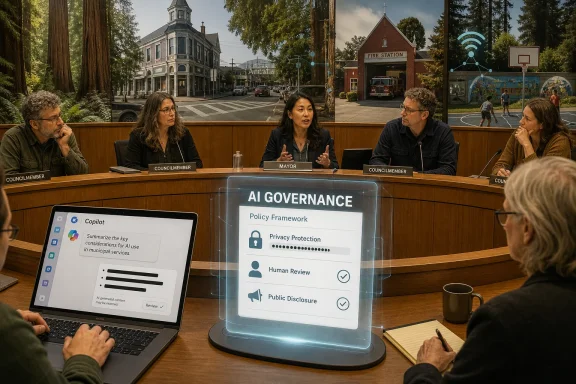
Arcata’s City Council has taken a distinctly cautious but practical stance on artificial intelligence, advancing a proposed policy that treats AI as a useful workplace tool rather than an autonomous decision-maker. The approach is notable because it pairs permission to use tools such as Microsoft Copilot with firm privacy restrictions, mandatory human review and clearer public disclosure requirements for AI-generated material.
The July 15 council meeting was far broader than a technology-policy discussion. Councilmembers also explored development impact fees to help support the Arcata Fire District, approved a timber-sale strategy for the Arcata Community Forest, funded long-delayed planning work for Reconnect Arcata, sought a new federal Opportunity Zone designation and authorized the next phase of Redwood Park basketball-court improvements.
Taken together, the agenda reveals a city attempting to make several systems work at once: digital governance, public safety, infrastructure, economic development, forest stewardship and recreation. The AI policy received the most immediate attention because it touches almost every department and raises questions that every public institution now faces: what information can staff safely provide to generative AI, how should AI-assisted work be identified, and who remains responsible when the software gets something wrong?
Arcata’s proposed artificial intelligence policy would apply broadly to city employees, interns, volunteers and work associated with the City of Arcata, whether it is produced on city-owned equipment or elsewhere. That broad scope is significant. It recognizes that public-sector information risks do not disappear merely because an employee uses a personal device or a personal AI account.
The proposed policy is not an outright prohibition on generative AI. Instead, it creates a permission structure. Department directors would need to approve use of the city’s chosen AI platform, with Microsoft Copilot identified as the likely core tool because of the city’s existing Microsoft environment.
That choice reflects an important practical reality for municipal IT teams. Employees are likely to encounter AI-assisted features in email, office productivity software, search tools and document platforms whether a formal policy exists or not. A written policy can reduce the likelihood of so-called shadow AI use, in which employees independently sign up for consumer services and potentially expose sensitive public information without oversight.
For a city government, this restriction is essential. Municipal systems routinely contain records involving residents, employees, utility customers, permits, code enforcement, emergency services, housing programs and other activities that may carry legal, privacy and public-trust obligations.
Generative AI can be deceptively conversational. A staff member seeking help to summarize a complaint, prepare a public notice or draft a response may think of the prompt as a quick office task. Yet the same prompt can become a data-handling event. If the information is transmitted to an external model or retained in a provider’s systems, the city may face privacy, records-management and security questions that are not apparent at the moment of use.
Arcata’s proposed requirement to use incognito or opt-out settings is intended to reduce the risk that city material is retained for external training purposes. That is a sensible direction, but it should not be treated as a complete technical solution.
“Incognito” can mean different things across platforms. In some services it may limit local browser history, while in others it may affect chat-history retention or model-training settings. Those are not identical protections. A mature municipal AI governance program should therefore require IT staff to document exactly what each approved mode does, what information is retained, where it is retained, who can access it and how long it remains available.
This requirement addresses the defining weakness of current large language models. Generative AI can produce polished prose, useful summaries and plausible explanations, but plausibility is not reliability. A fabricated statistic, invented regulation, outdated deadline or distorted summary can look credible enough to slip into a routine email, staff report or public web page.
For local government, the damage can extend beyond an embarrassing correction. Inaccurate content can affect permitting decisions, public notices, emergency messaging, vendor communications, grant applications and records that residents reasonably expect to be authoritative.
The council’s policy therefore correctly positions AI as a drafting and assistance technology, not as a source of truth. Staff remain responsible for the final work product. That should apply equally to text, images, audio, video, translations, data summaries and any code or spreadsheet formulas generated with AI assistance.
Councilmember Sarah Schaefer pushed for stronger language, seeking to replace permissive wording with a requirement that staff shall include disclaimers where the policy calls for them. That distinction matters. In policy drafting, “may” preserves discretion; “shall” creates an obligation.
A clear AI label does not automatically make content inaccurate or untrustworthy. Nor should it suggest that every use of an AI-assisted spelling, transcription or formatting feature needs an alarm-style disclaimer. The purpose is transparency where AI has substantially generated or altered public-facing content.
Useful disclosure practices should distinguish between:
If an email functions as a city determination, explains a regulatory obligation, communicates a public safety issue or makes a material representation to a resident, the human review obligation should be every bit as strict as it is for a formal report.
Arcata can, however, control its own conduct. The city should avoid instructing staff to upload copyrighted third-party documents, proprietary contractor materials, resident-created art or nonpublic datasets unless the city has clear authority to do so. It should also establish rules for AI-generated images used in public materials, particularly where visual work may imitate identifiable styles, real people or culturally important imagery.
The proposed policy is described as a baseline that can evolve. That is an appropriate posture. AI governance should not be a one-time resolution filed away until the next controversy. It needs regular review, staff training, technical documentation and a process for reporting mistakes or suspected misuse.
Different versions of Copilot, for example, can have different data protections, licensing terms and access to organizational content. The key question is not simply whether a product is called Copilot. It is whether the specific city-managed implementation provides the controls the policy assumes it provides.
The final policy should answer operational questions such as:
The Arcata Fire District cannot independently impose and collect land-use impact fees because it does not control land-use approvals. The City of Arcata and Humboldt County, however, can potentially establish and collect them through their development processes.
That is more than a technicality. The fee must correspond to the additional burden created by specific development categories. A new single-family home, apartment complex, mobile home, retail site, industrial facility and agricultural use can create different levels and types of demand on fire services.
Preliminary illustrations discussed at the meeting included varying per-unit and per-square-foot fees, while accessory dwelling units smaller than 700 square feet could be exempt. The details remain preliminary, and the council has not adopted a program.
The potential benefit is clear: a dedicated revenue stream could help a chronically constrained fire district prepare for population growth, denser development and changing service demands. The risk is that a poorly structured fee can increase project costs, complicate permitting and face legal challenge if the nexus analysis is weak or expenditures stray from the stated purpose.
The city’s plan to hold revenue separately, reimburse itself for reasonable administration and transfer the appropriate funds to the fire district on a scheduled basis is the right general model. Transparency will be crucial if the program moves forward.
Redwood log prices approved through the contracts vary by log size, with higher rates for larger logs. The city expects to negotiate separately for Douglas-fir and western hemlock rather than simply accept the initially available pricing.
That is a sensible commercial decision. Public forestry requires more than selling volume; it requires understanding species, grade, market conditions, transport costs and the value of retaining flexibility where bids do not reflect the resource’s potential value.
This is the critical distinction in Arcata’s community-forest model. The timber sale is presented not as a standalone revenue event, but as part of a forest management plan designed to balance ecological restoration, watershed protection, public access and long-term financial stewardship.
Still, public confidence depends on execution. The city should clearly report harvest boundaries, operational safeguards, post-harvest conditions, stream-crossing outcomes and Forest Fund revenues and expenditures. A sustainable forestry claim must be demonstrated over time through monitoring, not merely stated in a contract award.
Reconnect Arcata seeks to address transportation barriers created by the highway corridors that divide parts of the city. Its purpose is not limited to beautification or bicycle infrastructure. The effort aims to improve safety, access to jobs and services, connections between neighborhoods, housing development potential, transit use and the broader economic function of the city.
The restored local funding is intended to bridge planning work until a $700,000 Caltrans Sustainable Transportation Planning Grant becomes available for the next phase. That grant provides meaningful validation of the project’s regional relevance, particularly because it focuses on connections among Valley West, central Arcata, the Gateway Area, Cal Poly Humboldt and key highway corridors.
That is particularly relevant to the council’s Opportunity Zone request. Tax incentives may attract investor interest, but private capital is more likely to support projects that are connected to reliable transportation, active public spaces, housing demand and clear development rules.
The challenge will be moving from aspirational planning to a prioritized project list that can compete for construction dollars. High-level visions involving safer crossings, trail connections, interchange redesign and potential highway-cover concepts can be transformative, but they are expensive and technically complex. Arcata will need realistic phasing, public support, engineering rigor and a credible strategy for matching grants.
The distinction matters: Arcata has requested consideration, but the tract is not yet designated. The state must select from eligible areas, and federal certification governs when the new designations take effect.
The current Opportunity Zone framework is the result of federal changes enacted in 2025 that made the program permanent and created a new designation cycle. New Opportunity Zone designations are scheduled to take effect on January 1, 2027. California can nominate only a limited share of eligible census tracts, so local recommendations are competitive rather than automatic.
For Arcata, the appeal is clear. Downtown and the Gateway Area contain infill, redevelopment and housing opportunities that may benefit from long-term private investment. The tax incentives could support development that aligns with the city’s General Plan 2045 and Gateway Area Code.
But Opportunity Zones are not a substitute for public policy. They do not guarantee affordable housing, local hiring, small-business benefits or equitable development outcomes. The city should be prepared to pair any designation with guardrails and incentives that encourage projects meeting community priorities rather than simply maximizing tax advantages for outside investors.
The project will replace a deteriorated court surface, improve drainage, install new hoops and create an accessible parking space and entrance. It is a tangible quality-of-life investment, and it illustrates the kind of everyday public infrastructure that residents notice immediately.
Arcata’s July council agenda was unusually diverse, but a common theme runs through it: capacity. The city is trying to build administrative capacity to use AI responsibly, fire-service capacity to support growth, ecological capacity in the community forest, transportation capacity across highway divisions, investment capacity in key districts and recreational capacity in a heavily used park.
The proposed AI policy deserves attention because it establishes an early test of whether Arcata can turn broad public values into reliable operating practices. Its best features are its insistence on privacy, human verification and transparency. Its next challenge is implementation: approved-tool controls, staff training, records rules, auditability and clear consequences when the safeguards are ignored.
If the council finishes that work carefully, Arcata’s policy could become more than a reaction to AI anxiety. It could provide a grounded model for local government technology use—one that welcomes productive tools while refusing to outsource judgment, accountability or public trust.
The July 15 council meeting was far broader than a technology-policy discussion. Councilmembers also explored development impact fees to help support the Arcata Fire District, approved a timber-sale strategy for the Arcata Community Forest, funded long-delayed planning work for Reconnect Arcata, sought a new federal Opportunity Zone designation and authorized the next phase of Redwood Park basketball-court improvements.
Taken together, the agenda reveals a city attempting to make several systems work at once: digital governance, public safety, infrastructure, economic development, forest stewardship and recreation. The AI policy received the most immediate attention because it touches almost every department and raises questions that every public institution now faces: what information can staff safely provide to generative AI, how should AI-assisted work be identified, and who remains responsible when the software gets something wrong?
 A City AI Policy Built Around Human Accountability
Arcata’s proposed artificial intelligence policy would apply broadly to city employees, interns, volunteers and work associated with the City of Arcata, whether it is produced on city-owned equipment or elsewhere. That broad scope is significant. It recognizes that public-sector information risks do not disappear merely because an employee uses a personal device or a personal AI account.The proposed policy is not an outright prohibition on generative AI. Instead, it creates a permission structure. Department directors would need to approve use of the city’s chosen AI platform, with Microsoft Copilot identified as the likely core tool because of the city’s existing Microsoft environment.
That choice reflects an important practical reality for municipal IT teams. Employees are likely to encounter AI-assisted features in email, office productivity software, search tools and document platforms whether a formal policy exists or not. A written policy can reduce the likelihood of so-called shadow AI use, in which employees independently sign up for consumer services and potentially expose sensitive public information without oversight.
The Policy’s Most Important Safeguard: No Sensitive Data in AI Prompts
The clearest part of Arcata’s proposed policy is the bar on entering confidential or sensitive personal information into AI systems. Names, addresses, Social Security numbers and medical information are specifically among the data types employees must not submit.For a city government, this restriction is essential. Municipal systems routinely contain records involving residents, employees, utility customers, permits, code enforcement, emergency services, housing programs and other activities that may carry legal, privacy and public-trust obligations.
Generative AI can be deceptively conversational. A staff member seeking help to summarize a complaint, prepare a public notice or draft a response may think of the prompt as a quick office task. Yet the same prompt can become a data-handling event. If the information is transmitted to an external model or retained in a provider’s systems, the city may face privacy, records-management and security questions that are not apparent at the moment of use.
Arcata’s proposed requirement to use incognito or opt-out settings is intended to reduce the risk that city material is retained for external training purposes. That is a sensible direction, but it should not be treated as a complete technical solution.
“Incognito” can mean different things across platforms. In some services it may limit local browser history, while in others it may affect chat-history retention or model-training settings. Those are not identical protections. A mature municipal AI governance program should therefore require IT staff to document exactly what each approved mode does, what information is retained, where it is retained, who can access it and how long it remains available.
AI Output Is Not City Fact
The policy’s most consequential rule is also the simplest: humans must review AI-generated work for accuracy, tone, bias and context before publication or use. Unverified AI-generated information cannot be used.This requirement addresses the defining weakness of current large language models. Generative AI can produce polished prose, useful summaries and plausible explanations, but plausibility is not reliability. A fabricated statistic, invented regulation, outdated deadline or distorted summary can look credible enough to slip into a routine email, staff report or public web page.
For local government, the damage can extend beyond an embarrassing correction. Inaccurate content can affect permitting decisions, public notices, emergency messaging, vendor communications, grant applications and records that residents reasonably expect to be authoritative.
The council’s policy therefore correctly positions AI as a drafting and assistance technology, not as a source of truth. Staff remain responsible for the final work product. That should apply equally to text, images, audio, video, translations, data summaries and any code or spreadsheet formulas generated with AI assistance.
Disclosure Rules Could Strengthen Trust
The draft policy also calls for labeling AI-generated public documents and AI-generated audio or visual media. Informal correspondence between employees, including emails, would be excluded from the labeling requirement.Councilmember Sarah Schaefer pushed for stronger language, seeking to replace permissive wording with a requirement that staff shall include disclaimers where the policy calls for them. That distinction matters. In policy drafting, “may” preserves discretion; “shall” creates an obligation.
Why Labels Matter
Disclosure is not merely an etiquette issue. Government communications carry institutional authority. Residents may assume that an image, video, public flyer or written explanation reflects direct staff work, verified facts and deliberate editorial choices.A clear AI label does not automatically make content inaccurate or untrustworthy. Nor should it suggest that every use of an AI-assisted spelling, transcription or formatting feature needs an alarm-style disclaimer. The purpose is transparency where AI has substantially generated or altered public-facing content.
Useful disclosure practices should distinguish between:
- AI-assisted work, where staff created and substantively edited the material while using AI for limited support.
- AI-generated work, where an AI system produced most of the text, image, narration or visual component.
- Synthetic or altered media, especially audio, video and images that could reasonably be mistaken for authentic footage, photography or recorded speech.
- Verified public information, where the city has reviewed the final content and takes responsibility for its accuracy regardless of the tools used.
If an email functions as a city determination, explains a regulatory obligation, communicates a public safety issue or makes a material representation to a resident, the human review obligation should be every bit as strict as it is for a formal report.
Copyright, Training Data and the Limits of a Local Policy
Councilmembers also expressed concern about large language models using artwork and information created by people. Those concerns are well founded, even if a municipal AI-use policy cannot resolve every legal dispute involving training data, copyright and the ownership of machine-generated outputs.Arcata can, however, control its own conduct. The city should avoid instructing staff to upload copyrighted third-party documents, proprietary contractor materials, resident-created art or nonpublic datasets unless the city has clear authority to do so. It should also establish rules for AI-generated images used in public materials, particularly where visual work may imitate identifiable styles, real people or culturally important imagery.
The proposed policy is described as a baseline that can evolve. That is an appropriate posture. AI governance should not be a one-time resolution filed away until the next controversy. It needs regular review, staff training, technical documentation and a process for reporting mistakes or suspected misuse.
What Arcata Should Add Before Final Approval
Arcata’s draft establishes strong principles, but the city could make the final policy more durable by translating those principles into operating controls.A Formal Approved-Tools List
The city should maintain a public or internally accessible list of approved AI services, accounts, versions and permitted uses. The policy should make clear that a tool is not automatically approved merely because it is embedded in commonly used software.Different versions of Copilot, for example, can have different data protections, licensing terms and access to organizational content. The key question is not simply whether a product is called Copilot. It is whether the specific city-managed implementation provides the controls the policy assumes it provides.
Tiered Data Classification
A simple “do not enter sensitive information” rule is valuable, but a tiered model would help staff make consistent decisions. City information could be classified into categories such as:- Public information that may be used in approved AI systems after ordinary caution.
- Internal nonpublic information that may be used only in city-managed systems with defined protections.
- Confidential, personal, protected or legally restricted information that may never be entered into generative AI unless a future, explicitly approved system and legal review permit it.
- High-risk decision material, such as law enforcement, personnel, legal, health, benefits, procurement evaluation or code-enforcement records, which should require enhanced review or remain outside AI workflows.
Retention, Auditability and Public Records
Government use of AI is also a records-management issue. If a prompt, generated draft or model interaction contributes materially to a city decision, the city should determine whether it is a public record and how it will be retained.The final policy should answer operational questions such as:
- Must staff save prompts and outputs used to produce formal reports?
- Can an AI conversation be deleted after a task is complete?
- How will the city respond to public-records requests involving AI-assisted work?
- Can the city reconstruct how a public statement, recommendation or analysis was created?
- What disclosures are required when AI is used to translate or summarize public input?
Fire Development Impact Fees Move From Theory Toward Study
Earlier in the meeting, the council heard from Arcata Fire District Chief Chris Emmons and consultant Blair Aas about a potential development impact fee program. The concept is straightforward: new development can create additional demand for fire protection services, and fees from qualifying new construction could help fund the facilities, equipment or capacity necessary to meet that growth.The Arcata Fire District cannot independently impose and collect land-use impact fees because it does not control land-use approvals. The City of Arcata and Humboldt County, however, can potentially establish and collect them through their development processes.
The Nexus Requirement Is the Essential Constraint
A development impact fee cannot be set arbitrarily. It must be supported by a legally defensible nexus study linking the impacts of new development to the public facilities or capacity the fee would fund.That is more than a technicality. The fee must correspond to the additional burden created by specific development categories. A new single-family home, apartment complex, mobile home, retail site, industrial facility and agricultural use can create different levels and types of demand on fire services.
Preliminary illustrations discussed at the meeting included varying per-unit and per-square-foot fees, while accessory dwelling units smaller than 700 square feet could be exempt. The details remain preliminary, and the council has not adopted a program.
The potential benefit is clear: a dedicated revenue stream could help a chronically constrained fire district prepare for population growth, denser development and changing service demands. The risk is that a poorly structured fee can increase project costs, complicate permitting and face legal challenge if the nexus analysis is weak or expenditures stray from the stated purpose.
The city’s plan to hold revenue separately, reimburse itself for reasonable administration and transfer the appropriate funds to the fire district on a scheduled basis is the right general model. Transparency will be crucial if the program moves forward.
Timber Sales Pair Revenue With Forest Restoration
The council also awarded contracts tied to a planned selective harvest in the Jacoby Creek Tract of the Arcata Community Forest. The operation is expected to encompass approximately 45 to 55 acres and harvest roughly 430 thousand board feet of timber.Redwood log prices approved through the contracts vary by log size, with higher rates for larger logs. The city expects to negotiate separately for Douglas-fir and western hemlock rather than simply accept the initially available pricing.
That is a sensible commercial decision. Public forestry requires more than selling volume; it requires understanding species, grade, market conditions, transport costs and the value of retaining flexibility where bids do not reflect the resource’s potential value.
Selective Harvesting Versus Short-Term Extraction
The planned silvicultural approach is single-tree selection, intended to thin dense younger conifer stands and encourage development toward old-growth forest characteristics. The work also includes repairing or replacing five legacy stream crossings to reduce sediment runoff into Jacoby Creek.This is the critical distinction in Arcata’s community-forest model. The timber sale is presented not as a standalone revenue event, but as part of a forest management plan designed to balance ecological restoration, watershed protection, public access and long-term financial stewardship.
Still, public confidence depends on execution. The city should clearly report harvest boundaries, operational safeguards, post-harvest conditions, stream-crossing outcomes and Forest Fund revenues and expenditures. A sustainable forestry claim must be demonstrated over time through monitoring, not merely stated in a contract award.
Reconnect Arcata Regains Momentum
The council’s decision to restore $75,000 to the Reconnect Arcata planning budget is one of the meeting’s most strategically important actions. The approved amendment brings the SmithGroup planning contract to $225,000, partially reversing a previous $150,000 cut made during a period of General Fund pressure.Reconnect Arcata seeks to address transportation barriers created by the highway corridors that divide parts of the city. Its purpose is not limited to beautification or bicycle infrastructure. The effort aims to improve safety, access to jobs and services, connections between neighborhoods, housing development potential, transit use and the broader economic function of the city.
The restored local funding is intended to bridge planning work until a $700,000 Caltrans Sustainable Transportation Planning Grant becomes available for the next phase. That grant provides meaningful validation of the project’s regional relevance, particularly because it focuses on connections among Valley West, central Arcata, the Gateway Area, Cal Poly Humboldt and key highway corridors.
Connectivity Is Economic Infrastructure
City Engineer Netra Khatri’s case for Reconnect Arcata is fundamentally an economic-development argument. A city that wants investment, housing, tourism and commercial vitality must also make it easier and safer for people to reach destinations by walking, biking, transit and driving.That is particularly relevant to the council’s Opportunity Zone request. Tax incentives may attract investor interest, but private capital is more likely to support projects that are connected to reliable transportation, active public spaces, housing demand and clear development rules.
The challenge will be moving from aspirational planning to a prioritized project list that can compete for construction dollars. High-level visions involving safer crossings, trail connections, interchange redesign and potential highway-cover concepts can be transformative, but they are expensive and technically complex. Arcata will need realistic phasing, public support, engineering rigor and a credible strategy for matching grants.
Opportunity Zone Request Is a Bid, Not a Designation
The council unanimously authorized a recommendation that California nominate Census Tract 06023001001, encompassing downtown Arcata and portions of the Gateway Area, for the new Opportunity Zones 2.0 process.The distinction matters: Arcata has requested consideration, but the tract is not yet designated. The state must select from eligible areas, and federal certification governs when the new designations take effect.
The current Opportunity Zone framework is the result of federal changes enacted in 2025 that made the program permanent and created a new designation cycle. New Opportunity Zone designations are scheduled to take effect on January 1, 2027. California can nominate only a limited share of eligible census tracts, so local recommendations are competitive rather than automatic.
For Arcata, the appeal is clear. Downtown and the Gateway Area contain infill, redevelopment and housing opportunities that may benefit from long-term private investment. The tax incentives could support development that aligns with the city’s General Plan 2045 and Gateway Area Code.
But Opportunity Zones are not a substitute for public policy. They do not guarantee affordable housing, local hiring, small-business benefits or equitable development outcomes. The city should be prepared to pair any designation with guardrails and incentives that encourage projects meeting community priorities rather than simply maximizing tax advantages for outside investors.
A Practical Municipal Agenda With One Unifying Theme
The Redwood Park basketball-court contract, awarded at $139,370, may appear unrelated to AI policy, fire fees, forest management or transportation planning. In reality, it belongs to the same civic story.The project will replace a deteriorated court surface, improve drainage, install new hoops and create an accessible parking space and entrance. It is a tangible quality-of-life investment, and it illustrates the kind of everyday public infrastructure that residents notice immediately.
Arcata’s July council agenda was unusually diverse, but a common theme runs through it: capacity. The city is trying to build administrative capacity to use AI responsibly, fire-service capacity to support growth, ecological capacity in the community forest, transportation capacity across highway divisions, investment capacity in key districts and recreational capacity in a heavily used park.
The proposed AI policy deserves attention because it establishes an early test of whether Arcata can turn broad public values into reliable operating practices. Its best features are its insistence on privacy, human verification and transparency. Its next challenge is implementation: approved-tool controls, staff training, records rules, auditability and clear consequences when the safeguards are ignored.
If the council finishes that work carefully, Arcata’s policy could become more than a reaction to AI anxiety. It could provide a grounded model for local government technology use—one that welcomes productive tools while refusing to outsource judgment, accountability or public trust.