

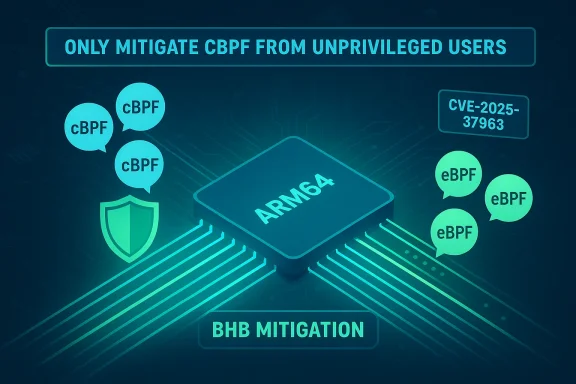
A narrowly scoped but operationally significant Linux kernel change addressing CVE-2025-37963 narrows Branch History Buffer (BHB) mitigations on ARM64 so they apply only to classic BPF (cBPF) programs loaded by unprivileged users — a corrective tweak that removes redundant mitigations for privileged paths while preserving defenses where they matter most. The net effect: smaller attack surface for speculative-execution style attacks on some Arm CPUs, but also an operational call-to-action for administrators to patch or apply conservative kernel hardening where vendor updates are not immediately available.
The Linux kernel's BPF subsystem — originally introduced as the classic Berkeley Packet Filter (cBPF) and later extended into the far more powerful and sandboxed eBPF — is a core technology used for packet filtering, tracing, and observability. Over the last several years, CPU speculative-execution vulnerabilities (Spectre-family and related microarchitectural attacks such as Branch History Injection / Spectre‑BHB) forced operating systems and CPU vendors to add mitigation sequences that neutralize speculative effects at critical transition points.
On May 20, 2025, the issue tracked as CVE-2025-37963 was published to document a kernel change for arm64 described succinctly as: “arm64: bpf: Only mitigate cBPF programs loaded by unprivileged users.” The intent of the change is to limit BHB clearing and related mitigation sequences to the class of BPF programs that truly require them — namely classic cBPF filters installed by unprivileged processes — while avoiding pointless mitigation for privileged users who can already load equivalent programs via eBPF. This change was merged upstream and later distributed by vendors as kernel updates and advisories. NVD and multiple distro advisories list the fix and the rationale behind it.
Why this matters: speculative-execution mitigations cost CPU cycles and sometimes increase latency; they are a defensive cost. The kernel maintainers aim to apply them only where they actually protect against plausible attacker-controlled flows. CVE-2025-37963 is therefore less a “new exploit” and more a precision correction to ensure mitigations are targeted, effective, and not unnecessarily applied to privileged flows that can already use alternative (and mitigated) paths. Open-source tracker listings and vendor advisories show the change was coordinated with other BPF/BHB fixes around the same timeframe.
However, it is important to parse this carefully:
But the change is important because:
Conclusion
CVE-2025-37963 is a surgical kernel change: it corrects where and when BHB mitigations are applied on arm64 so the kernel defends against unprivileged cBPF attacks while avoiding redundant mitigation for privileged flows. The vulnerability classification emphasizes availability concerns in unpatched contexts, which is why systems running Arm64 Linux kernels deserve prompt attention. The recommended path is straightforward: map your installed kernels to vendor advisories, apply the upstream or vendor-supplied patches, and use kernel knobs such as kernel.unprivileged_bpf_disabled to reduce exposure where immediate patching is not possible. Patch, validate, and monitor — because kernel fixes of this class touch performance, availability, and security simultaneously.
Source: MSRC Security Update Guide - Microsoft Security Response Center
 Background / Overview
The Linux kernel's BPF subsystem — originally introduced as the classic Berkeley Packet Filter (cBPF) and later extended into the far more powerful and sandboxed eBPF — is a core technology used for packet filtering, tracing, and observability. Over the last several years, CPU speculative-execution vulnerabilities (Spectre-family and related microarchitectural attacks such as Branch History Injection / Spectre‑BHB) forced operating systems and CPU vendors to add mitigation sequences that neutralize speculative effects at critical transition points.On May 20, 2025, the issue tracked as CVE-2025-37963 was published to document a kernel change for arm64 described succinctly as: “arm64: bpf: Only mitigate cBPF programs loaded by unprivileged users.” The intent of the change is to limit BHB clearing and related mitigation sequences to the class of BPF programs that truly require them — namely classic cBPF filters installed by unprivileged processes — while avoiding pointless mitigation for privileged users who can already load equivalent programs via eBPF. This change was merged upstream and later distributed by vendors as kernel updates and advisories. NVD and multiple distro advisories list the fix and the rationale behind it.
Why this matters: speculative-execution mitigations cost CPU cycles and sometimes increase latency; they are a defensive cost. The kernel maintainers aim to apply them only where they actually protect against plausible attacker-controlled flows. CVE-2025-37963 is therefore less a “new exploit” and more a precision correction to ensure mitigations are targeted, effective, and not unnecessarily applied to privileged flows that can already use alternative (and mitigated) paths. Open-source tracker listings and vendor advisories show the change was coordinated with other BPF/BHB fixes around the same timeframe.
What exactly changed: the technical details
cBPF vs eBPF — a short primer
- cBPF (classic BPF): the older, simpler socket-filter style instruction set. Many traditional tools still use cBPF (e.g., legacy libpcap filters), and cBPF programs can be installed via legacy syscalls or seccomp hooks.
- eBPF (extended BPF): a safe, richer virtual machine with a formal verifier, maps, helpers, and a modern JIT pipeline that is generally loaded through the bpf(2) syscall.
Branch History Buffer (BHB) and the mitigation model
- The Branch History Buffer (BHB) is a microarchitectural structure that records historical branch outcomes and is shared across contexts on many CPU designs. Attackers can potentially influence this history (Branch History Injection) so that speculative control-flow in victim contexts is steered into gadget sequences that leak information via side channels.
- CPU vendors introduced instructions and controls (for example, an Indirect Branch History Fence, IBHF, on some Arm and x86 families, and related platform controls like BHI_DIS_S) to let operating systems overwrite or clear branch history on critical transitions. Where explicit hardware support is absent or incomplete, the OS can instead run a carefully-crafted sequence (a software fence) to clobber BHB entries.
- Linux applied BHB-clearing sequences when untrusted code could run in kernel-adjacent contexts or influence speculative state. In the BPF case, cBPF programs had an epilogue that invoked a BHB-clearing sequence to avoid speculative leakage when returning to privileged execution.
The root of CVE-2025-37963
The kernel previously mitigated cBPF programs broadly, in some cases applying the BHB-clearing behavior without discriminating whether the cBPF program had been loaded by an unprivileged user or by a privileged one. Because privileged users can load programs via the modern eBPF path (bpf(2)), mitigating privileged cBPF instances offered little security benefit but did keep paying the mitigation cost. The fix encoded by CVE-2025-37963 narrows the mitigation: the kernel should only apply the BHB-clearing sequence to cBPF programs that were loaded by unprivileged processes. This keeps protection where it’s needed (against attacker-controlled, unprivileged filters) and reduces overhead or parity mismatches for privileged flows. Vendor release notes indicate the change was landed alongside companion patches that add BHB mitigation to cBPF epilogues and platform capability exposure for ARM mitigations.Impact and severity — availability, integrity, and attacker model
The public vulnerability records rate CVE-2025-37963 with a medium score (CVSS 3.1 ≈ 5.5 in several aggregators) and list availability impact as notable in some assessments; that reflects the kernel-level context where an unstable mitigation strategy or unchecked edge cases can produce sustained or persistent availability loss (kernel warnings, OOPS, or hangs) when BPF code misbehaves. The MSRC-style description the user provided characterizes the impact in availability terms — an attacker able to trigger the condition can cause sustained denial-of-service or repeated crashes that eventually take a service offline.However, it is important to parse this carefully:
- CVE-2025-37963 is not primarily a remote code execution vulnerability; instead, it is a correctness/mitigation-targeting issue with potential to cause availability problems when the kernel’s speculative-mitigation logic is misapplied.
- The practical attack surface is local (an attacker with the ability to load cBPF filters as an unprivileged user), and the fix reduces unnecessary mitigation overhead rather than opening new privileged escape vectors.
- Public trackers and vendor advisories indicate no widely reported exploit-in-the-wild tied to this CVE at the time the kernel fixes and distro advisories were published, but as always kernel-level issues warrant rapid attention because they live in a sensitive layer.
Vendor responses and practical patching status
Major distribution and vendor advisories list this CVE alongside nearby BPF/BHB fixes. A representative snapshot of the upstream and vendor response includes:- NVD / MITRE catalog entries describing the change and linking to upstream commits and advisories.
- Amazon Linux advisories mapping CVE-2025-37963 and offering fixes in specific kernels and images, with published package advisories for Amazon Linux 2023 and some kernel series. Operators of Amazon Linux images should consult their ALAS advisories and apply vendor updates.
- SUSE and other enterprise vendors bundled the offset change into broader kernel update releases and release notes that explictly mention the BHB-related BPF changes. SUSE’s update list includes explicit lines for “arm64: bpf: Only mitigate cBPF programs loaded by unprivileged users” and companion BHB epilogue patches.
- Debian, Red Hat, and other distributions issued security advisories or backports; Debian and the Debian LTS announcements, as tracked by OpenCVE and related feeds, show patched packages or DLA advisories that reference the same commits. Red Hat’s tracking notes show product-scoped decisions (some fixes deferred or backported per product lifecycle). Operators running vendor kernels should track their distribution’s security tracker for the exact package that maps to their kernel ABI.
Recommended action plan for administrators (step-by-step)
- Inventory: identify systems running Arm64 Linux kernels and list kernel versions and vendor packages (including cloud images). Focus on hosts that expose networking or allow unprivileged users on multi-tenant systems.
- Map to advisories: check your distribution’s security advisories for CVE-2025-37963 and companion BPF/BHB fixes. The NVD and vendor advisories list affected kernels and commit hashes — use those to map to your installed kernel.
- Patch priority: apply vendor-supplied kernel updates where available. If your vendor supplies a stable/enterprise kernel update that includes the upstream patches, schedule that update promptly (subject to your change control).
- If you cannot patch immediately, apply mitigations:
- Consider disabling unprivileged use of the bpf() syscall by setting the sysctl /proc/sys/kernel/unprivileged_bpf_disabled to 1 (permanent until reboot) or 2 (temporary, still changeable). This denies unprivileged processes direct bpf(2) access and reduces exposure to speculative BPF-related flows. Note: this does not block legacy cBPF socket filters or seccomp filters that do not use bpf(2).
- Restrict CAP_BPF and CAP_SYS_ADMIN allocation on hosts where feasible. Evaluate access controls for container runtimes, CI systems, and untrusted user spaces.
- Monitoring: audit kernel logs and security telemetry for unusual bpf(2) activity, seccomp installs, or kernel warnings; correlate with known advisory timelines.
- Test: run regression and performance testing after kernel updates. Because BHB mitigations and JIT changes can affect microbenchmarks, validate workloads that are latency-sensitive (networking paths, packet capture systems, telemetry pipelines).
- Long-term: integrate kernel CVE tracking into your patch-management pipeline, and treat microarchitectural-mitigation patches as both security and performance events — do targeted rollouts and benchmarks.
Detection, forensics, and indicators
- There are no public CVE-specific exploit signatures that security vendors have flagged for CVE-2025-37963 at the time vendors issued the upstream fixes; the issue is best treated as a kernel correctness/mitigation hardening item rather than a high-confidence in-the-wild exploitation case. Still, because kernel-level speculative flows can be subtle, it’s reasonable to monitor for:
- Repeated kernel warnings, OOPS, or panic logs tied to BPF epilogues or JIT paths.
- Unusual local attempts to install BPF programs from untrusted users (e.g., unexpected seccomp or socket-filter activity).
- Elevated use of bpf(2) or unprivileged filter loads on systems where that should be rare (container build agents, CI targets, untrusted guest VMs).
- If you perform forensic analysis after an incident, collect kernel oops logs, the associated BPF program bytecode (if possible), and timing/correlation with user processes that performed bpf(2) or created seccomp filters.
Tradeoffs and operational considerations
- Security vs performance: targeted mitigations (only for cBPF programs loaded by unprivileged users) reduce unnecessary CPU costs compared to blanket mitigations. That’s precisely the goal: defense in depth without unnecessary performance debt.
- Compatibility and telemetry: some appliances and embedded systems running Arm64 may rely on older kernels or specific JIT behavior. Kernel updates that alter the BPF epilogue or instruction encoding (e.g., ARM64 encoding/DSB handling) may require additional validation in those environments. SUSE’s update notes, for example, highlight both the epilogue changes and related ARM instruction encoding work. If you run custom kernel modules or vendors’ bespoke kernels, validate compatibility with those changes.
- Multi-tenant risk: cloud providers and hosts that permit untrusted users to exercise bpf(2) or install filters are higher risk. In multi-tenant compute, administrators should default to strict kernel knobs (disable unprivileged bpf) unless there is a compelling reason to allow it.
Why this fix is more surgical than sensational — and why it matters anyway
CVE-2025-37963 is not one of the flashy “remote RCE” kernel CVEs; instead, it is a measured course correction: the kernel now applies BHB mitigations where they actually defend against attacker-controlled programs. That makes the kernel’s behavior more logically consistent and reduces the cost of unnecessary mitigations.But the change is important because:
- Kernel-level speculative-execution mitigations are sensitive both for security and performance. Getting the logic right keeps systems secure and performant.
- The code paths affected are in a privileged and highly shared layer — errors here can produce real availability consequences (the kind of sustained or persistent DoS the MSRC description warns about). Administrators must therefore treat the update with appropriate urgency and care. The public vulnerability descriptions reflect an availability risk posture and advise operators to remediate accordingly.
Final analysis and verdict for WindowsForum readers
- Risk level: For most readers running modern vendor kernels that have absorbed upstream patches, this is a moderate operational-security item: important but not emergent like a remotely exploitable RCE. For edge cases (multi-tenant hosts, cloud images that permit untrusted BPF), the risk is materially higher until patched.
- Priority: If you run Arm64 hosts in production, treat this as a high-priority kernel update to evaluate and deploy, particularly on systems that allow unprivileged code paths or operate in high-threat multi-tenant scenarios.
- Immediate controls: If you cannot update the kernel immediately, set /proc/sys/kernel/unprivileged_bpf_disabled to a conservative value (1 or 2) and audit CAP_BPF/CAP_SYS_ADMIN exposure. These knobs are well-documented and are part of the kernel’s defensive toolkit for speculative-execution risks.
- Longer-term: Maintain upstream CVE tracking for BPF and Spectre/BHB-family mitigations. The kernel, CPU vendors, and distributions continue to iterate; keep patch cycles and validation pipelines tuned to absorb such behavioral fixes without surprise.
Additional context from our forum archive and kernel discussions
We track and summarize kernel BPF fixes frequently in our forum posts; recent kernel threads recount a string of BPF-related patches (epilogue BHB clearing, verifier hardening, and deadlock fixes) that together formed the upstream wave of mitigation work in 2024–2025. Those discussions provide useful operational context for the CVE’s motivation and for regression-test cases administrators may want to run internally. For readers who monitor kernel changelogs and vendor backports, this CVE is one entry in a sequence of targeted BPF and arm64 microarchitectural fixes delivered over the last 12–18 months.Conclusion
CVE-2025-37963 is a surgical kernel change: it corrects where and when BHB mitigations are applied on arm64 so the kernel defends against unprivileged cBPF attacks while avoiding redundant mitigation for privileged flows. The vulnerability classification emphasizes availability concerns in unpatched contexts, which is why systems running Arm64 Linux kernels deserve prompt attention. The recommended path is straightforward: map your installed kernels to vendor advisories, apply the upstream or vendor-supplied patches, and use kernel knobs such as kernel.unprivileged_bpf_disabled to reduce exposure where immediate patching is not possible. Patch, validate, and monitor — because kernel fixes of this class touch performance, availability, and security simultaneously.
Source: MSRC Security Update Guide - Microsoft Security Response Center
