

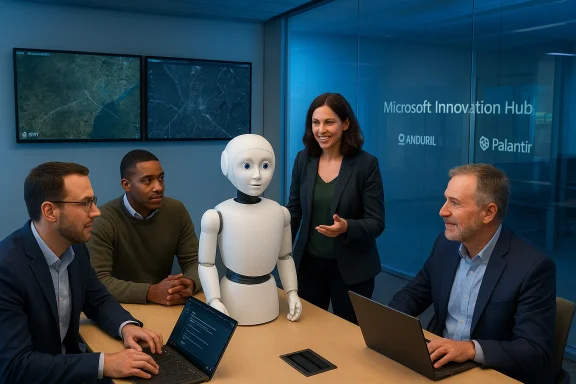
Training With Industry (TWI) fellows gathered at Microsoft’s Innovation Hub in Arlington, Virginia, for the 2026 midpoint review from January 12–16 — an event that crystallized the program’s central purpose: put frontline Army acquisition officers inside the private-sector engine room so they can return with the relationships, skills, and perspective necessary to accelerate force modernization.
The Army’s Training With Industry (TWI) initiative is a one‑year work‑experience program that embeds competitively selected Army acquisition officers with leading private‑sector companies. The stated aim is simple but consequential: expose officers to contemporary commercial management approaches, product development practices, and organizational culture so they can bring proven methods back to defense acquisition and program management. Eligibility, structure, and the program’s long‑standing objectives are documented in Army career‑development guidance and supporting policy.
TWI has two linked functions. First, it is an educational immersion: fellows learn processes, decision rhythms, and tools rarely taught in the institutional military classroom. Second, it is trust‑building: by living and working with industry peers, fellows form the professional ties that can later ease collaboration, contracting, and information flow between the Department of Defense and commercial partners. The midpoint review is a ritualized checkpoint where fellows present what they have learned, compare cross‑company observations, and shape the remaining months of their placements.
Key moments included:
Why this matters for the Army: embodied agents can reduce friction for users unfamiliar with traditional GUIs, enable low‑bandwidth spoken interfaces in certain environments, and accelerate user acceptance of AI assistants when deployed as familiar conversational "people‑like" touchpoints. At the same time, the demonstration illustrated the platform’s current reality: these systems are useful where the domain is bounded and the dataset curated; they are not a substitute for robust, unbounded situational awareness or complex decision support systems.
Why this matters for the Army: geospatial Copilots can collapse long analysis cycles, letting small teams get rapid situational snapshots from rich satellite collections. For logistics, route planning, or disaster response, that speed is transformational. But it raises two practical issues: (1) how to verify and provenance satellite‑derived inferences before they affect operational decisions, and (2) how to handle premium or restricted commercial imagery under contracting and data‑use rules.
These firsthand reactions reflect a classic TWI benefit: officers not only learn technical tools, but they also internalize cultural practices — iterative product development, acceptance of rapid experimentation, and measurement‑driven change — that underpin modern commercial transformation.
Microsoft’s U.S. Federal leaders at the event framed the opportunity as one of mutual adaptation: the Army needs guaranteed mission assurance and security, while industry requires stable contracting pathways and clearer signals about operational priorities. TWI fellows — by carrying experience and contacts across that boundary — can act as translators.
TWI sits at the intersection of these forces. By embedding officers in industry, the Army intentionally reduces the social and cognitive distance that makes reform difficult. When a fellow returns to a program office having personally worked inside a vendor’s sprint cycles, they can credibly advocate for modular contracting, continuous integration practices, or more flexible test and evaluation. That credibility matters.
Yet credibility alone is insufficient. The Army must institutionalize the tactical lessons fellows bring back. That means updating training materials, codifying successful vendor engagement patterns, and funding intermediate risk pools that let programs experiment without endangering core readiness.
The demonstrations — from Furhat’s conversational interface to Esri’s satellite layers paired with Copilot‑style prompts — crystallized both opportunity and obligation. If the Army is to move faster and smarter, it must pair the cultural lessons TWI supplies with rigorous data governance, hardened security baselines, and acquisition instruments fit for iterative delivery. Done well, TWI will remain a quiet but powerful conduit for change: the place where officers learn the language of industry, return fluent, and help the force translate commercial speed into battlefield advantage.
Source: army.mil TWI Fellows Meet For 2026 Midpoint Review
 Background
The Army’s Training With Industry (TWI) initiative is a one‑year work‑experience program that embeds competitively selected Army acquisition officers with leading private‑sector companies. The stated aim is simple but consequential: expose officers to contemporary commercial management approaches, product development practices, and organizational culture so they can bring proven methods back to defense acquisition and program management. Eligibility, structure, and the program’s long‑standing objectives are documented in Army career‑development guidance and supporting policy.TWI has two linked functions. First, it is an educational immersion: fellows learn processes, decision rhythms, and tools rarely taught in the institutional military classroom. Second, it is trust‑building: by living and working with industry peers, fellows form the professional ties that can later ease collaboration, contracting, and information flow between the Department of Defense and commercial partners. The midpoint review is a ritualized checkpoint where fellows present what they have learned, compare cross‑company observations, and shape the remaining months of their placements.
What happened at the 2026 midpoint review
The week‑long meeting centered on an industry day hosted at Microsoft’s Innovation Hub. Programming combined formal briefings, hands‑on demonstrations of AI‑enabled tools, site tours, and facilitated peer exchange among fellows placed across the commercial ecosystem. Microsoft personnel opened the day, described the theme of transformation, and framed the practical conversation around acquisition reform and the operational integration of artificial intelligence (AI).Key moments included:
- Opening comments that positioned TWI fellows as change agents who can import an “outside‑in” view to Army acquisition and operations. Carmen Krueger, Microsoft’s corporate vice president for U.S. Federal, framed the fellowship as a front‑row seat to technology adoption and urged practical mission alignment over technological novelty.
- A series of live demonstrations inside the Innovation Hub that showcased social robotics (Furhat), geospatial and satellite imagery analytics (Esri), and interactive Copilot scenarios led by Microsoft cloud practitioners. Fellows tested prompts, evaluated responses, and discussed operational utility and limitations.
- Industry briefings by defense‑tech contractors including Palantir and Anduril that focused on partnering strategies under new acquisition reform regimes and practical approaches to contracting and rapid delivery.
The Innovation Hub demonstrations: what fellows saw and why it matters
Furhat: social robotics as a conversation model
Fellows observed Furhat — a back‑projected humanoid bust that displays a projected human face and supports speech, gaze, and limited conversational flows. The Furhat setup demonstrated how embodied conversational agents can create a natural interface for information retrieval or training use cases, particularly in constrained datasets and scripted interaction scenarios. Furhat Robotics explicitly documents integrations with Microsoft Innovation Hubs, and the platform has been used as a showcase of how AI services can be presented in a humanized form.Why this matters for the Army: embodied agents can reduce friction for users unfamiliar with traditional GUIs, enable low‑bandwidth spoken interfaces in certain environments, and accelerate user acceptance of AI assistants when deployed as familiar conversational "people‑like" touchpoints. At the same time, the demonstration illustrated the platform’s current reality: these systems are useful where the domain is bounded and the dataset curated; they are not a substitute for robust, unbounded situational awareness or complex decision support systems.
ESRI + Copilot: satellite data, mapped intelligence, and prompt‑driven exploration
Microsoft’s Innovation Hub demonstration linked Esri’s imagery and analytics with Copilot‑style interfaces to show how earth observation layers — including Sentinel and Landsat derivatives — can be interrogated quickly for phenomena such as volcanic activity, fires, or infrastructure change. Esri’s ArcGIS ecosystem already exposes multispectral and temporal layers that are used in disaster response and environmental monitoring, and Microsoft’s work with Earth science partners has foregrounded "Copilot" concepts that translate complex geospatial queries into conversational prompts and visual outputs.Why this matters for the Army: geospatial Copilots can collapse long analysis cycles, letting small teams get rapid situational snapshots from rich satellite collections. For logistics, route planning, or disaster response, that speed is transformational. But it raises two practical issues: (1) how to verify and provenance satellite‑derived inferences before they affect operational decisions, and (2) how to handle premium or restricted commercial imagery under contracting and data‑use rules.
Copilot in the classroom: prompt testing and human judgment
Timothy Cashman, a principal cloud solution architect at Microsoft U.S. Federal, led an interactive Copilot session where fellows submitted prompts and assessed responses in a controlled classroom environment. The exercise underscored two realities: Copilot can dramatically accelerate information synthesis and planning, but outputs require human verification and careful prompt design to be mission‑safe. Fellows were explicitly asked to evaluate accuracy, identify hallucinations or data gaps, and consider operational constraints that a generic enterprise Copilot may not account for.Voices from the field: how fellows interpreted the experience
Maj. Douglas Richardson — a fellow assigned at Microsoft who opened the session — framed the theme as transformation and emphasized acquisition reform and AI integration as practical levers for change. Maj. Sean Jones, placed at Ford Motor Company, highlighted how industry cultures orient toward continuous improvement and benchmarking across sectors, which shapes how companies manage major shifts. Fellows repeatedly noted that the midpoint review is as much about peer exchange as it is about vendor briefings: sharing lessons learned from disparate host companies helps them refine the remainder of their year‑long placements.These firsthand reactions reflect a classic TWI benefit: officers not only learn technical tools, but they also internalize cultural practices — iterative product development, acceptance of rapid experimentation, and measurement‑driven change — that underpin modern commercial transformation.
Why Microsoft, Palantir, Anduril — and why now
The choice of hosts and briefers at the Innovation Hub is intentional. Microsoft provides the enterprise stack — cloud, productivity, and Copilot experiences — and an environment to surface use cases. Palantir and Anduril represent adjacent parts of the defense commercial base: Palantir with data integration and operational analytics, Anduril with rapid systems delivery and autonomy‑adjacent hardware. The pairing sharpened a central point made during the event: acquisition reform is pushing both the Army and industry to move faster, to accept managed risk, and to rely more on iterative delivery models rather than protracted, waterfall development cycles.Microsoft’s U.S. Federal leaders at the event framed the opportunity as one of mutual adaptation: the Army needs guaranteed mission assurance and security, while industry requires stable contracting pathways and clearer signals about operational priorities. TWI fellows — by carrying experience and contacts across that boundary — can act as translators.
Analysis: strengths revealed by the midpoint review
1) Practical, hands‑on literacy accelerates adoption
Seeing Copilot respond to real prompts and watching Esri imagery pulled into a conversational workflow converts abstract policy debates into operationally relevant artifacts. Fellows left with a more precise sense of what AI can and cannot do today. This kind of literacy is the prerequisite for responsible adoption: you cannot govern what you do not understand.- Strength: lowers the cognitive load for senior decision‑makers who must evaluate AI investments.
- Evidence: interactive Copilot and ESRI demos that grounded conceptual AI claims in observable outputs.
2) Relationship building is not optional
TWI’s model of embedding officers inside companies produces durable networks that can be leveraged for rapid problem solving, second‑source discovery, or emergency contracting. At a moment when acquisition timelines are compressing, people who know each other and speak a shared language are an operational advantage.- Strength: durable social capital across public‑private boundaries.
- Evidence: program structure and stated aims across Army guidance and recent TWI events.
3) A willingness to "fail fast" reduces long‑term program risk
Microsoft’s Krueger explicitly told fellows that rapid experimentation and fast failure are part of transformation. That cultural orientation—try small, measure, and iterate—is one of the central conditions for modern software and systems engineering to succeed.- Strength: decreases time to capability if paired with honest measurement and rollback mechanisms.
Risks exposed by the demonstrations and discussions
A. Data governance, provenance, and classification
AI systems, particularly those that integrate third‑party imagery or commercial datasets, introduce provenance and classification issues. Are the imagery layers cleared for the intended operational use? Does a Copilot response rely on open web sources, or on proprietary datasets with restricted re‑use? These are not hypothetical questions — they determine whether an output can be actioned or must remain an advisory product. Esri’s extensive use of Sentinel/Landsat and Microsoft’s Planetary Computer show promise, but operationalizing those feeds requires explicit authority and contractual clarity.B. Security posture of integrated systems
Combining robotics, cloud Copilots, and contractor analytics creates a multi‑layered attack surface. An embodied agent like Furhat is primarily an interface; it reduces friction, but if used to access or serve protected information, it must be subject to the same hardened enclave and authentication controls as any military endpoint. Likewise, Copilot experiences that execute scripts, query internal feeds, or link to operational databases must be vetted for privilege escalation and exfiltration risks.C. Procurement friction and vendor lock‑in
Rapid adoption of a given vendor’s Copilot plus proprietary imagery or analytics pipelines risks creating single‑vendor dependency. That can constrain later competition and complicate lifecycle sustainment. The Palantir and Anduril briefings acknowledged the need to navigate acquisition reform carefully; industry wants speed but also predictable procurement frameworks. The Army must balance rapid delivery against future interoperability and competition objectives.D. Human in the loop: automation bias and overreliance
Interactive demonstrations are compelling because they often show a clean flow from query to answer. In the field, noisy data, degraded communications, and adversary influence will complicate outputs. There is a genuine risk that decision‑makers could overtrust AI outputs without demanding provenance, confidence intervals, or repeatable verification. The classroom Copilot session that emphasized evaluation was a correct tactic; institutionalizing that skepticism is harder.Practical recommendations — what the Army and industry should do next
For the Army and acquisition leaders
- Formalize data provenance requirements for AI‑assisted geospatial products, including mandatory metadata fields and a clear rubric for "actionable" vs. "informational" outputs.
- Expand TWI assignments to include multi‑disciplinary placements: legal, cyber, and data governance teams should spend time in host firms to improve contractual and security literacy.
- Require structured verification exercises before Copilot‑style tools enter operational use: red‑team data challenges, controlled A/B comparisons, and a documented human‑in‑the‑loop policy.
For industry partners (and Microsoft specifically)
- Publish clear mechanisms for secure, segregated data handling when integrating commercial AI with government feeds; FedRAMP and similar standards should be front and center.
- Offer hardened, versioned Copilot capabilities tailored for defense customers with tamper‑evident logs, provenance tagging, and explainability primitives.
- Accept that "failing fast" inside doctrinally risk‑averse agencies requires scaffolding: safe testbeds, clear rollback plans, and joint metrics for success.
For TWI fellows
- Document not only the technical artifacts you encounter, but how decisions were made: procurement thresholds, approval gates, and escalation patterns. Those procedural insights travel faster than code.
- Prioritize learning about data contracts and licensing. Knowing which imagery bundles are redistributable or mission‑critical will prevent operational surprises.
- Keep a running continuity dossier for successors, as required by TWI policy, that includes contact lists, continuity documents, and lessons learned about security and contracting.
The larger strategic picture: TWI as a lever for acquisition reform
Two themes reverberated in Arlington: first, acquisition reform is not a paper‑only exercise — it demands cultural translation across public and private spheres. Second, AI and data technologies are forcing a rethink of delivery models, from fixed‑scope procurements to iterative contracts that prioritize capability delivery and user feedback.TWI sits at the intersection of these forces. By embedding officers in industry, the Army intentionally reduces the social and cognitive distance that makes reform difficult. When a fellow returns to a program office having personally worked inside a vendor’s sprint cycles, they can credibly advocate for modular contracting, continuous integration practices, or more flexible test and evaluation. That credibility matters.
Yet credibility alone is insufficient. The Army must institutionalize the tactical lessons fellows bring back. That means updating training materials, codifying successful vendor engagement patterns, and funding intermediate risk pools that let programs experiment without endangering core readiness.
Conclusion
The 2026 TWI midpoint review at Microsoft’s Innovation Hub was far more than a vendor showcase; it was an operational schoolhouse in a new lingua franca. Fellows left with clearer mental models of how AI and advanced geospatial analytics perform in realistic settings, stronger industry relationships, and a renewed mandate to bring commercial practices constructively into the Army acquisition system.The demonstrations — from Furhat’s conversational interface to Esri’s satellite layers paired with Copilot‑style prompts — crystallized both opportunity and obligation. If the Army is to move faster and smarter, it must pair the cultural lessons TWI supplies with rigorous data governance, hardened security baselines, and acquisition instruments fit for iterative delivery. Done well, TWI will remain a quiet but powerful conduit for change: the place where officers learn the language of industry, return fluent, and help the force translate commercial speed into battlefield advantage.
Source: army.mil TWI Fellows Meet For 2026 Midpoint Review
