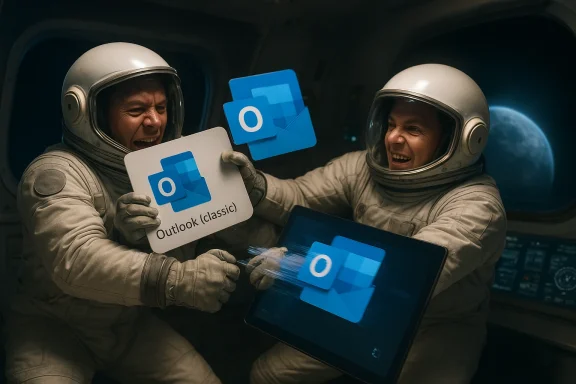
Microsoft’s long-running reputation for flaky software has now been beamed into one of the most dramatic workplaces on Earth — or rather, just above it. During NASA’s Artemis II mission, commander Reid Wiseman reportedly told mission control that both of his Microsoft Outlook apps were failing, a wonderfully on-brand complaint that instantly turned a routine orbital test into a viral moment. The timing is almost too perfect: Artemis II is the first crewed flight of NASA’s Artemis program, and Microsoft Outlook managed to become part of the story before the crew had even reached the Moon. It is equal parts absurd, funny, and revealing about how deeply office software now follows us into every environment imaginable.
Artemis II is not just another launch. It is NASA’s first crewed mission in the Artemis program, a 10-day test flight designed to send four astronauts around the Moon and back, without landing, while validating the systems that will support future lunar surface missions. NASA says the flight is intended to confirm life support, spacecraft performance, and mission operations ahead of a broader return to the Moon and, eventually, crewed Mars exploration.
That makes any software hiccup on the mission notable, even if the issue itself is mundane. Wiseman’s Outlook complaint is memorable precisely because it occurred in a context that is anything but mundane: a historic test flight, a Surface Pro tablet aboard Orion, and a crew already contending with the normal complexity of human spaceflight. In that sense, the joke practically wrote itself.
The episode also lands in the middle of Microsoft’s long transition from classic Outlook to the new Outlook for Windows, a shift that has generated plenty of user frustration on the ground. Microsoft’s own support pages now describe the migration path, feature comparisons, and phased rollout, including automatic switching for some users. That backdrop matters, because it turns a one-line astronaut complaint into a broader story about software maturity, product strategy, and trust.
For NASA, the incident is probably a footnote. For Microsoft, it is a reminder that branding, reliability, and user goodwill can be undermined by the smallest visible failure, especially when it happens somewhere as symbolically loaded as deep space. In the age of livestreamed missions, software doesn’t just have to work; it has to survive scrutiny from millions of viewers and a very unimpressed internet.
The complaint appears to have been surfaced during the mission’s early orbital phase, while Artemis II was still conducting post-launch operations and Earth-orbit tests. NASA’s own mission coverage shows the crew was busy with a high Earth orbit profile and subsequent burns to prepare Orion for the lunar flyby. In other words, this was not the moment for a desktop-grade email app to choose chaos.
It is also a reminder that mission hardware is a layered stack of specialized systems and familiar commercial tools. Even in Orion, the user experience can still involve mail clients, tablets, and remote support. That blend of frontier engineering and everyday software is exactly where modern reliability expectations become very unforgiving.
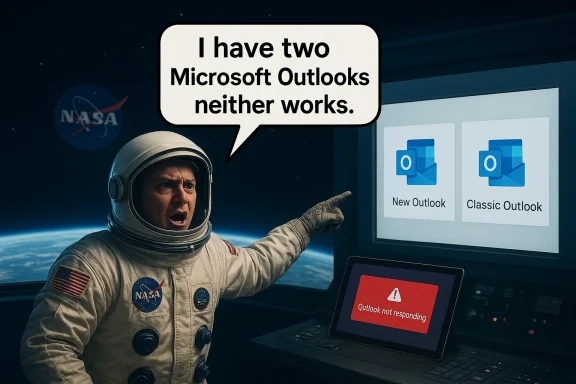
It also helps that the wording sounded like a line from a sitcom. “I have two Microsoft Outlooks” is not a sentence anyone expects to hear from a lunar mission commander, and that surprise gave the clip its velocity. If this had happened in an office break room, it would have been forgettable. In orbit, it became irresistible.
NASA’s coverage shows the launch occurred on April 1, 2026, with the mission then proceeding through orbital burns and proximity-operations preparations. The agency has also said that daily mission briefings and public livestreams are part of the experience, making every wrinkle visible to the public in real time. That transparency is a strength, but it also means every software annoyance becomes public theater.
That context is why the Outlook incident is amusing but also instructive. Space programs are often presented as triumphant abstractions, but the daily reality is still file transfers, device connectivity, and app troubleshooting. The more ambitious the mission, the more glaring the ordinary failure becomes.
It also means NASA can no longer rely on the mystique of space to cover up everyday friction. A broken toilet, a software hiccup, or a connectivity problem now becomes part of a real-time narrative. For public engagement, that is a feature. For software companies, it is a warning.
The phrase “two Microsoft Outlooks” is funny because it captures exactly that ambiguity. Users are not always sure which Outlook they have, which one is current, which one is being phased out, or which one is supposed to work better. A product ecosystem that confuses people on Earth is not likely to become easier to explain in space.
This matters because reliability is not just a feature; it is a promise. Email is infrastructure, not entertainment, and when a product family becomes associated with migration fatigue, users internalize the idea that even basic tasks might be unstable. The astronaut anecdote simply made that discomfort visible.
That confusion may seem trivial, but triviality is often what makes consumer frustration sticky. People remember the app that forces them to ask, “Wait, which Outlook is this?” They also remember when the answer still does not solve the problem. That kind of irritation accumulates, and in this case it orbited the Moon.
This is not necessarily a bad thing. Commercial hardware is often robust, widely supported, and familiar to operators. But it also means that when something goes wrong, astronauts may encounter the same categories of software failure that office workers and IT departments wrestle with every day. The altitude changes; the bugs do not.
That is why the Outlook incident feels larger than the joke suggests. It highlights how much spaceflight now depends on the same corporate software decisions that shape the rest of the enterprise world. When Microsoft tweaks an app, the ripple effects can reach places the product team probably never imagined.
It also reinforces an important point about modern infrastructure: the line between “consumer app” and “mission support tool” has blurred. Everything is now potentially mission adjacent, and that means product quality is no longer a parochial concern. It is a cross-domain one.
So when a NASA commander complains about two Outlooks not working, people hear more than a bug report. They hear confirmation of a broader narrative about Microsoft software: that it is indispensable, widely deployed, and occasionally exasperating in ways that feel strangely personal. The joke works because it confirms a belief people already carried.
That ubiquity also means Microsoft is judged differently from smaller competitors. Users expect the company to be boring in the best possible way: dependable, predictable, and mostly invisible. When it is instead visible for the wrong reasons, as it was here, the reaction is disproportionately harsh. That is the price of being the default.
The meme factor should not obscure the underlying truth, though. People laugh because Outlook frustration is common, not because it is exotic. The space angle simply made a daily annoyance feel cosmic.
For enterprise users, the implications are more serious. Outlook is a core business application, and Microsoft’s migration messaging suggests many organizations are already navigating the balance between continuity and change. If even a high-profile mission crew can run into Outlook confusion, IT departments may be even more wary of forced transitions and version drift.
The effect is especially strong when the criticism comes from someone with authority, even if delivered casually. An astronaut complaining about Outlook has a cultural weight a random tweet does not. It says, in effect, that Microsoft’s software frustrations are universal enough to survive launch.
The broader lesson is that software vendors should never underestimate the reputational cost of transition fatigue. If users think an app might change underneath them at any moment, they may start treating it as unreliable even before a real outage occurs. That is a hard trust problem to repair.
NASA will continue to post mission updates as Artemis II moves toward its lunar flyby, and that means more opportunities for small technical details to become public talking points. Meanwhile, Microsoft will keep pushing users toward the new Outlook experience, which makes user sentiment and migration stability especially important over the next several months. In both cases, perception will matter almost as much as engineering.
Source: Windows Central Microsoft's buggy apps just reached deep space
 Overview
Artemis II is not just another launch. It is NASA’s first crewed mission in the Artemis program, a 10-day test flight designed to send four astronauts around the Moon and back, without landing, while validating the systems that will support future lunar surface missions. NASA says the flight is intended to confirm life support, spacecraft performance, and mission operations ahead of a broader return to the Moon and, eventually, crewed Mars exploration.That makes any software hiccup on the mission notable, even if the issue itself is mundane. Wiseman’s Outlook complaint is memorable precisely because it occurred in a context that is anything but mundane: a historic test flight, a Surface Pro tablet aboard Orion, and a crew already contending with the normal complexity of human spaceflight. In that sense, the joke practically wrote itself.
The episode also lands in the middle of Microsoft’s long transition from classic Outlook to the new Outlook for Windows, a shift that has generated plenty of user frustration on the ground. Microsoft’s own support pages now describe the migration path, feature comparisons, and phased rollout, including automatic switching for some users. That backdrop matters, because it turns a one-line astronaut complaint into a broader story about software maturity, product strategy, and trust.
For NASA, the incident is probably a footnote. For Microsoft, it is a reminder that branding, reliability, and user goodwill can be undermined by the smallest visible failure, especially when it happens somewhere as symbolically loaded as deep space. In the age of livestreamed missions, software doesn’t just have to work; it has to survive scrutiny from millions of viewers and a very unimpressed internet.
What Actually Happened
According to reporting from Engadget and Windows Central, Wiseman told mission control that he had “two Microsoft Outlooks” and neither one was working. That line immediately resonated because it compresses the entire Outlook user experience into one sentence: confusion, duplication, and failure to launch. The tablet involved was identified as a Microsoft Surface Pro, which makes the sight even more fitting for Windows watchers.The complaint appears to have been surfaced during the mission’s early orbital phase, while Artemis II was still conducting post-launch operations and Earth-orbit tests. NASA’s own mission coverage shows the crew was busy with a high Earth orbit profile and subsequent burns to prepare Orion for the lunar flyby. In other words, this was not the moment for a desktop-grade email app to choose chaos.
The astronaut angle
The line became funny because Wiseman was not speaking as a tech columnist, but as a mission commander in the middle of a lunar test flight. That contrast turns an ordinary IT support gripe into a tiny piece of space history. It is the kind of moment that reminds us astronauts are still dependent on the same software plumbing as everyone else.It is also a reminder that mission hardware is a layered stack of specialized systems and familiar commercial tools. Even in Orion, the user experience can still involve mail clients, tablets, and remote support. That blend of frontier engineering and everyday software is exactly where modern reliability expectations become very unforgiving.
Why the joke landed
The internet immediately understood the joke because Outlook has long been associated with reliability complaints, confusing product naming, and inconsistent experiences across versions. Microsoft’s current support documentation even distinguishes between new Outlook and classic Outlook, underscoring how fragmented the product story has become. For everyday users, that is annoying; for astronauts, it is meme fuel.It also helps that the wording sounded like a line from a sitcom. “I have two Microsoft Outlooks” is not a sentence anyone expects to hear from a lunar mission commander, and that surprise gave the clip its velocity. If this had happened in an office break room, it would have been forgettable. In orbit, it became irresistible.
- The issue was notable because it happened during a historic lunar test flight.
- The device involved was a Microsoft Surface Pro.
- The complaint involved both Outlook versions reportedly failing.
- The moment was amplified by the mission’s livestreamed, public nature.
- The internet response was immediate because the line was unexpectedly relatable.
Artemis II and the Stakes for NASA
Artemis II is designed as a stress test for the spacecraft, the mission profile, and the operations chain that will support future lunar missions. NASA says the mission will take four astronauts around the Moon and back to Earth over roughly 10 days, using Orion and the Space Launch System in a crewed lunar flyby. That makes the mission both symbolic and technical: it is a demonstration that the system can safely carry humans into deep space.NASA’s coverage shows the launch occurred on April 1, 2026, with the mission then proceeding through orbital burns and proximity-operations preparations. The agency has also said that daily mission briefings and public livestreams are part of the experience, making every wrinkle visible to the public in real time. That transparency is a strength, but it also means every software annoyance becomes public theater.
A test flight with real-world pressure
Artemis II is not just a parade lap. It is intended to validate life support and other systems that will matter for future missions, which means the crew is constantly balancing operational testing against the reality of being human beings in a cramped spacecraft. Even small software problems take on added meaning when they sit inside a mission architecture this important.That context is why the Outlook incident is amusing but also instructive. Space programs are often presented as triumphant abstractions, but the daily reality is still file transfers, device connectivity, and app troubleshooting. The more ambitious the mission, the more glaring the ordinary failure becomes.
Public mission coverage changes the tone
NASA’s decision to livestream and regularly brief the public means the mission is not only an engineering event but also a communications event. The crew’s jokes, corrections, and support requests are part of the public record in a way that previous Apollo-era missions could never match. That creates a modern kind of space drama: human, immediate, and slightly ridiculous.It also means NASA can no longer rely on the mystique of space to cover up everyday friction. A broken toilet, a software hiccup, or a connectivity problem now becomes part of a real-time narrative. For public engagement, that is a feature. For software companies, it is a warning.
Outlook’s Reputation Problem
Microsoft Outlook’s reputation has been under strain for years, and the company’s own product transition has not helped. Microsoft is actively steering users from classic Outlook to new Outlook for Windows, with support pages describing version differences, feature gaps, and automatic migration timing for some business users. That is normal product evolution on paper, but in practice it has created a sense that Outlook is perpetually in transition.The phrase “two Microsoft Outlooks” is funny because it captures exactly that ambiguity. Users are not always sure which Outlook they have, which one is current, which one is being phased out, or which one is supposed to work better. A product ecosystem that confuses people on Earth is not likely to become easier to explain in space.
New Outlook vs. classic Outlook
Microsoft’s support documentation makes clear that the company is managing a phased shift, not a clean break. Some users will be switched automatically, while others retain access to classic Outlook depending on account type and subscription or enterprise status. That helps explain why Wiseman’s complaint sounded plural rather than singular. There are, in effect, multiple Outlooks to fail.This matters because reliability is not just a feature; it is a promise. Email is infrastructure, not entertainment, and when a product family becomes associated with migration fatigue, users internalize the idea that even basic tasks might be unstable. The astronaut anecdote simply made that discomfort visible.
Why the branding problem matters
Microsoft has long had a naming problem with productivity software, and the Outlook split is a perfect example. When users cannot immediately tell which app they are using, troubleshooting becomes harder, support becomes muddier, and trust declines. The space joke hit because it mirrors what many office workers already feel: Outlook is less a single app than a moving target.That confusion may seem trivial, but triviality is often what makes consumer frustration sticky. People remember the app that forces them to ask, “Wait, which Outlook is this?” They also remember when the answer still does not solve the problem. That kind of irritation accumulates, and in this case it orbited the Moon.
- Microsoft is managing a phased Outlook transition.
- Support pages distinguish between new and classic Outlook.
- Some users are automatically moved to the new client.
- The multiplicity of versions creates support ambiguity.
- Public failure in a high-profile setting magnifies existing user distrust.
The Technology Stack in Space
One of the most fascinating parts of the story is that the commander's device was reportedly a Surface Pro. That detail makes the whole episode feel almost comically terrestrial, as if the same laptop-tablet hybrid someone would use in a coffee shop has simply been promoted to lunar support duty. It is a reminder that modern spacecraft operations are increasingly intertwined with consumer-class hardware and software ecosystems.This is not necessarily a bad thing. Commercial hardware is often robust, widely supported, and familiar to operators. But it also means that when something goes wrong, astronauts may encounter the same categories of software failure that office workers and IT departments wrestle with every day. The altitude changes; the bugs do not.
A familiar interface in an unfamiliar environment
There is something deeply modern about trusting a tablet for mission operations. Familiar interfaces reduce training burden and can improve efficiency, especially in high-pressure environments. Yet familiarity can be a trap when software vendors change behavior, introduce cloud dependencies, or split product lines in confusing ways.That is why the Outlook incident feels larger than the joke suggests. It highlights how much spaceflight now depends on the same corporate software decisions that shape the rest of the enterprise world. When Microsoft tweaks an app, the ripple effects can reach places the product team probably never imagined.
When consumer software meets mission critical work
For NASA, the likely response is pragmatic: identify the issue, isolate it, resolve it, move on. But the symbolism is unavoidable. If a productivity app can fail at the far edge of human ambition, then no environment is immune to software sprawl. That is both reassuring and unnerving.It also reinforces an important point about modern infrastructure: the line between “consumer app” and “mission support tool” has blurred. Everything is now potentially mission adjacent, and that means product quality is no longer a parochial concern. It is a cross-domain one.
- Commercial tablets are now part of deep-space workflows.
- Familiar software lowers training overhead.
- Cloud-era app complexity can create new failure modes.
- Consumer software decisions can have outsized operational consequences.
- Mission environments do not exempt bad UX from embarrassment.
Why This Became a Microsoft Story
The reason this story exploded is not simply that Outlook failed. It is that Microsoft has spent years trying to convince users that the future of its productivity stack is cleaner, simpler, and more modern, while many users continue to experience the opposite. The “new Outlook” rollout, feature comparisons, and migration guidance all signal progress, but they also underline how unfinished the transition feels.So when a NASA commander complains about two Outlooks not working, people hear more than a bug report. They hear confirmation of a broader narrative about Microsoft software: that it is indispensable, widely deployed, and occasionally exasperating in ways that feel strangely personal. The joke works because it confirms a belief people already carried.
Brand trust and the cost of being ubiquitous
Microsoft’s greatest strength is also its greatest vulnerability. Because its software is everywhere, any flaw is instantly relatable, and any public embarrassment becomes a brand event. An obscure bug in a niche app would have barely registered; Outlook failing in space becomes proof that even the heavens cannot escape enterprise software drama.That ubiquity also means Microsoft is judged differently from smaller competitors. Users expect the company to be boring in the best possible way: dependable, predictable, and mostly invisible. When it is instead visible for the wrong reasons, as it was here, the reaction is disproportionately harsh. That is the price of being the default.
The meme factor
This story also benefited from perfect meme architecture. It has astronauts, a Moon mission, a familiar app, a quote with comic timing, and a socially recognizable frustration. Add in the absurdity of “I have two Microsoft Outlooks,” and you have a line that can travel farther than many formal press releases.The meme factor should not obscure the underlying truth, though. People laugh because Outlook frustration is common, not because it is exotic. The space angle simply made a daily annoyance feel cosmic.
Consumer and Enterprise Impact
For consumers, the incident is mostly a laugh line. It reinforces a familiar suspicion that Microsoft’s email stack is overcomplicated, too eager to reinvent itself, and occasionally fragile when users need it most. That perception can subtly influence product loyalty, especially for users who already juggle multiple email accounts and operating system quirks.For enterprise users, the implications are more serious. Outlook is a core business application, and Microsoft’s migration messaging suggests many organizations are already navigating the balance between continuity and change. If even a high-profile mission crew can run into Outlook confusion, IT departments may be even more wary of forced transitions and version drift.
Consumer perception
Consumers generally do not separate email client quality from vendor reputation. They experience the app as part of a bigger ecosystem, and one visible failure colors the whole brand. That is why jokes travel so well: they encode a real sentiment in a compact form.The effect is especially strong when the criticism comes from someone with authority, even if delivered casually. An astronaut complaining about Outlook has a cultural weight a random tweet does not. It says, in effect, that Microsoft’s software frustrations are universal enough to survive launch.
Enterprise concerns
Enterprises care less about jokes and more about operational risk. A product family in transition can create support complexity, training issues, and unexpected workflow changes, especially when users are moved automatically or are unsure which version they are on. Microsoft’s own guidance shows it is trying to manage that transition carefully, but complexity remains complexity.The broader lesson is that software vendors should never underestimate the reputational cost of transition fatigue. If users think an app might change underneath them at any moment, they may start treating it as unreliable even before a real outage occurs. That is a hard trust problem to repair.
- Consumers see brand reliability as a single experience, not a matrix of product versions.
- Enterprises see migration complexity as a cost center.
- Automatic switching increases support questions.
- Public failures strengthen the perception of fragility.
- High-profile users can amplify ordinary friction into reputational damage.
Strengths and Opportunities
There is a positive side to the story, even if it is wrapped in sarcasm. The fact that astronauts can complain about Outlook in real time during a lunar mission shows how connected and transparent modern spaceflight has become. It also gives Microsoft an unusual public reminder that its software is still central to daily life, which is a kind of proof of relevance few companies would refuse. This is a moment that can be used to improve messaging, sharpen reliability, and listen more carefully to user pain.- Microsoft gets an unusually visible reminder about real-world reliability.
- NASA’s mission tooling demonstrates how far commercial software has penetrated advanced operations.
- The public conversation keeps Outlook top-of-mind in a crowded productivity market.
- The joke reinforces Microsoft’s importance, even in criticism.
- Better clarity between Outlook versions could reduce confusion.
- The incident may spur stronger attention to user experience and support simplicity.
- High-profile visibility can accelerate product accountability.
Risks and Concerns
The downside is that the joke lands because it confirms a broader narrative about Microsoft software being complicated, inconsistent, or change-heavy. If users already distrust the Outlook transition, a public failure — even if minor — reinforces that skepticism. The risk is not just embarrassment; it is the quiet erosion of confidence that makes future migrations and feature rollouts harder to sell.- Trust erosion when a familiar app fails in a highly visible setting.
- Increased skepticism about the new Outlook migration strategy.
- Greater support burden for organizations managing mixed Outlook environments.
- Brand damage from the perception of inconsistency and confusion.
- A stronger meme cycle that overshadows legitimate product improvements.
- Potential reluctance from enterprise administrators to accelerate adoption.
- The danger of underestimating how much users dislike version ambiguity.
What to Watch Next
The most interesting question now is not whether the joke will live on — it will — but whether Microsoft and NASA treat the moment as more than a one-line embarrassment. If the Outlook issue was resolved quietly, the public may never know, but the symbolic damage is already done. The real story is whether this becomes a one-off anecdote or part of a wider pattern of product complaints during a major platform transition.NASA will continue to post mission updates as Artemis II moves toward its lunar flyby, and that means more opportunities for small technical details to become public talking points. Meanwhile, Microsoft will keep pushing users toward the new Outlook experience, which makes user sentiment and migration stability especially important over the next several months. In both cases, perception will matter almost as much as engineering.
- Whether NASA or the crew later clarifies the root cause of the Outlook failure.
- How smoothly Artemis II continues through the lunar flyby phase.
- Whether Microsoft’s Outlook transition avoids more high-profile embarrassment.
- Whether enterprise users report growing friction with the new Outlook rollout.
- Whether the meme outlives the news cycle and becomes part of Outlook folklore.
- Whether Microsoft improves version clarity and support messaging.
- Whether this incident becomes a cautionary tale for software on mission-critical systems.
Source: Windows Central Microsoft's buggy apps just reached deep space