

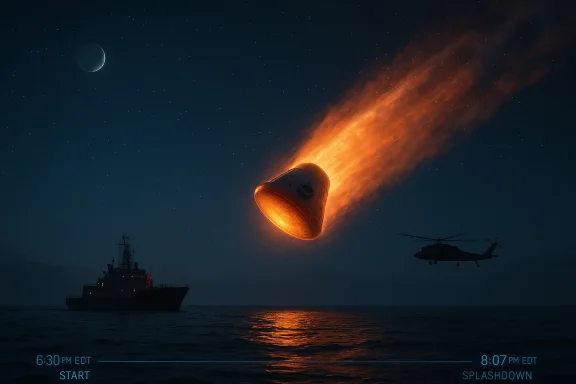
NASA’s Artemis II crew is closing in on splashdown after a historic lunar flyby, and the agency has lined up a full live broadcast for the return on Friday, April 10, 2026. The mission, which launched on April 1, has already delivered a string of firsts: four astronauts farther from Earth than any humans before them, a trip around the Moon’s far side, and a high-profile reminder that deep-space missions are still very much an exercise in precision engineering. NASA says Orion is scheduled to hit the Pacific off San Diego at about 8:07 p.m. EDT, with live coverage beginning at 6:30 p.m. EDT.
Artemis II is the first crewed mission in NASA’s Artemis program, and its significance goes well beyond a simple “test flight.” The mission is designed to prove that Orion, its recovery systems, and the broader ground-and-safety chain can safely carry astronauts to lunar distance and back. NASA has treated the flight as a system validation exercise for the next phase of lunar exploration, where reliability matters just as much as spectacle.
The crew — Reid Wiseman, Victor Glover, Christina Koch, and Jeremy Hansen — launched on April 1, 2026, and NASA’s daily mission updates quickly showed why this flight matters. The astronauts completed the Earth-orbit checkout phase, then swung out toward the Moon for a flyby that took them to the lunar sphere of influence and into a return trajectory. NASA reported that the crew exceeded Apollo 13’s human-distance record during the flight, underscoring the historical weight of the mission.
The return leg is not just a ceremonial ending. Reentry is where many of the hardest engineering questions get answered, from thermal protection to guidance stability to parachute sequencing. NASA’s timeline shows Orion separating its crew and service modules, entering the atmosphere at tremendous speed, deploying drogue parachutes, then main parachutes, and finally splashing down in the Pacific while recovery teams close in.
The public-facing side of Artemis II has also become a small media event in its own right. NASA has pushed the mission across NASA+, the agency’s app, major streaming platforms, and YouTube, reflecting a modern reality: spaceflight is as much a live digital experience as it is a technical milestone. That broad distribution matters because the Artemis program depends on sustaining public attention for a long campaign, not a one-off launch.
There’s a human story wrapped around the engineering story as well. NASA’s day-by-day posts captured the astronauts’ work, routine, and even their frustrations, including a toilet-system issue and a now-famous complaint about Microsoft Outlook inside Orion. Those details may seem comic, but they reinforce the central truth of crewed exploration: even historic missions still run on mundane, fragile systems that have to work under exceptional pressure. That is precisely what makes Artemis II valuable.
The mission also proved that the public can follow a deep-space crewed flight through multiple channels in near real time. NASA’s coverage has included continuous YouTube streams and broader availability through NASA+ and other platforms, which turns a mission formerly reserved for specialists into a broader civic event. That matters for Artemis because public legitimacy is part of the program’s endurance.
That distance also helps reframe the Artemis program in the public imagination. Apollo was about getting there first; Artemis is about building a repeatable pathway to the Moon. If the hardware can safely carry humans to a farther point than any previous crewed mission, then the conversation shifts from whether lunar return is possible to whether it can become routine.
The anecdotal details also have public-relations value. When astronauts joke about Outlook or note system quirks, it makes the mission less abstract and more relatable. That relatability is not trivial in a program that will require years of sustained political and budgetary support.
The stream will be available through NASA’s YouTube channel, and NASA has also promoted live coverage through NASA+, Amazon Prime, Apple TV, Netflix, HBO Max, Discovery+, Peacock, and Roku. That kind of distribution is unusual for a space mission and reflects the agency’s effort to meet viewers where they already are. It also acknowledges that attention is fragmented, and NASA has to compete for it like any other live event.
For viewers, the main thing is timing. NASA’s official schedule anchors the event to April 10, 2026, and the return coverage window begins well before splashdown. If you want the dramatic finish, you need to be tuned in ahead of time; reentry sequences move quickly once they start.
It also means the splashdown functions as a test of NASA’s media infrastructure. If the agency can deliver a seamless, multi-platform, global event for Artemis II, it strengthens the case for similar coverage of later Artemis milestones. In that sense, the broadcast is part of the mission architecture too.
The most consequential part of the mission may be the reentry phase. A human-rated capsule returning from lunar distance must survive heating, plasma blackout, and precisely managed descent through parachute deployment. This is where theoretical design becomes operational fact, and it is where NASA will learn whether Orion’s assumptions match reality.
NASA’s published timeline suggests a disciplined sequence: final burn, atmospheric entry, drogue parachutes, main parachutes, splashdown, and recovery. Each of those steps is both an engineering check and a public demonstration that the Artemis stack is maturing. If it all goes smoothly, NASA can argue that it has moved closer to a repeatable lunar transportation system.
The mission also illustrates the importance of redundancy in modern operations. Broad streaming access, multiple mission control updates, and layered recovery support all reduce the chance that a single failure becomes a public embarrassment. In a program as visible as Artemis, operational resilience is also reputational resilience.
Apollo 13 still looms over this conversation because it represents both human endurance and a benchmark distance that stood for more than five decades. Artemis II’s surpassing that record does not erase Apollo’s legacy; rather, it folds that legacy into a new era where lunar distance is no longer the ultimate frontier, but a proving ground. That is a profound symbolic shift.
The communications environment has changed just as much. In the Apollo era, most people saw the Moon missions through television broadcasts and next-day news cycles. Artemis II is unfolding in a world of live updates, social media, mobile alerts, and multi-platform streaming, where NASA must shape the story continuously rather than once a day.
That capital matters because Artemis will require sustained support over many years. A clean splashdown can do more for the program’s momentum than a dozen slide decks, because it turns promises into visible performance.
NASA, meanwhile, has leaned into a polished and highly controlled communications style. The agency’s official posts emphasize milestones, visuals, and structured timelines, while also inviting audiences to follow along live. That balance is important because spaceflight audiences now range from hardcore enthusiasts to casual viewers who may only tune in for splashdown day.
It also creates pressure for precision. Live broadcasts expose delays, uncertainties, and anomalies in real time, which means NASA must manage both the mission and the narrative. In that sense, the agency is not only landing a spacecraft; it is landing a message.
The same is true of the mission’s mundane challenges. A toilet issue inside Orion is not glamorous, but it is exactly the sort of thing that must be solved before humans can live and work farther from Earth for longer periods. The public may laugh, but engineers take note.
The mission also helps clarify what Artemis is really about. It is not just a flag-and-footprints program, and it is not simply a re-enactment of Apollo. It is a long-duration systems program built around operational learning, international cooperation, and a pathway toward sustained lunar activity. That broader ambition is what makes the mission strategically important.
In the medium term, a successful mission helps normalize the cadence of Artemis. Each good outcome makes the next one easier to defend, both technically and politically. This is how programs like Artemis mature: not through one dramatic leap, but through repeated proof points.
That transition is essential because the Moon is not the destination in NASA’s broader narrative. It is the proving ground for deeper human spaceflight ambitions, and Artemis II is one of the moments that makes that narrative credible.
There is also a broader institutional test coming. NASA must turn Artemis II into evidence that the program is maturing, that its timelines are believable, and that the Moon is once again within reach as a sustained destination. That credibility will matter more than any single splashdown image.
Source: theregister.com Here's how to watch the Artemis II splashdown
 Background
Artemis II is the first crewed mission in NASA’s Artemis program, and its significance goes well beyond a simple “test flight.” The mission is designed to prove that Orion, its recovery systems, and the broader ground-and-safety chain can safely carry astronauts to lunar distance and back. NASA has treated the flight as a system validation exercise for the next phase of lunar exploration, where reliability matters just as much as spectacle.The crew — Reid Wiseman, Victor Glover, Christina Koch, and Jeremy Hansen — launched on April 1, 2026, and NASA’s daily mission updates quickly showed why this flight matters. The astronauts completed the Earth-orbit checkout phase, then swung out toward the Moon for a flyby that took them to the lunar sphere of influence and into a return trajectory. NASA reported that the crew exceeded Apollo 13’s human-distance record during the flight, underscoring the historical weight of the mission.
The return leg is not just a ceremonial ending. Reentry is where many of the hardest engineering questions get answered, from thermal protection to guidance stability to parachute sequencing. NASA’s timeline shows Orion separating its crew and service modules, entering the atmosphere at tremendous speed, deploying drogue parachutes, then main parachutes, and finally splashing down in the Pacific while recovery teams close in.
The public-facing side of Artemis II has also become a small media event in its own right. NASA has pushed the mission across NASA+, the agency’s app, major streaming platforms, and YouTube, reflecting a modern reality: spaceflight is as much a live digital experience as it is a technical milestone. That broad distribution matters because the Artemis program depends on sustaining public attention for a long campaign, not a one-off launch.
There’s a human story wrapped around the engineering story as well. NASA’s day-by-day posts captured the astronauts’ work, routine, and even their frustrations, including a toilet-system issue and a now-famous complaint about Microsoft Outlook inside Orion. Those details may seem comic, but they reinforce the central truth of crewed exploration: even historic missions still run on mundane, fragile systems that have to work under exceptional pressure. That is precisely what makes Artemis II valuable.
What Artemis II Has Already Proved
Artemis II has demonstrated that NASA can operate a crewed spacecraft far beyond low Earth orbit with a modern communications and support architecture. The spacecraft and crew spent days in deep-space conditions, performed a lunar flyby, and maintained mission continuity through the long return arc. NASA’s updates indicate the mission has already crossed several major operational thresholds before splashdown.The mission also proved that the public can follow a deep-space crewed flight through multiple channels in near real time. NASA’s coverage has included continuous YouTube streams and broader availability through NASA+ and other platforms, which turns a mission formerly reserved for specialists into a broader civic event. That matters for Artemis because public legitimacy is part of the program’s endurance.
Why the distance record matters
NASA confirmed that Artemis II astronauts reached 248,655 miles from Earth, surpassing the Apollo 13 record. On one level, this is a neat historical marker; on another, it is a signal that Orion and its mission architecture can sustain humans at lunar distance under operational conditions. The record is less important than the confidence it builds for future missions, but it is still a powerful proof point.That distance also helps reframe the Artemis program in the public imagination. Apollo was about getting there first; Artemis is about building a repeatable pathway to the Moon. If the hardware can safely carry humans to a farther point than any previous crewed mission, then the conversation shifts from whether lunar return is possible to whether it can become routine.
- The mission has validated long-duration deep-space crew operations.
- It has extended the human distance record beyond Apollo 13.
- It has given NASA a high-visibility systems test before later Artemis missions.
- It has helped normalize Artemis as a sustained program rather than a single flagship flight.
The human factor inside Orion
NASA’s reports from the flight have included crew observations, a conversation with mission teams, and the kind of small operational headaches that define real spaceflight. These are not distractions; they are evidence that the mission is functioning as an integrated human-machine environment. A spacecraft is only as good as its crew interfaces, procedures, and contingency planning.The anecdotal details also have public-relations value. When astronauts joke about Outlook or note system quirks, it makes the mission less abstract and more relatable. That relatability is not trivial in a program that will require years of sustained political and budgetary support.
How to Watch the Splashdown
NASA has set the official live return coverage to begin at 6:30 p.m. EDT, with splashdown targeted for around 8:07 p.m. EDT off the coast of San Diego. The agency says coverage will continue until recovery teams safely assist the crew out of Orion and transfer them to the USS John P. Murtha. That makes the event more than a quick touchdown; it is a full recovery operation with public-facing milestones.The stream will be available through NASA’s YouTube channel, and NASA has also promoted live coverage through NASA+, Amazon Prime, Apple TV, Netflix, HBO Max, Discovery+, Peacock, and Roku. That kind of distribution is unusual for a space mission and reflects the agency’s effort to meet viewers where they already are. It also acknowledges that attention is fragmented, and NASA has to compete for it like any other live event.
What the timeline looks like
NASA’s posted timeline gives a sense of the return sequence. Orion is expected to reenter the atmosphere, undergo blackout during the most intense heating, then deploy parachutes before splashdown. In practical terms, that means viewers will be watching a carefully staged set of milestones rather than a single dramatic moment.For viewers, the main thing is timing. NASA’s official schedule anchors the event to April 10, 2026, and the return coverage window begins well before splashdown. If you want the dramatic finish, you need to be tuned in ahead of time; reentry sequences move quickly once they start.
- Coverage begins at 6:30 p.m. EDT.
- Splashdown is targeted for about 8:07 p.m. EDT.
- Recovery operations continue after splashdown.
- The crew’s exit from Orion is part of the broadcasted sequence.
Why multiple platforms matter
NASA’s choice to distribute the event broadly is strategic. Reaching audiences through streaming services and YouTube lowers the friction for casual viewers, while still preserving the agency’s own direct broadcast. That blend of channels is increasingly necessary for government communications, especially for high-interest moments that must compete with news, sports, and entertainment.It also means the splashdown functions as a test of NASA’s media infrastructure. If the agency can deliver a seamless, multi-platform, global event for Artemis II, it strengthens the case for similar coverage of later Artemis milestones. In that sense, the broadcast is part of the mission architecture too.
The Mission’s Technical Stakes
Artemis II is, at its core, a spacecraft systems test under real deep-space conditions. The mission has stressed Orion’s navigation, communications, crew accommodations, and power management while exposing the spacecraft to the harsh environment of lunar transit and return. NASA’s flight-day updates have repeatedly shown the emphasis on validation over drama.The most consequential part of the mission may be the reentry phase. A human-rated capsule returning from lunar distance must survive heating, plasma blackout, and precisely managed descent through parachute deployment. This is where theoretical design becomes operational fact, and it is where NASA will learn whether Orion’s assumptions match reality.
Reentry is the real exam
Reentry compresses risk into a very short period. There is little room for improvisation once Orion hits the atmosphere, and every stage depends on the one before it. If the thermal protection system, attitude control, or deployment sequencing hiccups, the consequences can cascade rapidly. That is why splashdown telemetry and recovery readiness matter so much.NASA’s published timeline suggests a disciplined sequence: final burn, atmospheric entry, drogue parachutes, main parachutes, splashdown, and recovery. Each of those steps is both an engineering check and a public demonstration that the Artemis stack is maturing. If it all goes smoothly, NASA can argue that it has moved closer to a repeatable lunar transportation system.
Systems beyond the spacecraft
A deep-space mission is never just about the spacecraft itself. Ground controllers, recovery teams, communications relays, and public affairs infrastructure are all part of the system, and Artemis II has highlighted that reality. NASA’s return coverage notes that Department of War personnel will assist with crew recovery, showing how interagency coordination remains central to crewed exploration.The mission also illustrates the importance of redundancy in modern operations. Broad streaming access, multiple mission control updates, and layered recovery support all reduce the chance that a single failure becomes a public embarrassment. In a program as visible as Artemis, operational resilience is also reputational resilience.
- Thermal protection must work cleanly on return.
- Parachutes must deploy in sequence and on schedule.
- Communications must survive the blackout window as expected.
- Recovery teams must reach the capsule quickly and safely.
- Crew transfer protocols must be smooth and uneventful.
The Historical Context Behind Artemis II
Artemis II sits in a lineage that begins with Apollo, but it is not simply Apollo updated for the 21st century. Apollo was a Cold War race with an end condition; Artemis is a longer strategic project tied to sustained lunar presence, international collaboration, and eventual Mars preparation. That difference shapes everything from hardware philosophy to how NASA markets the mission.Apollo 13 still looms over this conversation because it represents both human endurance and a benchmark distance that stood for more than five decades. Artemis II’s surpassing that record does not erase Apollo’s legacy; rather, it folds that legacy into a new era where lunar distance is no longer the ultimate frontier, but a proving ground. That is a profound symbolic shift.
The difference between then and now
Apollo missions were front-loaded with geopolitical urgency and national prestige. Artemis is more distributed in its purpose, with international partners and a broader technology ecosystem tied to the program. Jeremy Hansen’s presence on the crew is a visible sign of that collaboration, reinforcing the idea that lunar exploration is becoming a multinational endeavor.The communications environment has changed just as much. In the Apollo era, most people saw the Moon missions through television broadcasts and next-day news cycles. Artemis II is unfolding in a world of live updates, social media, mobile alerts, and multi-platform streaming, where NASA must shape the story continuously rather than once a day.
Why this mission matters politically
Crewed spaceflight is always partly about hardware and partly about legitimacy. Artemis II gives NASA an opportunity to show Congress, partners, and the public that the return-to-the-Moon program is not aspirational fluff but a functioning enterprise with measurable milestones. When a mission crosses distance records, completes lunar flyby operations, and returns on schedule, it builds political capital for what comes next.That capital matters because Artemis will require sustained support over many years. A clean splashdown can do more for the program’s momentum than a dozen slide decks, because it turns promises into visible performance.
Public Reaction and the Media Moment
The media coverage around Artemis II has had a distinctly 2026 flavor: part technical news, part cultural event, and part unexpected comedy. The Register’s reporting on the mission, including the Outlook and toilet anecdotes, shows how spaceflight stories travel differently when they intersect with recognizable office-life frustrations. That blend helps humanize the mission, even if the humor is incidental to the technical stakes.NASA, meanwhile, has leaned into a polished and highly controlled communications style. The agency’s official posts emphasize milestones, visuals, and structured timelines, while also inviting audiences to follow along live. That balance is important because spaceflight audiences now range from hardcore enthusiasts to casual viewers who may only tune in for splashdown day.
The value of a live audience
A live audience changes the meaning of the event. Instead of being a technical milestone that gets summarized afterward, splashdown becomes a shared public moment with the potential to build excitement around the whole Artemis architecture. That shared attention can help NASA when it asks for patience, funding, and support for the next steps.It also creates pressure for precision. Live broadcasts expose delays, uncertainties, and anomalies in real time, which means NASA must manage both the mission and the narrative. In that sense, the agency is not only landing a spacecraft; it is landing a message.
Why the details resonate
Small details, like the astronauts’ comments about Outlook or the naming of two lunar craters, give the mission texture. The crew’s suggestion of “Integrity” and “Carroll” for unnamed craters created a moment of personal meaning inside a profoundly technical mission. Those human touches matter because they remind viewers that exploration is still driven by people, not just systems.The same is true of the mission’s mundane challenges. A toilet issue inside Orion is not glamorous, but it is exactly the sort of thing that must be solved before humans can live and work farther from Earth for longer periods. The public may laugh, but engineers take note.
- Humor makes the mission more accessible.
- Personal details make the astronauts memorable.
- Routine problems highlight the practical side of exploration.
- Live coverage turns technical work into shared civic theater.
What This Means for the Artemis Program
Artemis II is not the end of the road; it is a checkpoint that tells NASA whether the road is worth continuing at the current pace. If splashdown and recovery proceed cleanly, the agency will have strong evidence that its crewed lunar architecture is functioning as intended. That would strengthen the case for the next missions and the infrastructure they depend on.The mission also helps clarify what Artemis is really about. It is not just a flag-and-footprints program, and it is not simply a re-enactment of Apollo. It is a long-duration systems program built around operational learning, international cooperation, and a pathway toward sustained lunar activity. That broader ambition is what makes the mission strategically important.
Near-term program implications
In the short term, NASA will be focused on post-flight data review, crew recovery, and mission debriefs. The agency will want to understand how Orion behaved, how the crew performed, and where any surprises appeared in the flight profile. Those findings will shape confidence in the next crewed steps.In the medium term, a successful mission helps normalize the cadence of Artemis. Each good outcome makes the next one easier to defend, both technically and politically. This is how programs like Artemis mature: not through one dramatic leap, but through repeated proof points.
Long-term strategic value
The long-term prize is a durable lunar transportation and exploration capability. If Orion and the recovery process prove dependable, NASA can focus more of its attention on surface systems, habitat planning, logistics, and scientific return. That is where the Artemis program transitions from “can we do this?” to “how do we make this sustainable?”That transition is essential because the Moon is not the destination in NASA’s broader narrative. It is the proving ground for deeper human spaceflight ambitions, and Artemis II is one of the moments that makes that narrative credible.
Strengths and Opportunities
Artemis II has shown that NASA can still mount a globally watched, technically demanding crewed flight with a strong public narrative and clear mission objectives. The opportunity now is to convert that success into durable program momentum. The strongest aspect of the mission is that it seems to have done exactly what it was designed to do: validate, reassure, and inspire.- The mission has produced a clear historical milestone by surpassing Apollo 13’s distance record.
- NASA has built a broad media distribution strategy that reaches modern audiences where they are.
- The flight has delivered real operational learning about Orion in deep space.
- The mission’s human moments make it easier to sustain public engagement.
- A successful splashdown would reinforce confidence in the Artemis roadmap.
- The crew’s composition underscores international collaboration and shared ownership.
- The broadcast offers a chance to strengthen NASA’s long-term storytelling around exploration.
Risks and Concerns
The biggest risk in any crewed return mission is that the ending can still spoil the story. Even a program that has performed well for days can be undermined by a problem in reentry, parachute deployment, or recovery. Artemis II has the momentum of success behind it, but the most dangerous part is still ahead until the crew is safely out of Orion.- Reentry remains the highest-stakes technical phase of the mission.
- Any anomaly in thermal protection or parachute sequencing would matter greatly.
- Recovery operations must work smoothly in real time, with no room for improvisation.
- Public expectations are high because NASA has framed the mission as a major success.
- A communications or broadcast problem could confuse viewers, even if the spacecraft performs well.
- The mission’s visibility means that small setbacks may be amplified in public discussion.
- Artemis’s long-term credibility still depends on translating one success into a repeatable pattern.
Looking Ahead
The most important thing to watch after splashdown is not just whether the crew lands safely, but what NASA says it learned from the flight. Detailed post-mission analysis will help determine how much confidence the agency can place in Orion for the missions that follow. The difference between a good mission and a transformational one often lies in what engineers discover once the cameras stop rolling.There is also a broader institutional test coming. NASA must turn Artemis II into evidence that the program is maturing, that its timelines are believable, and that the Moon is once again within reach as a sustained destination. That credibility will matter more than any single splashdown image.
- Post-flight data review and anomaly analysis.
- Crew debriefs on systems, workload, and usability.
- Recovery success and capsule condition after splashdown.
- NASA’s framing of Artemis II as a stepping stone.
- Public reaction to the broadcast and the mission’s storytelling.
Source: theregister.com Here's how to watch the Artemis II splashdown
Last edited:
