Microsoft Names Asha Sharma to Lead Xbox as Spencer Retires and Console Focus Returns

  • Thread Author
Microsoft’s gaming business entered a new chapter on February 20, 2026, when Satya Nadella tapped Asha Sharma, a senior Microsoft AI executive, to lead Xbox and the broader Microsoft Gaming organization—while long‑time leader Phil Spencer announced his retirement and Xbox president Sarah Bond resigned. The move was accompanied by a rapid internal reshuffle that promoted Matt Booty to Executive Vice President and Chief Content Officer and a public pledge from the new leadership to “recommit to console” after years of cross‑platform expansion and high‑profile strategic experiments.

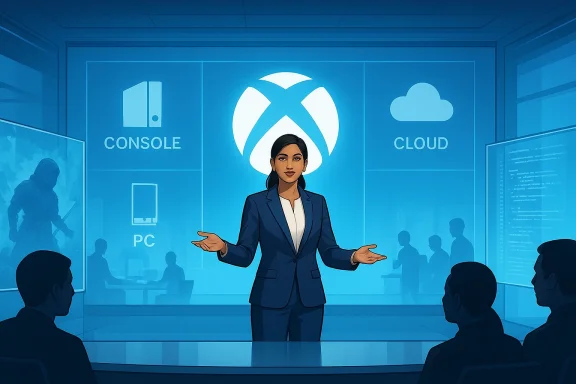
A woman presenter explains the Xbox ecosystem—console, PC, and cloud.Background​

The Phil Spencer era: growth, Game Pass, and consolidation​

Phil Spencer’s tenure as the public face and steward of Xbox stretched back decades, but he rose to formal leadership of Microsoft Gaming during an era of transformational bets: the institutionalization of Xbox Game Pass, aggressive studio acquisitions, and deeper integration with Windows and cloud services. Under Spencer Xbox became synonymous with subscription‑led platform thinking and content aggregation; Microsoft expanded its first‑party stable through major purchases that reshaped the competitive field.
These moves paid off in scale but produced tradeoffs. Game Pass redefined consumer expectations about access and value, yet it increased the need for continuous content investment. Big-ticket acquisitions — most notably the purchase of Activision Blizzard King — enlarged Microsoft’s IP portfolio and studio footprint, but also created integration complexity and heightened investor scrutiny over return on capital.

Asha Sharma: an unusual hire for games​

Asha Sharma is not an insider from gaming’s creative trenches. Before joining Microsoft she held senior consumer product roles at Instacart and Meta, and at Microsoft she led CoreAI—the company’s internal group building foundational AI models, developer tools, and AI agents. Her appointment signals a deliberate choice: Microsoft is recruiting a consumer‑product and platform executive with demonstrated experience scaling complex, multi‑stakeholder services rather than elevating a traditional studio veteran.
In her initial internal message Sharma outlined three headline priorities: great games, the “return” of Xbox with renewed emphasis on console, and a cautious, principled approach to AI in content creation. She explicitly rejected the idea of flooding the ecosystem with what she called “soulless AI slop,” while promising to invest in developers and make Xbox the home for ambitious projects.

Why this happened: the drivers behind the shakeup​

1) Business performance and investor pressure​

Microsoft’s gaming business has been under financial pressure in recent quarters. Revenue trends, margin targets, and the long‑tail economics of subscription services have combined to make gaming a focal point for corporate efficiency and strategic clarity. According to reporting at the time of the leadership change, Microsoft’s broader finance organization has been pushing gaming to improve operating margins and to scale more profitable business models. Those internal and external pressures make leadership that can marry product growth with financial discipline appealing to the C‑suite.
  • The economics of running dozens of studios and sustaining live services are capital‑intensive.
  • Subscription pricing adjustments, console hardware price inflation, and restructuring (including layoffs) have all tightened the financial picture of Xbox’s P&L.

2) Strategic pivot: console as a stabilizing core​

Over the past few years Microsoft deliberately broadened Xbox’s reach beyond living‑room consoles into PC, cloud streaming, and mobile. While strategically defensible—markets fragment and platform breadth can increase reach—those moves alienated sections of the core Xbox fanbase and complicated the brand identity. The new messaging around “recommit to console” reads like a corrective: Microsoft wants to signal to players, developers, and retailers that the traditional console remains central to Xbox’s identity, even as it pursues multiplatform distribution.

3) Cultural recalibration: developer relations and fan trust​

A combination of studio closures, layoffs, canceled projects, and deals to put marquee titles on rival platforms contributed to a trust deficit with both developers and long‑time Xbox fans. Microsoft’s consolidation and repeated strategic pivots created uncertainty about priorities: which franchises were sacred, how middle‑to‑long‑term projects would be funded, and how creators would be treated once IP was pooled. The leadership change allows Microsoft to reset messaging and to make a public recommitment to the communities that have historically centered around Xbox consoles.

4) An AI leader to bridge product, platform, and tooling​

Choosing an AI executive to run a major entertainment division might seem counterintuitive at first glance, but it’s sensible when you view modern gaming as increasingly defined by platform services, live operations, and developer toolchains. Sharma’s CoreAI background suggests Microsoft wants to move faster on tooling for creators, smarter personalization and discovery for players, and internal operational efficiencies across studios—all while signaling caution about indiscriminate generative content. Put plainly: Microsoft needs someone who can run a consumer‑facing platform and integrate AI into workflows without undermining craft.

What the appointment means in practice​

Reorganization and the role of content​

Matt Booty’s promotion to Chief Content Officer is a structural hedge: Microsoft separates platform leadership (Sharma) and content leadership (Booty), centralizing creative oversight across the company’s sprawling studio portfolio. This moves toward a model in which a single executive (Booty) orchestrates content roadmaps and cross‑studio collaboration while reporting to a product/platform CEO focused on distribution, monetization, and developer ecosystems. Expect increased executive control of release calendars, prioritization of cash‑generative live titles, and an emphasis on cross‑play and multi‑cloud deployment strategies.

AI as an enabler, not a replacement​

Sharma’s public remarks attempt to thread a narrow needle: embrace AI for productivity, personalization, and tooling, but avoid devaluing human creative work. Practically, this could unfold as:
  • Investment in AI tools that speed prototyping and QA for internal studios.
  • Player‑facing AI features that improve matchmaking, accessibility, and discovery without replacing narrative authorship.
  • Platform features that let creators and players generate mods or user content under clearly defined guardrails to protect IP and quality.
This posture is defensible, but execution risk is high. The difference between “AI as augmentation” and “AI as content shortcut” will be judged in the first 12–18 months by the visible quality of releases and by developer sentiment.

Console investments, hardware roadmap ambiguity​

The “recommit to console” language is politically valuable, but it leaves important strategic questions unanswered: What will Microsoft’s hardware cadence look like? Will the next Xbox be a bespoke AMD‑co‑designed box as before, or will Microsoft further blur the lines between a console and a Windows‑rooted TV PC? Reports and rumors of tighter integration between Xbox and Windows have swirled in recent years, and Sharma’s product platform experience increases the likelihood of hybrid approaches that prioritize software continuity across device classes. However, until Microsoft outlines capital allocation for hardware R&D or announces an official product timeline, console recommitment remains a strategic posture rather than a concrete roadmap.

Strengths of the move​

  • Platform discipline and product rigor: Sharma’s background in scaling consumer platforms could bring systematic product management, telemetry‑driven decisions, and stronger developer tools to Xbox.
  • Clear signal to stakeholders: Recommitting to console and elevating a seasoned content executive gives a straightforward narrative to investors, retail partners, and developers: Microsoft is focused and reorganized.
  • A balanced AI stance: Public disclaimers about “soulless AI content” show sensitivity to creative norms while preserving the ability to use AI for maker productivity and personalization.
  • Operational consolidation: With Booty in charge of content, Microsoft centralizes creative decisions—reducing duplication, creating clearer green‑lighting processes, and potentially shortening time‑to‑market for cross‑studio initiatives.

Risks and blind spots​

1) Cultural fit and credibility within the creative community​

Sharma’s resume is heavy on platform and consumer scale but light on traditional game development pedigree. The creative leadership, studio heads, and development talent that power first‑party AAA games often place outsized value on empathy for craft and long‑term creative stewardship. If developers perceive decisions as driven by efficiency targets rather than creative vision, the Exodus of talent—already a problem during earlier rounds of layoffs—could accelerate. Microsoft will need to prove that PC/console artisanship matters, not just in words but in multi‑year investment commitments and creative autonomy.

2) Messaging versus mechanics: “recommit to console” may be shallow​

Stating a commitment to console is one thing; funding next‑generation hardware, ensuring SKU economics, and delivering exclusive titles on a predictable cadence are different. Microsoft’s balance sheet and supply‑chain choices will determine whether words become durable shifts. If console receives only marketing dollars and not engineering and IP investment, fans will quickly view the pledge as performative. Keep an eye on CapEx allocations, new hardware hires, and dedicated silicon partnerships for signals this is substantive.

3) The AI dilemma: augmentation, monetization, and IP risk​

Using AI to accelerate development or generate player content creates complex legal and ethical webs: IP provenance, fair compensation for creators, safety and moderation, and quality control. Microsoft must develop robust guardrails, licensing frameworks, and tooling that ensures AI does not become a short‑term cost saver that harms long‑term franchise value. Failure here would both alienate creative talent and expose Microsoft to regulatory or reputational risk.

4) Continuity risk with high‑level departures​

Sarah Bond’s departure removes a public, platform‑savvy executive who had served as an accessible liaison for partners and fans. Coupled with Spencer’s exit, the changes concentrate institutional knowledge risk. Even though Spencer will reportedly provide advisory support during the summer transition, the loss of two senior executives in quick succession creates a fragile moment for continuity.

What to watch next (the 12‑ to 18‑month checklist)​

  • Console and hardware signals
  • Announcements of new console hardware, partnerships (AMD, OEMs), or evidence of dedicated R&D teams and budgets. Physical product investments are the best proof of a real console recommitment.
  • Studio funding and greenlight cadence
  • Are new AAA projects being greenlit? Are existing teams receiving multi‑year funding guarantees? Watch hiring patterns at high‑profile studios and public statements from studio leads.
  • AI tooling for creators
  • The rollout of sanctioned AI tools for edge cases—prototyping, QA automation, accessibility features—will show whether Sharma’s CoreAI experience translates into practical developer support without undermining creative authorship.
  • Game Pass and pricing strategy
  • Any material changes to Game Pass tiers, pricing, or bundling with hardware will reflect how Microsoft balances scale with profitability. Such moves will also show whether Microsoft is prioritizing margin expansion in the short term.
  • Developer and community sentiment
  • Track statements from third‑party partners, indie publishers, and major franchises. A sustained positive shift in developer relations will be required to stabilize Xbox’s content pipeline.

A pragmatic outlook​

Microsoft’s decision to appoint Asha Sharma as the new head of its gaming division reflects a broader trend inside big tech: platform engineering, AI tooling, and subscription economics now sit at the center of entertainment businesses. Microsoft needs leaders who can harmonize deep technical tooling with product management and consumer loyalty strategies. Sharma’s strengths in scaling consumer products and building AI tooling make her a defensible choice to run a modern, service‑oriented gaming organization.
That said, the job requires an unusual combination of competencies: respect for creative craft, an appetite for long‑horizon IP investment, and the ability to engineer platform economics that satisfy both players and shareholders. The early signs are encouraging—clear structural changes, a named content czar in Matt Booty, and explicit promises to honor console roots—but rhetoric must quickly convert into investment, product announcements, and developer goodwill.
If Microsoft can deliver on the three pillars Sharma outlined—great games, a credible return to console, and principled AI integration—Xbox can stabilize and then expand. If the change remains mainly rhetorical, or if AI and margin targets override investment in creative work, Microsoft risks further erosion of the goodwill it has built under Spencer.

Final assessment: cautious optimism, high execution bar​

This leadership change is neither a clean break nor a simple succession. It is an inflection: Microsoft is choosing a leader attuned to platform scale and AI capabilities to guide a content‑heavy business through a demanding financial and cultural landscape. That choice maps well to Microsoft’s broader corporate priorities, but it raises two imperative demands for the company:
  • Fund and protect creative work with durable multi‑year commitments; and
  • Build trustworthy AI and platform tools that demonstrably augment rather than replace human creativity.
How Microsoft answers those demands will determine whether the “return of Xbox” becomes a genuine renaissance for console‑first fans and creators—or a recalibrated corporate strategy that leaves Xbox’s cultural and creative identity stretched between too many competing ambitions. In short: the appointment is bold and defensible, but the path to success is narrow and will be judged in concrete investments, quality of releases, and the health of Microsoft’s developer community over the next 12–24 months.

Source: Bloomberg.com https://www.bloomberg.com/news/arti...exec-sharma-to-run-xbox-recommits-to-console/
 

Phil Spencer’s decision to step away from Microsoft marks the end of a defining chapter for Xbox and the broader gaming business he helped build, and it ushers in an abrupt leadership reset that places an AI executive at the head of a highly creative, performance‑sensitive industry. After nearly 38 years at Microsoft and twelve years leading Xbox and Microsoft Gaming, Spencer is retiring; Satya Nadella has tapped Asha Sharma — the company’s president of CoreAI product — to run Microsoft Gaming, while longtime studio executive Matt Booty moves into a new Executive Vice President and Chief Content Officer role. At the same time, Xbox President Sarah Bond is leaving the company. The changes come at a fraught moment: Microsoft reports roughly 500 million monthly active gaming users across its platforms, but the gaming business has experienced revenue swings, hardware pressure, and ongoing integration and cultural challenges following large acquisitions. This transition will reshape product priorities, studio oversight, and the role of AI in what Microsoft calls “the next era of growth” for gaming.

Executives sit around a glowing holographic table in a neon-lit, futuristic boardroom.Background: the Spencer era in context​

Phil Spencer’s rise to the top of Microsoft’s gaming organization was gradual and consequential. He joined Microsoft as an intern in the late 1980s and ultimately became the most public face of Xbox after assuming leadership of Microsoft’s gaming business in 2014. Spencer inherited a console division shaken by the Xbox One launch and a market that increasingly rewarded services and platform flexibility. Over his tenure he made strategic bets that redefined Xbox’s purpose inside Microsoft.
Under Spencer, Microsoft shifted from a hardware‑centric console strategy toward a platform and services model. That pivot accelerated around two pillars: subscription services (Xbox Game Pass) and cloud delivery (Xbox Cloud Gaming). He also presided over a wave of acquisitions intended to expand first‑party content and cross‑platform reach — notable examples include Mojang (Minecraft), ZeniMax/Bethesda, and the headline‑making Activision Blizzard deal — moves that remade Microsoft’s gaming footprint.
The business results have been mixed but notable: Microsoft says the gaming group now reaches roughly 500 million monthly active users across consoles, PC and mobile devices, and the company has grown the gaming business substantially on Spencer’s watch. But hardware revenue has shown weakness in cycles, and the integration of large studios and new franchises has created organizational and financial complexity. The leadership change takes place against that mixed performance and amid heightened focus inside Microsoft on AI and consumer strategy.

What changed today: the new leadership map​

The headline moves​

  • Phil Spencer announced his retirement after nearly 38 years at Microsoft and a dozen years leading the gaming organization. He will remain in an advisory capacity through a transition period.
  • Asha Sharma, currently president of Microsoft’s CoreAI product organization, has been appointed Executive Vice President and CEO of Microsoft Gaming and will report directly to CEO Satya Nadella.
  • Matt Booty — the longtime head of Xbox Game Studios — is promoted to Executive Vice President and Chief Content Officer, consolidating oversight of first‑party studios and content pipelines.
  • Sarah Bond, President of Xbox and a public‑facing leader within the organization, is leaving Microsoft.
Multiple internal messages and company communications describe a planned succession that accelerated this week; some outlets reported a formal retirement effective date in late February. The messaging from leadership frames the change as carefully planned and positions Asha Sharma and Matt Booty as complementary leaders: operational and AI platform experience paired with deep industry content leadership.

Quick profile: Asha Sharma​

  • Current role before appointment: President, CoreAI product at Microsoft (senior leader overseeing AI product initiatives inside the company).
  • Past experience (as reported in company communications and press): operational roles at large consumer platforms, including executive posts at major technology companies and scaled consumer services operations.
  • Primary message to the gaming teams: recommit to “great games,” renew focus on the console and core Xbox identity, and expand Xbox experiences across PC, cloud, and mobile while signaling caution about low‑quality AI productization in games.

Quick profile: Matt Booty​

  • Longstanding industry veteran and head of Xbox Game Studios prior to elevation.
  • A steady hand on Microsoft’s growing portfolio of owned studios (Bethesda/ZeniMax, Activision Blizzard franchises, Mojang, and Xbox Game Studios houses).
  • Charged with consolidating content strategy, studio coordination, and day‑to‑day creative oversight in the new structure.

Why this matters: strategy, culture, and markets​

A tactical and symbolic reset​

Microsoft’s move is both tactical — rearranging executive accountability for content and platform — and symbolic: it signals that Microsoft believes gaming must be stitched more tightly into its broader consumer and AI ambitions. Installing an AI platform executive at the top of Microsoft Gaming suggests leadership wants to accelerate how AI capabilities and infrastructure are applied to player experiences, operations, personalization, and perhaps even monetization.
Putting Matt Booty in charge of content acknowledges a practical reality: Microsoft’s massive catalog of studios and IP requires a seasoned industry executive to protect creative quality and developer relationships. Booty’s new remit should reduce friction between platform‑level initiatives and studio autonomy — if executed well.

The stewardship question: creativity vs. scale​

A core tension under this structure is stewardship of creative studios versus the imperative to scale services. Studios — particularly AAA teams with multi‑year development cycles — prioritize craft, iteration, and creative control. Platform and AI executives focus on metrics, scale, and operational reproducibility. Balancing those priorities is the central leadership challenge for Sharma and Booty together.

Financial and operational realities​

Microsoft’s gaming division is a complex mix of subscription revenue, digital content sales, licensing, and hardware. The company’s own reporting points to large scale but also to volatility: content and services growth has generally been stronger than hardware, and Microsoft has taken impairment charges and recorded revenue declines in certain quarters tied to hardware cycles and broader consumer spending dynamics. The incoming leadership must sustain the business and drive efficiency without eroding the creative ecosystem that produces the experiences subscribers value.

Strengths exposed by the transition​

1. Platform and infrastructure advantage​

Microsoft controls an industry‑leading cloud platform and a growing AI product portfolio. That infrastructure gives Microsoft unique levers to deliver cross‑device continuity, lower latency cloud streaming, and sophisticated personalization and discovery features. A leader from CoreAI brings first‑hand knowledge of how to operationalize AI — a potential accelerant for innovation in matchmaking, in‑game personalization, analytics‑driven live services, and developer tools.

2. Deep content inventory and scale​

Under Spencer, Microsoft amassed a constellation of studios and franchises that few rivals can match. Having an executive dedicated to content coordination (Booty) reduces the risk of siloed priorities across first‑party teams and helps present a singular creative roadmap to partners and consumers.

3. Executive continuity and staged transition​

Spencer’s advisory role during a defined transition window and Booty’s internal promotion both preserve continuity. That continuity matters for developer morale, partner relationships, and execution on near‑term pipelines. Internal promotions typically reduce disruption compared to outside hires.

Real risks and unanswered questions​

1. The optics and reality of a non‑gaming hire​

Asha Sharma’s strengths in AI and large‑scale consumer product operations are obvious, but she does not bring a conventional gaming pedigree. That raises legitimate concerns:
  • Will studio leadership and creators view platform‑level AI and operational priorities as sympathetic to the timeframes and craft requirements of AAA development?
  • How will decisions about exclusivity, platform parity, and studio autonomy be made when a non‑gaming executive sits at the top?
The company will need to provide very clear governance safeguards to reassure internal teams and external partners that commercial or efficiency incentives will not override creative health.

2. Community and cultural headwinds​

Xbox has an engaged and exacting community — from core console fans to PC and mobile players. Earlier decisions on pricing, hardware availability, and content access have produced sharp reactions. The new leadership must manage community trust: talk is cheap, and any perception that AI will be used to reduce development headcount or dumb down content will provoke backlash.

3. Monetization and AI ethics​

Sharma’s memo explicitly warned against “soulless AI slop” and short‑term monetization tactics. That message will be tested. The rapid infusion of AI into game development raises ethical and creative concerns:
  • Will AI tools be used to replace writers, artists, or designers in ways that erode quality?
  • How will Microsoft protect player‑facing creative IP from algorithmic homogenization?
  • What guardrails will be placed around AI‑generated content, player safety, and moderation?
The company must publish transparent guidance and invest in toolchains that augment rather than replace core creative roles.

4. Regulatory and antitrust shadow​

Microsoft’s acquisition strategy — particularly the purchase of major publishers and studios — has invited regulatory scrutiny in multiple jurisdictions. Leadership change does not remove legal and policy risks. Decisions about platform exclusivity, licensing, or cross‑platform content deals will continue to be watched by regulators, partners and rival platforms.

5. Hardware strategy clarity​

Microsoft’s console hardware revenue has fluctuated; Game Pass and cloud streaming have been prioritized over higher‑margin hardware sales. Sharma has spoken about a “return to Xbox” and renewed console focus, but the market needs specifics: is Microsoft committing to a new hardware generation? Will prices be stable or follow the inflationary trajectory seen last year? Unclear hardware signaling risks confusing key platform partners (retailers, accessory manufacturers) and consumers.

What to watch next: short‑ and medium‑term signals​

  • Leadership messaging and governance: will Microsoft publish a clear charter that defines Asha Sharma and Matt Booty’s respective authorities? Transparency here will reassure studios and regulators alike.
  • Studio autonomy and creative investment: look for concrete commitments on budgets, multi‑year roadmaps, and how creative disputes will be resolved.
  • AI tooling and developer partnerships: Microsoft should articulate how CoreAI tooling will be made available to developers and what constraints govern its use.
  • Game Pass and monetization evolution: any change in pricing tiers, day‑one releases, or cross‑platform licensing will be scrutinized for implications on revenue and developer economics.
  • Hardware roadmap clarity: keep an eye on roadmaps for Xbox Series hardware refreshes, handheld initiatives, or next‑gen plans and how Microsoft intends to price and market them.
  • Community outreach and PR: major developer letters, direct community AMAs, or public commitments to studio culture and creative safeguards would help contain negative reaction.

How the industry and market are likely to respond​

  • Developers will seek reassurances. Studio leads and creators will want written guarantees that AI adoption won’t undermine creative control or job security. Expect union representatives and developer groups to press for explicit labor and AI usage protections.
  • Competitors will probe openings. Rivals may highlight Microsoft’s non‑gaming hire as a potential weakness and will press for platform differentiation around developer tools, exclusives, and hardware.
  • Investors will parse near‑term financial guidance. Microsoft’s gaming metrics — MAUs, Game Pass revenue, content backlog, and hardware margins — will be closely watched for signs of strategy continuity or change.
  • Regulators and policy voices will monitor behavior around exclusivity and platform leverage, especially given recent large deals. Transparency on content licensing and cross‑platform agreements may ease concerns.

What this means for Xbox players and creators​

For players, the message from day one is mixed: Microsoft publicly reaffirms its commitment to console hardware and to “great games,” but the arrival of an AI platform leader also signals more product integration and experimentation ahead. Players should expect:
  • Continued investment in services (Game Pass, cloud gaming) and potential new AI‑powered features for discovery and personalization.
  • The possibility of more live‑service experimentation, new subscription features, or changes in day‑one release strategies.
  • Short‑term uncertainty around specific franchises and hardware pricing until the new leadership sets a clear roadmap.
For creators and studios, the priorities are safeguarding creative processes and ensuring AI becomes a productivity multiplier rather than an austerity tool. The new leadership must demonstrate respect for the craft of game making while offering modern tooling that reduces repetitive tasks and empowers artists and designers.

A fair assessment: opportunity tempered by risk​

Microsoft’s move is bold and pragmatic. It aligns with the company’s broader strategic pivot toward AI and platform integration, and it pairs operational AI experience with deep content leadership. That mix could unlock new product categories and make Xbox experiences more seamless across console, PC, cloud, and mobile.
But success is not guaranteed. The most important variable is cultural: will Microsoft preserve the creative sanctity and long‑term planning cadence that studios require, while still pursuing platform‑level integration and operational scale? The tensions between scale and craft, between AI efficiency and artistic integrity, and between studio autonomy and platform cohesion will define this era.
This is not simply a personnel shuffle — it is a regime change in approach. If Microsoft can institutionalize creative protections, publish clear AI and labor guardrails, and deliver tangible improvements to player experience without eroding studio trust, the transition could mark a compelling new chapter in gaming. If not, it risks alienating the very creative talent and communities that made the platform compelling in the first place.

Recommendations for Microsoft’s new leadership (what to do first)​

  • Publish a governance framework that delineates responsibilities between the CEO of Microsoft Gaming and the Chief Content Officer, making studio autonomy explicit.
  • Release a developer‑facing AI policy outlining how CoreAI tools may be used, labor protections, and transparency on any automation that affects creative roles.
  • Broadcast a short‑term content and hardware roadmap with clear milestones so partners, retailers, and players have concrete expectations.
  • Institute an independent advisory panel of creators and studio leads to provide ongoing input into AI adoption and creative safeguards.
  • Commit to public, periodic updates on Game Pass economics, content investment, and studio support to reduce speculation.

Conclusion​

Phil Spencer’s retirement closes the book on a transformative era for Xbox and Microsoft Gaming — one defined by major acquisitions, a services‑first pivot, and the elevation of gaming inside a broader enterprise that is now squarely focused on AI. Asha Sharma’s appointment brings operational rigor and AI product expertise; Matt Booty’s elevation preserves studio stewardship; Sarah Bond’s exit removes a public‑facing continuity figure.
The next phase will be a test of stewardship: can Microsoft blend scale‑level AI advantages with the slow, deliberate craft of building extraordinary games? The stakes are high — commercially, culturally, and politically. If Microsoft gets this balance right, it could define a new model for platform‑driven, creator‑respecting gaming in an AI world. If it gets it wrong, it risks creating a rift between engineering ambitions and the people who make the games players love.
Players, developers, competitors, and regulators will be watching closely. The first signals — governance, concrete roadmaps, and public commitments to creative safeguards — will tell us whether this leadership change is an inflection toward a stronger Xbox ecosystem or an experiment that must be course‑corrected.

Source: TechPowerUp Xbox Boss Phil Spencer is Leaving Microsoft After Nearly 40 Years | TechPowerUp}
 

The switch at the top of Microsoft’s gaming empire — with longtime leader Phil Spencer retiring and Asha Sharma stepping in as Executive Vice President and CEO of Microsoft Gaming — has set off one of the loudest, most polarized moments in Xbox history: a mix of cautious optimism inside the industry and a visceral, often vitriolic backlash from parts of the gaming community that loudly declare “Xbox is dead” and warn of an AI-first future that will crush consoles and creative craft alike.

A woman walks through a futuristic Microsoft event with a glowing holographic Xbox controller.Background​

Asha Sharma was named EVP and CEO of Microsoft Gaming in an internal announcement from Microsoft following Phil Spencer’s decision to retire after nearly four decades with the company. Alongside that leadership change, Sarah Bond — who had served as President and COO of Xbox — is leaving the company, and Matt Booty was promoted to Executive Vice President and Chief Content Officer, reporting directly to Sharma.
Sharma’s first messages to staff framed three strategic priorities: great games, a recommitment to the Xbox console heritage, and a cautious but forward-looking approach to AI and the future of play. Her most headline-grabbing line — “we will not chase short-term efficiency or flood our ecosystem with soulless AI slop” — was read by many as both a promise and a provocation, given her prior leadership role in Microsoft’s Core AI product organization.
What followed in public spaces was immediate, intense, and split between reasoned takes and outright hostility. Comment threads, forums, and social feeds produced everything from sober analysis about strategic pivoting to sexist and xenophobic abuse aimed at Sharma. At the same time, industry observers noted that Microsoft’s official message expressly re-affirmed the company’s console commitments, and elevated a proven games executive — Matt Booty — to guard the content side of the business.

What Microsoft said, and what it actually committed to​

Sharma’s internal memo: three pillars​

In her initial communications Sharma laid out a three-point plan that is as much about tone as it is about strategy:
  • Great Games — invest in creative excellence, back iconic franchises, and support studio-level risk-taking.
  • Xbox Recommitment — celebrate console roots while treating gaming as a multi-device ecosystem spanning PC, mobile, and cloud.
  • Future of Play — explore new business models and developer tools, harnessing technology — including AI — to extend what creators can do, but not to replace human craft.
That language is intentionally broad but also specific enough to push back against the most alarmist readings: there is an explicit recommitment to the console as a locus of identity for Xbox fans, and an insistence that AI must not be used as an excuse to cut corners on creative content.

The content guardrails: Matt Booty’s role​

Promoting Matt Booty to Chief Content Officer is a strategic move with immediate signaling value. Booty is a veteran of Xbox Game Studios and Bethesda-era stewardship; placing him in charge of the nearly 40-studio portfolio is Microsoft’s bet that continuity of creative leadership will counterbalance any operational or platform changes that come from the top. In other words, Microsoft has split platform and operations leadership (Sharma) from creative stewardship (Booty), which should reassure teams that artistic decisions remain under experienced hands.

Who is Asha Sharma — and why her background matters​

Sharma arrives from Microsoft’s Core AI organization, where she helped build and scale AI infrastructure and product tooling. Before Microsoft she held senior roles at large consumer platforms and marketplaces. That resume explains why some fans shorthand her as an “AI specialist,” and why critics fear an engineering- and metrics-first approach.
But that shorthand is incomplete. Sharma’s career includes operating large consumer services and scaling product businesses — skills that matter if your corporate objective is to expand a subscription platform, grow global engagement, or integrate a diverse set of studios and technologies under one commercial architecture. Her stated commitments about not producing low-quality AI-generated content should be weighed against her operational instincts: executives who scale platforms know how to align product, monetization, and distribution to drive growth.
Put plainly: Microsoft likely hired Sharma not to replace games with AI pixels, but to accelerate Xbox’s platform capabilities — subscriber growth, cross-device distribution, cloud economics, and the tooling that studios use to ship and operate games at scale.

Why the community exploded: three fault lines​

The sharp online reaction is driven by overlapping anxieties.
  • Identity and ownership: For many long-time Xbox fans, consoles are cultural artifacts tied to identity. Phil Spencer was seen as a gamer-friendly executive who spoke the language of developers and fans. His departure — with a non-gaming executive installed in his place — felt like a severing of that cultural link.
  • AI anxiety: The gaming industry has watched generative AI evolve faster than many governance frameworks. Fans fear automation that displaces writers, composers, or artists, and worry about homogenized, procedurally generated “content” that lacks human intent or craft. Sharma’s CoreAI background triggered that fear, even though she explicitly rejected “AI slop” in her memo.
  • Organizational signals: Sarah Bond’s exit and the simultaneous promotion of a non-gaming operator fed speculation that Microsoft is shifting priorities — from a games-first studio championing model toward a platform-and-monetization model focused on subscriptions, services, and cloud delivery.
Those fears produced predictable social patterns: declaration headlines (“Xbox is dead”), meme-fueled thumb-screws, and a subset of reactions that crossed into misogyny and xenophobia. History shows gaming communities can be hostile when leadership changes threaten identity, and this episode has followed that script.

What is true — and what is speculation​

It’s essential to separate verifiable commitments from rumor.
  • Verifiable: Phil Spencer is retiring; Asha Sharma has been appointed EVP and CEO of Microsoft Gaming; Matt Booty was promoted to Chief Content Officer; Sarah Bond is leaving. Sharma’s internal memo contains the lines about recommitting to consoles and avoiding “soulless AI slop.” These are official, documented facts.
  • Less verifiable: Claims that Microsoft will “exit the console market” entirely, or that the next generation of Xbox hardware is cancelled, are speculative. Microsoft’s public messaging explicitly references renewed console commitment. Future decisions about hardware or market exits would be material corporate moves and require different confirmation. Treat proclamations of “the end of Xbox” as opinion and not evidence.
  • Unverified but plausible: Microsoft’s commercial priorities will continue to center on growing subscriptions and platform reach, given Game Pass economics and the need to monetize a 500-million-plus active player base. A leader with experience scaling consumer platforms is likely to focus on distribution, tools, and monetization — but the how remains a managerial and creative question rather than a foregone conclusion.

Business realities behind the hire​

From Microsoft’s executive vantage point, the hire makes pragmatic sense.
  • Modern gaming is as much about distribution and recurring revenue as it is about boxed consoles. Game Pass and cloud services are central to Microsoft’s consumer strategy, and expanding cross-device reach requires strong product and platform leadership.
  • Consolidating studio operations across acquisitions creates integration work that values experienced product operators. Sharma’s track record scaling services and integrating product teams is useful for coordinating multiple studios, cloud infrastructure, and developer tooling.
  • AI tooling offers real operational leverage: faster build-test cycles, more efficient QA, enhanced accessibility features, intelligent in-game agents, and tooling to assist creators. The company likely wants to own that stack rather than cede it to third parties.
Microsoft’s calculus is likely: retain creative credibility by keeping game leadership in experienced hands (Booty), while accelerating the platform, distribution, and tooling elements that drive long-term consumer growth (Sharma).

Creative risks: what to watch for​

Even with reassurances, real creative risks exist.
  • Talent morale and retention: Leadership changes and the exit of familiar executives can unsettle studio teams. If signals from the top prioritize engineering metrics over narrative craft, some creators may leave for studios that emphasize artistry.
  • Tooling that replaces craft: AI tools that augment artists are different from tools that strip authorship away. Guardrails, transparent processes, and studio-level control are required to ensure AI augments rather than replaces key creative roles.
  • Monetization creep: Platform leaders often explore new ways to monetize catalogues. Aggressive experiments with microtransactions, gating, or algorithmically tailored monetization run the risk of alienating core players.
  • Reputation shock: Public missteps in AI deployment or pricing changes could cause a long-term trust deficit with the core Xbox audience that voting with wallets could exacerbates.

Strategic opportunities: how Microsoft can have the upside​

This leadership change can be a pivot point for meaningful improvements if Microsoft executes carefully.
  • Invest in creator tooling that reduces grunt work but preserves authorship. Examples include intelligent QA, automated localization assistants, and content discovery engines for user-generated content.
  • Anchor console identity with tangible investments: commit to a hardware roadmap (even if iterative), exclusive first-party experiences built for the console, and marketing that emphasizes console community and ecosystem.
  • Use AI to expand accessibility and player agency: dynamic difficulty adjustments, speech-to-text and multimodal interfaces, personalized accessibility suites — these uses upgrade player experience without diluting creative authorship.
  • Publish transparent AI policies: set standards for how AI-generated content is disclosed, credited, and governed within Microsoft’s ecosystem. Clear rules will reduce PR risk and build community trust.

How competitors and the console market might react​

Microsoft’s move will ripple across the industry.
  • Sony and Nintendo can continue to double-down on platform uniqueness: exclusive titles, first-party creative autonomy, and hardware differentiation. Microsoft’s platform prioritization may leave openings for competitors who emphasize artistry.
  • Cloud and mobile players will watch closely: if Microsoft makes cross-device play seamless and profitable, it may accelerate industry-wide shifts toward multi-device releases and subscription bundling.
  • Third-party developers will evaluate trade-offs: Game Pass distribution offers reach but can compress revenue per unit. Developers will want assurances that revenue models, creative control, and IP stewardship are balanced.

The community problem: repairing trust after the headlines​

The most immediate practical task for Microsoft is rebuilding trust among its most vocal constituencies. That requires both words and demonstrable action.
  • Demonstrate continuity through content: keep big first-party projects on track and showcase them early. Visible progress on flagship console titles will be the single most convincing antidote to “Xbox is dead” narratives.
  • Open the studio playbooks: hold developer roundtables and publish how AI is being used (and not used) in production pipelines. Transparency reduces the imagination gap where fears thrive.
  • Commit to inclusive channels: address harassment and abuse on public forums, enforce community guidelines, and make leadership accessible to community managers and creators.
  • Publish measurable commitments: timelines for hardware, concrete Game Pass roadmap items, and pledges about creative headcount or studio autonomy will make corporate intent verifiable.

Legal, regulatory, and ethical angles to monitor​

Sharma’s AI pedigree also introduces governance obligations.
  • Antitrust and platform dominance: Microsoft’s growing platform reach, combined with heavy Game Pass integration, will attract regulatory scrutiny around bundling and fair access for competitors and developers.
  • AI transparency and IP: games increasingly incorporate user-generated and model-assisted content. Ensuring provenance and licensing is clear prevents intellectual property disputes.
  • Data privacy and safety: AI features that personalize or moderate experiences must abide by privacy best practices and robust safety standards to protect players, especially minors.
Microsoft’s legal and policy teams will need to be tightly integrated into product roadmaps to avoid costly missteps.

A reading of the cultural moment​

This episode is more than an executive shuffle. It’s a cultural battleground where expectations about what gaming should be — a craft-driven art form, a technological platform, or a subscription economy — collide.
  • For a vocal subset of players, a values conflict is unfolding: the fear that platforms will prioritize efficiency and scale over artistic risk and depth.
  • For industry strategists, this is a platform pivot: aligning massive content portfolios with subscription economics and infrastructure scale.
Both readings contain truth. The challenge for Microsoft will be to reconcile them: use platform-scale tools to expand the possibilities of creation, not to replace the craft that makes games resonate.

Bottom line: what to expect next​

  • Expect a period of intense communication from Microsoft: more internal memos, developer AMAs, and marketing focused on both consoles and cross-device play.
  • Matt Booty’s early actions — protective statements, development timelines, and studio-level autonomy signals — will be critical to calm creative teams and fans.
  • Concrete moves will matter far more than rhetoric. Early promises about hardware, exclusive content, or transparent AI policies will be the gauge by which the community judges this new leadership.
  • The “Xbox is dead” narrative is premature. Organizational change creates noise; whether it signals the death of the console era depends on product choices that will play out over months to years.

Recommendations for Microsoft (practical, near-term)​

  • Announce a console roadmap commitment: even an incremental hardware timeline would reduce speculation and show ongoing console investment.
  • Publish an AI use charter for games: clear categories of permitted and discouraged AI applications, including crediting rules and transparency for player-facing content.
  • Protect first-party creative autonomy: codify studio guarantees around hiring, editorial control, and creative timelines to preserve craft.
  • Create public developer incentives tied to console-first exclusives: balance platform expansion with console-differentiated content that rewards dedicated hardware purchasers.
  • Engage community moderators and trusted creators in policy formation: involve the people who speak to fans daily to shape messaging and rollout plans.

Conclusion​

The appointment of Asha Sharma is a strategic signal: Microsoft is leaning into platform-scale experience and the deep technical infrastructure that underpins the modern games business. That move naturally alarms some fans who fear the erosion of console identity and creative craft, and it has generated an ugly swell of online toxicity that must be condemned and addressed.
Yet the more immediate truth is pragmatic rather than apocalyptic. Microsoft has paired a platform and AI veteran with a proven content steward; the company’s public statements reaffirm the console lineage even as they push for cross-device opportunities. The next chapter of Xbox will be written in actions: how Microsoft invests in first-party creativity, how it governs AI, and whether it can preserve the human artistry that players value while modernizing the tools and platforms that bring games to billions.
For players, creators, and industry watchers, the sensible stance is to demand clarity, monitor concrete commitments, and hold the new leadership to the promises it has made: great games, a genuine recommitment to consoles, and an intelligent, human-centered approach to the use of AI in games. The era is not necessarily ending — it’s being recalibrated. The choice now belongs to the executives who will make hard trade-offs and to the community that will reward or reject their decisions with attention, purchases, and persistence.

Source: IXBT.games Asha Sharma at Xbox: Gamers Predict the End of the Microsoft Console Era
 

Phil Spencer’s decision to step away from Microsoft Gaming marks more than an executive shuffle — it signals a deliberate pivot in strategy, leadership DNA, and the role of artificial intelligence in the future of Xbox and the broader gaming ecosystem. rview
Phil Spencer’s retirement after nearly four decades at Microsoft closed a defining chapter for Xbox: the era that prioritized studio autonomy, blockbuster exclusives, and a gamer-first culture built around hardware, subscriptions, and cloud play. Multiple contemporaneous accounts confirm that Satya Nadella named Asha Sharma — previously President of Microsoft’s CoreAI product organization — as Executive Vice President and CEO of Microsoft Gaming, while Xbox president Sarah Bond is departing and Matt Booty moves into an expanded content leadership role.
Asha Sharma’s first internal memo to the organization laid out three priorities — great games, the return of Xbox (a console-first recommitment), and the future of play — and included a pointed line meant to calm a nervous creative community: “we will not chase short-term efficiency or flood our ecosystem with soulless AI slop.” That sentence is already being parsed as both reassurance and roadmap.
This article examines what that leadership change actually means for Xbox, developers, and players. It synthesizes the public record, evaluates the technical and strategic signals inside Microsoft’s broader AI investments, and highlights the pragmatic risks and opportunities of placing an AI executive at the helm of a creative-first business.

A suited presenter on a Microsoft Gaming stage under a Future of Play banner with a glowing brain model.Why this leadership change matters​

A shift in leadership DNA​

Xbox’s modern identity was forged by leaders who were, first and foremost, long-time game industry insiders — people who shipped consoles, negotiated studio deals, and lived in development roadmaps. Phil Spencer’s tenure was characterized by deal-making (notably Mojang, ZeniMax/ Bethesda, and Activision), heavy investment in Game Pass, and a culture that put creative teams near the center of decision‑making. His retirement and the appointment of Asha Sharma — an executive whose career highlights are product, platform scaling, and AI operations at companies like Instacart and Meta — marks a clear change in the kinds of expertise Microsoft is prioritizing for the next phase.
That change is meaningful because CEOs shape incentives. A CEO steeped in platform growth and AI productization will likely emphasize tooling, scalable services, and cross-platform monetization in ways a studio‑first leader might not. That can be a powerful engine for growth when balanced with creative stewardship, but it can also create tension when short‑term efficiency pressures meet long development cycles and high artistic risk.

The symbolic power of the “AI CEO” label​

Asha Sharma’s prior role running CoreAI at Microsoft and board positions at consumer businesses were repeatedly cited in onboarding and press materials. Her leadership is being framed internally as a marriage of product-scale operational discipline and a renewed attention to console fans and studio craft. But the optics are obvious: Microsoft has placed an AI executive at the top of its gaming business during a period of intense platform and model buildout across the company. That invites natural questions about how AI will be integrated into games, tooling, and monetization.

What Asha Sharma’s stated priorities actually say — and what they do not​

Read the memo carefully​

Sharma’s memo (excerpted in press reporting) emphasizes three pillars:
  • Invest in and empower studios to build great games.
  • Recommit to Xbox as a console (and platform) with broader cross-device integration.
  • Shape the future of play, including new business models and tools, while cautioning against degrading creative value with “soulless AI.”
At face value, this is a balanced message: prioritize content while modernizing platform tools. The crucial nuance is that Sharma did not promise to avoid AI — she promised to avoid poor implementations. In practice, that leaves Microsoft with two concurrent priorities: accelerate AI-enabled capabilities and protect creative authenticity. Those priorities are not contradictory, but they require concrete guardrails and clear organizational accountability to reconcile.

What the memo does not answer​

  • Which concrete AI projects get priority funding and where the ROI thresholds lie.
  • How studio autonomy will be preserved if AI becomes a primary productivity lever for content delivery.
  • Whether AI-enabled features (in-development tools, in‑game systems, monetization automation) will be optional for players and developers, or prescribed.
  • How Microsoft will measure and publish ethical standards or quality thresholds for “human-guided” versus automated creative outputs.
Because these specifics were absent, many developers and players see the memo as a signal rather than a plan — and signals are interpreted quickly in public communities.

The corporate calculus: Microsoft, AI spend, and the economic backdrop​

The scale of Microsoft’s AI commitments​

Microsoft’s bets on AI are real and large. Public reporting shows the company has layered massive capital and infrastructure commitments — including finance leases and multi‑billion-dollar arrangements — to support AI compute and cloud capacity. Reporting on Microsoft’s AI-related finance leases and collaborative investment funds with partners suggests an enterprise-scale capital posture measured in the tens of billions, and public commentary from analysts has projected AI-driven revenue uplifts measured in the hundreds of billions over a multi-year horizon. These figures are often reported in different contexts (compute commitments, potential revenue uplift, infrastructure funds) and therefore can be conflated — which is why some outlets and readers repeat phrases like “$100 billion” when speaking broadly about Microsoft’s AI era investments. Those numbers should be treated as context, not a precise statement that Microsoft has set aside a single $100 billion line item exclusively for gaming.

Why that matters for gaming​

AI at scale is expensive. The platforms that host model training and inference run on large fleets of GPU-based infrastructure, and the marginal costs of inference can be substantial for services with wide distribution. That dynamic creates incentives to automate, standardize, and scale tooling that reduces per-unit cost — which is precisely where conflicts with bespoke, high-effort creative work can arise.
Microsoft’s business imperative is to deploy profitable, durable products. If gaming is viewed primarily as a channel through which AI-driven features and services can drive wallet share or subscription retention, changes in studio processes, release cadence, and feature sets will follow. Whether that ultimately benefits players depends on how Microsoft balances operational efficiencies with creative freedom and player experience.

AI in gaming: practical use-cases and where problems are likely to surface​

Practical, near-term AI use cases that could genuinely help​

  • Developer tooling: AI-assisted asset generation (textures, animations), rapid prototyping, QA automation, and code generation can reduce tedium and accelerate iteration cycles.
  • Personalization: On-device or server-side models that adapt difficulty, tutorial pacing, or content recommendations to players’ skill and preferences.
  • Accessibility and inclusion: Automatic localization, voice-to-text, and in-game narration that lowers barriers for players with disabilities or language differences.
  • Companion experiences: Optional Co‑pilot-style assistants that provide contextual help, lore summaries, or mission hints without spoiling core discovery.
These are legitimate areas where AI can amplify human creativity and broaden player access.

Risk vectors where AI could harm the craft​

  • Asset replacement at scale: Mass‑generating art, music, dialogue, or levels with limited human oversight risks a homogenized aesthetic and potential IP or originality issues.
  • Design atrophy: Overreliance on AI suggestions for balancing, narrative beats, or procedural content could erode the craft skills that make standout games.
  • Monetization creep: AI-driven personalization can be used to optimize microtransactions and pricing, potentially pushing players toward pay-to-progress systems if not checked.
  • Developer dependency: Studios could become dependent on vendor-provided AI toolchains that lock creative pipelines, reducing negotiation leverage and increasing systemic fragility.
The presence of these risks does not mean AI must be avoided; it means Microsoft and studios will need explicit policies, tooling transparency, and product design guardrails.

Governance and guardrails: what healthy oversight looks like​

If Microsoft wants to follow the spirit of “no soulless AI slop,” it needs operational commitments, not just rhetoric. Effective guardrails should include:
  • Clear opt-in/opt-out defaults for AI features in both developer tooling and player-facing systems.
  • Auditability and provenance for AI-generated assets, with traceability to source datasets and licenses.
  • Studio autonomy guarantees for creative decisions, backed by service-level funding commitments that insulate development budgets from short-term efficiency pressures.
  • Public ethics and quality thresholds for in-game AI content (e.g., nondiscrimination checks, originality thresholds, safety filters).
  • Transparent monetization rules that prevent AI-optimized systems from targeting vulnerable players or exploiting behavioral design in harmful ways.
Implementing these measures requires cross-disciplinary teams — legal, data governance, studio leadership, and player advocacy — working on binding policies and measurable KPIs, not merely aspirational statements.

Studio economics and organizational design: Matt Booty’s expanded role​

Promoting Matt Booty to Executive Vice President and Chief Content Officer is a clear organizational design choice: pair deep creative leadership with an operations-first CEO. Booty’s remit is to protect studio craft and pipeline health, while Sharma’s remit will likely focus on platform scaling, monetization frameworks, and tooling. That division can work when roles have clearly delimited authority and when creative leaders have budgetary autonomy to resist efficiency pressures that threaten long-lead creative risk-taking.
The key test will be whether Matt Booty retains the final say on creative greenlighting and pipeline investments, and whether studios receive explicit, multi-year financial commitments that tolerate failures — the sort of investment model required for high-innovation projects.

Community reaction and the cultural challenge​

Players and developers are right to be skeptical. Change at scale often produces reflexive backlash, especially in a community that values craft and authenticity. Two overlapping concerns dominate discourse:
  • Loss of creative authenticity: Fans fear machine-made or machine-augmented content will feel less human.
  • Corporate incentives misalignment: Players worry that AI will be used to squeeze revenue rather than improve experience.
Those are valid fears. The antidote is not denial but demonstrable practice: pilot projects that transparently augment, rather than replace, human authorship; open communication about what tools do; and clear opt-in player experiences for any AI-driven in-game mechanics.

Where Microsoft can get this right — examples and practical steps​

  • Fund “AI augmentation” pilot labs that are embedded in studios, with shared metrics that value creative output over immediate cost savings.
  • Open-source non-critical tooling to reduce lock-in and invite community scrutiny for safety and quality.
  • Commit to publisher-style creative oversight boards composed of internal executives, studio leads, and independent creators who review any AI-generated or AI-augmented product prior to launch.
  • Publish an annual “AI and Creativity” transparency report that lists AI use-cases, data lineage, and user opt-in statistics.
These steps would convert rhetoric into repeatable governance and create a competitive advantage: a platform that uses AI to enable distinctive, human-crafted games rather than substitute them.

The near-term roadmap: what to watch for​

  • Product signals: Watch for developer toolkit rollouts (AI-assisted asset pipelines, Copilot-style game design assistants) and the default settings they ship with. Opt-in defaults are an early indicator of responsible design.
  • Studio funding: Track multi-year budget commitments and whether Microsoft earmarks funds for riskier IP and unproven creative bets that don’t have immediate monetization paths.
  • Player-facing AI features: Early Copilot-for-Gaming parity tests, accessibility features, and moderation tools will reveal whether Microsoft frames AI as augmentation or replacement.
  • External audits and governance: Look for third-party audits, dataset provenance disclosures, or ethics boards being formed to oversee gaming-specific AI.

Strengths in Microsoft’s position​

  • Scale of platform: Xbox + Windows + Azure provides a distribution and compute backbone few competitors can match.
  • Financial capacity: Microsoft’s cloud and enterprise cashflows allow it to invest in expensive, long-lead infrastructure and tooling.
  • Mixed leadership: The pairing of an AI-savvy CEO with an experienced content chief is a rational structure for blending platform and creative needs — if the balance is honored in practice.
  • Rich studio roster: Microsoft controls an unusually diverse set of studios and IP, enabling experimentation across genres and business models.

Key risks and strategic blind spots​

  • Cultural mismatch: AI-first leadership must internalize the fragility of creative workflows; otherwise, it risks alienating the very talent that produces high-end games.
  • Misaligned incentives: Short-term margin pressures can degrade long-term IP value if not carefully insulated.
  • Community trust erosion: Poor implementations or aggressive monetization will generate distrust that is hard to reverse.
  • Vendor lock-in and data dependency: Heavy reliance on proprietary toolchains without open governance increases systemic risk for developers and consumers.

Conclusion: an opportunity, not an inevitable outcome​

Microsoft’s appointment of Asha Sharma to lead Microsoft Gaming is a consequential bet. It signals a new synthesis: platform-scale product thinking married to a creative-first promproduce exceptional outcomes — better tools for creators, more accessible games for players, and new forms of play made possible by responsible AI.
But the promise will only be realized with disciplined governance, studio-first funding guarantees, and transparent implementations that privilege human authorship while using AI as an amplifier. If Microsoft makes those commitments real — not performative — the company could lead a responsible, creative-forward wave of AI in games. If it fails to do so, the community’s wariness will harden into a long-term credibility gap that's difficult to repair.
For players, developers, and observers, the next 12–24 months will be decisive. Watch for the first generation of AI-assisted tools and player-facing features, demand transparency about how those systems were built and trained, and insist that creative autonomy remains non-negotiable. Microsoft has the technical and financial resources to do this responsibly — now it must prove it has the governance and cultural commitment to match the rhetoric.

Source: Windows Central https://www.windowscentral.com/gami...t-the-gamer-era-is-over-ai-runs-the-show-now/
 

Phil Spencer’s decision to step away from Microsoft Gaming and the elevation of Asha Sharma to CEO is not just a personnel change — it’s a structural pivot that tests whether Xbox remains a company that serves players or one that primarily serves corporate scale and platform calculus.

A woman in a blazer speaks at a podium about Responsible AI in a modern, collaborative office.Background​

On February 20–21, 2026, Microsoft announced a sweeping leadership change: Phil Spencer, the architect of modern Xbox, will retire after roughly 38 years with Microsoft, and Asha Sharma — an executive with deep product and AI platform experience at Microsoft, Instacart, and Meta — will take over as Executive Vice President and CEO of Microsoft Gaming. Matt Booty was promoted to Executive Vice President and Chief Content Officer to oversee studios and content, while Xbox president Sarah Bond is leaving the company as part of the transition.
Sharma’s first internal memo set a tone designed to calm a jittery industry and fan base: three commitments — “great games,” “the return of Xbox,” and the “future of play” — plus an explicit warning that Microsoft will not “flood our ecosystem with soulless AI slop.” That memo repeatedly framed games as art and pledged to empower studios and creators while modernizing business models and platforms.
The announcement landed amid a bruising 18–24 months for Microsoft Gaming: multiple studio closures, several rounds of layoffs, and public criticism about prioritization and stewardship of acquired studios have left many players and developers wary. The shuttering of Arkane Austin, Alpha Dog, and Tango Gameworks in 2024 — events that provoked community and journalistic backlash — still hangs over the division and is part of what makes this succession consequential.

Why the “Is She a Gamer?” Question Misses the Point​

The internet’s reflexive search for a gaming resume is understandable: fans want reassurance that the people running Xbox “get” the culture, habits, and instincts of players. But focusing on whether a CEO has logged more playtime than the average launch-line camper is the wrong metric for predicting the future of Xbox.
What matters far more is whether a leader can:
  • Identify and protect what actually produces value in gaming beyond short-term financial metrics.
  • Put creators and gamers in roles that make decisions about craft and contrm squeezes that undermine long-term creative health.
The real question isn’t whether Sharma plays Halo on weekends; it’s whether she will institutionalize structures that prioritize creative craft, platform trust, and developer autonomy. That means decisions that look after the health of studio pipelines, patience for creative risk, investment in console-first experiences where they matter, and genuine two-way community engagement.

Asha Sharma’s Background — Strengths and Questions​

Asha Sharma arrived at Microsoft via a résumé that reads like a consumer-product operator’s playbook: senior roles at Meta (product and engineering), COO at Instacart (operations, P&L), and leadership inside Microsoft’s CoreAI product organization. That background signals particular strengths:
  • Platform scale and operational rigor. Sharma has experience shipping products and scaling services that reach hundreds of millions to billions of users.
  • AI and tooling expertise. She understands the engineering and product tradeoffs involved in bringing AI into consumer experiences.
  • Consumer product metrics and monetization discipline. Her CV suggests an emphasis on aligning product decisions to measurable growth and retention.
Those are not trivial assets for a platform as broad as Microsoft Gaming. Microsoft’s gaming business is simultaneously a creative industry and a platform business that spans consoles, PC, cloud, and mobile — a mix that requires both operational fluency and respect for creative craft.
But her background also raises legitimate questions:
  • Does a product/operator background translate to stewardship of creative studios and serialized IP?
  • Will the natural impulses of platform optimization — efficiency, reuse, monetization — crowd out the tolerance for long development cycles and unproven innovation?
  • Can Sharma strike the balance between AI/tooling that empowers creators and a push for automation that erodes craft?
Those questions are not hypothetical; the record of the last several years — studio closures and aggressive headcount reductions — shows how quickly platform priorities can reshape creative outcomes. The community’s anxiety is therefore less about what shampoo a CEO uses and more about whether the new leader will change the incentives that studios face.

What “Putting Gamers First” Actually Requires​

If the industry and players want a CEO who “puts gamers first,” here’s a practical, operational translation of that demand. Each item below is a measurable obligation Sharma should accept if she intends to lead a player-first Xbox.

1) Protect creative capacity and studio autonomy​

  • Maintain an internal structure where content decisions (narrative direction, creative hires, experimental projects) are driven by experienced game makers, not only by product or monetization teams.
  • Preserve dedicated budgets for new IP and mid-sized studios that produce creative breakthroughs, beyond the blockbuster-first allocation model.
The long-term vitality of a platform depends on a healthy funnel of experimentation; closing studios that create new franchises decimates future options. Microsoft’s 2024 studio closures remain the most visible counterexample.

2) Re-commit to hardware where it matters​

  • If Xbox is going to “return to Xbox” as Sharma’s memo promises, that means a tangible console roadmap, support for first-party hardware innovations, and marketing that re-affirms console fans’ value.
  • Consoles provide a curated experience and technical targets that incubate ambitious, optimized content. If the next Xbox is treated like “just another PC” internally, distinct console-first audiences risk being left behind.

3) Build transparent developer governance​

  • Create clear charters for how studios are measured, what KPIs trigger resource shifts, and the decision rules for mergers, closures, and IP reassignment.
  • Publish transparency reports — not every internal memo, but periodic metrics about studio funding, portfolio health, and how creative risk is funded.
Developers need a predictable rulebook that values craft. Surprises in studio closures or abrupt cancelations corrode trust across the ecosystem.

4) Guardrail AI — empower creators, don’t replace thols that speed iteration, prototyping, and content pipelines (e.g., faster debugging, localized QA, audio mixing), while explicitly forbidding the wholesale substitution of generative content where it would hollow out authorship.​

  • Publish usage policies and a creator charter that differentiates “assistive AI” from “production AI replacement” and sets creative attribution standards.
Sharma’s memo already flags a refusal to “flood our ecosystem with soulless AI slop,” but the test will be how that statement becomes policy and tooling practice.

5) Center accessibility and inclusion​

  • Continue and expand investments in hardware and software accessibility (the Xbox Adaptive Controller is a benchmark example). These investments are not just ethically right; they materially expand the player base and community goodwill.
  • Embed accessibility into design sprints and budget lines, not as an afterthought.

Concrete Signals to Watch: How We’ll Know If Gamers Are Really First​

Promises are cheap. Here are concrete, verifiable signals that will tell whether Sharma’s leadership is gamer-first in practice.
  • Studio budgets: are small and mid-size teams receiving multi-year funding commitments for original IP?
  • Content cadence: is Game Pass and first-party release scheduling favoring new creative projects, not just microtransactions or live-service reworks?
  • Hardware investment: is there evidence of engineering headcount and R&D dollars earmarked for a new console generation or controller innovations?
  • Developer governance: has Microsoft published a clearer studio decision framework (funding thresholds, pivot rules, buy/sell mechanics)?
  • Community engagement: has the company rebuilt two-way channels where legitimate feedback is heard and acted upon (not moderated away), with public follow-ups?
  • AI policy: are there published toolkits and usage policies that empower creators while prohibiting mass replacement of human-authored content?
Each of the above is measurable. If budget spreadsheets and public reporting show positive signals across several of them within 6–12 months, that will be encouraging. If not, skepticism is rational.

The Risks — What Could Go Wrong​

Asha Sharma’s strengths as a scale operator come with built-in risks, particularly when platform thinking meets a creative business.
  • Risk: Efficiency becomes the dominant metric.
  • What happens when “time-to-market” and “unit economics” trump narrative depth and artistic risk? The division could funnel all resources into risk-averse, monetizable formulas.
  • Risk: AI becomes a cover for cost-cutting.
  • Without firm policies and cultural counterweights, AI tooling could be weaponized as a way to reduce headcount or sideline labor-intensive craft work.
  • Risk: Community alienation.
  • If the company emphasizes platform metrics over player experience (e.g., invasive monetization, poor live-service balance), the fan base can turn adversarial quickly.
  • Risk: Decapitalizing mid-tier creativity.
  • The steady stream of blockbuster sequels and service redesigns can starve the industry’s middle tier — the studios that produced the next "surprise hit."
All of these risks are visible in previous cycles across the industry and were explicitly or implicitly referenced in public reactions to Microsoft’s prior closures and layoffs.

What Success Looks Like — A Short, Operational List​

If Sharma wants to prove the skeptics wrong and show that gamers and creators come first, here’s a short, operational blueprint she can follow in her first 12–24 months:
  • Publish a short-term studio funding roadmap that protects at least 20–30% of first-party studio budgets for experimental, non-blockbuster projects.
  • Charter an independent “Creators Council” composed of veteran developers, accessibility experts, community representatives, and external indie leaders to review policies and provide public advice.
  • Roll out a transparent AI policy and a publicly available “AI for Game Makers” toolkit that prioritizes augmentation, not replacement.
  • Reaffirm a console roadmap and a hardware investment pledge, with measurable milestones and dedicated R&D hires or teams.
  • Launch a quarterly “State of Microsoft Gaming” update that includes high-level metrics on active players, studio investment, first-party release slate, and accessibility initiatives.
These are not gimmicks; they are governance and signaling mechanisms that rebuild trust across the developer community and player base.

The Role of Matt Booty and Studio Leadership​

Promoting Matt Booty to Chief Content Officer is a sensible hedge: it pairs Sharma’s operational skill set with Booty’s deep studio experience. A balanced leadership team should separate platform and product nt stewardship, while ensuring direct lines of communication and veto rights for creative leads on work that affects craft. The long-term health of an IP pipeline depends on that balance: platform-led efficiency can coexist with crafts-first studio autonomy — but only when the organization enforces boundaries and incentives that prioritize craft where it matters.

Community and Media Reaction: Why Emotions Are Running High​

Reactions have ranged from cautious optimism to outright hostility. Part of this is cultural: gamers are emotionally invested in franchises, studios, and the people who make them. When studios with stellar creative reputations are closed or their projects are killed, the community response is fierce and lasting.
Another part is structural: a decade of acquisitions followed by contraction leaves a widely diffused sense that Microsoft is willing to buy talent but not necessarily keep every creative flame alive. That history colors how new leadership is perceived; it’s not just about a CEO’s playlist — it’s about whether organizational incentives have changed.

Recommendations for Gamers and Developers Watching the Transition​

  • For gamers: Demand transparency and measurable commitments. Community scrutiny matters — public pressure can slow or reverse bad decisions if it’s targeted and evidence-based.
  • For developers: Push for codified governance (budget protection, creative veto processes, and independent review). Don’t rely on goodwill; institutionalize guardrails.
  • For media and analysts: Track the visible, measurable signals listed earlier (budgets, console/R&D spend, studio funding commitments) rather than reading tea leaves from tweets.
A well-functioning ecosystem requires continuous accountability and public metrics. The more visible the commitments, the harder it is for short-term pressures to quietly erode them.

Final Assessment: Why I Don’t Care If the CEO Is a Gamer — But I Do Care About the Outcome​

The viral insistence that a CEO must be a “gamer” is a proxy argument for a deeper anxiety: who structurally protects the creative heart of Xbox? Asha Sharma’s appointment tells us Microsoft is leaning into platform, AI, and product scaling — skills that are essential for the division’s growth ambitions. But the proof of success is whether she and her leadership team institutionalize protections for creative people, invest in consoles and hardware where required, and create transparent governance that centers players and creators.
If Sharma can do the following, Xbox will be in good hands:
  • Put experienced game-makers in roles that shape craft and content decisions.
  • Publish and obcreative risk taking.
  • Use AI to empower creators rather than replace them.
  • Reaffirm console commitments when consoles are the right home for bold experiences.
  • Preserve and expand accessibility investments that make gaming inclusive.
If she cannot do those things — or if Microsoft’s corporate calculus lets platform optimization override creative stewardship — then the backlash will have been right to worry.
There is reason for cautious optimism: her memo explicitly invoked a return to console-first thinking, an emphasis on great games, and a public rejection of low-quality, AI-driven shortcuts. But memos are the beginning, not the end. The next 12 to 24 months will be decisive: funding decisions, public metrics, developer relations, and the slate of first-party content will show whether Xbox under Asha Sharma truly puts gamers first — or whether the battle will be fought over the heart of the platform itself.

In the end, whether the Xbox CEO is an avid player is a social curiosity; the material question is whether she changes incentives, protects creators, and commits resources where they nurture art and play. That is what will define the next decade of Xbox.

Source: Windows Central I Don’t Care if the Xbox CEO Is a Gamer — I Care if She Puts Gamers First
 

Back
Top