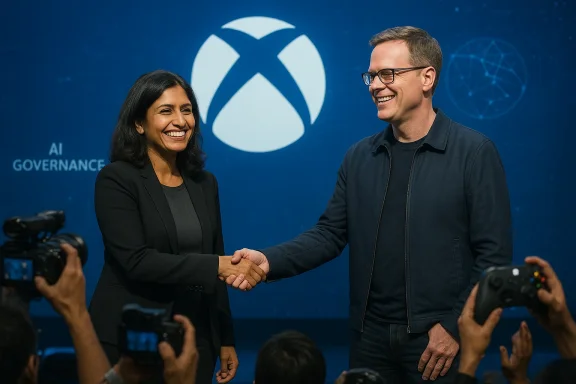
Asha Sharma’s first week as Xbox’s new leader has been defined less by strategy memos and more by social media—she publicly answered questions about her Xbox gamertag, denied being an AI stunt, and tried to close a trust gap that opened the moment Microsoft announced her appointment.
Microsoft announced on February 20, 2026 that Asha Sharma, previously a senior executive in Microsoft’s CoreAI organization, would become Executive Vice President and CEO of Microsoft Gaming, taking over as Phil Spencer stepped away and Xbox president Sarah Bond departed. The official blog post laid out Sharma’s first priorities—great games, a return of Xbox focus on consoles, and a vision for the future of play—and included an explicit line rejecting blunt, short-term AI-driven content: “we will not chase short-term efficiency or flood our ecosystem with soulless AI slop.”
That appointment immediately produced two overlapping reactions: industry watchers noting this is an unusually platform/AI-heavy choice for the head of a creative entertainment business, and sections of the online gaming community reacting with skepticism and cultural backlash. The scrutiny intensified as Sharma began engaging with players on X (formerly Twitter), sharing favorite games and her gamertag—moves that prompted deep dives into her achievements and accusations that she was either faking gamer credentials or letting generative AI write her posts. Multiple outlets documented both the corporate announcement and the ensuing online storm.
The Asha Sharma moment is instructive beyond Xbox. It reveals how modern corporate appointments are judged in real time by communities empowered to analyze, amplify, and punish perceived inauthenticity. Tech companies now face a double bind: they need leaders who can operate platform-scale systems while simultaneously meeting communities’ cultural expectations.
For Microsoft, the choice to pair a platform leader with a seasoned content chief—Sharma plus Matt Booty—is an explicit attempt to bridge that gap. But the community test runs in a different currency: authenticity, openness, and proof that creative values are protected. Sharma’s social replies were an attempt to transact in that currency; they were necessary but not sufficient.
However, intent is not the same as outcome. The real test will be tangible: budget allocations, studio autonomy decisions, release slates, and the practical rules Microsoft puts around AI in development and player experiences. The company must translate a pithy phrase into guardrails, roadmaps, and transparent practices.
For the gaming community, transparency and consistent behavior will matter far more than a single social media thread. For Microsoft, the opportunity is clear: if it can demonstrate that platform rigor and creative stewardship are not mutually exclusive, the hire could be a masterstroke—uniting scale, tooling, and craft. If not, today’s skepticism risks becoming tomorrow’s reputational headwind.
Sharma’s reply to accusations—short, direct, and human—was a necessary first move. Now every subsequent move will be parsed not just for strategy, but for sincerity.
Asha Sharma has started the job by talking to players and acknowledging where the community is worried; the onus is now on Microsoft to back those words with visible actions that preserve creative craft, protect studio autonomy, and define a principled, limited role for generative AI in games. Only then will social media skepticism be replaced by durable industry confidence.
Source: Windows Central The new CEO of Xbox replies to 'fake gamer' and generative AI accusations
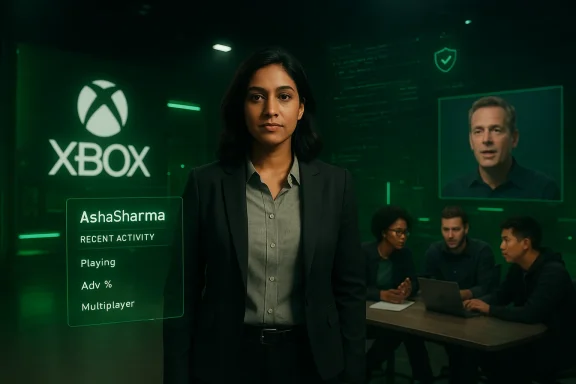 Background / Overview
Microsoft announced on February 20, 2026 that Asha Sharma, previously a senior executive in Microsoft’s CoreAI organization, would become Executive Vice President and CEO of Microsoft Gaming, taking over as Phil Spencer stepped away and Xbox president Sarah Bond departed. The official blog post laid out Sharma’s first priorities—great games, a return of Xbox focus on consoles, and a vision for the future of play—and included an explicit line rejecting blunt, short-term AI-driven content: “we will not chase short-term efficiency or flood our ecosystem with soulless AI slop.”That appointment immediately produced two overlapping reactions: industry watchers noting this is an unusually platform/AI-heavy choice for the head of a creative entertainment business, and sections of the online gaming community reacting with skepticism and cultural backlash. The scrutiny intensified as Sharma began engaging with players on X (formerly Twitter), sharing favorite games and her gamertag—moves that prompted deep dives into her achievements and accusations that she was either faking gamer credentials or letting generative AI write her posts. Multiple outlets documented both the corporate announcement and the ensuing online storm.
What Sharma said — the direct replies and the corporate message
The Microsoft position
In her message to the Xbox organization, Sharma framed her role as one of stewardship: protect craft, invest in studios, and build shared developer tools. She promoted Matt Booty to Executive Vice President and Chief Content Officer—an explicit signal that creative leadership and studio relationships will remain central under the new structure. The Microsoft blog post is the primary, verifiable source for the company’s public commitments and organizational changes.The social reply that cut through the noise
Within days of those internal messages, Sharma started posting and replying on X. One widely quoted exchange followed a cautious, public critique from Ryan McCaffrey of IGN—who suggested it wouldn’t be surprising if a more experienced gamer on the Xbox team was helping craft Sharma’s social posts. Sharma replied bluntly: “Faking would be a terrible idea and wouldn’t work,” explained that her gamertag was recently created to learn the platform, revealed the account had been a shared home account across family devices (which explained a wide, mixed achievement list), and confirmed she was writing her own posts. That direct answer has been picked up by outlets from Windows Central to Pure Xbox and GamesRadar.The anatomy of the online backlash
Two separate but related accusations
The reaction online took two distinct paths that often overlapped in comment threads:- Accusation A — Fake gamer: Critics argued that Sharma’s gamertag and achievements looked “manufactured” or too polished for someone new to the platform. Observers pointed to compressed timelines, unusual completion rates, and a high Gamerscore as evidence. Outlets summarized those claims and reproduced screenshots of achievement pages when reporting.
- Accusation B — AI-authored posts: Because Sharma’s background is in AI, some users suggested her X replies might be generated or heavily edited by language models or PR handlers. That line of suspicion ran alongside the “fake gamer” theory and was fueled by a climate of distrust about AI authenticity more broadly.
What the available evidence actually shows
- The corporate record: Microsoft’s official announcement and Sharma’s opening memo are clear about her role and priorities; they also contain Sharma’s own language rejecting mindless AI content. That message is verifiable on Microsoft’s corporate blog.
- The social reply: Multiple news outlets captured Sharma’s reply to McCaffrey verbatim, and X archives show the exchange exists in public timelines. Those reproductions corroborate her wording about the shared home account and her authorship claim (“And yes, I’m writing my own posts”).
- The gamertag scrutiny: Reporters and enthusiasts independently inspected Sharma’s publicly visible Xbox profile and highlighted rapid Gamerscore increases and several high completion percentages in a short window. Those observations are reproducible from public profile views; however, interpretations about how those scores were achieved (e.g., natural play, shared device activity, achievement-farming services) are not conclusively provable from screenshots alone. Several outlets that raised flags did so defensively (noting the data is suggestive rather than definitive). Readers should treat claims about specific numbers or “impossible” achievements as circumstantial evidence rather than proven deceit.
Why the reaction matters: trust, identity, and leadership optics
Authenticity is a currency in games culture
The gaming community places a premium on authenticity. Decades of fandom, speedruns, achievement-hunting culture, and streamer transparency have created social norms where a leader claiming to be “one of us” is expected to have demonstrable playing history. When a new CEO with a non-traditional gaming background arrives, the optics of authenticity become magnified. A gamertag that looks manufactured or a social feed that reads like corporate copy triggers a visceral backlash precisely because it violates those norms.The friction between platform leadership and creative stewardship
Putting an AI/platform leader at the head of a creative organization is a structural gamble. On one hand, platform thinking—scale, tooling, developer services—can unlock developer productivity and reach. On the other, creative leaders complain when platform priorities override artistic autonomy. Microsoft’s explicit textual commitment—“we will not chase short-term efficiency or flood our ecosystem with soulless AI slop”—is an attempt to guard against the worst optics of that pivot, but words will need backing through behavior and organizational signposts.Reputation risk is real and fast-moving
When a leader’s credibility is in question on day one, three risks materialize quickly:- PR and community relations become a constant drain, occupying executive time that should go to product strategy.
- Developer morale and studio autonomy narratives can harden into distrust if studios perceive top-down AI mandates.
- Competitors and critics seize the moment to frame the leadership shift as evidence of a broader, negative strategic pivot.
Strengths of the new leadership move (and why Sharma’s background matters)
It’s easy to reduce this leadership change to “AI exec replaces gaming boss”; that’s an oversimplification that ignores real operational strengths Microsoft gains by appointing someone with Sharma’s background.- Platform experience at consumer scale: Sharma’s product and operations experience—building consumer-facing, large-scale services—maps directly to Game Pass, cross-platform distribution, and cloud-enabled features that require platform thinking. Microsoft’s blog highlights this reasoning in choosing her.
- A stated commitment to guardrails: Her memo explicitly frames a refusal to let AI hollow out creativity, creating a rhetorical contract that Microsoft can be held to. That language is useful and unusual in executive messaging.
- Promotion of experienced creative leadership: By elevating Matt Booty to Chief Content Officer and keeping studios’ leadership intact, Microsoft has signaled a hybrid leadership model—platform executive at the top, experienced content leadership in a powerful creative role. If executed well, that balance can preserve studio trust while enabling platform investments.
The real risks and how they can be mitigated
Risk 1: Cultural mismatch and studio morale
Gaming studios prize autonomy; top-down platformization risks being read as creative interference.- Mitigation: A clear charter preserving studio decision rights, published commitments on IP stewardship, and sustained on-the-ground meetings (town halls, studio visits) with concrete examples of non-interference. Microsoft’s public memo helps, but must be reinforced with policy and budget signals.
Risk 2: Perception of inauthenticity and PR contagion
Day-one social media controversies can snowball into a long-term credibility deficit.- Mitigation: Transparent clarifications (as Sharma began with her reply) are useful; better still are verifiable gestures—regular AMAs, visible studio roundtables, and community programming that moves beyond single posts to sustained engagement. Independent verification of claims (e.g., allowing a community inspection of onboarding activities or an official statement clarifying account histories) could blunt rumor cycles without compromising privacy.
Risk 3: Overreliance on AI narratives
Given Sharma’s CoreAI background, there’s a risk the discourse will default to “AI will replace X,” feeding fear in developers and players.- Mitigation: Concrete product-level commitments that define where AI will be used (developer tooling, QA, accessibility features) and where it won’t be used (core content generation without human authorship) will create a predictable framework. Microsoft’s phrase “no soulless AI slop” is a good start—but it needs product guardrails and accessible documentation.
Tactical steps Xbox should take now (practical recommendations)
- Publish a short, public AI and Creativity policy that clearly defines permissible uses of generative AI in games, with guardrails for studio autonomy and IP provenance.
- Hold a week-long community listening tour: staged AMAs, moderated Reddit/Discord roundtables, and recorded studio interviews to demonstrate authenticity and accessibility.
- Institutionalize an Independent Developer Advisory Board—trusted studio leads and creators who can publicly vouch for decision-making processes.
- Provide tangible budget and hiring signals that confirm investments in both first-party content and platform tooling (e.g., show increased studio spend, not just tooling budgets).
- Make the onboarding of Sharma’s public communications team transparent—identify who is representing official voices and how posts are produced, without requiring excessive personal disclosure.
How to judge success over the next 12 months
If the first week is judged on optics, the next twelve months should be judged on concrete outcomes. Watch for these metrics:- Creative pipeline health: Are studios given stable budgets and timelines for the next two years? Is there evidence of new greenlit projects that reflect risk-taking, not just monetization?
- Community sentiment: Does online sentiment about Xbox shift from skepticism to cautious optimism—measured by independent community surveys and social metrics?
- Product rollouts that reflect the stated balance: Does Microsoft ship platform features that enable studios (tools, cloud services, QA) while simultaneously releasing marquee titles that demonstrate creative excellence?
- Transparent AI practices: Is there a published, practical framework for how AI is used across tooling, accessibility, and content creation, with documented provenance and opt-outs for players and creators?
The Asha Sharma moment is instructive beyond Xbox. It reveals how modern corporate appointments are judged in real time by communities empowered to analyze, amplify, and punish perceived inauthenticity. Tech companies now face a double bind: they need leaders who can operate platform-scale systems while simultaneously meeting communities’ cultural expectations.
For Microsoft, the choice to pair a platform leader with a seasoned content chief—Sharma plus Matt Booty—is an explicit attempt to bridge that gap. But the community test runs in a different currency: authenticity, openness, and proof that creative values are protected. Sharma’s social replies were an attempt to transact in that currency; they were necessary but not sufficient.
Final analysis: cautious optimism, with a demand for proof
Asha Sharma’s initial public interactions—her internal memo, the “no soulless AI slop” language, and a direct answer about her gamertag and social authorship—establish a baseline of intent. Those are real and verifiable signals that Microsoft is aware of the optics and is trying to address them head-on.However, intent is not the same as outcome. The real test will be tangible: budget allocations, studio autonomy decisions, release slates, and the practical rules Microsoft puts around AI in development and player experiences. The company must translate a pithy phrase into guardrails, roadmaps, and transparent practices.
For the gaming community, transparency and consistent behavior will matter far more than a single social media thread. For Microsoft, the opportunity is clear: if it can demonstrate that platform rigor and creative stewardship are not mutually exclusive, the hire could be a masterstroke—uniting scale, tooling, and craft. If not, today’s skepticism risks becoming tomorrow’s reputational headwind.
Sharma’s reply to accusations—short, direct, and human—was a necessary first move. Now every subsequent move will be parsed not just for strategy, but for sincerity.
Asha Sharma has started the job by talking to players and acknowledging where the community is worried; the onus is now on Microsoft to back those words with visible actions that preserve creative craft, protect studio autonomy, and define a principled, limited role for generative AI in games. Only then will social media skepticism be replaced by durable industry confidence.
Source: Windows Central The new CEO of Xbox replies to 'fake gamer' and generative AI accusations