

Microsoft’s new Xbox chief Asha Sharma is winding down Copilot for Gaming on mobile and stopping its console version before launch, a May 5 decision that reverses one of Microsoft’s most visible AI-for-games bets barely 14 months after its debut. The move is not an anti-AI retreat so much as a demotion of the chatbot from strategy to experiment. For Xbox, the more important news is that Sharma appears willing to kill Microsoft’s favorite kind of feature: one that proves a corporate thesis but not a player need. That makes the end of Gaming Copilot less a cancellation than a first test of whether the new Xbox regime can tell the difference between platform ambition and product clutter.
For the last two years, Microsoft’s default product answer has often been Copilot. Office needed Copilot. Windows needed Copilot. Security, search, coding, sales, support, and seemingly every productivity surface needed a branded assistant ready to summarize, recommend, and converse.
Gaming was always the awkward fit. A spreadsheet worker may welcome a helper that turns a messy workbook into a chart; a player deep in a boss fight, multiplayer match, or carefully paced RPG is not necessarily looking for another conversational pane. The question was never whether AI could be made to answer gaming questions. The question was whether that answer belonged inside Xbox.
Copilot for Gaming was introduced in March 2025 with the familiar language of assistance: it would help players get back into games, offer coaching, provide tips, and smooth over friction. Microsoft showed it as a companion rather than a replacement for play, a second-screen helper that could remind you where you left off or explain what to do next. The pitch sounded plausible in a demo, because almost every AI assistant sounds plausible in a demo.
The problem is that games are not productivity apps with dragons. They are designed around friction, discovery, memory, failure, mastery, and sometimes willful confusion. A universal helper that tells you where to go next may be useful in one context and corrosive in another. Xbox was trying to package that tension into a friendly assistant bubble, and Sharma has now decided the bubble is not where Xbox’s scarce attention should go.
That does not mean Sharma is hostile to AI. Her public framing points in the opposite direction: Xbox will still invest in AI, but in areas that more directly touch performance, discovery, personalization, and development friction. Automatic Super Resolution is the telling example. It is AI in the background, not AI as a character in the room.
This distinction matters. The consumer AI boom has trained executives to treat chat as the canonical interface for intelligence. But some of the most useful AI systems will be invisible to users: upscalers, latency reducers, recommendation systems, accessibility tools, testing pipelines, moderation aids, and developer workflows. A game console does not need to talk to prove it is smart.
By nixing Gaming Copilot for mobile and console, Sharma is also signaling that the Xbox organization will not be allowed to carry every experiment forward simply because it maps to a Microsoft-wide strategy. That is a necessary message inside a company where internal gravity is powerful. If Xbox is to regain momentum, it cannot be merely the gaming-shaped landing zone for whatever Redmond is trying to standardize this fiscal year.
Gaming Copilot tried to wrap several of those ideas inside the least trusted AI form factor: a chatbot. That immediately put it in competition with guides, wikis, YouTube walkthroughs, Discord communities, Reddit threads, and the informal knowledge networks that have surrounded games for decades. The assistant did not merely risk being redundant. It risked feeling extractive.
That criticism landed early. If an AI gaming helper answers player questions by ingesting and paraphrasing the open web, it depends on the same guide writers and community authors whose traffic it may reduce. The more successful the assistant becomes, the more it can weaken the ecosystem that makes it useful. That is not a gaming-specific problem, but gaming makes it especially visible because walkthroughs and community knowledge are part of the culture.
There is also a tonal problem. Players tolerate platform features that reduce chores: faster downloads, better matchmaking, cloud saves, universal libraries, controller remapping, smarter captures. They are less patient with features that seem to misunderstand why they play. A bot that interrupts the mystery of a game with a cheerful hint risks becoming Clippy with a controller.
For years, Xbox has been stretching between identities. It is a console platform, a PC publisher, a subscription service, a cloud gaming provider, a storefront, a first-party studio network, a mobile aspiration, and now a broader cross-device brand. Each identity has logic. Together, they can blur the answer to a simple consumer question: what is Xbox for?
Gaming Copilot did not create that confusion, but it belonged to the same era of sprawl. It was another feature attached to a platform already trying to be everywhere at once. Its cancellation is therefore symbolic because it suggests Sharma is beginning with subtraction. In a mature platform business, subtracting the wrong things is dangerous. In a confused one, refusing to subtract is worse.
The leadership shake-up reinforces that reading. Sharma is bringing in executives from CoreAI and adjacent consumer-platform backgrounds while saying Xbox needs to move faster, reduce friction, and deepen its connection with players and developers. That mix is risky, because Xbox fans have good reason to be suspicious of outsiders who arrive speaking the language of growth, engagement, and personalization. But it is also coherent if the goal is to make Xbox less like a collection of inherited org charts and more like a product system.
That diagnosis has merit. Xbox has often had the ingredients of a formidable ecosystem while struggling to make them feel inevitable. Game Pass was early and bold, but its pricing, tiers, day-one promises, and value story have become harder to parse. Cloud gaming works better than skeptics expected, but it has not become the mainstream distribution revolution Microsoft once implied. The PC app has improved, but years of Windows gaming friction are not erased by a new coat of Xbox green.
Bringing in CoreAI veterans does not automatically solve those problems. It could even aggravate them if Xbox starts treating players as funnel metrics and developers as implementation endpoints. But the forward-deployed engineering language is notable. It implies teams closer to actual developer pain, not merely platform roadmaps.
The departures of long-serving Microsoft executives Kevin Gammill and Roanne Sones also give the overhaul a sharper edge. Institutional knowledge is valuable, especially in gaming hardware and developer platforms. Yet Xbox has been carrying too much history as burden. Sharma is betting that the cost of continuity now exceeds the comfort it provides.
That strategy was visionary in parts and messy in execution. It anticipated a world in which games move across devices and platform exclusives lose some of their old power. It also left Xbox with a problem: if the console is not the center, and Game Pass is not growing fast enough to become the center, and cloud is not yet the center, then the brand becomes a promise looking for a primary surface.
Sharma inherits the consequences. The task is not simply to “save the console,” nor is it to abandon hardware in favor of a services abstraction. It is to decide which parts of Xbox deserve to be first-class and which parts have been kept alive because Microsoft can afford to keep almost anything alive longer than its competitors.
Gaming Copilot is a small example of that discipline. It was a feature that Microsoft could afford to build, market, test, and drag toward console launch. Sharma’s choice says affordability is no longer enough. The relevant standard is alignment: does this solve a player problem, strengthen a developer relationship, or make the Xbox ecosystem easier to understand?
That distinction matters because consoles are curated environments. Every dashboard feature competes with play, store discovery, social presence, captures, subscriptions, ads, and system settings. When a platform inserts an AI assistant into that space, it is not just adding utility. It is making a statement about what kind of relationship the company wants with the player.
A console Copilot would have been a permanent temptation. It could recommend games, upsell subscriptions, explain achievements, summarize friends’ activity, provide hints, route support requests, and eventually become a storefront concierge. Some of that could be useful. Some of it could also become the most annoying version of Xbox: a dashboard that talks when it should get out of the way.
By canceling the console launch, Sharma avoids turning a debatable feature into a brand referendum. Xbox fans may disagree about exclusives, hardware strategy, and Game Pass, but they are remarkably united in wanting Microsoft to stop overcomplicating the path between turning on a device and playing a game. A console chatbot was unlikely to help that case.
This is likely where AI in gaming becomes durable. Players do not need to love AI as a category to appreciate improved frame rates, sharper image reconstruction, better matchmaking, smarter accessibility, cleaner voice chat moderation, faster support triage, or less painful game discovery. The best AI features will feel less like assistants and more like infrastructure.
That also fits Microsoft’s strengths. The company owns Windows, DirectX, Azure, Xbox services, massive developer tooling, and a growing first-party content empire. Its comparative advantage is not that it can put a Copilot button everywhere. It is that it can improve the layers beneath the game experience across PC, console, cloud, and handheld devices.
The danger is that invisible AI is harder to market than a chatbot. A demo of a talking assistant is simple. A system-level improvement to discovery or rendering takes more explanation and may not produce the same executive-stage sparkle. Sharma’s cancellation suggests she is willing, at least for now, to trade spectacle for usefulness.
If Sharma is adopting daily active players as a core internal metric, that may push Xbox toward a more usage-driven view of success. That can be healthy if it forces the company to ask whether players are actually playing more, discovering better games, and staying engaged because the ecosystem works. It can be unhealthy if it reduces games to retention surfaces and encourages the same engagement-maximizing logic that has made parts of consumer tech miserable.
Here again, Gaming Copilot was the wrong tool for the right concern. Discovery is a real player problem. Backlog paralysis is real. Returning to a game after months away can be disorienting. But the solution may be better library design, smarter resume systems, richer save metadata, more humane recommendation controls, and platform features that respect context.
A chatbot can paper over bad information architecture. It can also excuse it. If the Xbox app, dashboard, store, and subscription surfaces are too confusing, asking an AI to explain them is not innovation. It is a workaround for design debt.
Sharma’s memo language about friction for players and developers is therefore well chosen. The hard part is making it operational. Developers do not need another annual promise that Xbox cares deeply about creators. They need predictable tools, clean documentation, responsive support, transparent storefront dynamics, and platform features that do not force them to design around Microsoft’s latest corporate initiative.
AI could help here more than it helped as a player-facing chatbot. Internal engineering assistants, automated testing support, localization aids, crash analysis, build pipeline help, and certification triage are less glamorous than a gaming sidekick but potentially more valuable. If CoreAI talent is being imported to make Xbox development easier, that is a better use of Microsoft’s AI muscle.
The risk is that “developer tools” becomes another umbrella for Microsoft-first priorities. Xbox must resist the urge to make developers prove loyalty to the platform through integration work that does not improve their games. The best platform tools disappear into better shipping velocity. The worst become another checklist.
That question is the political core of the decision. Consumer technology companies often misread backlash as resistance to change. Sometimes it is. But often users are not rejecting the future; they are rejecting misallocated attention. Xbox players see hardware sales declining, first-party schedules shifting, multiplatform strategy evolving, and the console identity wobbling. In that context, an AI helper can feel like a company changing the subject.
Sharma’s cancellation is therefore a goodwill play, whether or not it was intended as one. It tells the core audience that Xbox is capable of hearing skepticism before a feature becomes mandatory. It also distinguishes her from the easy caricature of an AI executive parachuted in to replace games with prompts.
Goodwill, however, is not strategy. Fans will applaud killing a disliked feature for about a day. Then they will ask what replaces it. Sharma’s next moves will matter more: hardware commitments, studio accountability, Game Pass clarity, PC improvements, and whether Xbox can produce a platform story that does not require a flowchart.
The challenge is that Xbox now means too many things at once. Microsoft wants it to be a console brand and a cross-device identity. It wants to reassure hardware loyalists while telling investors that growth is not limited by hardware. It wants to sell subscriptions without making game ownership feel obsolete. It wants to publish on rival platforms without making its own platform feel optional.
Asha Sharma cannot solve that with nostalgia. The Xbox name still has power, but only if attached to decisions that make it legible again. Killing Gaming Copilot helps because it removes one more layer of abstraction from the brand. It says Xbox is not a synonym for whatever Microsoft’s AI roadmap demands.
But the brand will need affirmative proof. Players will look for better hardware messaging, better Windows handheld integration, stronger first-party cadence, and a dashboard that treats their time with respect. Developers will look for signs that Xbox can grow audiences rather than merely reorganize executives. The Xbox name is a start, not a shield.
That makes the leadership shake-up more interesting than a standard org-chart story. Sharma is importing people who know AI, growth, design, infrastructure, and consumer platforms, but her first big AI move is restraint. That combination could produce a sharper Xbox, or it could produce a different flavor of executive overreach. The difference will come down to whether the new team treats gaming as a culture with platform needs, not merely a market with engagement gaps.
The financial pressure gives the moment urgency. Declining hardware revenue and uneven gaming performance mean Xbox does not have the luxury of decorative strategy. Every major feature has to justify its place. Every team has to explain how it helps players play, developers ship, or the platform grow.
For once, Microsoft’s decision is easier to admire because it is negative. The company stopped something. In a tech industry addicted to launches, roadmaps, previews, and branded layers, killing a feature before it becomes load-bearing is a form of discipline. Xbox has needed more of that for years.
Source: GeekWire Microsoft’s new Xbox chief nixes Gaming Copilot for mobile and console, shakes up leadership
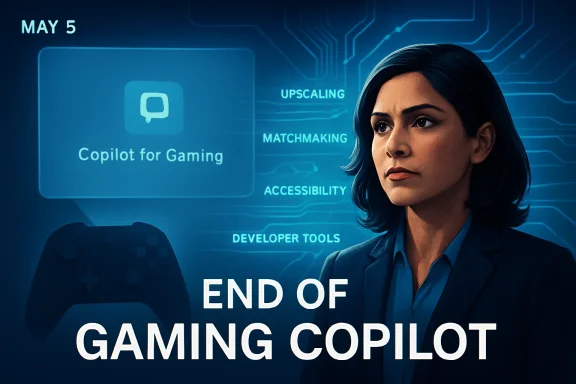 Microsoft’s AI Reflex Finally Meets the Controller
For the last two years, Microsoft’s default product answer has often been Copilot. Office needed Copilot. Windows needed Copilot. Security, search, coding, sales, support, and seemingly every productivity surface needed a branded assistant ready to summarize, recommend, and converse.Gaming was always the awkward fit. A spreadsheet worker may welcome a helper that turns a messy workbook into a chart; a player deep in a boss fight, multiplayer match, or carefully paced RPG is not necessarily looking for another conversational pane. The question was never whether AI could be made to answer gaming questions. The question was whether that answer belonged inside Xbox.
Copilot for Gaming was introduced in March 2025 with the familiar language of assistance: it would help players get back into games, offer coaching, provide tips, and smooth over friction. Microsoft showed it as a companion rather than a replacement for play, a second-screen helper that could remind you where you left off or explain what to do next. The pitch sounded plausible in a demo, because almost every AI assistant sounds plausible in a demo.
The problem is that games are not productivity apps with dragons. They are designed around friction, discovery, memory, failure, mastery, and sometimes willful confusion. A universal helper that tells you where to go next may be useful in one context and corrosive in another. Xbox was trying to package that tension into a friendly assistant bubble, and Sharma has now decided the bubble is not where Xbox’s scarce attention should go.
The New Boss Kills the Most Obvious Symbol First
Sharma’s decision carries extra weight because of her résumé. She came to Xbox from Microsoft’s CoreAI organization, after leadership roles at Instacart and Meta, and her arrival in February was easy to caricature as Redmond sending an AI executive to complete the Copilot-ization of gaming. Instead, one of her first visible product moves is to kill the gaming chatbot on the surfaces where it mattered most.That does not mean Sharma is hostile to AI. Her public framing points in the opposite direction: Xbox will still invest in AI, but in areas that more directly touch performance, discovery, personalization, and development friction. Automatic Super Resolution is the telling example. It is AI in the background, not AI as a character in the room.
This distinction matters. The consumer AI boom has trained executives to treat chat as the canonical interface for intelligence. But some of the most useful AI systems will be invisible to users: upscalers, latency reducers, recommendation systems, accessibility tools, testing pipelines, moderation aids, and developer workflows. A game console does not need to talk to prove it is smart.
By nixing Gaming Copilot for mobile and console, Sharma is also signaling that the Xbox organization will not be allowed to carry every experiment forward simply because it maps to a Microsoft-wide strategy. That is a necessary message inside a company where internal gravity is powerful. If Xbox is to regain momentum, it cannot be merely the gaming-shaped landing zone for whatever Redmond is trying to standardize this fiscal year.
The Chatbot Was a Poor Ambassador for a Better AI Argument
There are good reasons to want AI in gaming. Players with limited time could benefit from smarter save-state summaries, better onboarding, and systems that remember what they were trying to do three months ago. Disabled players could benefit from adaptive interfaces and real-time assistance. Developers could benefit from better tools for testing, localization, content pipelines, asset search, and telemetry analysis.Gaming Copilot tried to wrap several of those ideas inside the least trusted AI form factor: a chatbot. That immediately put it in competition with guides, wikis, YouTube walkthroughs, Discord communities, Reddit threads, and the informal knowledge networks that have surrounded games for decades. The assistant did not merely risk being redundant. It risked feeling extractive.
That criticism landed early. If an AI gaming helper answers player questions by ingesting and paraphrasing the open web, it depends on the same guide writers and community authors whose traffic it may reduce. The more successful the assistant becomes, the more it can weaken the ecosystem that makes it useful. That is not a gaming-specific problem, but gaming makes it especially visible because walkthroughs and community knowledge are part of the culture.
There is also a tonal problem. Players tolerate platform features that reduce chores: faster downloads, better matchmaking, cloud saves, universal libraries, controller remapping, smarter captures. They are less patient with features that seem to misunderstand why they play. A bot that interrupts the mystery of a game with a cheerful hint risks becoming Clippy with a controller.
Xbox’s Real Crisis Is Not a Missing Assistant
The timing of the cancellation matters because Xbox is not operating from a position of comfort. Microsoft’s gaming revenue has been under pressure, and recent reporting around the company’s quarterly results showed another steep decline in Xbox hardware revenue. Content and services remain the center of Microsoft’s gaming economics, but console weakness still matters because hardware is more than a device line; it is a commitment signal.For years, Xbox has been stretching between identities. It is a console platform, a PC publisher, a subscription service, a cloud gaming provider, a storefront, a first-party studio network, a mobile aspiration, and now a broader cross-device brand. Each identity has logic. Together, they can blur the answer to a simple consumer question: what is Xbox for?
Gaming Copilot did not create that confusion, but it belonged to the same era of sprawl. It was another feature attached to a platform already trying to be everywhere at once. Its cancellation is therefore symbolic because it suggests Sharma is beginning with subtraction. In a mature platform business, subtracting the wrong things is dangerous. In a confused one, refusing to subtract is worse.
The leadership shake-up reinforces that reading. Sharma is bringing in executives from CoreAI and adjacent consumer-platform backgrounds while saying Xbox needs to move faster, reduce friction, and deepen its connection with players and developers. That mix is risky, because Xbox fans have good reason to be suspicious of outsiders who arrive speaking the language of growth, engagement, and personalization. But it is also coherent if the goal is to make Xbox less like a collection of inherited org charts and more like a product system.
The CoreAI Imports Are a Bet on Operating Discipline
The new leadership additions reportedly include executives with backgrounds in engineering infrastructure, design, growth, and forward-deployed engineering. That roster reads less like a traditional console war room and more like a consumer platform turnaround team. It suggests Sharma sees Xbox’s problems not only as content gaps or hardware weakness, but as execution failures.That diagnosis has merit. Xbox has often had the ingredients of a formidable ecosystem while struggling to make them feel inevitable. Game Pass was early and bold, but its pricing, tiers, day-one promises, and value story have become harder to parse. Cloud gaming works better than skeptics expected, but it has not become the mainstream distribution revolution Microsoft once implied. The PC app has improved, but years of Windows gaming friction are not erased by a new coat of Xbox green.
Bringing in CoreAI veterans does not automatically solve those problems. It could even aggravate them if Xbox starts treating players as funnel metrics and developers as implementation endpoints. But the forward-deployed engineering language is notable. It implies teams closer to actual developer pain, not merely platform roadmaps.
The departures of long-serving Microsoft executives Kevin Gammill and Roanne Sones also give the overhaul a sharper edge. Institutional knowledge is valuable, especially in gaming hardware and developer platforms. Yet Xbox has been carrying too much history as burden. Sharma is betting that the cost of continuity now exceeds the comfort it provides.
Phil Spencer’s Xbox Was Expansive; Sharma’s May Need to Be Ruthless
Phil Spencer’s long Xbox tenure was defined by expansion. Under his watch, Microsoft rebuilt credibility after the Xbox One’s disastrous launch posture, invested heavily in backward compatibility, pushed Game Pass into the center of the brand, and ultimately bought ZeniMax and Activision Blizzard. Spencer made Xbox feel less like a box and more like a network of play.That strategy was visionary in parts and messy in execution. It anticipated a world in which games move across devices and platform exclusives lose some of their old power. It also left Xbox with a problem: if the console is not the center, and Game Pass is not growing fast enough to become the center, and cloud is not yet the center, then the brand becomes a promise looking for a primary surface.
Sharma inherits the consequences. The task is not simply to “save the console,” nor is it to abandon hardware in favor of a services abstraction. It is to decide which parts of Xbox deserve to be first-class and which parts have been kept alive because Microsoft can afford to keep almost anything alive longer than its competitors.
Gaming Copilot is a small example of that discipline. It was a feature that Microsoft could afford to build, market, test, and drag toward console launch. Sharma’s choice says affordability is no longer enough. The relevant standard is alignment: does this solve a player problem, strengthen a developer relationship, or make the Xbox ecosystem easier to understand?
The Console Cancellation Is More Important Than the Mobile Wind-Down
Ending the mobile beta is a retreat. Stopping the console version is a strategic admission. Mobile could always be framed as an experiment, a second-screen companion that did not intrude on the living-room experience. Console integration would have made Copilot part of Xbox’s main identity.That distinction matters because consoles are curated environments. Every dashboard feature competes with play, store discovery, social presence, captures, subscriptions, ads, and system settings. When a platform inserts an AI assistant into that space, it is not just adding utility. It is making a statement about what kind of relationship the company wants with the player.
A console Copilot would have been a permanent temptation. It could recommend games, upsell subscriptions, explain achievements, summarize friends’ activity, provide hints, route support requests, and eventually become a storefront concierge. Some of that could be useful. Some of it could also become the most annoying version of Xbox: a dashboard that talks when it should get out of the way.
By canceling the console launch, Sharma avoids turning a debatable feature into a brand referendum. Xbox fans may disagree about exclusives, hardware strategy, and Game Pass, but they are remarkably united in wanting Microsoft to stop overcomplicating the path between turning on a device and playing a game. A console chatbot was unlikely to help that case.
The AI That Survives Will Be the AI Players Don’t Have to Perform For
Automatic Super Resolution is a useful contrast because it asks almost nothing of the player. If it works, games look better or run better. If it fails, it can be tuned, toggled, or ignored. It does not ask the player to have a conversation, feed prompts, judge hallucinations, or wonder where an answer came from.This is likely where AI in gaming becomes durable. Players do not need to love AI as a category to appreciate improved frame rates, sharper image reconstruction, better matchmaking, smarter accessibility, cleaner voice chat moderation, faster support triage, or less painful game discovery. The best AI features will feel less like assistants and more like infrastructure.
That also fits Microsoft’s strengths. The company owns Windows, DirectX, Azure, Xbox services, massive developer tooling, and a growing first-party content empire. Its comparative advantage is not that it can put a Copilot button everywhere. It is that it can improve the layers beneath the game experience across PC, console, cloud, and handheld devices.
The danger is that invisible AI is harder to market than a chatbot. A demo of a talking assistant is simple. A system-level improvement to discovery or rendering takes more explanation and may not produce the same executive-stage sparkle. Sharma’s cancellation suggests she is willing, at least for now, to trade spectacle for usefulness.
Game Pass Needs Clarity More Than Another Interface
The leadership changes also reportedly put new attention on subscriptions and cloud, two areas where Xbox still has enormous opportunity and persistent ambiguity. Game Pass remains one of the most consequential ideas in modern gaming, but it has become harder to explain as Microsoft adjusts pricing, experiments with tiers, and balances first-party releases across competing business models. The service is valuable, but value alone does not remove confusion.If Sharma is adopting daily active players as a core internal metric, that may push Xbox toward a more usage-driven view of success. That can be healthy if it forces the company to ask whether players are actually playing more, discovering better games, and staying engaged because the ecosystem works. It can be unhealthy if it reduces games to retention surfaces and encourages the same engagement-maximizing logic that has made parts of consumer tech miserable.
Here again, Gaming Copilot was the wrong tool for the right concern. Discovery is a real player problem. Backlog paralysis is real. Returning to a game after months away can be disorienting. But the solution may be better library design, smarter resume systems, richer save metadata, more humane recommendation controls, and platform features that respect context.
A chatbot can paper over bad information architecture. It can also excuse it. If the Xbox app, dashboard, store, and subscription surfaces are too confusing, asking an AI to explain them is not innovation. It is a workaround for design debt.
Developers Will Judge the Reorg by Friction, Not Slogans
Xbox’s relationship with developers is just as important as its relationship with players. For large publishers, Xbox is one distribution channel among several. For independent developers, it can be a meaningful path to discovery or a maze of certification, visibility, business terms, and support. For Microsoft-owned studios, it is both patron and pressure system.Sharma’s memo language about friction for players and developers is therefore well chosen. The hard part is making it operational. Developers do not need another annual promise that Xbox cares deeply about creators. They need predictable tools, clean documentation, responsive support, transparent storefront dynamics, and platform features that do not force them to design around Microsoft’s latest corporate initiative.
AI could help here more than it helped as a player-facing chatbot. Internal engineering assistants, automated testing support, localization aids, crash analysis, build pipeline help, and certification triage are less glamorous than a gaming sidekick but potentially more valuable. If CoreAI talent is being imported to make Xbox development easier, that is a better use of Microsoft’s AI muscle.
The risk is that “developer tools” becomes another umbrella for Microsoft-first priorities. Xbox must resist the urge to make developers prove loyalty to the platform through integration work that does not improve their games. The best platform tools disappear into better shipping velocity. The worst become another checklist.
The Community Wanted Less Copilot and More Confidence
The reaction to Gaming Copilot’s demise has been telling because it has not produced widespread mourning. Some users liked the concept, and there are legitimate use cases for contextual help. But the broader sentiment around the feature was skepticism from the beginning: why is Microsoft building this when Xbox has more urgent problems?That question is the political core of the decision. Consumer technology companies often misread backlash as resistance to change. Sometimes it is. But often users are not rejecting the future; they are rejecting misallocated attention. Xbox players see hardware sales declining, first-party schedules shifting, multiplatform strategy evolving, and the console identity wobbling. In that context, an AI helper can feel like a company changing the subject.
Sharma’s cancellation is therefore a goodwill play, whether or not it was intended as one. It tells the core audience that Xbox is capable of hearing skepticism before a feature becomes mandatory. It also distinguishes her from the easy caricature of an AI executive parachuted in to replace games with prompts.
Goodwill, however, is not strategy. Fans will applaud killing a disliked feature for about a day. Then they will ask what replaces it. Sharma’s next moves will matter more: hardware commitments, studio accountability, Game Pass clarity, PC improvements, and whether Xbox can produce a platform story that does not require a flowchart.
The Old Xbox Name Returns Because the Brand Still Has Work to Do
One of Sharma’s reported early moves was dropping the “Microsoft Gaming” framing in favor of Xbox. That may sound cosmetic, but names are strategy compressed into a word. “Microsoft Gaming” describes a corporate division. “Xbox” describes a culture, a history, a store, a controller, a console, a subscription, and a promise.The challenge is that Xbox now means too many things at once. Microsoft wants it to be a console brand and a cross-device identity. It wants to reassure hardware loyalists while telling investors that growth is not limited by hardware. It wants to sell subscriptions without making game ownership feel obsolete. It wants to publish on rival platforms without making its own platform feel optional.
Asha Sharma cannot solve that with nostalgia. The Xbox name still has power, but only if attached to decisions that make it legible again. Killing Gaming Copilot helps because it removes one more layer of abstraction from the brand. It says Xbox is not a synonym for whatever Microsoft’s AI roadmap demands.
But the brand will need affirmative proof. Players will look for better hardware messaging, better Windows handheld integration, stronger first-party cadence, and a dashboard that treats their time with respect. Developers will look for signs that Xbox can grow audiences rather than merely reorganize executives. The Xbox name is a start, not a shield.
The First Real Signal From Sharma’s Xbox Is Subtraction
The lesson from this week is not that AI has no place in games. It is that AI must earn its way into games the same way any other feature should: by solving a problem players or developers already recognize. Gaming Copilot’s failure was not that it was technologically impossible. It was that it arrived as a product-shaped expression of a corporate habit.That makes the leadership shake-up more interesting than a standard org-chart story. Sharma is importing people who know AI, growth, design, infrastructure, and consumer platforms, but her first big AI move is restraint. That combination could produce a sharper Xbox, or it could produce a different flavor of executive overreach. The difference will come down to whether the new team treats gaming as a culture with platform needs, not merely a market with engagement gaps.
The financial pressure gives the moment urgency. Declining hardware revenue and uneven gaming performance mean Xbox does not have the luxury of decorative strategy. Every major feature has to justify its place. Every team has to explain how it helps players play, developers ship, or the platform grow.
For once, Microsoft’s decision is easier to admire because it is negative. The company stopped something. In a tech industry addicted to launches, roadmaps, previews, and branded layers, killing a feature before it becomes load-bearing is a form of discipline. Xbox has needed more of that for years.
The Xbox Reset Is Written in the Features That Disappear
The concrete readout from Sharma’s first months is not that Xbox is becoming less ambitious. It is that ambition may be moving away from public spectacle and toward platform utility. That is a healthier place for Microsoft to compete, provided it can keep the organization from drifting back into buzzword gravity.- Microsoft is winding down Copilot for Gaming on mobile and stopping development of the planned console version rather than expanding the beta into Xbox’s core living-room experience.
- The decision does not end Xbox’s AI work, but it redirects attention toward less intrusive uses such as graphics enhancement, discovery, personalization, and developer productivity.
- Sharma’s leadership changes bring in CoreAI and consumer-platform executives, suggesting a push for faster execution and stronger operating discipline inside Xbox.
- The cancellation lands against weak hardware trends and uneven gaming revenue, which makes feature prioritization more than an internal product-management exercise.
- The move gives Sharma an early credibility boost with skeptical Xbox fans, but that goodwill will evaporate unless it is followed by clearer hardware, Game Pass, PC, and first-party strategies.
- The larger test is whether Xbox can use AI as infrastructure instead of theater, improving the experience without turning the platform into another chatbot surface.
Source: GeekWire Microsoft’s new Xbox chief nixes Gaming Copilot for mobile and console, shakes up leadership
