

Microsoft’s internal marketing team quietly handed its website a new kind of customer service: an agentic, low‑code assistant built with Copilot Studio that now helps millions of visitors find product details, pricing, and trial information—and, according to Microsoft, has meaningfully improved site engagement, reduced live‑chat escalations, and accelerated signups. What began as a prototype for the Azure product pages became an orchestrated network of sub‑agents called Ask Microsoft, deployed at pace, and presented by Microsoft as a proof point for how Copilot Studio can scale agentic experiences across complex enterprise properties. (microsoft.com)
Microsoft’s Copilot Studio is the company’s low‑code, visual platform for designing, testing, and publishing AI agents—what Microsoft calls copilots—that can be connected to business data, integrated into workflows, and published across channels including websites and Microsoft 365. The offering bundles a canvas‑style builder with connectors, monitoring, and lifecycle controls so non‑engineers and engineers can collaborate on agent design. Copilot Studio also sits within a broader Copilot ecosystem that includes Microsoft Foundry and other agent services for higher‑volume indexing and advanced orchestration.
The idea of “agentic” software—AI systems that can plan, call sub‑agents, and take multi‑step actions—has moved from research labs to mainstream vendor product lines in the last 18 months. Major outlets have documented Copilot Studio’s rapid feature expansion (including the ability for agents to interact with desktop and web UIs), and analysts have positioned the product as Microsoft’s primary vehicle for producing enterprise agents that can automate workflows and customer interactions. That context frames why Microsoft chose to pilot Ask Microsoft on its own site: it’s both a real‑world testbed and a persuasive customer story.
Other large enterprises are already building production assistants on top of Copilot Studio, which provides an independent signal that Microsoft’s platform is being used beyond marketing claims. Recent reporting shows companies such as Intel using Copilot Studio to power customer support assistants—an example of the same pattern Microsoft describes for Ask Microsoft, albeit with different workflows and governance models. These third‑party deployments provide real‑world comparators for claimed outcomes.
At the same time, the technology raises non‑trivial questions about governance, data handling, and operational risk. Independent reporting confirms that Copilot Studio now includes powerful automation capabilities (including UI automation), which multiply utility—and risk. Enterprises that rush to deploy without strong governance and rigorous testing will almost certainly run into issues of accuracy, data leakage, or unintended automation. In short: the tool works, the results look persuasive on Microsoft’s own site, but the successful enterprise adoption playbook is not plug‑and‑play.
Ask Microsoft is more than a marketing case study: it is a pragmatic demonstration of a new delivery model for customer experience built around multi‑agent orchestration, low‑code authoring, and data‑aware grounding. For IT leaders, the message is optimistic but cautious—agents can accelerate conversion and reduce human load, but they must be governed, observed, and continuously tested. The future of customer experience will be agentic; the smarter question now is how to ship that future without trading safety, privacy, or trust for velocity.
Source: Microsoft Microsoft uses Copilot Studio to reshape customer experience and drive higher engagement | Microsoft Customer Stories
 Background
Microsoft’s Copilot Studio is the company’s low‑code, visual platform for designing, testing, and publishing AI agents—what Microsoft calls copilots—that can be connected to business data, integrated into workflows, and published across channels including websites and Microsoft 365. The offering bundles a canvas‑style builder with connectors, monitoring, and lifecycle controls so non‑engineers and engineers can collaborate on agent design. Copilot Studio also sits within a broader Copilot ecosystem that includes Microsoft Foundry and other agent services for higher‑volume indexing and advanced orchestration.The idea of “agentic” software—AI systems that can plan, call sub‑agents, and take multi‑step actions—has moved from research labs to mainstream vendor product lines in the last 18 months. Major outlets have documented Copilot Studio’s rapid feature expansion (including the ability for agents to interact with desktop and web UIs), and analysts have positioned the product as Microsoft’s primary vehicle for producing enterprise agents that can automate workflows and customer interactions. That context frames why Microsoft chose to pilot Ask Microsoft on its own site: it’s both a real‑world testbed and a persuasive customer story.
What Microsoft did: Ask Microsoft in practice
From prototype to production in weeks
Microsoft’s customer story says the Azure product team prototyped a web assistant in Copilot Studio and went live “in just a few weeks,” using a low‑code approach that minimized custom development needs. Because the agent relied on familiar building blocks—knowledge sources, connectors, and a visual canvas—the team could iterate rapidly and A/B test in production with feature flags and fallbacks to legacy flows. Those operational choices are typical for low‑code platforms and reflect Copilot Studio’s design goals: speed of iteration and integration with existing authentication and telemetry systems. (microsoft.com)Multi‑agent orchestration and sub‑agents
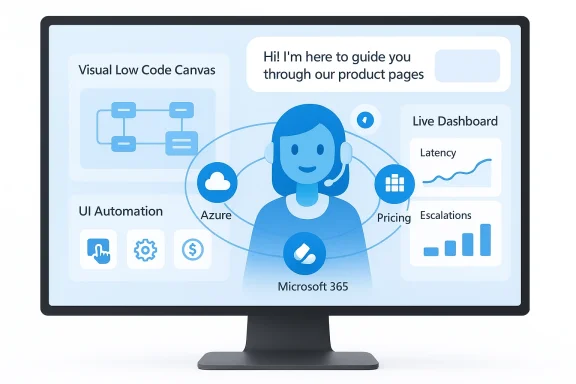
The original Ask Microsoft agent crawled—or tapped—site content and answered simple queries. But as traffic and content grew, Microsoft rewired the architecture to a multi‑agent orchestration model: a top‑level coordinator routes requests to specialized sub‑agents (for Azure, Microsoft 365, pricing, trials, etc.), then composes the responses into a single, context‑aware reply. This pattern reduces the load on any one knowledge source, improves relevance when queries touch multiple domains, and enables targeted scaling strategies for heavy pages (e.g., routing very long pricing pages to Microsoft Foundry agents that use Bing‑powered indexing). That design shift is an example of how orchestration can improve latency and accuracy when a single monolithic agent is overwhelmed. (microsoft.com)Measured outcomes (Microsoft’s numbers)
Microsoft reports several performance improvements after migrating to the orchestrated architecture:- Up to 61% lower latency for responses on Microsoft 365 pages.
- Up to 70% fewer human escalations, meaning significantly less live‑chat volume routed to sales or support agents.
- 10× higher likelihood of visitors who interacted with the agent to move forward with product signups.
- 16% more trial initiations observed on the Azure product pages after the upgrade.
Why this matters: strengths and practical wins
1. Speed to market and operational leverage
One of the clearest advantages Microsoft demonstrates is rapid deployment. By prototyping in Copilot Studio and leveraging the platform’s low‑code templates and connectors, the team went from concept to live agent quickly. For organizations with large, content‑heavy websites, that speed reduces the lead time—and cost—of experimentation. Copilot Studio’s SaaS nature means iterative improvements can be staged with feature flags and monitored through a unified dashboard.2. Better routing reduces human load and cost
Routing routine queries to an agent reduces non‑transactional load on sales and support teams. Microsoft’s reported 70% reduction in human escalations is significant: fewer repetitive chats let human agents focus on high‑value conversations, complex technical support, and upsell opportunities. That dynamic scales both customer experience and staff productivity when the automation is reliable. (microsoft.com)3. Multi‑agent architecture improves relevance and resilience
The sub‑agent pattern gives clear operational benefits: specialization improves domain accuracy; separate indexing strategies allow heavy or long pages to be handled by more appropriate tooling; and orchestration makes the top‑level user experience cohesive while the back end remains modular. This modularity also enables progressive feature rollout and fallbacks—critical for mission‑critical customer touchpoints. (microsoft.com)4. Real business impact on conversion and trials
Microsoft attributes measurable conversion wins to Ask Microsoft—ten‑times greater likelihood to sign up is a headline result. Whether that multiplier holds across other industries, the principle is clear: well‑timed, context‑aware answers reduce friction and help customers complete high‑intent actions (trial starts, purchases). For companies that monetize leads and trials, the ROI of a properly tuned agent can be immediate. (microsoft.com)What the platform enables: technical and product capabilities
- Low‑code visual canvas: natural‑language prompts generate starter agent flows that can be refined visually—lowering the skill barrier for non‑developers.
- Generative orchestration: the ability to route intent to sub‑agents and compose multi‑source responses for multi‑turn conversations. (microsoft.com)
- Computer Use / UI automation: Copilot Studio has introduced capabilities that let agents interact with UIs like a human (clicking, typing) when APIs are unavailable—expanding the automation surface to legacy systems. This capability broadens what agents can automate but raises governance questions.
- Integrations with Foundry and Bing indexing: for very large or complex pages, agents can rely on specialized indexing services to access and summarize long content. (microsoft.com)
- Monitoring and governance: dashboards for latency, errors, usage, and feedback are central to safe rollouts and continuous improvement.
Independent context and industry verification
Copilot Studio’s capabilities and the trend toward agentic automation are not unique to Microsoft’s marketing narrative. Independent reporting (The Verge, TechCrunch) documents Copilot Studio’s progression from a developer tool to a business platform—highlighting both the “computer use” automation and the multi‑agent orchestration approach that Microsoft is packaging for enterprises. Tech outlets also note the broader industry movement toward interoperable agent protocols and the rising interest in commercialized agent frameworks. Those independent observations corroborate Microsoft’s technological choices and offer an external checklist for what enterprises should evaluate when adopting agent platforms.Other large enterprises are already building production assistants on top of Copilot Studio, which provides an independent signal that Microsoft’s platform is being used beyond marketing claims. Recent reporting shows companies such as Intel using Copilot Studio to power customer support assistants—an example of the same pattern Microsoft describes for Ask Microsoft, albeit with different workflows and governance models. These third‑party deployments provide real‑world comparators for claimed outcomes.
Risks, blind spots, and what to watch for
Agentic systems bring big gains but also concentrated risks. Enterprises should weigh these carefully before a wide rollout.1. Measurement and attribution bias
Microsoft’s metrics are compelling, but they originate from the vendor’s own deployment and telemetry—an expected dynamic for a customer story. Independent validation in a different industry or site architecture is necessary before assuming the same conversion multipliers or latency gains will apply. When considering vendor case studies, enterprises should request raw definitions, test plans, and pre/post baselines to understand attribution. (microsoft.com)2. Governance and security of automated actions
Features that let agents operate UIs or trigger actions across systems raise immediate security and governance concerns. The “computer use” capability can automate tasks that previously required APIs or privileged access—so controlling what agents can do and auditing those actions becomes central to security posture. Microsoft and other vendors are building runtime checks and monitoring, but organizations must plan policy enforcement, least privilege, and incident response for agentic workflows.3. Data residency, training, and privacy
Even when platforms promise not to use customer data for model retraining, the movement, storage, and processing of conversational transcripts and contextual knowledge can create privacy obligations and compliance risk. Enterprises must confirm where data is processed, whether telemetry or prompt data are retained, and how retention maps to regulatory needs—GDPR, CCPA, sector‑specific rules (e.g., HIPAA). Contracts and Data Processing Agreements should reflect agent‑specific flows.4. Over‑reliance on canned models for domain nuance
Low‑code agents speed development, but complex product portfolios (like Microsoft’s) have nuanced pricing, SKUs, and compliance rules that can trip up generic generative responses. The sub‑agent approach mitigates this by grounding agents on specific knowledge sources, but robust evaluation and guardrails (explicit fact‑checking, fallback to human reps for high‑risk intents) remain essential. (microsoft.com)5. User trust and UX design
An assistant that increases engagement but delivers incorrect or misleading answers harms trust quickly. Transparent affordances (clear labels that the user is talking to an AI), easy escalation to human agents, and visible provenance (showing where an answer came from) are design elements that preserve trust. Microsoft’s ability to A/B test and fall back to legacy flows is an important operational control, but not a substitute for thoughtful UX and transparency. (microsoft.com)Governance, observability, and testing: a pragmatic checklist
If your organization is considering Copilot Studio—or any agent platform—treat deployment like launching a customer‑facing product, not an internal prototype. Critical steps include:- Define clear success metrics and telemetry (latency SLAs, escalation rates, conversion lift).
- Establish red‑team tests that probe hallucinations, data leaks, and adversarial prompts.
- Enforce least‑privilege for any agent that can take actions; require multi‑party approvals for high‑impact tasks.
- Build provenance and explanations into agent responses so users can see which knowledge sources were used.
- Maintain feature flags and canary rollouts to detect regressions early.
- Contractually clarify data residency, retention, and whether prompts or responses are used for model training.
- Provide a fast, obvious human‑in‑loop escape hatch and make escalation seamless.
Cost and procurement realities
Copilot Studio is licensed via Copilot Credits and pay‑as‑you‑go models; Microsoft publishes pricing tiers and recommends an Azure subscription to run production agents. The economics of agent deployment therefore shift from development costs to ongoing per‑interaction consumption—meaning that initial low‑code savings can be offset by usage costs at scale. Companies should model expected conversational volume, average tokens per interaction, and integration complexity before committing to capacity packs. Transparent budgeting for live production traffic and QA traffic is essential.Where this fits in your roadmap: practical guidance for IT leaders
- Start small, but instrument heavily: pilot a high‑value funnel (e.g., trial signups, license selection) and measure cleanly.
- Prioritize grounding: connect agents to curated knowledge bases and make sure long pages or offline systems have specialized indexing strategies.
- Plan governance in parallel with UX: train agents on permitted actions, and design UI affordances that make provenance and escalation obvious.
- Budget for steady state: model Copilot Credits and usage; expect iterative tuning rather than a “build once” deployment.
- Consider multi‑vendor strategies: Microsoft is enabling multi‑model and multi‑agent interoperability; plan for portability and vendor lock‑in risk.
Final assessment: opportunity with caveats
Ask Microsoft is a useful, high‑visibility demonstration of how Copilot Studio can be used to rebuild a large, complex corporate site’s customer experience. The deployment showcases the practical benefits of low‑code experimentation, multi‑agent design, and integrated monitoring—delivering tangible improvements in latency, escalation volumes, and conversion according to Microsoft’s published metrics. For businesses, the takeaway is clear: agentic assistants can reduce friction and improve business outcomes when they are designed with domain grounding, observability, and safety controls. (microsoft.com)At the same time, the technology raises non‑trivial questions about governance, data handling, and operational risk. Independent reporting confirms that Copilot Studio now includes powerful automation capabilities (including UI automation), which multiply utility—and risk. Enterprises that rush to deploy without strong governance and rigorous testing will almost certainly run into issues of accuracy, data leakage, or unintended automation. In short: the tool works, the results look persuasive on Microsoft’s own site, but the successful enterprise adoption playbook is not plug‑and‑play.
What to watch next
- How other Fortune‑scale websites measure the same KPIs (latency, escalation, conversion) after deploying agentic assistants. Early adopters beyond Microsoft—now being reported in the press—will offer crucial comparative data.
- Regulatory guidance around agent actions and automated UI interaction: as agents take actions that previously required human work, regulators and auditors will look for controls and traceability.
- Standards for agent interoperability and governance: cross‑industry protocols (agent2agent and MCP‑style specs) could make multi‑vendor agent stacks safer and more composable.
Ask Microsoft is more than a marketing case study: it is a pragmatic demonstration of a new delivery model for customer experience built around multi‑agent orchestration, low‑code authoring, and data‑aware grounding. For IT leaders, the message is optimistic but cautious—agents can accelerate conversion and reduce human load, but they must be governed, observed, and continuously tested. The future of customer experience will be agentic; the smarter question now is how to ship that future without trading safety, privacy, or trust for velocity.
Source: Microsoft Microsoft uses Copilot Studio to reshape customer experience and drive higher engagement | Microsoft Customer Stories
