

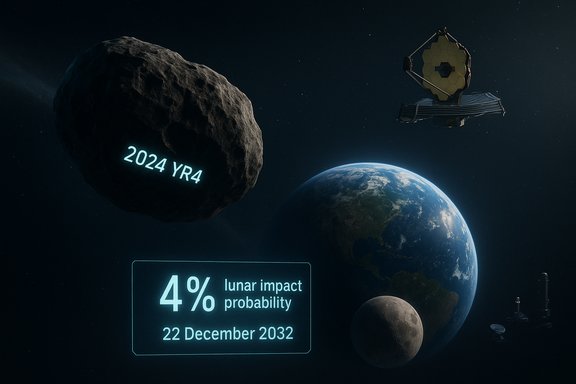
NASA and ESA now agree that asteroid 2024 YR4 poses virtually no danger to Earth but retains a small — and carefully watched — chance of striking the Moon on 22 December 2032, a scenario that would be spectacular to observe yet could create short-term hazards for satellites and cis‑lunar operations if it occurs.
Background
Asteroid 2024 YR4 was discovered on 27 December 2024 by the ATLAS survey in Chile after it had already passed its closest approach to Earth, a discovery timeline that immediately underlined a familiar blind spot in near‑Earth object (NEO) detection: objects approaching from the Sunward side can slip past ground‑based surveys. Initial automated orbit solutions produced a worrying sequence of probability updates: within weeks the object’s computed chance of hitting Earth climbed from fractions of a percent to a few percent, briefly elevating 2024 YR4 to Level 3 on the Torino Impact Hazard Scale — an unusually high rating reserved for objects with non‑zero impact probability and appreciable size. Follow‑up observations through February and March 2025, including infrared imaging from the James Webb Space Telescope (JWST), rapidly refined the orbit and size estimate and effectively ruled out an Earth impact in 2032. That same data left a residual, and now more discussed, possibility of a lunar impact on 22 December 2032.Where the probabilities stand today
- The most recent agency summaries published during 2025 place the lunar‑impact probability at around 4% (giving a roughly 96% chance of no impact of the Moon on the designated date), while Earth impact in 2032 has been reduced to essentially zero by multiple independent analyses.
- NASA’s Sentry/CNEOS tracking history shows the characteristic climb‑and‑drop pattern for newly discovered NEOs: an orbit solution with limited data produces a wide “cloud” of possible future positions that can intersect Earth or the Moon, then narrows as new observations arrive. For 2024 YR4 that narrowing pushed early probabilities up before additional observations drove the Earth probability down to negligible values by late February–March 2025.
- The figure of 4% is not a static, final verdict — it reflects the best fit to the asteroid’s orbital uncertainty as of the latest published calculation and will change when new, high‑quality telescopic data arrives after the object re‑emerges from behind the Sun in mid‑2028. ESA explicitly notes the probability will remain roughly stable until then because the asteroid is currently unobservable from Earth‑based facilities.
Discovery, follow‑up and the role of JWST
Discovery and the early risk spike
2024 YR4 was first detected on 27 December 2024 by ATLAS, two days after its close approach when it became bright enough for survey telescopes to spot it. The initial orbit solution carried sufficient uncertainty to allow a non‑negligible intersection with Earth’s or lunar path on 22 December 2032. That uncertainty produced the attention‑grabbing rise on the Sentry risk table and an unprecedented level of coordinated follow‑up.Infrared observations from JWST
The James Webb Space Telescope obtained thermal and near‑infrared imagery of 2024 YR4 on 26 March 2025, allowing teams to constrain its size and surface properties far better than visible‑light photometry alone can. Webb’s thermal data indicated a building‑sized body — roughly in the ballpark of a 15‑storey building — which translates to an estimated diameter in the approximate range published by ESA and NASA (roughly 50–70 metres, depending on assumptions about albedo). Those measurements were decisive in ruling out an Earth impact while refining the Moon‑impact probability.Why infrared and thermal data matter
- Thermal observations measure the heat the asteroid emits, which combined with reflected light measurements constrains the object’s size and surface thermal properties.
- Size and bulk density estimates feed directly into impact consequence models: a 40–90 m rock behaves very differently from a 100–200 m rock in terms of energy release and ejecta generation. JWST’s data substantially reduced size uncertainty — and therefore narrowed the range of realistic impact outcomes.
What an impact on the Moon would look like
When discussions of 2024 YR4 turn to “what if,” researchers have produced a spectrum of modeled outcomes. A Canadian team led by Paul Wiegert and collaborators published a preprint in June 2025 that simulated a lunar strike scenario and quantified likely consequences for the lunar surface, for near‑Earth space, and for satellites. The paper and subsequent media coverage summarize the core findings:- Energy release: The modeled collision would produce on the order of 6.5 megatons TNT equivalent (depending on chosen impact speed and angle), comparable to a large thermonuclear detonation in raw energy terms.
- Crater size: Simulations place the resulting crater at roughly 0.5–1 km in diameter, with many analyses centering on a ~1 km figure for a ~60 m projectile at typical lunar impact velocities. That would likely be the largest observed fresh crater on the Moon in several thousand years.
- Ejecta mass and distribution: The Wiegert et al. models estimate up to 10^8 kg (100 million kilograms) of lunar material could be launched with velocities sufficient to escape the Moon’s gravity, though the vast majority would fall back to the lunar surface. Depending on the impact location (near side versus far side) and ejection geometry, up to ~10% of the highest‑velocity ejecta could be captured by Earth’s gravity and arrive at Earth over a timescale of days.
- Consequences for satellites: The key near‑term hazard would not be human fatalities or atmospheric effects but an elevated flux of millimetre‑ to centimetre‑scale debris in near‑Earth space that could increase micrometeoroid impacts on satellites by orders of magnitude for days or weeks — a meaningful risk for sensitive optical sensors, solar panels, thermal radiators, and some star trackers. Wiegert’s analysis projects that LEO satellites could experience a temporary spike in impact flux that in aggregate is equivalent to years of normal background exposure.
- Meteor shower spectacle: Much of the media attention has focused on the possibility of a “moondust meteor shower” visible from Earth. If ejecta that reaches Earth’s atmosphere is fine enough, it would produce a low‑velocity, prolonged meteor display. Models suggest many meteors per minute could be visible for several days if the impact conditions were favorable — but the display’s brightness and geographic visibility depend strongly on the impact location on the Moon and the size distribution of ejecta.
Scientific upside: a once‑in‑a‑lifetime live experiment
An observed lunar impact of a previously tracked asteroid would be an extraordinary scientific opportunity. The Moon’s surface preserves impact records for billions of years; watching crater formation and ejecta dispersal in real time would give unique data on:- Cratering mechanics and shock propagation across a regolith‑covered surface.
- Ejecta size distributions and velocity spectra for mid‑sized impactors.
- How impact‑generated dust populates cislunar space and decays into Earth‑bound streams.
- Calibration of remote sensing techniques (optical, thermal, radar) for interpreting crater age and formation energy.
Mitigation and response planning: what agencies are considering
Agencies and the planetary‑defense community have a menu of conceptual options for averting or altering impacts. For Earth threats the discussion is mature; for a lunar risk the calculus changes because the Moon is not a protected population center but an active human and robotic asset hub. Key options under conceptual review include:- Kinetic impactor: Hitting the asteroid with a fast mass to nudge its trajectory — the approach successfully demonstrated by NASA’s DART mission in 2022. For YR4, a kinetic mission could be feasible in principle but would require an early launch and higher confidence in asteroid mass and composition to avoid under/overcorrection.
- Nuclear deflection: A last‑resort concept involving a standoff or surface nuclear explosion to change velocity; politically and technically fraught, legally constrained, and used only when trajectories and timelines leave no other options. Agencies state it is not currently considered necessary for 2024 YR4.
- Fragmentation or surface disruption: Breaking the asteroid could disperse mass and possibly reduce the highest energy flux delivered to the lunar surface, but fragmentation can create multiple hazardous objects and complicate predictability. Models indicate breaking up a body without careful planning can increase short‑term risk.
- Operational mitigation for satellite operators: The most realistic near‑term steps if the lunar‑impact probability rises would be hardening, re‑orientation, or temporary safe modes for sensitive satellites; enhanced tracking and risk modelling for LEO constellations; and prioritized protection for crewed cis‑lunar assets. Those are coordination and policy exercises as much as engineering ones.
Media reporting and misstatements — what to watch for
The 2024 YR4 story highlights how rapidly evolving technical analyses collide with the media cycle, producing small but important discrepancies between outlets. Two recurring issues are:- Dates and planned observations: Some articles reported JWST observations as “planned for early 2026,” but Webb actually observed 2024 YR4 on 26 March 2025, and those observations are already part of the orbit and size refinements. That mismatch matters because it changes the timeline for data‑driven probability updates. This claim should be treated as incorrect.
- Confidence estimates and over‑precise prognoses: A few pieces quote an “80% probability that new data will reduce the impact risk to near zero.” That percentage is not traceable to an explicit NASA or ESA public statement and appears to be speculative commentary rather than an agency forecast. Such numbers should be flagged as unverified unless they are traceably attributed to a named analyst or agency memo. Clear communication from agencies has stuck to describing uncertainty windows and the expectation that more observations will shrink uncertainty; they have not issued firm numeric “probability of probability changes” in the way some outlets have paraphrased.
Risks to space infrastructure: realistic and bounded
It’s important to separate sensationalized fears from real operational concerns.- Human safety on Earth: There is no credible pathway for a lunar impact by a 50–70 m asteroid to cause direct harm to people on Earth. The Moon’s orbit and mass are unaffected by such impacts in any meaningful way.
- Satellite and crewed‑vehicle risk: Here the risk is concrete, modelled, and time‑limited. A spike in millimetre‑scale ejecta could increase impact rates on satellites’ exposed surfaces, raising the risk of sensor damage, degradation of solar arrays, and, in aggregated terms, shortening mission lifetimes or causing temporary service outages for constellations. Crew safety in cis‑lunar habitats or during lunar surface missions would be a major concern, so mission planners must pay attention to evolving probability estimates and potential mitigation options.
- Long‑term environment: Most ejecta will fall back to the Moon or be ground down by atmospheric entry; only a small fraction would reach Earth and survive to ground. The dominant hazard to orbital assets is micrometeoroid impacts in the days to months following an impact, not sustained global environmental catastrophe.
Policy, preparedness and the next steps
- Observation priority (2028): Agencies should maintain observation readiness for the mid‑2028 reappearance window, because improved tracking at that time will be the most decisive factor in refining lunar‑impact probability and localizing any potential impact corridor.
- Contingency planning for satellite operators: Operators of large LEO constellations and critical infrastructure should evaluate short‑notice operations: safe modes, reorientation, and prioritized replacement strategies for vulnerable components. National space agencies and commercial operators need coordinated protocols for an elevated‑ejecta event.
- International coordination: Any decision to attempt a kinetic deflection or other intervention would require international consultation, legal review (outer space treaties and nuclear‑usage agreements), and clear public justification. Agencies are right to treat intervention as a last resort until orbital certainty improves.
- Investment in detection: The discovery of 2024 YR4 after it had already passed Earth again emphasizes the value of infrared and space‑based surveys that can see objects in sunward approaches (for example, the planned NEO Surveyor and proposed NEOMIR concepts). Better lead time reduces both the need for extreme mitigation and the uncertainty that drives costly contingency planning.
Critical analysis: strengths and weaknesses of the current response
Notable strengths
- Rapid international coordination: The detection-to‑follow‑up timeline demonstrated effective global coordination between ground surveys, space telescopes, and planetary‑defense centers — an ecosystem that functioned as intended to reduce Earth risk quickly.
- Effective use of high‑value assets: JWST’s thermal imaging supplied a decisive reduction in size uncertainty, showing the value of cross‑agency instrument deployment for NEO characterization.
- Active modelling of secondary risks: The timely publication of ejecta and satellite‑hazard simulations provides useful operational foresight to satellite operators and mission planners. Proactive modelling is a major improvement in planetary‑defense thinking, extending concern beyond direct Earth impacts to cislunar infrastructure risks.
Potential weaknesses and risks
- Observational blind spots: Objects approaching from near the Sun remain the Achilles’ heel of current ground surveys. Unless space‑based surveys that can observe sunward approaches are in place, late discovery will continue to limit decision windows.
- Public communication gaps: Early, high Torino ratings and rapidly changing probabilities create fertile ground for confusion. Predictive nuance is difficult to convey, and speculative figures that lack traceable provenance (for example, “80% chance further data will drop the lunar risk to zero”) complicate public understanding. Clear, dated agency statements should be the baseline for reporting.
- Intervention complexity: Any deflection attempt aimed at preventing a lunar impact carries non‑trivial operational risk; altering the object’s orbit inaccurately could unintentionally increase Earth impact probability unless mass, composition, and trajectory are well known. That trade‑off means intervention decisions are legally, politically, and technically fraught.
Conclusion
Asteroid 2024 YR4 is now a textbook case for 21st‑century planetary defense: it exposed detection gaps, triggered rapid international collaboration, and produced a layered response combining high‑value observations with new modeling of secondary hazards. Agencies are clear that Earth is safe from this object in 2032, but the residual (roughly 4%) chance of a lunar impact is legitimately worth monitoring because of its potential to generate ejecta that could temporarily threaten satellites and cis‑lunar operations.The responsible path forward is not alarmism or complacency but disciplined observation, international coordination with satellite operators, and investing in the detection systems that would give humanity earlier, clearer choices in the future. If 2024 YR4 reappears in 2028 still carrying a non‑negligible lunar‑impact probability, decision makers will be able to move from models and contingency planning to concrete, time‑constrained operations — with far better information than we have today.
Source: ARY News NASA: Asteroid 2024 YR4 - Moon collision risk remains low | ARY News

