

ASUS’s CES 2026 haul — eight Innovation Awards across six distinct product categories — is a clear, public-facing signal that the company is staking its brand on a mix of on-device AI, pro‑grade creative tools, sustainability messaging, and a hard push into high‑end gaming displays. The honors span Computer Hardware & Components, Sustainability & Energy Transition, Artificial Intelligence, Gaming & eSports, Imaging, and Computer Peripherals & Accessories, and were announced by ASUS during CES week in Las Vegas.
ASUS’s presentation at CES 2026 positions the company as a broad-spectrum innovator: slim, AI-capable laptops; creator-focused ProArt hardware; ROG gaming monitors that push refresh-rate boundaries; and calibration tools aimed at professional workflows. The company framed the wins as evidence of a strategy centered on Ubiquitous AI and product-level design thinking, with Co‑CEO S.Y. Hsu describing the awards as “a testament to our drive to create technology that empowers everyone, everywhere.” ASUS’s announcement was syndicated across multiple press channels the morning of January 6, 2026. These awards follow a pattern: ASUS took a large share of CES Innovation Awards in prior years as well, using the show as a staging ground to demonstrate where it intends to lead in portable AI, creator workflows, and premium gaming displays. The consistency of recognition across categories helps explain why ASUS emphasizes cross‑team R&D and verticalized product families (Zenbook, ProArt, ROG).
Source: Technobezz ASUS Wins Eight CES 2026 Innovation Awards Across Six Product Categories
 Background
ASUS’s presentation at CES 2026 positions the company as a broad-spectrum innovator: slim, AI-capable laptops; creator-focused ProArt hardware; ROG gaming monitors that push refresh-rate boundaries; and calibration tools aimed at professional workflows. The company framed the wins as evidence of a strategy centered on Ubiquitous AI and product-level design thinking, with Co‑CEO S.Y. Hsu describing the awards as “a testament to our drive to create technology that empowers everyone, everywhere.” ASUS’s announcement was syndicated across multiple press channels the morning of January 6, 2026. These awards follow a pattern: ASUS took a large share of CES Innovation Awards in prior years as well, using the show as a staging ground to demonstrate where it intends to lead in portable AI, creator workflows, and premium gaming displays. The consistency of recognition across categories helps explain why ASUS emphasizes cross‑team R&D and verticalized product families (Zenbook, ProArt, ROG). Overview of the winners
Below is a concise inventory of the honored products and the claims ASUS and exhibitors made at CES 2026. Where a specification is important to the product’s proposition, it’s cross‑checked against vendor materials or industry reporting.- Computer Hardware & Components
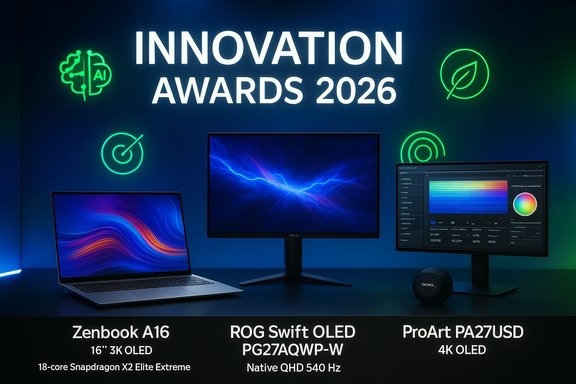
- Zenbook A16 (UX3607): 16‑inch 3K OLED, claimed 1.2 kg chassis, 18‑core Snapdragon X2 Elite Extreme with an 80 TOPS NPU.
- ProArt GoPro Edition (PX13): convertible ProArt with AMD Ryzen AI Max+ 395, up to 128 GB unified memory, GoPro Cloud integration and StoryCube app tailored for 360°/action workflow.
- ROG Crosshair X870E Glacial: enthusiast motherboard with AI‑driven tuning, extensive M.2 support, and next‑gen overclocking features.
- Sustainability & Energy Transition
- Zenbook S14 (UX5406): ultra‑thin 1.1 cm chassis with a Ceraluminum ceramic‑treated lid (ASUS describes this as an eco‑friendly aluminum treatment requiring less energy in production), ambient cooling, and a 3K ASUS Lumina OLED.
- Artificial Intelligence
- Zenbook DUO (UX8407): dual 14‑inch 3K ASUS Lumina Pro OLED displays, Intel Core Ultra X9 variants with up to 50 TOPS NPU figures, and a 99 Wh dual‑battery system for sustained runtime.
- Gaming & eSports
- ROG Swift OLED PG27AQWP‑W: a 26.5‑inch QHD WOLED monitor billed as the world’s fastest OLED, with QHD @ 540 Hz native mode (and a dual‑mode frame‑rate boost to 720 Hz at lower resolution), 0.02 ms GTG response, and new Tandem OLED enhancements.
- Imaging
- ProArt Display OLED PA27USD: a 4K UHD QD‑OLED pro display with 99% DCI‑P3, up to 240 Hz, built‑in colorimeter for automatic calibration, and broadcast‑grade connectivity including 12G‑SDI and dual Thunderbolt 4.
- Computer Peripherals & Accessories
- ProArt CaliContrO MCA02: compact 3‑in‑1 calibrator and hardware/software calibration tool capable of measuring up to 10,000 nits for HDR workflows, with ASUS Dial and OSD control.
What the technical claims mean — verification and context
NPUs and TOPS: useful but not definitive
ASUS emphasizes NPU throughput — e.g., 80 TOPS on Snapdragon X2 Elite Extreme devices and 50 TOPS on some Intel/AMD configurations — as a central selling point for Copilot+ and on‑device generative features. Those TOPS figures are echoed in chip‑maker disclosures and industry coverage: Qualcomm’s X2 Elite Extreme products are widely reported with an 80 TOPS Hexagon NPU, and AMD’s Ryzen AI Max family was promoted with a 50 TOPS NPU on higher‑end models. TOPS can be a practical shorthand for raw matrix throughput, but it’s not a direct measure of user experience, latency in real apps, or thermal efficiency. Real‑world performance depends heavily on model size, quantization, memory architecture, and software integration.Snapdragon X2 Elite Extreme: architecture and expectations
Qualcomm’s X2 generation pushed NPU and CPU clocks aggressively; independent reporting detailed an 18‑core design and marketing claims of 80 TOPS for the top X2 Elite Extreme variant. Industry press corroborates ASUS’s device claims that the Zenbook A16 uses that silicon to deliver high on‑device AI throughput for inference and features intended to work with local models and Copilot+ scenarios. That said, shipping devices and real‑world performance — including battery life and app compatibility on Windows ARM — will be the decisive factors once retail units reach reviewers.AMD Ryzen AI Max+ 395 and unified memory
AMD’s Ryzen AI Max family and associated SKUs were introduced to bring higher unified memory pools and stronger integrated NPU support to creative laptops and thin workstations. AMD’s documentation supporting the Ryzen AI Max+ 395 indicates a 50 TOPS NPU and platform support for high unified memory configurations — claims ASUS echoes for the ProArt PX13. That combination is significant for creators working with large models and multi‑layer video workloads, provided the software stack (LLM quantization, GPU/NPU offloading) is well‑optimized.OLED refresh rates and burn‑in mitigation
ASUS’s ROG Swift OLED PG27AQWP‑W brings a rare convergence of very high refresh rates and OLED contrast benefits: native QHD @ 540 Hz, lowered‑resolution boosts to 720 Hz, and Tandem WOLED engineering intended to increase brightness and lifespan. Industry test previews and ASUS’s own spec pages confirm the refresh‑rate and response‑time claims but also note the company’s burn‑in mitigation strategy (Neo Proximity Sensor and OLED Care Pro), which should help real‑world durability though cannot eliminate the physical realities of self‑emissive panels. The monitor’s claims are exceptional for competitive gamers who value ultra‑low latency; however, for most users the benefits above ~240‑360 Hz are marginal.Calibration and HDR measurement at the pro level
The ProArt CaliContrO MCA02’s ability to measure up to 10,000 nits is aimed squarely at HDR‑reference workflows where high peak luminance mapping is important. ASUS’s product pages support the measurement range and outline hardware/software calibration features that write 3D‑LUTs and support professional color‑management suites. In short, the tool can simplify HDR‑calibration chores for studios that purchase ProArt displays and need repeatable results. Independent lab verification will still be important to confirm color‑meter linearity and long‑term stability.Strengths: where ASUS is playing to win
- Broad, coherent AI narrative. ASUS isn’t just launching a single “AI laptop” — it’s aligning Zenbook, ProArt, and ROG lines with silicon partners (Qualcomm, AMD, Intel) and emphasizing on‑device inference across consumer to professional use cases. That coherence helps OEM messaging and ecosystem partnerships.
- Display leadership. ROG’s push on WOLED speed and ProArt’s QD‑OLED pro display reflect a clear investment in panel tech. For creators and competitive gamers, display innovation remains a tangible differentiator and one of the few hardware features users perceive instantly.
- Creator‑centric integration. The ProArt GoPro Edition and StoryCube app show an attempt to productize real workflow integrations (e.g., GoPro Cloud). Bundling software workflow pieces with hardware reduces friction for creators who want end‑to‑end toolchains.
- Sustainability messaging. Ceraluminum and energy‑efficient production claims address a growing buyer concern. When executed honestly, eco‑oriented design can influence procurement decisions for businesses and conscious consumers.
- Proven R&D horsepower. ASUS cites a large in‑house R&D headcount and continued award recognition; consistent investment in displays, chassis materials, and thermal systems shows up tangibly in these product claims.
Risks and unanswered questions
- Marketing numbers vs. delivered experience. TOPS figures, peak refresh rates, and headline NPUs are compelling marketing metrics, but they don’t automatically translate to better user experiences. Model support, runtime, thermal throttling, and application integration (e.g., whether a local LLM runs smoothly in a video editor) will determine whether on‑device AI feels compelling or gimmicky. Independent reviews and real‑world benchmarks will be essential.
- Windows on ARM ecosystem friction. Devices based on Snapdragon X2 silicon have improved architecture, but historic compatibility gaps for x86 apps and enterprise tooling mean some customers — particularly in corporate or specialist creative environments — may delay upgrades until software compatibility is proven across their toolchains. OEMs and Microsoft must keep pace with application portability and driver maturity.
- OLED longevity and workflow suitability. While ASUS’s OLED Care Pro and Neo Proximity Sensor reduce burn‑in risk, long‑term durability for static UI elements (menus, timelines, overlays) remains a concern for pro users. Buyers who plan long hours with static content will need to evaluate warranty coverage and empirical longevity data.
- Sustainability claims require verification. The energy advantage of Ceraluminum is a vendor claim at this stage. Independent lifecycle analyses that include manufacturing, supply chain, recyclability, and end‑of‑life treatment are necessary to substantiate the full sustainability story. Until those third‑party audits are available, treat energy‑production claims as manufacturer statements.
- Price and availability. Many CES reveals and award winners arrive first as high‑end, limited SKUs. Pricing, regional availability, and configuration choices will heavily shape commercial success. ASUS lists the awards and exhibits at CES through January 8th, but shipping windows and final retail SKUs remain to be announced for several items.
What this means for buyers and enterprise purchasers
- If you’re a content creator: The ProArt PX13 GoPro Edition and PA27USD are promising for on‑site editorial and color‑critical work, but confirm your specific toolchain support (DaVinci Resolve, Adobe suite versions, hardware acceleration paths) before committing to a single‑vendor workflow. The PA27USD’s broadcast I/O (12G‑SDI) and built‑in colorimeter make it compelling for studios that need reference monitors in a compact footprint.
- If you’re a pro gamer or esports outfitter: The PG27AQWP‑W is an extraordinary spec sheet for competitive play and broadcast streams. Assess whether your games and streaming pipeline materially benefit from >240 Hz refresh rates versus the ergonomics and desk space cost of a 26.5‑inch QHD OLED. Also factor in long‑term burn‑in strategies and warranty coverage.
- If you’re shopping for an AI‑capable Windows laptop: Look beyond TOPS and core counts. Ask for measured CPU/GPU/NPU performance on the apps you use, check thermal profiles and battery life under realistic creative or inference loads, and confirm whether key enterprise security features and management tools are supported. Early adopters will get the fastest silicon, but mainstream compatibility is still being proven.
- If sustainability matters: Treat Ceraluminum and similar materials claims as encouraging but provisional. Demand lifecycle disclosures or certifications when buying into “eco” branded hardware for procurement policies.
Practical next steps for reviewers and buyers
- For reviewers: prioritize mixed‑workload testing that exercises AI inference, video transcode, sustained CPU/GPU load, and battery runtime. Validate display claims (refresh, HDR peaks, calibration accuracy) with hardware colorimeters and independent test rigs.
- For prospective buyers: request engineering samples or wait for initial third‑party reviews that replicate the exact configurations you plan to purchase — especially where unified memory, integrated NPUs, or unique display modes are key buying factors.
- For enterprise procurement: request a compatibility matrix from ASUS documenting driver support, security platform (TPM/Pluton), manageability features, and Windows image validation for the required line‑of‑business apps.
Final assessment
ASUS’s eight CES 2026 Innovation Awards are a strategic win: they validate the company’s investment in on‑device AI, premium displays, and creator tools, while also giving the company a strong narrative around sustainability and performance as it pivots toward AI‑centric user experiences. The awards amplify ASUS’s message that the next generation of Windows PCs and peripherals will blend high TOPS NPUs, unified memory architectures, and differentiated display technologies to serve distinct user groups — from creators to competitive gamers. At the same time, the most important work for ASUS (and for buyers) begins after CES: turning headline TOPS numbers and novel materials into predictable, durable, and well‑integrated customer experiences. The products on display make bold technical promises — many are confirmed in vendor spec sheets and industry reporting — but independent testing and real‑world usage will be the ultimate arbiter of whether these designs reshape expectations or add another set of premium choices to an already crowded market. Until then, treat the awards as a signpost: ASUS is pushing aggressively on AI and displays, but verification in the field will be the decisive follow‑through.Quick reference: key product callouts
- Zenbook A16 (UX3607): Snapdragon X2 Elite Extreme, 18 cores, 80 TOPS NPU, 1.2 kg.
- ProArt GoPro Edition (PX13): AMD Ryzen AI Max+ 395, up to 128 GB unified memory, StoryCube + GoPro Cloud integration.
- Zenbook S14 (UX5406): Ceraluminum lid, 1.1 cm thin, ambient cooling, 3K Lumina OLED.
- Zenbook DUO (UX8407): dual 3K Lumina Pro OLED 144 Hz panels, up to 50 TOPS NPU, 99 Wh battery.
- ROG Swift OLED PG27AQWP‑W: 26.5‑inch QHD WOLED, native 540 Hz, 0.02 ms GTG, Tandem OLED tech.
- ProArt Display OLED PA27USD: 4K QD‑OLED, 99% DCI‑P3, up to 240 Hz, built‑in colorimeter, 12G‑SDI.
- ProArt CaliContrO MCA02: 3‑in‑1 colorimeter and OSD control, measures up to 10,000 nits.
Source: Technobezz ASUS Wins Eight CES 2026 Innovation Awards Across Six Product Categories
