

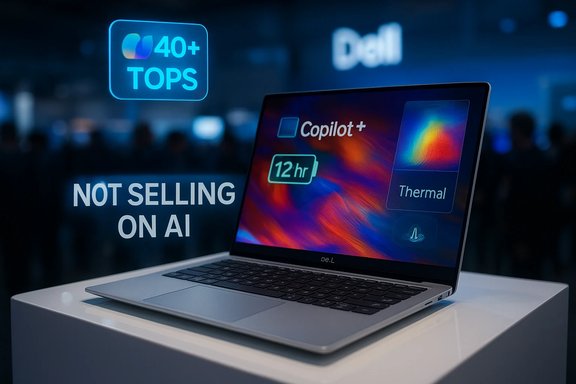
Dell’s shift at CES 2026 — quietly shipping AI-capable silicon while publicly downplaying “AI-first” marketing — rewrites the narrative of this year’s PC market and exposes a widening gap between platform ambition and consumer reality. The company’s executive remarks and product repositioning underscore a pragmatic recalibration: Dell will continue to build machines that meet Microsoft’s Copilot+ hardware floor, but it will sell them on battery life, displays, thermals and gaming credentials rather than the promise of instant on-device intelligence. This pivot arrives against the backdrop of Microsoft’s aggressive Copilot and Copilot+ rollout, public controversies around Windows Recall, and the hard calendar pressure of Windows 10’s October 14, 2025 end-of-support deadline — a set of forces that together have reshaped procurement logic, OEM messaging and the practical expectations for AI PCs.
The last 18 months have seen Microsoft reposition Windows 11 as an “AI-first” desktop with Copilot at the center and a new hardware tier — Copilot+ PCs — defined by concrete hardware thresholds. The most consequential technical requirement is an NPU (Neural Processing Unit) capable of approximately 40+ TOPS (trillions of operations per second); Microsoft ties some advanced Copilot experiences to that on-device inference capacity. At the same time, Windows 10 reached official end of mainstream support on October 14, 2025, which created a policy and security-driven upgrade window for many organizations and consumers. Those two threads — a platform-level AI push and a hard lifecycle deadline — were expected to catalyze a rapid refresh wave toward AI-capable hardware. Microsoft’s Copilot+ documentation and developer guidance make the 40+ TOPS floor explicit, and retail/marketing materials show Copilot+ labeled SKUs and experiences. Yet OEM telemetry and public statements suggest the upgrade story is far more layered. Dell’s product leadership publicly stated that mainstream buyers are not purchasing laptops primarily because of AI; instead, they prioritize battery life, display fidelity, sustained performance, price and reliability. Dell says it will still ship devices capable of Copilot+ experiences when required, but it will not lead with AI as the core consumer marketing narrative. That strategic adjustment — a deliberate decoupling of technical capability and marketing emphasis — is the central news that rippled through CES 2026 coverage and investor commentary.
For OEMs, the short-term imperative is clear: ship capable hardware, but sell what matters today. For Microsoft, the task is to make Copilot features demonstrably reliable, transparent and easily governed. For buyers, the sensible path is a measured one: prioritize tangible user experience gains, pilot advanced AI features with metrics, and treat Copilot+ as a targeted add-on rather than an across-the-board replacement rationale. Dell’s pivot is a market-sensible response to that precise calculus — a signal that the era of “buy this laptop because it’s an AI PC” is paused, being rewritten to link capability with concrete, everyday value.
Source: Windows Report https://windowsreport.com/dell-turns-its-back-on-ai-pcs-while-microsoft-pushes-copilot/
 Background / Overview
The last 18 months have seen Microsoft reposition Windows 11 as an “AI-first” desktop with Copilot at the center and a new hardware tier — Copilot+ PCs — defined by concrete hardware thresholds. The most consequential technical requirement is an NPU (Neural Processing Unit) capable of approximately 40+ TOPS (trillions of operations per second); Microsoft ties some advanced Copilot experiences to that on-device inference capacity. At the same time, Windows 10 reached official end of mainstream support on October 14, 2025, which created a policy and security-driven upgrade window for many organizations and consumers. Those two threads — a platform-level AI push and a hard lifecycle deadline — were expected to catalyze a rapid refresh wave toward AI-capable hardware. Microsoft’s Copilot+ documentation and developer guidance make the 40+ TOPS floor explicit, and retail/marketing materials show Copilot+ labeled SKUs and experiences. Yet OEM telemetry and public statements suggest the upgrade story is far more layered. Dell’s product leadership publicly stated that mainstream buyers are not purchasing laptops primarily because of AI; instead, they prioritize battery life, display fidelity, sustained performance, price and reliability. Dell says it will still ship devices capable of Copilot+ experiences when required, but it will not lead with AI as the core consumer marketing narrative. That strategic adjustment — a deliberate decoupling of technical capability and marketing emphasis — is the central news that rippled through CES 2026 coverage and investor commentary. What Dell Announced at CES 2026 — A Practical Pivot
XPS revival and a return to hardware fundamentals
At CES 2026 Dell formally restored XPS as its marquee consumer brand and repositioned its product messaging around traditional purchase drivers: premium materials, thermals, keyboard feel, and display quality. The new XPS 14 and XPS 16 models emphasize CNC-machined chassis, optional high-quality OLED panels, and battery claims that Dell frames as tangible rather than speculative. Those are precisely the attributes mainstream buyers notice in store and in reviews — the things that move conversion in a soft consumer market. Dell’s leadership framed the change as a course correction after the prior year’s rebrand and aggressive AI positioning.“We’re not selling on AI” — what Dell’s executives actually said
Public remarks from Dell executives crystallized the strategy. Kevin Terwilliger, head of product, explicitly observed that many buyers find AI messaging confusing and are not choosing devices purely for NPU counts or Copilot badges. Jeff Clarke, Dell’s COO, described an “un‑met promise of AI” that has tempered consumer demand and made the company cautious about leading with speculative AI narratives. Those quotes — repeated across press briefings and investor communications — represent a rare, candid OEM admission that the industry’s marketing calculus needs recalibration.What Dell will still do (and what it won’t)
- Ship modern silicon and optional NPUs where appropriate to preserve functionality for business customers and creators.
- Comply with Microsoft’s Copilot+ certification and keyboard/firmware requirements where those are contractual or channel-expected.
- Avoid making on-device AI the dominant consumer-facing selling point; instead emphasize daily experience improvements.
Copilot+ Reality Check: The Hardware Floor and Fragmentation Risk
What Copilot+ demands in practice
Microsoft’s Copilot+ program is not mere branding — it sets a technical floor. Many premium Copilot+ experiences are designed around a local NPU capable of 40+ TOPS, plus baseline system memory and storage (commonly 16 GB RAM and 256 GB SSD minimums for listed Copilot+ capabilities). That 40+ TOPS figure appears across Microsoft technical documentation and public product pages as the performance expectation for the on-device AI workloads that underpin features like Cocreate, Live Captions with translation, and advanced assistant tasks. Independent silicon vendors have produced NPUs that meet or exceed that floor: Qualcomm’s Snapdragon X Elite/X Plus family and newer entries from AMD and Intel have been specified by vendors as meeting Microsoft’s 40+ TOPS guidance. AMD has even shipped Ryzen AI parts that advertise NPUs in the 50 TOPS range, and Qualcomm’s Snapdragon X Elite variants were publicized with NPU figures in the mid‑40 TOPS. Those silicon milestones show the hardware ecosystem can meet Microsoft’s floor, but they also reveal a practical reality: not every new laptop includes a qualifying NPU, and the result is a bifurcated Windows 11 experience.The fragmentation problem
The Copilot+ ecosystem inevitably creates a two‑tier environment:- Copilot+ certified devices that can run the full suite of locally accelerated features.
- Non‑Copilot but Windows 11 devices that may still run cloud-backed or partial Copilot features at lower responsiveness.
Windows Recall: Trust, Security, and the Cost of a High-Profile Fail
Recall’s promise and the backlash
One of Copilot+’s headline features, Windows Recall, aimed to create a searchable timeline of user activity using period snapshots and on-device AI. The idea was to let users find content from earlier sessions without cloud indexing. But the feature became a lightning rod for privacy and security criticism: researchers flagged unencrypted snapshot databases, easy extraction by info‑stealer malware, and the risk of capturing sensitive content in background screenshots. The public controversy forced Microsoft to delay, redesign and re-secure the feature — making Recall opt‑in, encrypting the snapshot store, tying access to Windows Hello and VBS enclaves, and implementing filtering to exclude passwords and other sensitive data in snapshots. Those changes are material, but the episode underscored how easily trust can erode when agentic AI features touch user data.Why Recall matters to Dell’s messaging
Recall’s high-profile failures and fixes mattered because they created negative, easily communicable headlines that overshadowed Copilot+ marketing. When the public sees screenshots of a misbehaving AI or reads that data was temporarily stored insecurely, the wider AI story suffers. Dell’s decision to de-emphasize AI-first messaging is therefore at least partly a reaction to a public relations environment in which AI missteps amplify consumer skepticism and reduce the efficacy of abstract upgrade arguments.Verifying the Key Technical Claims — A Cross-Check
A responsible reporting approach requires confirming the most load-bearing numeric and timeline claims with multiple sources:- Windows 10 end of mainstream support: October 14, 2025. Microsoft’s lifecycle pages and support articles confirm the date and the available Extended Security Updates paths. This deadline is a factual anchor for procurement behavior.
- Copilot+ NPU performance floor: 40+ TOPS. Microsoft developer guidance and the Copilot+ marketing pages explicitly reference NPUs capable of at least 40 TOPS as prerequisites for many premium experiences. Industry reporting from Tom’s Hardware, Wired and other outlets also document the same threshold and note qualifying silicon families.
- Vendor silicon examples: Qualcomm’s Snapdragon X Elite/X Plus and AMD’s Ryzen AI 300 series have been specified by manufacturers and independent reviewers with NPU figures in the 40–50 TOPS range. These silicon measurements corroborate Microsoft’s requirement and show OEMs can meet the floor, albeit at BOM cost.
- Recall controversy and remediation: widely reported investigations and Microsoft’s subsequent security hardening steps (opt‑in, encryption, VBS enclave design, Windows Hello protection) are confirmed across major outlets and security coverage. Those changes mitigate threats but do not erase the reputational cost of the initial missteps.
Strengths of Dell’s Repositioning — Why This Makes Commercial Sense
- Focus on buyer-centered benefits: Consumers can tangibly measure battery life and display fidelity; marketing those wins aligns purchase motivations with observable outcomes.
- Avoiding overpromise reduces churn: Tempered messaging keeps early adopters (who want NPUs) satisfied while not alienating the mainstream.
- Preserve technical optionality: Dell will still ship Copilot-capable hardware in configurations that need it, which avoids closing future upgrade paths.
- Channel realism for partners: Slower Windows 11 adoption and mixed demand means resellers and enterprise procurement can plan staged refreshes instead of pushing an aggressive, hype-driven cycle.
Risks and Open Questions
No strategy is risk‑free. Dell’s pivot introduces several potential downsides that warrant close attention:- Perception of retreat: Investors and certain enterprise buyers could interpret the de-emphasis as a concession that the AI value proposition is weak, potentially dampening confidence in premium Copilot+ SKUs.
- Feature fragmentation: The Copilot+ divide imposes procurement and lifecycle complexity for IT teams that need predictable feature parity across fleets.
- Long-term competitive positioning: Competitors that continue to invest aggressively in AI-first messaging (or produce more immediately useful on-device features) could capture the imagination of certain buyer segments.
- Regulatory scrutiny: Agentic features that process or index user activity will attract regulatory attention; vendors must be prepared for policy-driven constraints and compliance costs.
- Supply and pricing pressure: NPUs, additional RAM and sophisticated thermal designs add BOM cost; in a price-sensitive market, those costs can suppress volume unless offset by clear, measurable benefits.
What Microsoft, OEMs and IT Leaders Should Do Next
For Microsoft
- Prioritize reliability and conservative public demos: every high-visibility failure amplifies skepticism.
- Publish clear, testable privacy and data flow receipts for agentic features and provide enterprise governance tools.
- Make feature gating and fallbacks explicit so OEMs and IT teams can map experiences to SKUs reliably.
For OEMs
- Tie AI claims to repeatable user outcomes; ship simple, demonstrable features with consistent behavior.
- Provide transparent SKU-level documentation about NPU TOPS, power characteristics and feature parity.
- Offer firmware controls and remap utilities for Copilot keys and other UX changes that have annoyed users.
For IT leaders and buyers
- Inventory and classify devices by security needs vs. AI benefit.
- Pilot Copilot features with clear KPIs (time saved, error rates, user acceptance) before broad rollout.
- Negotiate device refresh terms, support and testing windows with OEM partners — you have leverage while migration is slower.
- Validate Copilot+ claims at the SKU level and require independent benchmarks where NPU performance is material.
Practical Buying Guide (for Consumers and IT Pros)
- Prioritize daily experience: battery, display, keyboard feel, and thermals for general-purpose users.
- Reserve Copilot+ purchases for power users: creators, translators, frequent transcribers, or mobility-first knowledge workers who will use on-device AI regularly.
- Verify NPU figures for the exact SKU you plan to buy — family names can be misleading.
- Demand remappability: insist on keyboard firmware or utilities that let you repurpose Copilot keys to avoid UX friction.
- Use the Windows 10 ESU as a staging mechanism if immediate refresh is not required; that buys time for feature maturation and price stabilization.
Conclusion — Pragmatism Wins the Quarter, Not the Hype Cycle
Dell’s CES 2026 repositioning is a corrective, not a contradiction: technical progress toward local AI acceleration continues, but commercial reality has devoured the clean marketing narrative. Consumers and IT buyers reward observable, reliable advantages — longer battery life, better displays and predictable thermals — not abstract projections of future productivity gains. Microsoft’s Copilot+ program and hardware bar (40+ TOPS NPUs) create meaningful technical differences, but they also risk fragmenting the Windows ecosystem and complicating procurement at scale. The Windows Recall episode further demonstrated that trust and privacy are fragile currencies in the AI transition.For OEMs, the short-term imperative is clear: ship capable hardware, but sell what matters today. For Microsoft, the task is to make Copilot features demonstrably reliable, transparent and easily governed. For buyers, the sensible path is a measured one: prioritize tangible user experience gains, pilot advanced AI features with metrics, and treat Copilot+ as a targeted add-on rather than an across-the-board replacement rationale. Dell’s pivot is a market-sensible response to that precise calculus — a signal that the era of “buy this laptop because it’s an AI PC” is paused, being rewritten to link capability with concrete, everyday value.
Source: Windows Report https://windowsreport.com/dell-turns-its-back-on-ai-pcs-while-microsoft-pushes-copilot/
