

AT&T’s expansion of its Connected Spaces portfolio into enterprise and manufacturing scenarios signals a purposeful push to move IoT from simple sensor kits into a platformed, AI-enabled edge architecture — but the announcement also raises important questions about cloud choice, edge compute, video analytics, and data governance that every IT leader should weigh before rolling this into production.
AT&T first introduced Connected Spaces as a plug‑and‑play IoT sensor kit aimed at small and medium businesses, with pre‑staged wireless sensors, a gateway, and a cloud dashboard to deliver near‑real‑time monitoring of temperature, motion, leaks and other environmental signals. The product was publicly detailed in AT&T’s January 2025 launch for SMBs and has since been listed through cloud marketplaces as AT&T expands procurement channels.
At the same time, AT&T’s enterprise play has evolved beyond simple telemetry: AT&T’s B2B materials and partner case studies show deeper integrations with cloud platforms, including Microsoft Azure for certain restaurant and kitchen solutions (notably the “Connected Kitchen” integration with Azure Sphere), and broader use of Azure AI across AT&T’s internal enterprise initiatives. Those moves reflect a strategic history of collaboration between AT&T and Microsoft that stretches back to their 2019 strategic alliance around cloud, 5G and edge computing.
At the same time, the most important success factors will be non‑technical: governance, procurement clarity, vendor accountability and operational rigor. Where AI is embedded in operational decisions, companies must hold vendors to standards for explainability, audit trails, version control and human‑in‑the‑loop safety. Enterprises that treat Connected Spaces as another vendor‑managed sensor pack will miss the essential integration and governance work required to make IoT+AI production‑grade.
In short: Connected Spaces is a significant step toward more integrated, carrier‑delivered IoT and edge AI services for enterprise and manufacturing — but success will depend on sober due diligence, strong governance, and tightly specified operational contracts rather than marketing claims alone.
Source: Telecompaper AT&T launches new enterprise, manufacturing connected AI solutions
 Background
AT&T first introduced Connected Spaces as a plug‑and‑play IoT sensor kit aimed at small and medium businesses, with pre‑staged wireless sensors, a gateway, and a cloud dashboard to deliver near‑real‑time monitoring of temperature, motion, leaks and other environmental signals. The product was publicly detailed in AT&T’s January 2025 launch for SMBs and has since been listed through cloud marketplaces as AT&T expands procurement channels.At the same time, AT&T’s enterprise play has evolved beyond simple telemetry: AT&T’s B2B materials and partner case studies show deeper integrations with cloud platforms, including Microsoft Azure for certain restaurant and kitchen solutions (notably the “Connected Kitchen” integration with Azure Sphere), and broader use of Azure AI across AT&T’s internal enterprise initiatives. Those moves reflect a strategic history of collaboration between AT&T and Microsoft that stretches back to their 2019 strategic alliance around cloud, 5G and edge computing.
What AT&T is selling now: Connected Spaces for enterprise and manufacturing
The productized promise
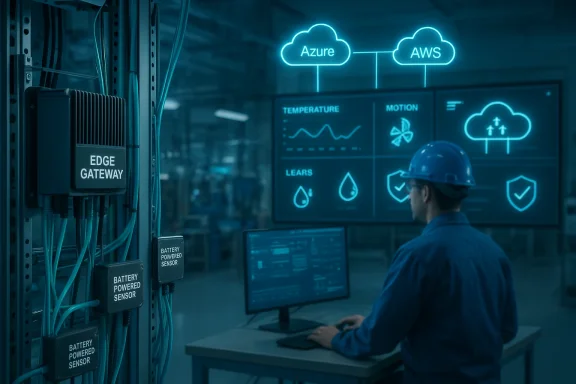
Based on AT&T’s materials and the press coverage summarized in the recent announcement, Connected Spaces for Enterprise appears to be a composable platform that combines:- Wireless sensors and gateways for environmental, motion and asset telemetry,
- An on‑premises/edge gateway that aggregates sensor data and connects via cellular / managed connectivity,
- Cloud‑hosted dashboards and alerts for near‑real‑time monitoring,
- Integration points for downstream analytics, workflows and — crucially in AT&T’s messaging — AI‑driven insights to improve safety, operations, loss prevention and customer experience.
Manufacturing and industrial use cases
The move to explicitly call out manufacturing and related verticals is logical: the same sensor + gateway + cloud model that reduces spoilage and shrinkage in retail maps to predictive maintenance, environmental control, and asset tracking in factories and warehouses. AT&T’s public materials and blog posts point to:- Cold‑chain and refrigeration monitoring (reduce spoilage),
- Leak and water detection and facility environmental alarms,
- Entry/motion detection for extended security and evidence collection,
- Aggregated telemetry for operational dashboards and workforce alerts.
The Microsoft angle: Azure, Azure Sphere and Azure AI — what’s confirmed and what isn’t
Multiple pieces of public evidence show AT&T working closely with Microsoft technologies, but the linkage between “Connected Spaces for Enterprise” and a full Azure + Azure AI architecture needs careful parsing.- AT&T’s restaurant/Connected Kitchen solution explicitly references Microsoft Azure Sphere as a secure element used to onboard and protect kitchen IoT. That demonstrates a concrete Azure technology in an AT&T vertical solution.
- Separately, Microsoft’s customer story about AT&T documents a broad, enterprise‑scale deployment of Azure services — including Azure Kubernetes Service, Azure Cosmos DB and integration with Azure OpenAI and agent frameworks — within AT&T’s internal AI platform and employee‑facing solutions. That proves AT&T uses Azure AI at scale inside the company.
- AT&T’s marketing for Connected Spaces, however, also shows activity on other cloud channels (for example an AWS Marketplace listing), and the Connected Spaces product pages focus on sensor/gateway basics without an explicit single‑cloud mandate. That suggests the product is being positioned as multi‑cloud / cloud‑agnostic in procurement channels even when particular vertical integrations (like Connected Kitchen) leverage Microsoft technologies.
Architecture: edge + connectivity + cloud (how it likely fits together)
Edge collection and aggregation
Connected Spaces uses a lightweight gateway to collect sensor data and forward it to a cloud service. Key characteristics AT&T advertises include:- Support for 100+ sensors per gateway,
- Long wireless range (claimed up to 1.2 miles between gateway and sensors),
- Multi‑year battery life for sensors,
- Standardized encryption and mutual authentication between device and gateway.
Connectivity and network fabrics
For enterprise and manufacturing customers, the network layer is critical. AT&T can deliver cellular SIM connectivity, private LTE/5G, or hybrid backhaul as required. In high‑value manufacturing environments, a predictable private network (or on‑site wired fallback) is often mandated for control‑plane uptime, deterministic latency and local data residency. The product’s success will hinge on how AT&T packages private connectivity options and SLAs for industrial customers.Edge compute and AI inference
Where Connected Spaces aims to move beyond alerts and dashboards is at the inference layer: running models that convert telemetry streams into actionable operational recommendations. There are two major architectural approaches:- Cloud‑side AI — telemetry is uplinked and models run centrally (cheaper to manage, but introduces latency and higher bandwidth use).
- Edge inference — models execute on the gateway or local compute to enable near‑real‑time action (lower latency; more complex orchestration and security).
Why telcos want to sell connected AI services — and why enterprises should care
- New revenue streams for carriers. AT&T has long been pushing IoT and managed services as growth levers beyond consumer connectivity; sensor‑to‑insights subscriptions, cloud integrations, and AI services are higher‑margin than connectivity alone. The AWS Marketplace listing and expanded enterprise messaging are consistent with a commerce strategy to remove procurement friction.
- Lower friction for adoption. Many enterprises struggle to manage device onboarding, connectivity, security and analytics. Carrier‑provided bundles that include devices, SIMs, gateways and managed dashboards remove integration work and accelerate time‑to‑value.
- Edge + network + AI as a differentiated stack. Carriers can leverage network visibility, private 5G and edge compute to guarantee service levels for AI workloads that pure cloud vendors cannot offer alone — particularly for latency‑sensitive or regulated manufacturing environments. Microsoft and telcos have been public about joint edge initiatives for precisely this reason.
Security, privacy and governance — non‑negotiables for industrial deployments
AT&T’s Connected Spaces documentation lists mutual authentication and 128‑bit encryption, but enterprises need a fuller security and governance view when deploying sensors and AI in production:- Data residency and sovereignty. If telemetry contains PII or commercially sensitive operational metrics, where data is stored, how long it is retained, and whether it crosses borders are essential contract items. AT&T’s multi‑cloud/product placements (including AWS Marketplace listings) make it particularly important to specify regional controls.
- Model governance and provenance. When AI models make or recommend operational changes — e.g., stop a production line, trigger maintenance — you need auditable model lineage, version pinning, and rollback controls. AT&T’s broader Azure‑based AI programs emphasize governance controls; procurement should demand the same level of model governance for connected spaces offerings.
- Video and camera analytics. Telecompaper’s summary mentions “cameras” being part of the architecture, but AT&T’s Connected Spaces pages focus primarily on sensors and gateways; explicit camera/video management and retention controls aren’t front‑and‑center on the public product pages. If video analytics are required for manufacturing security or quality inspection, buyers should validate whether video is natively supported, whether analytics run on‑device or in the cloud, and how footage is stored and encrypted. Do not assume camera support is included without explicit documentation.
Operational realities and deployment risks
Latency expectations
“Near‑real‑time” has many meanings. For human alerting and dashboarding, seconds may be acceptable; for closed‑loop control or robot safety, milliseconds matter. Buyers must define clear latency SLAs and test in their environment, especially where wireless propagation through metal and concrete is a challenge.Device lifecycle and support
Battery lifetime and field reliability are attractive claims, but enterprises must plan for a long device lifecycle: firmware updates, over‑the‑air security patches, replacement policies and spare‑parts logistics are all required to maintain industrial uptime. Ask suppliers for an explicit device‑lifecycle management plan and response SLAs.Integration with OT systems
Manufacturing environments are full of legacy PLCs, SCADA systems and proprietary field buses. Integrating sensor insights with existing operational technology (OT) workflows requires careful OT/IT orchestration, middleware or connectors, and often system integrator support. Expect potential scope for custom integration work.Vendor lock‑in and multi‑cloud strategies
AT&T’s presence on AWS Marketplace and its integrations with Azure components illustrate a hybrid commercial footprint. That can be an advantage (procurement flexibility) or a complexity (fragmented management). Buyers who prefer a single management pane or strict cloud standards should negotiate technology portability or open APIs.Competitive landscape — who else plays here?
- Hyperscalers (AWS, Microsoft, Google). Each offers IoT device management, edge compute options and AI tools (Azure IoT/Azure AI, AWS IoT/Greengrass + SageMaker, Google Cloud IoT + Vertex AI). AT&T’s channel relationships with both AWS (Marketplace) and Microsoft (Azure Sphere and Azure AI collaborations) show carriers may act as integrators rather than exclusive cloud partners.
- Other carriers and managed service providers. Verizon and others have their own intelligent video and IoT offerings. System integrators and SI‑partners (NTT Data, Accenture, etc.) are likewise packaging IoT + AI for manufacturing.
- Edge and specialized vendors. Companies that provide edge AI platforms, private networking (Celona, Veea), and industrial imaging vendors will play a role in delivering the low‑latency inference and video analytics that factories require.
How enterprise IT and manufacturing leaders should evaluate Connected Spaces offers
- Request a complete, vendor‑supplied architecture diagram showing:
- Where data is collected and stored,
- Where models run (gateway, local edge, cloud),
- Which cloud providers and regions are used,
- Data retention and access control points.
- Validate latency and reliability with in‑site pilots:
- Run realistic production‑floor trials that measure end‑to‑end latency, false positive rates for alerts, and battery/drift behavior over multiple weeks.
- Insist on security and governance artifacts:
- Encryption at rest/transit, firmware signing, model‑audit logs and SOC‑2 / ISO attestation documentation.
- Confirm OT compatibility:
- Ask for references where the vendor successfully integrated with PLCs, MES, CMMS and existing ERP systems.
- Negotiate exit and portability terms:
- Ensure device keys, data exports and APIs remain accessible if you decide to migrate.
The promise — and the prudent approach
The marriage of sensors, carrier connectivity, edge compute and AI has genuine potential to reduce shrinkage, prevent downtime, and improve worker safety in manufacturing and enterprise spaces. AT&T’s Connected Spaces program has several positive elements: a productized sensor bundle for faster deployments, marketplace availability for procurement ease, and demonstrable Azure partnerships for secure vertical integrations like the Connected Kitchen.At the same time, the most important success factors will be non‑technical: governance, procurement clarity, vendor accountability and operational rigor. Where AI is embedded in operational decisions, companies must hold vendors to standards for explainability, audit trails, version control and human‑in‑the‑loop safety. Enterprises that treat Connected Spaces as another vendor‑managed sensor pack will miss the essential integration and governance work required to make IoT+AI production‑grade.
Final verdict: tactical pilot, conditional expansion
For IT and manufacturing leaders evaluating Connected Spaces:- Treat the announcement as an invitation to pilot, not a turnkey replacement for mature OT systems.
- Use a short, well‑scoped pilot (3–6 sites) to validate latency, false positives, system resiliency and integration with existing workflows.
- Require detailed, vendor‑provided documentation about cloud placement, model governance, camera/video support (if needed) and lifecycle SLAs before scaling.
In short: Connected Spaces is a significant step toward more integrated, carrier‑delivered IoT and edge AI services for enterprise and manufacturing — but success will depend on sober due diligence, strong governance, and tightly specified operational contracts rather than marketing claims alone.
Source: Telecompaper AT&T launches new enterprise, manufacturing connected AI solutions
