

AT&T’s new Connected Spaces for Enterprise — delivered in partnership with Microsoft Azure — promises to turn distributed physical footprints into data-rich, remotely managed environments, combining AT&T’s connectivity and edge stack with Azure cloud and AI services to deliver real‑time analytics, equipment monitoring, energy optimization, and AI‑driven video intelligence at scale.
AT&T announced on March 2, 2026 that Connected Spaces for Enterprise is now available to enterprise customers in the United States. The offering packages a Windows‑based enterprise gateway called the SmartHub with AT&T connectivity and edge services, and integrates with Azure and Azure AI for centralized analytics and cloud insights. Early proof‑of‑concept engagements are under way with convenience retail and quick‑service restaurant (QSR) operators that run large, distributed site footprints and serve millions of customers daily. Those pilots are focused on loss prevention and organized retail crime (ORC) mitigation, shrink reduction, operational automation, queue and traffic monitoring, equipment uptime, and energy consumption optimization.
This move positions AT&T — historically a connectivity and managed services provider — deeper into site intelligence and edge‑to‑cloud solutions. It also leans on Microsoft’s cloud, AI, and Windows device ecosystem to provide an off‑the‑shelf platform enterprises can scale across thousands of physical locations.
However, customers will compare:
That said, the technical and ethical challenges of AI‑driven video surveillance and large‑scale edge deployments are non‑trivial. Enterprises must treat data governance, model accountability, and security hardening as first‑class requirements — not afterthoughts. False positives, privacy violations, and inadequate security posture at the edge can quickly erode any business benefits and expose organizations to regulatory and reputational risk.
For IT and security leaders considering Connected Spaces, the immediate next steps are clear: run tightly scoped pilots, validate the platform against legal and compliance standards, demand transparent model governance, and secure contractual protections for SLAs and data portability. When those boxes are checked, Connected Spaces can be a practical tool in the enterprise toolbox for reducing shrink, improving operations, and making distributed environments more responsive and efficient.
Connected physical spaces are now a major battleground for enterprise efficiency and security; the latest carrier‑cloud plays, like AT&T’s Connected Spaces built on Azure, make it easier to get on the field. But the wins will go to organizations that pair rapid deployment with disciplined governance, clear human oversight, and a security posture that treats the edge with the same rigor as the data center.
Source: AT&T https://about.att.com/story/2026/connected-spaces-for-enterprise.html
 Background
AT&T announced on March 2, 2026 that Connected Spaces for Enterprise is now available to enterprise customers in the United States. The offering packages a Windows‑based enterprise gateway called the SmartHub with AT&T connectivity and edge services, and integrates with Azure and Azure AI for centralized analytics and cloud insights. Early proof‑of‑concept engagements are under way with convenience retail and quick‑service restaurant (QSR) operators that run large, distributed site footprints and serve millions of customers daily. Those pilots are focused on loss prevention and organized retail crime (ORC) mitigation, shrink reduction, operational automation, queue and traffic monitoring, equipment uptime, and energy consumption optimization.This move positions AT&T — historically a connectivity and managed services provider — deeper into site intelligence and edge‑to‑cloud solutions. It also leans on Microsoft’s cloud, AI, and Windows device ecosystem to provide an off‑the‑shelf platform enterprises can scale across thousands of physical locations.
Overview: What Connected Spaces for Enterprise actually is
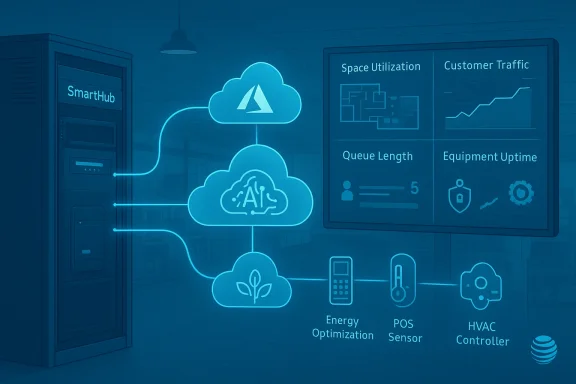
- At its core, Connected Spaces is an edge‑to‑cloud platform that ingests signals from cameras, sensors, and equipment, processes rules and analytics at the SmartHub gateway, and forwards telemetry to Azure for deeper analytics, model training, and long‑term storage.
- The SmartHub functions as a centralized communications and intelligence layer, running on Microsoft Windows technology and providing device orchestration, secure connectivity, and real‑time alerting at the edge.
- Key enterprise use cases AT&T highlights include:
- Space utilization analytics, customer traffic and queue monitoring to optimize staffing and layout.
- Associate efficiency via equipment monitoring, lifecycle telemetry, remote troubleshooting, and workflow automation.
- Energy optimization with consumption monitoring and automated control of HVAC, lighting and equipment.
- Loss prevention and ORC mitigation using AI‑driven video and sensor intelligence.
- The solution is sold as an enterprise offering designed to scale across thousands of sites, integrate with existing back‑end systems, and maintain centralized security and management.
Why this matters: industry context and timing
Physical retail, QSRs, logistics hubs, and hospitality operations are under intense margin and security pressure. Rising organized retail crime, labor constraints, and energy costs have pushed operators toward automation and remote visibility. That creates demand for a packaged solution that:- Reduces on‑site staffing needs by automating routine checks and alerts.
- Uses analytics to optimize staffing and operations with measurable KPIs (dwell time, queue length, equipment uptime).
- Provides proactive loss prevention capabilities that augment security teams rather than replace them.
- Taps cloud scale for cross‑site analytics and model improvements while keeping latency‑sensitive decisions at the edge.
Technical anatomy: SmartHub, edge compute, and Azure integration
The SmartHub gateway
The SmartHub is described as a Windows‑based enterprise gateway that:- Aggregates device telemetry (cameras, environmental sensors, POS signals, HVAC controllers).
- Runs local analytics and rule engines to trigger real‑time alerts.
- Secures device connectivity and manages data flows to the cloud.
- Provides remote management functions, remote troubleshooting, and software updates.
Edge + Cloud model
- Latency‑sensitive work (motion alerts, queue thresholds, immediate device control) is handled at the SmartHub to avoid unnecessary cloud roundtrips.
- Aggregated telemetry and higher‑order analytics, model training, and cross‑store benchmarking are handled in Azure, leveraging cloud compute and Azure AI services.
- The combination aims to deliver the responsiveness of edge compute with the scale and intelligence of cloud analytics.
Connectivity and scale
- AT&T brings enterprise grade connectivity — wired, cellular failover, and managed network components — with the ability to operate at thousands of sites.
- Centralized management aims to allow operations teams to onboard new sites and sensors quickly without disrupting daily workflows.
Strengths and meaningful advantages
- Single‑vendor managed pathway for distributed sites
- Enterprises with thousands of small, remote locations often struggle with fragmented procurement and integration. A single offering that bundles connectivity, edge hardware, device on‑boarding, and cloud integration reduces procurement complexity and shortens time to value.
- Edge‑first architecture
- Keeping real‑time logic at the gateway lowers latency, conserves bandwidth, and reduces cloud costs. That matters for time‑sensitive use cases such as queue detection or immediate equipment fault alarms.
- Azure and Windows ecosystem compatibility
- Integration with Azure AI and cloud services opens access to mature analytics, model lifecycle tools, and enterprise governance frameworks. A Windows‑based gateway benefits organizations already invested in Microsoft management and security tooling.
- Targeted industry use cases
- The initial focus on convenience retail and QSRs maps to high‑frequency operations where ROI from shrink reduction, labor optimization, and energy savings can become material quickly.
- Rapid piloting and scaling
- AT&T's piloting with enterprise customers indicates the offering is already usable in live environments, which reduces the uncertainty enterprises often face when adopting new IoT platforms.
Risks, blind spots, and operational realities enterprises should weigh
1. Surveillance, privacy, and legal exposure
AI‑driven video intelligence and sensor fusion used for ORC detection and loss prevention raise significant privacy and legal questions:- Video analytics systems can produce false positives: merchant profiling and misidentification risk civil liabilities, reputational harm, and regulatory friction.
- Laws governing video surveillance and biometric processing vary by state and municipality; enterprises must ensure lawful notice, retention policies, and data minimization.
- Use of AI to profile individuals or predict intent is a legal and ethical minefield. Enterprises should adopt explicit policy guardrails, human‑in‑the‑loop escalation, and strict access controls.
2. Attack surface: Windows on the edge
Using Microsoft Windows as the gateway OS gives interoperability benefits, but also creates a larger attack surface than hardened, purpose‑built embedded platforms:- Edge devices running full Windows need timely patching and robust remote management to avoid common vulnerabilities.
- Physical access to gateways at distributed sites increases the risk of tampering; secure boot, disk encryption, and tamper detection should be standard.
3. Data residency, governance, and third‑party model risk
- Moving sensitive telemetry (video, POS, employee behavior) into the cloud requires clear data residency and governance controls. Cross‑border data flows and third‑party model training may create compliance challenges.
- If Azure AI models are used to infer behavior or predict loss, enterprises must understand model provenance, auditability, and retraining cadence to avoid model drift and bias.
4. Integration complexity with legacy systems
- “Integrate with existing systems and workflows” is a valuable claim — but reality often requires custom connectors, transformation layers, and change management.
- Enterprises with bespoke POS, HVAC controllers, or legacy camera systems should plan for device compatibility testing and lifecycle replacement costs.
5. Vendor lock‑in and operational dependency
- A tightly coupled offering from AT&T + Microsoft can simplify operations but also creates dependency: changing providers mid‑deployment is costly.
- Enterprises must negotiate clear exit clauses, data export guarantees, and portability of analytics configurations and models.
6. False positives and human workflow impact
- For security and ORC detection to be useful, systems must keep false positives low and integrate cleanly into security operations. Frequent false alerts can erode trust and increase manual triage burden.
Practical adoption considerations: a checklist for IT and operations teams
Before committing to a large rollout, enterprises should treat Connected Spaces like any mission‑critical platform:- Conduct a privacy impact assessment and legal review for surveillance, biometric, and behavioral analytics.
- Run multi‑store pilots that validate accuracy, false positive rates, and ROI for the specific use cases — shrink reduction, queue management, energy savings.
- Confirm device compatibility and inventory: list existing cameras, sensors, POS systems, HVAC controllers, and confirm interoperability with SmartHub.
- Define required SLAs for connectivity, edge compute uptime, and cloud processing latency; include remediation and escalation paths in contract negotiations.
- Insist on transparent model governance: versioning, retraining schedules, test datasets, and explainability for any AI that affects security decisions.
- Validate data retention, encryption (in transit and at rest), role‑based access control, and audit trails for sensitive telemetry.
- Prepare a network architecture plan that segments IoT devices into protected VLANs, applies least privilege, and monitors lateral movement.
- Establish a phased deployment plan that includes training for store managers and security staff on how to act on alerts, handle false positives, and escalate incidents.
Recommended technical safeguards and governance controls
Enterprises that deploy AI‑enabled physical surveillance and device management should enforce the following safeguards:- Zero‑trust segmentation: isolate SmartHubs, cameras, and sensor networks from corporate data networks; use mutually authenticated TLS and device certificates.
- Secure update pipeline: ensure signed firmware and OS updates for SmartHub with rollback capability and secure code signing.
- Edge hardening: enable secure boot, disk encryption, and tamper detection on all gateway hardware.
- Model validation and human review: require human confirmation for any enforcement action suggested by AI (e.g., security detentions, law enforcement referral).
- Data minimization and retention policies: store video and sensor data only as long as needed for the use case; implement automated purge.
- Access logging and auditing: full audit trails for who accessed video, analytics, or device controls; regular audits to validate principle of least privilege.
- Transparency and signage: clear customer and employee notice where video analytics or behavioral tracking is used.
Integration steps: a high‑level implementation roadmap
- Plan and scope pilot: define success metrics (shrink reduction %, queue wait time, energy usage delta).
- Inventory devices and sites: identify incompatible legacy equipment and replacement needs.
- Network readiness: design connectivity, failover (cellular/fiber), and security segmentation.
- Deploy SmartHub in pilot locations: configure edge rules, telemetry forwarding, and local alerts.
- Connect to Azure analytics: validate pipelines, dashboards, and model access controls.
- Tune analytics and operating procedures: refine detection thresholds, escalation workflows, and human‑in‑the‑loop processes.
- Measure ROI and iterate: compare against baseline KPIs, and gradually scale using a phased rollout.
- Operationalize lifecycle management: automate updates, monitoring, and incident response playbooks.
Business and operational ROI: what enterprises can expect
- Shrink and ORC mitigation: when AI drives earlier detection and coordinated responses, pilot customers can expect reductions in shrink and faster recovery on incidents; however, gains depend heavily on integration with security operations and loss prevention teams.
- Labor optimization: queue analytics and space utilization can inform staffing decisions, reducing idle time and improving customer throughput.
- Energy and maintenance savings: telemetry‑driven control of HVAC and equipment can reduce consumption and cut reactive maintenance costs by alerting on anomalies before failure.
- Centralized operational visibility: cloud analytics enable cross‑site benchmarking that can reveal hidden inefficiencies and best practices.
Competitive landscape and market fit
Connected Spaces competes in a crowded market of smart‑building and retail analytics providers, from specialist analytics startups to system integrators and hyperscale cloud offerings. AT&T’s differentiator is the bundled managed offering — combining connectivity, on‑site gateways, and Azure backend — which appeals to enterprises seeking a single commercial and operational partner.However, customers will compare:
- Price and flexibility versus DIY approaches (mix and match cameras, on‑prem VMS, third‑party analytics).
- Security posture and auditability versus purpose‑built hardened appliances.
- Integration depth with existing retail systems (POS, ERP, workforce management).
Final analysis: where Connected Spaces can succeed — and where caution is needed
AT&T Connected Spaces for Enterprise is a pragmatic, enterprise‑oriented approach to turning physical locations into actionable digital assets. For organizations that want a managed path to edge analytics without assembling multiple vendors, the offering is compelling. It leverages the operational strengths of a major carrier together with Microsoft’s cloud and AI ecosystem — a combination that can accelerate deployments, centralize management, and reduce integration friction.That said, the technical and ethical challenges of AI‑driven video surveillance and large‑scale edge deployments are non‑trivial. Enterprises must treat data governance, model accountability, and security hardening as first‑class requirements — not afterthoughts. False positives, privacy violations, and inadequate security posture at the edge can quickly erode any business benefits and expose organizations to regulatory and reputational risk.
For IT and security leaders considering Connected Spaces, the immediate next steps are clear: run tightly scoped pilots, validate the platform against legal and compliance standards, demand transparent model governance, and secure contractual protections for SLAs and data portability. When those boxes are checked, Connected Spaces can be a practical tool in the enterprise toolbox for reducing shrink, improving operations, and making distributed environments more responsive and efficient.
Connected physical spaces are now a major battleground for enterprise efficiency and security; the latest carrier‑cloud plays, like AT&T’s Connected Spaces built on Azure, make it easier to get on the field. But the wins will go to organizations that pair rapid deployment with disciplined governance, clear human oversight, and a security posture that treats the edge with the same rigor as the data center.
Source: AT&T https://about.att.com/story/2026/connected-spaces-for-enterprise.html
