

Auni’s rapid climb — signing more than 3,500 Kenyan businesses inside three months of launch — is a striking early proof-point that AI, when designed for the constraints and habits of frontier markets, can move from novelty into everyday tools for micro, small and medium enterprises (MSMEs). ([businesstimes.co.kmes.co.ke/nairobis-ai-app-auni-surpasses-3500-business-sign-ups-in-three-months/)
Kenya’s digital economy has long pivoted around mobile money rails, and any technology that sits on top of those rails immediately gains reach. Safaricom’s M‑Pesa, the nation’s most ubiquitous mobile-money platform, still commands overwhelming use for person‑to‑person transfers and commerce. While market-share numbers vary by quarter, independent reports place M‑Pesa’s share in the high 80s to low 90s percentage points in recent periods — a market position that turns integrations inside the M‑Pesa ecosystem into a fast route to scale.
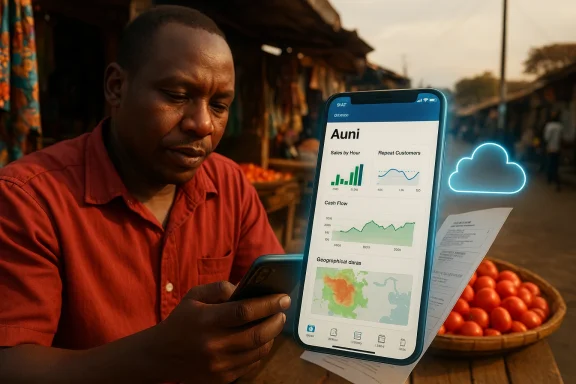
Fastagger, a Nairobi‑based startup, built Auni as a mini app inside Safaricom’s M‑Pesa Business Super App. The product’s promise is straightforward: convert M‑Pesa PDF statements and SMS/mobile-money trails into structured, visual business intelligence so that everyday merchants can see customer patterns, peak hours, cash‑flow trends and other metrics without hiring analysts or building spreadsheets. Fastagger says it optimised Auni to run on low‑cost phones and in low‑connectivity environments, using a combination of on‑device models and cloud services on Microsoft Azure. The result was 3,500 business sign‑ups within three months of the mini app’s launch.
Key context points:
If Fastagger can operationalise careful governance, maintain low device‑side compute costs, and keep merchant trust, Auni could become a template for locally built, globally powered AI products that improve profitability and resilience for the informal economy. The next 12–24 months — as generative features roll out and sector expansions are piloted — will be the decisive phase that tests whether rapid initial adoption translates into lasting, inclusive economic benefit.
Conclusion: Auni’s early momentum shows how context‑aware engineering, platform partnerships and an unglamorous focus on extraction and action can make AI useful today for small businesses. The product’s future, however, depends as much on technical resilience and trustworthy data practices as on marketing and distribution — and that is where the hard, meaningful work begins.
Source: TechTrendsKE Microsoft-Powered AI App Auni Surpasses 3,500 Business Sign-ups in Three Months
 Background
Kenya’s digital economy has long pivoted around mobile money rails, and any technology that sits on top of those rails immediately gains reach. Safaricom’s M‑Pesa, the nation’s most ubiquitous mobile-money platform, still commands overwhelming use for person‑to‑person transfers and commerce. While market-share numbers vary by quarter, independent reports place M‑Pesa’s share in the high 80s to low 90s percentage points in recent periods — a market position that turns integrations inside the M‑Pesa ecosystem into a fast route to scale.Fastagger, a Nairobi‑based startup, built Auni as a mini app inside Safaricom’s M‑Pesa Business Super App. The product’s promise is straightforward: convert M‑Pesa PDF statements and SMS/mobile-money trails into structured, visual business intelligence so that everyday merchants can see customer patterns, peak hours, cash‑flow trends and other metrics without hiring analysts or building spreadsheets. Fastagger says it optimised Auni to run on low‑cost phones and in low‑connectivity environments, using a combination of on‑device models and cloud services on Microsoft Azure. The result was 3,500 business sign‑ups within three months of the mini app’s launch.
Why this matters: the structural problem Auni tackles
Small businesses in Kenya and across much of sub‑Saharan Africa transact heavily via mobile money, but that transactional data is rarely converted into accessible insights.- Many merchants use paper ledgers, spreadsheets, or memory to track sales.
- M‑Pesa statements arrive as PDF or SMS blobs that are hard to analyse at scale.
- Internet connectivity and device capabilities vary; many merchants use basic Android phones.
- Hiring data analysts or subscribing to enterprise BI tools is out of reach for typical MSMEs.
Overview of how Auni works (technical breakdown)
Data extraction: OCR + table extraction
Auni begins with the documents merchants already receive: monthly or transactional PDF statements from M‑Pesa, plus SMS receipts. Using optical character recognition (OCR), Auni converts images and PDFs into text. A subsequent table‑extraction layer normalises rows into transaction records (date, time, payer, amount, reference). For lower‑resolution scans or older phones, the pipeline includes heuristics for noisy characters and pattern‑matching to typical M‑Pesa receipt formats.Lightweight models for edge conditions
To serve merchants with limited connectivity or older devices, Auni uses pruned, compressed AI models that can run partially or fully on device. Fastagger’s engineering team compresses models and leans on runtime tools that are known to be efficient on mobile hardware; Microsoft Azure provides cloud‑scale fallbacks when connectivity and compute budgets allow. This hybrid model reduces latency, cuts data transfer costs, and improves privacy by keeping sensitive data on the merchant’s device where possible.Analytics and dashboards
Once transactions are structured, Auni produces pre‑built dashboards focused on the core decisions MSME owners care about:- Sales by hour and day (peak hours)
- Repeat customer frequency
- Average transaction size and revenue trends
- Geographic concentrations by payer details
- Cash‑flow projections and receivables tracking
Roadmap: natural‑language interaction and generative features
Fastagger says Auni will add generative AI features so merchants can query their data in plain language (for example: “How did weekend revenue change after the September promotion?”) and receive concise, contextual answers. Where generative components are added, Fastagger plans to blend on‑device summarisation with cloud models to reduce latency and limit data exfiltration. Those generative features are explicitly on the product roadmap and align with a trend of conversational BI.Market context: why the grab for MSMEs is strategic
MSMEs are the backbone of many African economies. Across policy papers and regional analyses, small businesses frequently represent the vast majority of registered enterprises and provide a substantial share of employment — numbers commonly cited near 90 percent of businesses and 50–80 percent of employment, depending on how formal and informal activity is measured. Strengthening the productivity of thousands of small firms yields outsized social and macroeconomic benefits.Key context points:
- Mobile money penetrated Kenya far earlier and more deeply than the rest of the world, making M‑Pesa an embedded payments layer.
- The M‑Pesa Business Super App gives third‑party mini apps fast access to an active merchant audience — a distribution advantage that would be costly to replicate via standalone apps.
- Even small percentage increases in customer retention or operational efficiency can drive meaningful profit improvements for low‑margin MSMEs. Research often cited in practitioner literature suggests that modest retention gains translate into double‑digit profitability increases.
Real merchants, real outcomes: early case studies
Mandevu Beard Care — turning receipts into inventory and channel strategy
Njoki Njoroge, founder of Mandevu Beard Care, told reporters that Auni gave her a unified view of online and offline orders, repeat‑purchase timing, and geographic demand patterns. That visibility enabled targeted reminders when products were likely to run out, better retailer negotiations, and smarter delivery resourcing during peak hours. The practical effect: fewer stockouts and faster fulfilment cycles, which are crucial for a fast‑moving consumer brand.Master Stylists Hair Salon — smarter staffing and retention marketing
For a neighborhood salon, understanding which days and hours deliver peak traffic and which customers lapsed has a direct impact on scheduling and promotions. The salon owner who used Auni reported being able to design targeted discounts and send re‑engagement offers — moves that translated into higher utilization of staff and measurable revenue growth. These are the bread‑and‑butter operational decisions that scale across thousands of similar small businesses.Critical analysis: strengths, limitations and risks
Strengths
- Distribution leverage: Embedding Auni inside M‑Pesa’s Business Super App gives massive distribution and discovery without expensive customer acquisition. This is a core reason 3,500 sign‑ups were achievable so quickly.
- Design for constraints: Optimising models for low‑end Android devices and intermittent connectivity is precisely the product engineering required for frontier markets; it reduces the dependency on continuous cloud compute and keeps costs down.
- Focus on actionability: The product’s UX prioritises immediate operational decisions (staffing, promotions, deliveries) rather than forcing merchants into complex dashboarding workflows they may never use.
- Local entrepreneurship + global infra: Auni is a locally built solution that layers on Microsoft Azure services — a collaboration model that combines regional market understanding with reliable cloud infrastructure.
Limitations and technical risks
- OCR accuracy on low‑quality PDFs and SMS: OCR remains brittle with noisy input. Older phones, scanned printouts, or non‑standard statement formats can increase error rates. Those errors cascade into analytics biases — e.g., undercounted transactions or misattributed payers.
- Model drift and receipt variability: M‑Pesa statement templates can change, and merchant payment narratives are often inconsistent. Maintaining table‑extraction accuracy will require ongoing model retraining and robust monitoring.
- Device heterogeneity: Africa’s handset ecosystem is diverse; what runs on one four‑gigabyte phone may stutter on another with a slower CPU or older Android version. The user experience can vary widely, which challenges uniform product quality.
- Generative AI hallucinations: When generative or conversational features are added, the product will need strong grounding mechanisms to prevent confidently wrong answers. For business decisions, hallucinations are not merely irritating — they could be harmful.
Privacy, data governance and regulatory exposure
- Sensitive financial data: Auni processes transaction‑level financial information. Even if processing happens on device, backups, cloud fallbacks or support workflows may transmit PII or transactional metadata to servers. Transparent, auditable data‑handling policies and opt‑in consent flows are essential.
- Third‑party platform dependency: Auni’s reach comes from being inside the M‑Pesa Super App; that dependency creates strategic risk. Changes to Safaricom’s partner policies, API access, or revenue‑share terms could affect distribution or economics.
- Regulatory scrutiny: As governments intensify scrutiny on fintech, cross‑border data flows, and AI, Auni and Fastagger will need to ensure compliance with local data‑protection rules and payments regulation. Non‑compliance could derail deployment or impose fines.
Commercial model and unit economics
Fastagger has several commercial levers it can use, each with pros and cons:- Freemium + paid tiers: Give basic dashboards for free, charge for advanced reporting, exports, or multi‑user access.
- Revenue share with Safaricom: Negotiate a commercial split in exchange for preferred placement inside the super app.
- Enterprise upsell: Offer custom analytics and integrations to larger merchants or aggregators for higher ARPU.
- Channel partnerships: Integrate with POS vendors, aggregator platforms or logistics providers to create bundled offerings.
Competitive landscape and positioning
Auni sits within an emerging class of on‑device or hybrid BI tools targeted at frontline commerce. Competitors may include:- Local startups building merchant analytics tied to point‑of‑sale or e‑wallet data.
- International SaaS companies offering lightweight analytics via web dashboards.
- Telecom/VAS providers expanding their merchant services.
- Iterate on data ingestion robustness for varied statement formats.
- Keep latency and compute costs low on device.
- Build trust around privacy and financial data handling.
Product roadmap: sector expansion and generative AI
Fastagger has signalled plans to expand Auni into sectors beyond retail and salons — notably healthcare, manufacturing and agriculture — and to add generative AI capabilities that let entrepreneurs ask natural‑language questions about performance.- Healthcare: Turning payment flows into revenue and claims intelligence for clinics and pharmacies.
- Manufacturing: Aggregating supplier payments and invoicing cadence to improve working capital planning.
- Agriculture: Mapping seasonal cash flows and buyer concentrations for traders and aggregators.
Governance checklist: what Fastagger should publish and operationalise
- Clear data‑use policy: Explain what stays on device, what is uploaded, and for what purpose.
- Model validation docs: Publish error rates for OCR and table extraction on representative statement samples, plus a changelog of template coverage.
- Human‑in‑the‑loop support: Offer merchant review flows to correct misparsed transactions and feed corrections back into training data.
- Regulatory map: Document compliance with local data‑protection law and payment‑data custody rules.
- Security controls: Use strong device encryption, encrypted backups, MFA for dashboard exports, and least‑privilege cloud access.
Broader implications: economics, jobs and inclusion
Auni’s early traction illustrates a broader principle: democratising data access at scale can tilt competitive dynamics for low‑margin businesses. When thousands of merchants move from intuition to evidence‑based decision‑making, the cumulative effect could include:- Higher retention and revenue for local shops, supporting livelihoods.
- Better supply‑chain coordination as merchants negotiate with evidence.
- More informed lending and working‑capital products when lenders can rely on cleaner, digitised transaction histories.
Recommendations for merchants, partners and policymakers
For merchants evaluating Auni today:- Start with a single month of statements to validate extraction accuracy.
- Use insights to make one operational change (staffing, promotion timing) and measure results over 30–60 days.
- Correct any misparsed transactions via the app to improve future accuracy.
- Consider a merchant education push explaining how data is processed and secured.
- Enable an easy opt‑in for cloud backup that is transparent about storage and access.
- Foster a sandbox for AI solutions handling financial data to set standards for consent, portability and redress.
- Support digital literacy programs that help small merchants interpret and act on BI outputs.
Final appraisal: pragmatic innovation with meaningful caveats
Auni’s first quarter — onboarding 3,500 businesses through a mini‑app inside the M‑Pesa ecosystem — is an encouraging example of pragmatic, constraint‑aware AI product design. It demonstrates three principles that matter for tech in emergifor the lowest common denominator of device and connectivity.- Leverage existing distribution rails (payments, telco super apps).
- Focus tightly on decisions merchants actually make.
If Fastagger can operationalise careful governance, maintain low device‑side compute costs, and keep merchant trust, Auni could become a template for locally built, globally powered AI products that improve profitability and resilience for the informal economy. The next 12–24 months — as generative features roll out and sector expansions are piloted — will be the decisive phase that tests whether rapid initial adoption translates into lasting, inclusive economic benefit.
Conclusion: Auni’s early momentum shows how context‑aware engineering, platform partnerships and an unglamorous focus on extraction and action can make AI useful today for small businesses. The product’s future, however, depends as much on technical resilience and trustworthy data practices as on marketing and distribution — and that is where the hard, meaningful work begins.
Source: TechTrendsKE Microsoft-Powered AI App Auni Surpasses 3,500 Business Sign-ups in Three Months
