

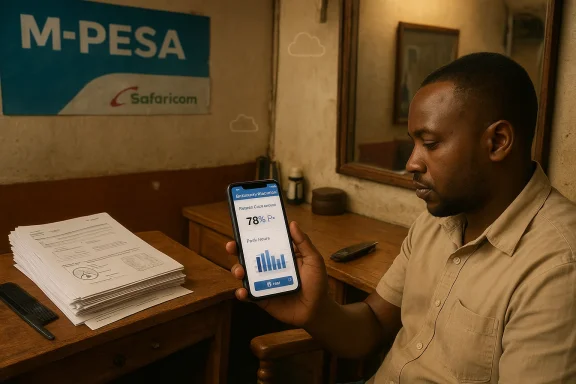
A small Nairobi barber shop using an app inside M-Pesa to turn a stack of PDF transaction statements into a simple chart of repeat customers and peak hours is not a novelty — it is a signal. In the past three months a Nairobi startup called Fastagger has embedded a mini app, Auni, inside Safaricom’s M-Pesa Business Super App and signed up thousands of MSMEs. Auni converts M-Pesa PDF statements into structured tables and dashboards using optical character recognition, lightweight table-extraction models and a mix of on-device and cloud processing, delivering instant, actionable business intelligence to merchants who previously relied on memory, receipts and gut feel. What sounds like small plumbing — extracting rows from a PDF — is quietly reshaping how Kenyan small businesses run sales, staffing, inventory and local expansion, and it exposes broader technical, regulatory and strategic consequences for the mobile-money-first economies of Africa.
M-Pesa is more than a payment rail in Kenya — it’s the ledger for everyday commerce. Millions of transactions flow through it daily, and for many micro and small businesses the only consolidated record they receive is a periodic PDF statement. Those statements are information-dense: customer names or phone numbers, timestamps, amounts, sometimes narrative notes — but they are not analysis-ready.
Auni’s core value proposition is simple: turn the PDF into a table, then turn the table into insights. The app applies optical character recognition (OCR) to extract text, uses table reconstruction to restore rows and columns, and maps transactions into a compact dashboard that surfaces repeat customers, peak sales hours, geographic hotspots and cash-flow trends. This removes manual spreadsheet labor and the need for dedicated IT staff — two major friction points for MSMEs operating on tight margins and older Android devices.
That simplicity is not accidental. Fastagger designed Auni explicitly for African constraints: intermittent connectivity, low-end phones, and a distribution channel that already reaches merchants — Safaricom’s M-Pesa Business Super App. The result: adoption that moved quickly in the early months after launch and a product that quietly embeds analytics into the merchant workflow.
This hybrid design balances four constraints that matter in real-world deployments:
Beyond raw sign-ups, early qualitative outcomes from merchants illustrate the business value:
That shift produces a positive feedback loop:
But growth must be paired with responsibility. The power of transactional data to improve operations is real and immediate; the risks to privacy, security and market power are also real. As telco super apps and startups build the next layer of SME tools, the best outcomes will come from combining rapid iteration with clear guardrails: consent, portability, minimal data collection, and transparent model outputs.
If these elements come together, the result will be quietly transformative: millions of small enterprises moving from intuition to insight with tools that are unglamorous, inexpensive and profoundly practical. That shift — from receipts to recommendations to smarter local economies — may be the most consequential way AI can help everyday entrepreneurs across Africa and beyond.
Source: LinkedIn From beards to bytes: How AI is empowering small business owners in Kenya | Fintech Association Of Kenya
 Background: why M-Pesa PDFs hold the key
M-Pesa is more than a payment rail in Kenya — it’s the ledger for everyday commerce. Millions of transactions flow through it daily, and for many micro and small businesses the only consolidated record they receive is a periodic PDF statement. Those statements are information-dense: customer names or phone numbers, timestamps, amounts, sometimes narrative notes — but they are not analysis-ready.Auni’s core value proposition is simple: turn the PDF into a table, then turn the table into insights. The app applies optical character recognition (OCR) to extract text, uses table reconstruction to restore rows and columns, and maps transactions into a compact dashboard that surfaces repeat customers, peak sales hours, geographic hotspots and cash-flow trends. This removes manual spreadsheet labor and the need for dedicated IT staff — two major friction points for MSMEs operating on tight margins and older Android devices.
That simplicity is not accidental. Fastagger designed Auni explicitly for African constraints: intermittent connectivity, low-end phones, and a distribution channel that already reaches merchants — Safaricom’s M-Pesa Business Super App. The result: adoption that moved quickly in the early months after launch and a product that quietly embeds analytics into the merchant workflow.
How Auni works: the tech behind the table
Auni’s architecture is pragmatic and hybrid: lightweight models on device for speed and reliability, and cloud services for heavier tasks, updates and cross-account aggregation.The pipeline, step by step
- The merchant opens the Auni mini app inside the M‑Pesa Business Super App and imports a PDF statement.
- An OCR engine reads the PDF and converts images of text into character data.
- A table-extraction model reconstructs transaction rows and their associated fields — date, time, amount, counterparty data, and narrative.
- Parsed records are normalized and mapped to analytics schemas: customer frequency, average ticket size, peak hours, product-type proxies and basic cash-flow.
- Auni renders a small dashboard and generates operational prompts (restock reminders, staffing suggestions, win-back offers).
- Optionally, anonymized or aggregated data can be uploaded to cloud services for model improvements and optional generative features.
Lean models, practical trade-offs
To operate on low-spec phones and unstable networks, Auni uses pruned, edge-friendly models and open-source tools where possible. This reduces latency and compute cost and allows many operations to run without continuous connectivity. Heavier operations — such as cross-merchant aggregation, backups, and model retraining — are delegated to cloud infrastructure.This hybrid design balances four constraints that matter in real-world deployments:
- Performance on older CPUs and limited memory.
- Robustness during intermittent connectivity.
- Cost control for startups and merchants.
- A privacy posture that reduces constant cloud transfer of raw transaction logs.
Early traction: numbers that matter
The most-talked-about metric is adoption: roughly 3,500 merchant sign-ups in the first three months after Auni was embedded in the M‑Pesa Business Super App. That figure is notable for two reasons. First, it suggests a product-market fit for low-friction analytics among merchants who already live in the M‑Pesa ecosystem. Second, it demonstrates the power of platform distribution: embedding inside a widely used super app removes onboarding barriers that typically slow down standalone SaaS for MSMEs.Beyond raw sign-ups, early qualitative outcomes from merchants illustrate the business value:
- A hair salon reworked staffing rosters to align with peak appointment hours identified in transaction logs, improving utilization and reducing overtime costs.
- A beard-care retailer identified repeat customers and introduced targeted restock SMS, recovering lapsed buyers and smoothing inventory turnover.
- A small grocery used neighborhood demand maps to plan a second kiosk, reducing last-mile delivery friction and increasing daily cash flow.
Why this matters strategically: M-Pesa’s move up the stack
Embedding analytics mini apps like Auni is a strategic inflection for digital platforms. M‑Pesa began as a payments rail. Adding merchant-facing operating tools — bookkeeping, analytics, inventory prompts — nudges Safaricom toward becoming an SME operating layer, not just a transaction provider.That shift produces a positive feedback loop:
- More utility inside the platform increases merchant stickiness.
- Stickier merchants generate richer transactional signals.
- Richer data enables better tools and personalization.
- Better tools further increase platform engagement and revenue opportunities.
Strengths: why Auni’s approach is high-impact
- Low-friction distribution. Embedding inside a super app eliminates many onboarding barriers — merchants don’t discover an unknown standalone app and they can reuse a credentialed environment they already trust.
- Opportunity-rich data. For many Kenyan MSMEs, M-Pesa transaction logs are the closest thing to an operational database. Converting that data into insights is high-return work.
- Device- and connectivity-aware design. Prioritizing on-device inference and minimal cloud roundtrips matches the constraints of the target market and reduces latency and cost.
- Practical ROI. Auni focuses on operational decisions with immediate payoff — staffing, restock timing, customer win-backs — rather than abstract predictive scores that are harder to act on.
- Rapid evidence of demand. Early adoption numbers and repeat-user anecdotes suggest merchants value accessible analytics and are willing to try integrated mini apps.
Risks and open questions: the darker side of the flywheel
High-impact plumbing raises complex questions. Four concerns deserve particular scrutiny.1. Privacy and consent
Transactions are financial records. Even when parsed and analyzed for operational insights, transaction data contains sensitive details: counterparty phone numbers, amounts, timestamps and sometimes purchase narratives. Responsible design requires:- Clear, informed consent flows that explain what is extracted and how it will be used.
- Data-minimization by default — only extract and persist fields that are strictly necessary for the merchant’s requested features.
- Easy revocation and deletion options for merchants.
2. Data governance and security
Where is the parsed data stored, and who can access it? Hybrid designs reduce cloud transfer but do not eliminate the need for secure backups and central analytics. Critical controls include:- Strong encryption in transit and at rest.
- Role-based access control and audit logs for any cloud-hosted datasets.
- Explicit policies on retention, anonymization, and aggregation thresholds.
3. Lock-in and vendor economics
Embedding inside a dominant platform offers fast distribution but creates dependencies. Questions merchants should consider:- If the mini app is tightly coupled to M-Pesa, can merchants export their structured data in open formats?
- What are the terms if Safaricom changes platform rules or if the min app is delisted?
- Is there a clear migration path or data portability mechanism?
4. Model accuracy and fairness
OCR and table-extraction models perform differently across diverse fonts, languages, handwritten notes and low-quality scans. Poor extraction can produce misleading dashboards — for example, misattributing multiple customers to one phone number or failing to detect refunds versus sales. Operational decisions based on bad signals can harm small businesses. To mitigate this:- Provide explainable UI cues and simple quality checks (e.g., show parsed rows for merchant confirmation).
- Surface confidence scores and allow easy corrections.
- Continuously test models on representative, real-world statements, including noisy and atypical formats.
Design lessons for “AI for SMEs” from the Auni case
Auni’s early success suggests a few design axioms worth generalizing for AI products aimed at small businesses in emerging markets.Build where users already are
Embedding within a mass-market platform (a super app, a telco bundle) is often the fastest path to traction. Distribution is half the product for resource-constrained MSMEs.Solve concrete operational problems
High-value, low-complexity features beat flashy generative chatbots for small merchants. Items like repeat-customer identification, peak-hour staffing suggestions, and restock triggers are easy to understand, measure, and monetize.Optimize for constraints
Design for low compute, intermittent connectivity and a mix of languages, scripts and document quality. That typically means edge-friendly models, compact data schemas and asynchronous flows that tolerate interruptions.Minimize cognitive load
Present one clear action per insight. Instead of dashboards that require interpretation, give direct next steps: “Send SMS to 12 customers who haven’t purchased in 30 days,” or “Open one additional shift on Saturdays.”Make corrections simple
Allow merchants to validate and correct parsed records quickly. This both improves model quality and builds trust.Regulatory and ethical guardrails to insist on
As these tools spread across payment platforms and telco super apps, regulators and platform owners should adopt guardrails that protect small-business owners and their customers without stifling innovation.- Consent and purpose limitation. Extraction must be limited to purposes explicitly agreed by the merchant. Reuse of parsed data for unrelated features should require fresh consent.
- Data portability. Merchants should be able to export structured data in open formats to switch providers or run their own analysis.
- Transparency and redress. Merchants must see why a recommendation was made, the confidence behind it, and an easy way to correct errors.
- Minimum-security standards. Platforms hosting financial-transaction-derived analytics should be subject to baseline security requirements and periodic audits.
- Non-discrimination. If models begin to support lending or credit scoring, fairness checks and dispute processes are essential to prevent the entrenchment of bias.
Business models and sustainability
How does a mini app like Auni sustain itself while keeping the product accessible to micro-businesses?- Freemium with high-value paid features: basic analytics remain free or tethered to the super app relationship, while advanced capabilities (multi-location aggregation, staff payroll suggestions, advanced segmentation) are paid.
- Platform revenue share: the super app can take a commission for distribution, lowering acquisition costs but creating margin pressure on the startup.
- B2B partnerships: integrate with suppliers, distributors or local banks for contextual offers (invoice factoring, inventory credit) that are monetized via referral or partnership fees.
- Data-as-a-service (carefully governed): anonymized, aggregated market insights can be sold to supply-chain actors or city planners — but this requires ironclad privacy controls and merchant consent.
What comes next: natural language queries, multi-source fusion, and regional expansion
Fastagger’s roadmap includes two natural next steps that are already visible across similar efforts worldwide.Natural-language querying
Allowing merchants to ask questions in plain language — “Which days last month had the highest average sale?” — lowers the friction of analysis further. To be useful in this context, natural-language features must be robust to local dialects, Swahili-English code-switching and simple enough to avoid hallucinations. That suggests small, deterministic language models or retrieval-augmented approaches rather than large, unconstrained generative models.Fusion with other data sources
M-Pesa statements are a rich starting point, but combining them with other signals — SMS logs, supplier invoices, inventory snapshots, or point-of-sale inputs — will deepen insights. Multi-source fusion must be opt-in and modular so merchants can add capabilities progressively.Geographic and sectoral growth
If the model generalizes, the product can scale to other markets where mobile money is dominant — Tanzania, Uganda and beyond — or to adjacent sectors like formalized retail, health clinics, and micro-factories. Each new sector requires additional parsing rules and domain-specific safety checks.Practical guidance for merchants and platform operators
For small-business owners considering a tool like Auni, practical questions matter more than technical details. Here is a short checklist:- Confirm what fields the app extracts and whether those are necessary for the features you want.
- Check data-export options: can you get your structured records if you leave the service?
- Look for simple validation UIs that let you correct parsed rows — this prevents bad recommendations.
- Understand the consent flow: who gets access to your data, under what conditions, and for how long?
- Try a pilot: use the insights for one operational decision (staffing or a small win-back campaign) and measure the result before changing core processes.
- Require apps that handle financial-transaction parsing to disclose data flows in plain language.
- Mandate basic security controls for any mini app that stores or transmits transaction-derived data.
- Encourage portability with standardized export formats for parsed transaction data.
Conclusion: unglamorous plumbing with outsized impact
The Auni story reframes how we should think about AI for MSMEs in emerging markets. The headline is not a dramatic chatbot or a viral consumer app — it’s a focused utility that turns messy PDFs into a decision-support layer on the devices business owners already use. That kind of pragmatic engineering — edge-aware models, careful UI design, and platform-based distribution — can scale rapidly and deliver concrete value to merchants.But growth must be paired with responsibility. The power of transactional data to improve operations is real and immediate; the risks to privacy, security and market power are also real. As telco super apps and startups build the next layer of SME tools, the best outcomes will come from combining rapid iteration with clear guardrails: consent, portability, minimal data collection, and transparent model outputs.
If these elements come together, the result will be quietly transformative: millions of small enterprises moving from intuition to insight with tools that are unglamorous, inexpensive and profoundly practical. That shift — from receipts to recommendations to smarter local economies — may be the most consequential way AI can help everyday entrepreneurs across Africa and beyond.
Source: LinkedIn From beards to bytes: How AI is empowering small business owners in Kenya | Fintech Association Of Kenya
