

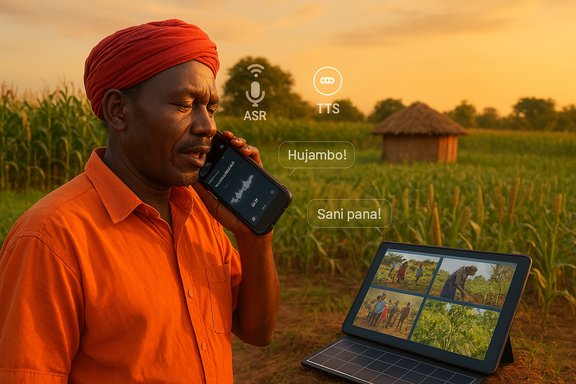
Microsoft Research’s Project Gecko is rolling out a speech‑first, multimodal AI pilot that targets smallholder farmers in Kenya and India — bringing Automatic Speech Recognition (ASR), Text‑to‑Speech (TTS), Small Language Models (SLMs), and a novel reasoning layer called the MultiModal Critical Thinking Agent (MMCTAgent) to local languages such as Swahili, Kikuyu, Maa and others, and integrating that capability into Digital Green’s FarmerChat to deliver voice, text and time‑anchored video answers tailored to oral‑first farming communities.
Generative AI has accelerated productivity in many markets, but its training data and interfaces are heavily biased toward English and text‑first online communities. That leaves large parts of the world — oral‑first users, low‑bandwidth environments, and speakers of low‑resource languages — with tools that are slow, inaccurate, or culturally inappropriate. Project Gecko is positioned as an answer to that imbalance: a cross‑lab Microsoft Research initiative co‑led from the Microsoft Research Accelerator, Microsoft Research Africa (Nairobi), and Microsoft Research India that explicitly focuses on building AI systems “from the ground up” for the global majority. Agriculture is the initial focus because it is a classic multiplier sector: improving extension services and on‑field decision support for smallholder farmers can raise incomes, increase resilience, and improve food security at scale. Microsoft chose to pair new models and tooling with Digital Green’s FarmerChat — a speech‑first assistant already used in field pilots — to ground AI outputs in locally produced videos and community knowledge rather than distant web content. Early field work in Kenya and India shows improved response quality, usability and user trust versus off‑the‑shelf systems.
Project Gecko’s ambition — to deliver multilingual AI for the global majority that speaks like and listens to the communities it serves — is both timely and necessary. If Microsoft and its partners sustain localized governance, measurable benchmarks, and meaningful community partnerships, this approach could become a practical blueprint for bringing generative AI to oral‑first, low‑bandwidth populations across sectors beyond agriculture.
Source: HapaKenya - Microsoft launches AI to empower farmers with speech models in Kikuyu, Swahili & Maa - HapaKenya
 Background: why Microsoft built Project Gecko and why agriculture first
Generative AI has accelerated productivity in many markets, but its training data and interfaces are heavily biased toward English and text‑first online communities. That leaves large parts of the world — oral‑first users, low‑bandwidth environments, and speakers of low‑resource languages — with tools that are slow, inaccurate, or culturally inappropriate. Project Gecko is positioned as an answer to that imbalance: a cross‑lab Microsoft Research initiative co‑led from the Microsoft Research Accelerator, Microsoft Research Africa (Nairobi), and Microsoft Research India that explicitly focuses on building AI systems “from the ground up” for the global majority. Agriculture is the initial focus because it is a classic multiplier sector: improving extension services and on‑field decision support for smallholder farmers can raise incomes, increase resilience, and improve food security at scale. Microsoft chose to pair new models and tooling with Digital Green’s FarmerChat — a speech‑first assistant already used in field pilots — to ground AI outputs in locally produced videos and community knowledge rather than distant web content. Early field work in Kenya and India shows improved response quality, usability and user trust versus off‑the‑shelf systems. What Project Gecko actually delivers: core components and capabilities
Project Gecko is not a single product; it’s a stack of technical and human‑centered pieces designed for deployment in low‑resource, multilingual settings.Core technical building blocks
- VeLLM platform — a foundation to create multilingual, multimodal copilots that can be tailored to cultural contexts and limited hardware. VeLLM is the orchestration layer for model adaptation, retrieval, and grounding.
- MMCTAgent (MultiModal Critical Thinking Agent) — a reasoning agent that decomposes complex queries across modalities (speech, text, images, long‑form video), devises a strategy, and verifies answers with an internal critic. Its goal is to reduce hallucination by grounding answers in community videos and transcripts and by allowing the agent to "check itself." MMCTAgent has been released as a research experiment and shows improved multimodal reasoning in internal benchmarks.
- Speech models (ASR and TTS) — ASR and TTS have been developed or fine‑tuned specifically for Kenyan local languages and other target languages, trained on crowd‑sourced speech data. Microsoft reports approximately 3,000 hours of Kenyan speech data used to expand support to Swahili, Kikuyu, Kalenjin, Dholuo, Maa, and Somali. These models are optimized for oral‑first interaction patterns common among farmers.
- Small Language Models (SLMs) — lightweight LMs tuned for domain content and to run efficiently on low‑cost devices with limited compute and bandwidth. SLMs are used when full‑scale LLMs are impractical on the device or costly to operate remotely.
Product integration: FarmerChat + community videos
FarmerChat, developed by Digital Green, is a speech‑first web assistant that indexes community‑produced agricultural videos. Project Gecko’s MMCTAgent enables farmers to ask a question in a local language (voice or text), receive an actionable response, and be taken directly to the relevant video segment — i.e., the video will start at the exact timestamp where the solution appears. Responses can be delivered in text, audio (TTS), and an anchored video clip extracted from community content. This multimodal grounding is central to the project’s trust and usability claims.Verified technical claims and evidence
To avoid repeating press summaries without verification, the most important technical claims were cross‑checked against Microsoft Research’s public pages and independent press coverage.- Microsoft Research’s Project Gecko pages (Project Gecko overview and research story) explicitly describe VeLLM, MMCTAgent, an initial agriculture focus, the 3,000‑hour Kenyan speech dataset, and support for six Kenyan languages. These statements come directly from Microsoft Research materials.
- Independent technology outlets and national press coverage (examples include Times of India and Mint) corroborate the project scope and list MMCT/VeLLM/SLM concepts and the FarmerChat partnership. These outlets summarize the same core facts and quote Microsoft’s stated goals and partners, providing independent confirmation of the announcement.
Why Project Gecko’s design matters for farmers
Project Gecko deliberately applies several design choices aligned to typical constraints in rural, agricultural settings:- Speech‑first interfaces match oral learning traditions and high illiteracy or low digital literacy rates in many rural areas. ASR and TTS in local languages lower the barrier to use.
- Multimodal grounding (answers linked to community video evidence) strengthens trust because farmers can see the technique demonstrated by peers in a local context.
- SLMs and model optimization make on‑device inference feasible, reducing latency, cost, and dependency on continuous high‑bandwidth connections. This is essential for low‑cost phones and patchy mobile coverage.
- Community data loops (crowd‑sourced speech, local videos) allow iterative improvement with real‑world inputs rather than only web‑scraped corpora that poorly reflect local practices.
Critical analysis: strengths, practical impact, and early signals
Strengths and opportunities
- Contextual accuracy and trust: Grounding answers in community videos and transcripts helps reduce the classic “LLM hallucination” problem by tying recommendations to demonstrable practices. For many farmers, seeing a neighbor’s video showing a planting technique is more convincing than a generic text instruction.
- Language coverage and inclusion: Supporting Kiswahili, Kikuyu, Kalenjin, Dholuo, Maa, and Somali addresses real, documented gaps in ASR/TTS coverage for African languages. The explicit focus on code‑switching and oral modalities is a step beyond surface translations.
- Low‑resource engineering: Emphasis on SLMs and edge optimization acknowledges the economic realities of hardware in the field and can make the solution more sustainable and affordable.
- Human‑centered evaluation: Microsoft reports field studies with over 130 farmers showing improved response quality and trust — an encouraging early signal for real‑world usefulness versus lab benchmarks.
Practical impact scenarios
- A farmer with a Kikuyu‑language query about a pest can speak into FarmerChat, receive step‑by‑step audio instructions, and watch a two‑minute video clip showing the treatment, starting precisely where the technique is demonstrated. That saves time and reduces ambiguity.
- Extension workers can use MMCTAgent to compile verified, localized evidence packages (text + short video clips) to standardize training across districts without requiring heavy in‑person workshops.
Risks, unknowns, and governance challenges
Project Gecko’s ambitions are technically and socially promising, but the deployment context raises several material risks that need mitigation:- Data provenance and consent: Crowd‑sourced speech and community videos are central to the approach, but there is limited public detail about consent workflows, data ownership, and whether contributors retain rights or are compensated. Responsible deployment should document consent, opt‑out, and benefit‑sharing mechanisms. This is not yet fully documented in public materials.
- Quality and liability of recommendations: Agricultural advice can have real financial and ecological consequences. If an agent recommends an incorrect pesticide dosage or timing, who is accountable? Relying on community videos may perpetuate local bad practices if not validated by agronomic experts. MMCTAgent’s internal critic reduces risk, but operational governance (human review, disclaimers, escalation pathways) is essential and not fully specified in public briefings.
- Model bias and representativeness: Even 3,000 hours of speech — while substantial — may not fully capture dialectal variance, female voice patterns, or domain‑specific vocabulary across regions. Under‑represented dialects could see reduced accuracy, producing poorer outcomes for the most vulnerable users.
- Privacy and telemetry: Low‑cost devices and intermittent connectivity mean systems will likely batch and sync data. Telemetry on usage and geo‑tagged media can be valuable for improvement, but it also raises surveillance and privacy risks if not carefully protected. Public documentation on telemetry policies is sparse.
- Sustainability and long‑term support: Pilots can produce impressive early results; scaling and maintaining models (continuous retraining, moderation of videos, updating agronomic guidance) requires ongoing funding and local capacity-building. There’s a risk of short‑term pilots that leave communities dependent on tools that later degrade.
Recommendations for responsible deployment and scale
- Implement explicit, auditable consent and data‑use contracts for every contributor of audio or video, with local language consent flows and clear options for withdrawal.
- Establish a mixed review panel of agronomists and trusted local extension agents to vet and curate community videos used as evidence; require an “expert validation” flag for any recommendation that could have health or economic risk.
- Publish model performance metrics broken down by language, dialect, gender, and domain (pest, irrigation, fertilizer) and maintain a public leaderboard for transparent benchmarking of ASR/TTS/SLM performance.
- Design offline‑first UX patterns (message queues, SMS fallbacks, compressed audio) so key guidance survives connectivity drops and can be shared peer‑to‑peer without the cloud.
- Fund local capacity building for model maintenance: train local data stewards, linguists, and extension officers to curate and update evidence libraries and retrain models with newly collected data.
Implementation realities: devices, bandwidth, and UX tradeoffs
Project Gecko’s emphasis on SLMs and ASR/TTS is a practical recognition of hardware limitations. However, deployment success depends on small but critical UX and infrastructure choices:- Model sizing vs. latency: Smaller models reduce compute and energy use but can lose nuance. Designing hybrids — on‑device SLMs for first‑pass answers and cloud LLMs for complex queries — balances responsiveness with depth.
- Data compression and video anchoring: Serving time‑anchored video clips is powerful but bandwidth‑heavy. Practical deployments will need server‑side transcoders to deliver short, low‑bitrate video segments and progressive downloads.
- Multilingual UX: Farmers frequently code‑switch between languages; the ASR and dialogue manager must handle mixed utterances and preserve intent across switches. Models must be trained and evaluated on code‑mixed speech datasets.
Broader ecosystem context and comparisons
Microsoft is not the only org working on inclusive multilingual AI, but its approach bundles research, tooling, and field partnerships in a way that stands out. Project Gecko’s release sits alongside other initiatives (open datasets for African languages, regional dataset consortia, and private companies providing localized speech corpora), and the field is rapidly evolving. For example, community datasets like KenCorpus and distributed collections on public repositories are enabling more independent ASR/TTS work in East Africa; commercial data vendors also provide large Swahili corpora for enterprise use. Those parallel efforts complement and sometimes compete with platform‑level programs like Project Gecko. Community and forum conversations also highlight industry momentum: recent WindowsForum threads examine similar industry partnerships (for example, collaborations between Microsoft and Land O’Lakes for agronomic copilots), showing a trend toward sector‑specific copilots for agriculture.What success looks like — measurable outcomes and timelines
Success should be judged not on downloads or headline metrics alone but on measurable outcomes for farmers:- Accuracy improvements: Reduced ASR word error rates (WER) in target languages and demonstrable increases in correct, actionable recommendations when compared against human‑verified baselines.
- Adoption and retention: Sustained usage among a representative cross‑section of farmers (different districts, genders, and crop types) with high repeat engagement and peer‑to‑peer sharing.
- Agronomic impact: Local studies showing improved yields, reduced losses, or reduced input waste attributable to recommended actions (even modest percentage improvements can be economically meaningful for smallholders).
- Governance metrics: Percentage of content with formal consent, number of expert‑validated videos, and published performance benchmarks by language/dialect.
Final assessment: promising approach with important guardrails
Project Gecko is an important and technically credible attempt to address a genuine problem: mainstream generative AI today often excludes oral‑first populations and low‑resource languages. Microsoft’s integration of MMCTAgent, VeLLM, targeted ASR/TTS, SLMs, and a partner like Digital Green forms a coherent strategy that aligns technical choices to field realities. Early published materials and press corroboration confirm the core claims about language coverage, the 3,000‑hour Kenyan speech dataset, and the FarmerChat pilots. However, the project’s real impact will be determined by careful operational governance: transparent data practices, expert validation of agronomic recommendations, robust privacy protections, and durable local capacity for ongoing curation and model maintenance. Without these guardrails, well‑intentioned tools can entrench bad practices, introduce privacy harms, or fail to scale. The responsible path is to treat Project Gecko as the first step in a long program of locally governed, iteratively refined systems that put farmers and local institutions at the center.Project Gecko’s ambition — to deliver multilingual AI for the global majority that speaks like and listens to the communities it serves — is both timely and necessary. If Microsoft and its partners sustain localized governance, measurable benchmarks, and meaningful community partnerships, this approach could become a practical blueprint for bringing generative AI to oral‑first, low‑bandwidth populations across sectors beyond agriculture.
Source: HapaKenya - Microsoft launches AI to empower farmers with speech models in Kikuyu, Swahili & Maa - HapaKenya
