

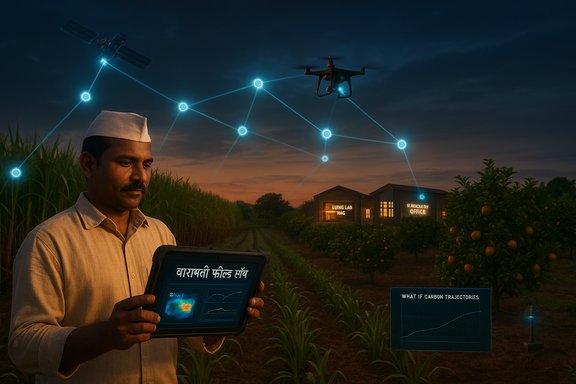
In Baramati, a decades-old agricultural trust and a cluster of progressive growers have become the testing ground for a bold idea: stitch together cloud-first data architecture, spatial AI and vernacular advisory delivery to make precision farming practicable — and profitable — for India’s smallholder farmers. What began as Microsoft Research’s FarmVibes experiments and a local Centre of Excellence at the Agricultural Development Trust (ADT), Baramati, has evolved into a working template that pairs Microsoft’s Azure Data Manager for Agriculture and spatial-AI toolkits with AgriPilot.ai’s farmer‑facing advisory network. The result is an integrated “living lab” that promises continuous, field‑level intelligence without the usual barriers of expensive sensors, high-bandwidth connectivity or complex interfaces.
That said, the leap from living lab to national program requires sober attention to continuity, governance, independent validation and sustainable economics. The technology is not a silver bullet; it is an enabling infrastructure. When platform engineering, agronomy and farmer institutions are aligned — with transparent measurement and farmer agency at the centre — the promise of precision, profitable and climate‑resilient smallholder farming becomes achievable at scale. The Baramati experiment is an important waypoint on that journey; the rigorous work of auditing, scaling and institutionalizing the model will determine whether it becomes a national template or a celebrated pilot.
Source: Agro Spectrum India Azure Data Manager and AgriPilot.ai deliver India’s first fully integrated farm intelligence system - Agro Spectrum India
 Background / Overview
How we got here: FarmBeats → FarmVibes → Azure Data Manager for Agriculture
Microsoft’s agricultural research has been iterative. The FarmBeats project — an early research effort to show how low‑cost sensors, aerial imagery and cloud processing could enable data-driven decisions on farms — matured into a set of production and research offerings under Microsoft’s agriculture portfolio. Project FarmVibes, announced and open‑sourced as a library of spatial‑AI algorithms and edge/connectivity tooling, extended FarmBeats’ philosophy: fuse satellite, drone and ground sensor data to produce high‑resolution, modelled farm signals (soil moisture, nutrient heatmaps, pest risk overlays and “what‑if” carbon scenarios). Microsoft subsequently surfaced these capabilities under the Azure Data Manager for Agriculture umbrella, a domain‑specific data fabric with connectors, a standardized agriculture data model and APIs to support apps and models. Important operational note: Microsoft’s Azure Data Manager for Agriculture (preview) has seen active preview development, but Microsoft published retirement guidance for that preview offering and advised existing customers to begin transition planning. This makes platform transition and continuity a practical consideration for any production deployments that relied on the preview path.The Baramati Centre of Excellence
Baramati’s Agricultural Development Trust has hosted a FarmVibes Centre of Excellence since Microsoft Research helped set up pilot activities there. That partnership focused initially on sugarcane demo plots and a sensor‑enabled pilot area where satellite layers, drone flights and plot‑level agronomy were blended to produce localized advisories. The collaboration — which has been highlighted in multiple public briefings and visits by Microsoft leadership — is now being cited as a replicable template for clustered, smallholder‑friendly precision agriculture.Inside the technology stack: what’s actually running in the field
Azure Data Manager for Agriculture: the data backbone
Azure Data Manager for Agriculture (ADMA) is designed as an industry‑specific data fabric that ingests imagery, weather feeds, sensor telemetry, farm operations and market data into a standardized hierarchy and ontological model. Its key capabilities include:- Connectors for satellite imagery, common weather services and farm equipment.
- A standard agricultural data model to store farms, fields, activities and sensor observations.
- REST APIs and SDKs to let ISVs and researchers build apps and models on top of consistent, queryable farm data.
FarmVibes and spatial AI: fusion, denoising and microclimate models
Project FarmVibes contributes a set of practical spatial‑AI building blocks:- Async Fusion: pairs intermittent drone imagery and spot sensors with frequent but coarser satellite data to create continuous nutrient and moisture heatmaps.
- SpaceEye: uses AI to remove cloud and atmospheric artifacts from satellite layers to improve temporal coverage.
- DeepMC (Deep MicroClimate): blends on‑site sensor data and weather forecasts to model farm‑level microclimate trends and short‑term risk signals for frost, heat stress or wind events.
- “What‑if” simulation tools to evaluate soil carbon trajectories under different management regimes.
Edge, Fabric and traceability
The Stack typically spans:- Edge collection (low‑cost soil probes, passive weather stations, drone captures).
- Intermittent uplinks (compressed imagery via LTE/TV‑white‑space links or periodic field agent uploads).
- Cloud processing in Azure (data model normalization, model scoring, traceability ledger).
- Delivery via local language mobile apps, SMS and voice callbacks.
AgriPilot.ai: translating models into farmer action
Who is AgriPilot.ai and what they bring to Baramati
AgriPilot.ai (often referenced in media and partner statements as a local integrator) operates as the grassroots delivery mechanism in the Baramati experiment. According to public interviews and reporting, AgriPilot emphasizes:- Vernacular-first delivery: advisories and alerts in Marathi and local dialects to overcome literacy and language friction.
- Field‑validating agronomy: agronomists corroborate satellite‑derived signals with on‑farm checks and curated recommendations.
- Low‑sensor, “no‑touch” models: reliance on satellite and aerial imagery plus targeted ground checks to keep per-farm costs low.
What the pilots say they’ve achieved — and how to read the numbers
Multiple media accounts around public demonstrations and executive visits have reported strong percentage lifts in key metrics: yield uplifts in the 20–40% range for sugarcane in demonstration plots; improvements in sucrose content; reductions in input use; and sharper revenue outcomes when crops were diversified into higher‑margin vegetables. Satya Nadella’s public commendation of ADT Baramati after visiting the site underscored these headline gains. At the same time, proprietary reporting from local partners lists more granular, headline‑grabbing figures — for example, claims of a 20% increase in crop production, a 60% rise in revenue, an 18% fall in costs and a 104% increase in profitability across ADT networked farms. Those numbers, while compelling, come from program summaries and press reports tied to project stakeholders; they have not been published as independent evaluations or randomized trials in publicly accessible datasets. As a result, the most prudent interpretation is this:- The direction of change — higher yields, lower unit input use and improved revenues — is supported by multiple independent press reports and executive statements from Microsoft and ADT.
- The precise, farm‑level percentages reported in trade reports or partner PR are claims that require independent verification via third‑party audits, multi‑season trials and transparent baseline definitions (area, cropping intensity, input costs, price realization). Readers should treat programmatic headline metrics as indicative but provisional until validated by independent measurement.
Strengths: why Baramati matters for India’s smallholder context
- Platform-first approach reduces duplication. By standardizing ingestion and a data model, Azure Data Manager reduces the engineering overhead that typically stalls ISV and research efforts. That means more time building farmer‑facing logic and less time solving plumbing problems.
- Spatial AI that tolerates sparse inputs. FarmVibes’ fusion strategies allow high‑resolution signals without requiring every farm to host expensive, always‑on sensors. For fragmented holdings, that is a practical game‑changer.
- Vernacular delivery and agronomist loops. The combination of automated signals plus validated agronomic advice — delivered in Marathi and other local languages — tackles two core adoption obstacles: comprehension and trust. Reports from Baramati show that local agronomists and farmer champions are central to uptake.
- Traceability and ESG pathways. By linking primary field data into chain‑level ledgers, projects can create pathways to sustainability premiums and compliance markets for coffee, rubber and other commodities — opening revenue channels beyond yield gains. Microsoft’s experiments and partnerships in traceability show this is technically feasible.
Risks, gaps and unresolved technical questions
While the Baramati experiment is promising, multiple operational and governance risks must be acknowledged before declaring the model “solved”:- Platform continuity and vendor risk. Microsoft’s advisory that the ADMA preview will be retired signals that organizations using preview pathways must plan migration. Production deployments must factor in platform roadmaps, support SLAs and migration costs.
- Data governance and sovereignty. Aggregating farm‑level telemetry and commercializing traceability touches on consent, ownership and revenue sharing. Clear, legally binding data governance frameworks are required if farmers’ data is to be monetized for sustainability claims or supply‑chain premiums.
- Validation and external measurement. Percent‑change claims require transparent baselines, control comparisons and multi‑season replication. Without independent audits or peer‑reviewed evidence, it is difficult to separate novelty effects from structural productivity improvements.
- Operational cost and business model sustainability. Demonstration costs often include subsidies, free device installs and research funding. Scaling to millions of smallholders demands clear unit economics (who pays for sensors, comms, agronomy, and cloud processing at scale? and sustainable revenue funnels.
- Digital divide and human capacity. Vernacular UI reduces friction, but phone access, intermittent literacy and local extension infrastructure remain practical constraints for universal adoption.
- Agronomic edge cases and model biases. Spatial models trained on certain geographies or cropping systems may not generalize; calibration for micro‑soil types, cropping calendars and irrigation regimes is essential to avoid harmful recommendations.
Policy implications and the national scaling challenge
Baramati’s model carries strategic lessons for national policy:- Platform‑level investments (data models, connector commons, cloud credits for public research) yield outsized leverage compared with funding narrow pilots.
- Public‑private collaboration must mandate open, auditable measurement frameworks so results feed national extension planning.
- Subsidy redesign can favor outcome‑linked payments (e.g., yield improvements, water saved, verified carbon sequestered) rather than capital equipment giveaways.
- Capacity building for local agronomists, cooperative federations and mandi actors is a prerequisite to sustain behavioral change at scale.
A practical roadmap: how to move from living lab to programmatic scale
- Build transparent baseline datasets. Standardize what “yield,” “profit” and “cost” mean across pilots before reporting percent changes.
- Institutionalize third‑party validation. Fund independent agronomic trials and randomized evaluations to measure effects across crops and seasons.
- Adopt open data standards and exportable models. Encourage ISVs to publish model specs and performance metrics so adoption can be reproduced without lock‑in.
- Design farmer‑centric financing. Use crop‑linked payment mechanisms, pooled subscription models via cooperatives, and outcome‑linked public procurement to share costs.
- Strengthen data governance. Create templates for farmer consent, joint data ownership by co‑ops, and escrowed traceability ledgers for sustainability claims.
- Provision offline resilience. Deploy edge inferencing and compressed sync strategies so advisories remain effective with intermittent connectivity.
- Launch a staged scale plan. Move from demonstration clusters (hundreds of farms) to impact pilots (thousands) only after independent validation and unit‑economics clarity.
What to watch next
- Microsoft’s strategic product moves and the ADMA preview retirement timeline will materially affect platform continuity and partner roadmaps. Teams running production pilots should track Microsoft’s migration guidance and service announcements closely.
- Independent audits of Baramati’s reported numbers. Replication studies, government‑sponsored trials and transparent datasets will be the difference between enthusiast press coverage and national policy adoption.
- Business model experiments that move beyond free pilots (e.g., revenue shares from traceability premiums, input supplier co‑investment, or aggregator subscription models).
- Agronomic peer review for sensational trial claims (extreme varietal performance, novel grafts) — science must catch up to storytelling to ensure sustainability.
Conclusion
Baramati demonstrates a persuasive design pattern for 21st‑century agriculture: treat the farm as a data entity; bind imagery, sensors and expert knowledge into a common data layer; and deliver AI‑led recommendations in the farmer’s language through validated agronomy. The Microsoft FarmVibes / Azure Data Manager architecture and AgriPilot.ai’s vernacular, field‑led delivery together address the classic adoption trilemma — cost, connectivity and comprehension — in ways that are realistic for smallholders.That said, the leap from living lab to national program requires sober attention to continuity, governance, independent validation and sustainable economics. The technology is not a silver bullet; it is an enabling infrastructure. When platform engineering, agronomy and farmer institutions are aligned — with transparent measurement and farmer agency at the centre — the promise of precision, profitable and climate‑resilient smallholder farming becomes achievable at scale. The Baramati experiment is an important waypoint on that journey; the rigorous work of auditing, scaling and institutionalizing the model will determine whether it becomes a national template or a celebrated pilot.
Source: Agro Spectrum India Azure Data Manager and AgriPilot.ai deliver India’s first fully integrated farm intelligence system - Agro Spectrum India
