

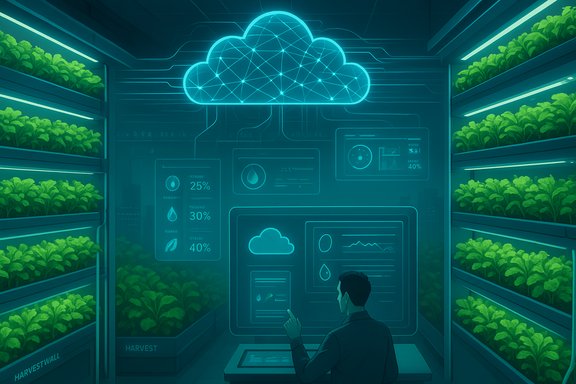
Agroz’s launch of Agroz OS — a cloud-native, AI-driven platform for controlled-environment agriculture — marks a deliberate push to package vertical farming as repeatable, investable infrastructure rather than a collection of one-off horticultural projects. The company says Agroz OS runs on Microsoft Azure and will power a suite of products (including Agroz Copilot) that combine automation, data analytics, and energy optimization with Harvest Today’s patented Harvest Wall vertical grow systems; Agroz also completed an IPO in October and is publicly trading under the ticker AGRZ.
Agroz Inc. positions itself as a fully vertically integrated AgTech business: it designs and builds vertical farms, operates them, sells technology (Agroz OS and related services), and commercializes modular products such as the Agroz Groz Wall, a localized adaptation of the Harvest Wall. The company’s October announcements combined product launch messaging with financial milestones — notably the closing of an IPO that raised roughly $5.0 million by selling 1,250,000 ordinary shares at $4.00 per share — and an outline of growth plans that target Malaysia and other Asia-Pacific markets. Agroz frames the offering as an attempt to make food production behave like infrastructure: modular, measurable, and attractive to institutional capital because it promises predictable outputs, ESG-aligned returns, and the kinds of recurring revenue patterns infrastructure investors seek. The core public claims in the launch are threefold:
However, scaling from demonstration sites to dense regional footprints requires mastering three domains simultaneously: horticulture (agronomy), engineering (reliable hardware and energy optimization), and software (models, UX, data governance). Historically, companies that succeed combine deep domain expertise, capital-efficient deployment strategies (leasing, revenue share) and robust data pipelines to continuously improve models.
Agroz’s pitch — to turn food production into a digitally managed, investable infrastructure class — is bold and consonant with broader trends in cloud-enabled physical industries. The company has assembled the elements necessary to tell that story: a cloud backbone, a partner-supplied modular hardware product, an emerging software stack and public-market capital. The next 12–24 months will determine whether the thesis converts into scale and sustainable economics, or whether the well-known operational and capital challenges of vertical farming constrain growth.
Source: Investing.com Agroz unveils AI-driven food production platform on Microsoft Azure By Investing.com
 Background / Overview
Agroz Inc. positions itself as a fully vertically integrated AgTech business: it designs and builds vertical farms, operates them, sells technology (Agroz OS and related services), and commercializes modular products such as the Agroz Groz Wall, a localized adaptation of the Harvest Wall. The company’s October announcements combined product launch messaging with financial milestones — notably the closing of an IPO that raised roughly $5.0 million by selling 1,250,000 ordinary shares at $4.00 per share — and an outline of growth plans that target Malaysia and other Asia-Pacific markets. Agroz frames the offering as an attempt to make food production behave like infrastructure: modular, measurable, and attractive to institutional capital because it promises predictable outputs, ESG-aligned returns, and the kinds of recurring revenue patterns infrastructure investors seek. The core public claims in the launch are threefold:- Agroz OS is built on Microsoft Azure’s AI stack and will choreograph distributed vertical farms.
- The first go-to-market product set is a Harvest Wall-based offering to deliver pesticide-free produce close to consumption hubs.
- The company is already a public company and claims rapid revenue growth and solid gross margins.
Why the Agroz OS announcement matters
1. Packaging vertical farming as “food infrastructure”
Agroz’s narrative reframes vertical farming from an experimental, often subsidy-dependent activity into an asset class thesis: if farms can be standardized, monitored and governed by software, they can, in theory, be scaled and financed like distributed infrastructure. This is an appealing thesis for investors who want tangible, ESG-positive assets with measurable outcomes (yield per square foot, water saved, proximity-to-market metrics).2. Leveraging cloud AI platforms in physical industries
Saying a farm OS is “built on Microsoft Azure” is shorthand for two distinct facts: (a) Agroz is using Microsoft’s cloud and AI services as the backbone for telemetry, modelling and orchestration; and (b) the company intends to build higher-level applications — like Agroz Copilot — that provide prescriptive recommendations and predictive analytics to operators. The move mirrors other industry patterns where Azure and other hyperscalers are being used to glue together sensors, models, and user interfaces to convert sensory data into operational decisions.3. A public-market debut and the credibility test
Listing on Nasdaq (AGRZ) gives Agroz access to public capital and raises scrutiny and transparency expectations (SEC filings, periodic financial reporting). The October IPO and listing — covered by Nasdaq’s press release and market outlets — is a concrete milestone: it both funds near-term growth and subjects Agroz’s claims to investor due diligence and regulatory disclosures.Technical anatomy: what Agroz OS claims to do
Architecture and platform components
Agroz’s public materials describe Agroz OS as a vertical farm operating system combining:- Device integration and automation for environmental controls (lighting, fertigation, HVAC).
- Telemetry collection and time-series storage for sensors and cameras.
- Analytical layers for energy optimization, yield forecasting and resource-efficiency modelling.
- An application layer for tools such as Agroz Copilot — a real-time recommendations engine for farm operators.
Harvest Wall integration
Agroz’s first commercial product ties Agroz OS to Harvest Today’s Harvest Wall — a modular vertical grow-wall system designed for dense indoor production, low water use and claimed pesticide-free outputs. Harvest Today’s system uses a vertical fertigation approach and modular tiles that scale in height and width, enabling different port counts and form factors for commercial customers. Agroz says it will integrate the Harvest Wall hardware into the Agroz Groz Wall product for hotels, schools, restaurants and small farms.On the “built on Azure” claim
Agroz’s documentation and press release state Agroz OS is built on Microsoft Azure’s AI infrastructure. That claim is explicit in the company release; however, there is no evidence in Agroz’s materials of a co-development agreement or equity partnership with Microsoft. The factual reading is that Agroz is an Azure customer and uses Azure services as the platform layer — a common and pragmatic approach for startups shipping cloud-enabled physical products. The implication for customers and investors is that Agroz can lean on Azure’s scale and compliance tools, but Agroz still owns the product roadmap, model training data and operational service assurances unless a formal partnership is announced.Financial snapshot and validation of key claims
Agroz’s investor-facing materials and market summaries contain several numerical claims that shape the investment story. These are the most load-bearing figures and how they check out across independent sources:- IPO and listing: Agroz priced and closed an IPO of 1,250,000 ordinary shares at $4.00 per share, raising approximately $5.0 million (gross), and began trading on the Nasdaq Capital Market under ticker AGRZ in early October. This is confirmed by Agroz’s own SEC/press filings and Nasdaq/market announcements.
- Market capitalization and trading band: Market-data snapshots around the October period show AGRZ trading in a range with a 52-week high reported near $6.30 in some outlets; market-cap calculations can vary day-to-day depending on share count and price. Market-data pages reflect the volatility common to newly listed small caps. Readers should check live market feeds for current market cap and price.
- Revenue growth and gross margin: Third-party financial data providers show Agroz with rapid revenue growth year-over-year (multiple vendors report substantial growth; one aggregator shows revenue rising by roughly 121% on a 12-month lookback, with a gross margin reported near 36.26%). These figures are drawn from the company’s filed statements and subsequent market-data aggregation. Multiple independent data providers show consistent gross margin reporting for 2024 at ~36%. Cross-referencing two independent aggregators confirms the margin figure but prospective investors should validate the company’s consolidated statements in its SEC filings for the period covered.
- Profitability and leverage: Aggregators show positive operating results and moderate leverage metrics in recent reported periods, but financials for small public companies can change rapidly and often reflect one-off events (grants, extraordinary items, FX effects). The IPO proceeds are modest relative to capital-hungry CEA (controlled environment agriculture) deployments; scaled rollouts will likely require additional capital or customer-financing models.
Business model: four divisions and revenue levers
Agroz describes four revenue streams that together form its go-to-market strategy:- Design & Build: engineering and capex projects to install vertical farms for institutional and commercial clients.
- Operations & Management: recurring service contracts to operate installed farms (O&M revenues).
- Technology: licensing or SaaS revenues from Agroz OS and analytics like Agroz Copilot.
- Product Commercialization: sales of modular hardware products (the Agroz Groz Wall series) and packaged solutions for hospitality and education.
Market and competitive landscape
Market opportunity
Asia-Pacific, and Malaysia in particular, presents structural tailwinds: high population density, cold-chain constraints, and import dependence for fresh produce create demand for localized urban agriculture. Agroz’s playbook — sell modular vertical farms into urban consumption nodes — targets that opportunity. The company also cites alignment with UN SDGs and regional innovation initiatives to support public-sector and institutional engagement.Competitors and substitutes
Agroz sits in an increasingly crowded arena that spans:- Pure-play vertical farm operators (companies that run farms as the business).
- Hardware providers selling vertical racks, LED systems and hydroponic equipment.
- Software providers offering farm management and predictive analytics.
- Traditional greenhouse operators adopting automation.
Sustainability and operational claims
Agroz and its partner Harvest Today emphasize resource efficiency: low water use (Harvest Today claims large percentage reductions in water consumption versus conventional production), pesticide-free outputs, and reduced food miles through proximity to consumption hubs. These are real levers for sustainability and can add measurable ESG value in corporate procurement and municipal programs. Harvest Today’s product literature documents features like Vertigation™ (vertical fertigation) and modular tile counts to substantiate those claims. However, independent lifecycle assessments (LCA) and region-specific energy mixes are required to quantify the true carbon and water impacts of a given deployment.Strategic positives
- Platform leverage: If Agroz OS can be licensed to third parties, the software margins could materially outpace hardware deployment economics and create a high-margin annuity stream.
- Market timing: Urbanization, supply-chain fragility and ESG investing appetite create attractive conditions for “food infrastructure” narratives.
- Proven hardware partner: Harvest Wall is a patented, modular product with product documentation and market traction; leveraging an existing, scalable hardware design shortens time-to-market.
Key risks and execution challenges
- Capital intensity and cash runway: Building and installing vertical farms is capex-heavy. Agroz’s IPO proceeds (~$5M) provide a start but may not be sufficient for broad-scale rollouts without additional financing, partnerships, or creative customer-financing models.
- Operational scalability: Controlled-environment agriculture is operationally complex; yield consistency across geographies, pest/pathogen management, utility cost controls and staffing are non-trivial and historically have truncated margins for some vertical-farm ventures.
- Model fidelity and data quality: Agroz Copilot’s utility depends on high-quality data, correct model assumptions and well-defined human workflows. Bad sensor placement, poor calibration or inadequate local agronomy expertise can produce erroneous recommendations.
- Regulatory and policy assumptions: Agroz’s growth case cites Malaysia’s Budget 2026 and a 10-year tax exemption for new agricultural ventures. That point derives from Agroz’s announcement and subsequent market reporting; direct confirmation from official budget text is advisable before relying on it as a financing assumption. Companies commonly cite policy tailwinds, but investors should verify the specific tax guidance, eligibility criteria, start/retroactive dates and any state-level variations.
- Technology dependence and vendor risk: Running the OS on a third-party cloud (Azure) reduces infrastructure burden but creates vendor dependency (costs, region availability, compliance and future pricing). Contingency plans for regional data residency and model portability will be important for institutional customers.
What success looks like — practical milestones to watch
- Contract wins with anchor customers (hospitals, hotels, schools, municipalities) with disclosed ARR or multi-year O&M contracts.
- Published unit economics for typical Groz Wall installations: capex per square foot, payback period, and fully loaded yield metrics.
- Demonstration of Agroz Copilot improving yields or reducing utility inputs with third-party validation or peer-reviewed case studies.
- A clear path to capital: either a series financing, larger public investor support, or revenue-backed leasing models to finance hardware deployments.
- Independent verification of policy incentives (Budget 2026) and clarity on eligibility timelines and tax filing implications for new ventures.
Operational recommendations for prospective customers and investors
- For procurement teams: insist on a clear service-level agreement (SLA) for yields, food-safety certifications, energy and water consumption baselines, and a maintenance escalation matrix.
- For procurement or facilities managers: require on-site commissioning and a seasonal performance guarantee; require access to the underlying telemetry so that vendor claims can be independently verified.
- For investors: treat Agroz as an early-stage industrial operator with a technology layer, not a pure SaaS play; evaluate runway, unit economics and customer-concentration risk before pricing future rounds.
- For policy makers: assess whether tax incentives require domestic manufacturing or local employment thresholds to qualify; unvetted incentives can create asymmetric winners and concentrated risk.
Longer-term implications for AgTech and urban food systems
Agroz’s approach signals a broader evolution in AgTech: cloud-native orchestration layers linked to modular hardware create the possibility of standardized operational primitives for food production — similar to how containerization standardized application delivery in IT. If repeatable, that could speed the arrival of localized, predictable production networks that reduce food miles, insulate supply chains and create new revenue models for real estate owners and operators.However, scaling from demonstration sites to dense regional footprints requires mastering three domains simultaneously: horticulture (agronomy), engineering (reliable hardware and energy optimization), and software (models, UX, data governance). Historically, companies that succeed combine deep domain expertise, capital-efficient deployment strategies (leasing, revenue share) and robust data pipelines to continuously improve models.
Final verdict — measured optimism with caution
Agroz’s Agroz OS launch is credible as a product announcement and as a market positioning move: the company has announced a real technical architecture using Azure and a commercialized hardware partner in Harvest Today, and it has recently completed an IPO that places it under public-market scrutiny. Independent market-data providers corroborate the company’s revenue growth and margin profile in recent reporting periods, and the Harvest Wall partnership gives Agroz a productized entry point into the market. At the same time, the steep challenges of scaling capital-intensive CEA deployments, proving unit economics across geographies, and converting a platform story into recurring high-margin software revenues should temper exuberance. The Budget 2026 tax incentive is a potential tailwind, but that assertion currently appears in Agroz’s release and market reporting; interested stakeholders should verify the official Malaysian budget text and eligibility rules before treating the incentive as a financing certainty. Investors and commercial partners will be best served by watching the company’s next public disclosures for:- customer contracts with disclosed ARRs or guaranteed volumes,
- detailed unit-economic case studies or independently audited pilots,
- transparent operational KPIs from early Agroz Groz Wall deployments,
- and further clarification on the Microsoft / Azure relationship if Microsoft commits to any formal program or co-sell arrangement.
Agroz’s pitch — to turn food production into a digitally managed, investable infrastructure class — is bold and consonant with broader trends in cloud-enabled physical industries. The company has assembled the elements necessary to tell that story: a cloud backbone, a partner-supplied modular hardware product, an emerging software stack and public-market capital. The next 12–24 months will determine whether the thesis converts into scale and sustainable economics, or whether the well-known operational and capital challenges of vertical farming constrain growth.
Source: Investing.com Agroz unveils AI-driven food production platform on Microsoft Azure By Investing.com
