

Microsoft’s Azure is no longer just a cloud for storage and virtual machines — it’s becoming the enterprise-grade platform where companies build, host, govern and monetize AI at scale, and Microsoft is staking the company’s future on that bet by bundling infrastructure, model choice, developer tools and end-user Copilots into a single, opinionated stack. The recent expansion of Azure’s AI offering — led by the Azure AI Foundry, the Azure AI Agent Service, a sprawling model catalog (including large reasoning models like DeepSeek‑R1), and public financial milestones such as an AI annualized revenue run‑rate north of $13 billion — signals a deliberate pivot: Azure is being marketed as the enterprise AI platform for organizations that need scale, governance and integration with existing Microsoft products.
Enterprise cloud providers have moved from raw compute and storage to curated platforms that package services, marketplaces and governance controls. Microsoft’s play centers on three linked ideas:
For IT leaders and Windows ecosystem customers this is a practical inflection point:
(Selected claims in this article — including Azure’s model catalog size, Azure AI Foundry features, the public preview of Azure AI Agent Service, and Microsoft’s AI annualized revenue run‑rate — are documented in Microsoft’s materials and independent reporting and have been cross‑checked against available public statements and platform pages.
Source: FourWeekMBA Microsoft’s Azure: The Enterprise AI Platform Play - FourWeekMBA
 Background
Enterprise cloud providers have moved from raw compute and storage to curated platforms that package services, marketplaces and governance controls. Microsoft’s play centers on three linked ideas:- Delivering a broad model catalog where enterprises can pick foundation models, vertical models, or distilled on‑device variants without managing model weights or vendor contracts.
- Packaging developer and operations tooling (the Azure AI Foundry SDK, Copilot Studio integrations and a unified portal) to reduce the friction of building and shipping AI apps.
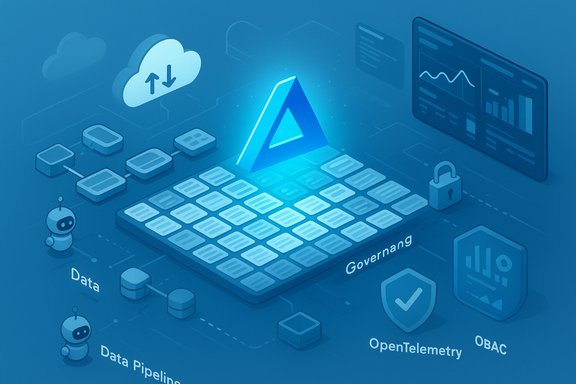
- Embedding governance, identity, and networking controls so agents and models can access corporate data safely (BYO storage, private networking, RBAC and observability).
What Azure AI Foundry Actually Is
A single‑pane platform for model choice and operations
Azure AI Foundry is presented as a unified application platform for enterprise AI that does more than host models: it curates them, integrates them with Azure services, and provides enterprise SLAs and compliance controls. The Foundry’s model catalog contains more than 1,900 entries spanning foundation models, reasoning engines, multimodal models and domain‑specific engines — intentionally broad so enterprises can choose the right tradeoffs between cost, latency and fidelity without getting locked into a single provider. Key characteristics:- Centralized catalog of models (first‑party and partner models).
- Models sold directly by Azure (with Microsoft product terms and support) versus partner/community models.
- Built‑in model cards, content safety tooling and enterprise SLAs for hosted models.
- Integration with Azure identity (AAD), billing, and observability tools for production management.
Developer ergonomics: SDKs, templates and IDE integrations
Microsoft shipped the Azure AI Foundry SDK in preview, with a set of prebuilt templates and integrations for familiar developer surfaces: GitHub, Visual Studio, Visual Studio Code and Copilot Studio. The intent is to shorten the distance from idea to production by enabling engineers to prototype with “mini” models and route heavier reasoning to pro models when needed. This also makes hybrid strategies (on‑device + cloud) more practical.The Azure AI Agent Service: Agents as a First‑Class Concept
What it does and why it matters
The Azure AI Agent Service provides orchestration and runtime for agentic workloads — AI components that take actions, integrate across systems, and persist or change state on behalf of users. Microsoft pitched this as the enterprise‑ready agent service that connects models, corporate knowledge sources (SharePoint, Microsoft Fabric, Azure AI Search), actions (Logic Apps, Functions, OpenAPI tool calls), and governance. Key enterprise features include bring‑your‑own storage (BYOS), private networking, on‑behalf‑of authentication and OpenTelemetry‑based observability. Why enterprises care:- Agents can automate repetitive decision‑making and orchestrate cross‑system processes.
- Practical governance controls (private network, storage) reduce data exfiltration risk.
- Observability and audit trails are essential for compliance in regulated industries.
Early adoption and real‑world pilots
Microsoft presented customer examples (healthcare, energy, travel and professional services) showing agents automating reports, sales assistance, predictive maintenance and itinerary planning. The tone of these examples is pragmatic: move from PoC to managed production with centralized lifecycle controls rather than leaving agent fleets unmanaged. That is precisely the operational gap many enterprises are trying to close.The Model Catalog and Market Openness
Breadth of choice: “not just one model”
Azure’s catalog includes Microsoft‑hosted models, OpenAI offerings (via Azure OpenAI Service), third‑party models (Mistral, Cohere, Meta Llama), and new entrants — packaged to run under Azure governance and SLAs. Microsoft explicitly positions Foundry as multi‑model and multi‑vendor, enabling routing policies that trade cost and fidelity across a stack. That multi‑vendor stance is strategic: it reduces single‑provider lock‑in and supports enterprise multi‑model strategies.Mini models vs. pro models: economics built into routing
Foundry is designed with cost‑tiering in mind: smaller “mini” models are intended for high‑volume, lower‑fidelity paths, while pro models are reserved for high‑accuracy or compliance‑sensitive operations. The platform supports dynamic routing so developers can prototype on cheap models and route high‑risk flows to more expensive, higher‑quality models. This is a core commercial argument for Azure: enable predictable consumption economics for enterprise deployments.DeepSeek‑R1, Large Reasoning Models, and the New Weaponry
A practical sign of the Foundry’s ambitions is the inclusion of large reasoning models like DeepSeek‑R1 in the catalog. DeepSeek‑R1, with reported architecture claims around 671 billion parameters and specialized reasoning capabilities, is available in the Azure catalog as a hosted model; Microsoft lists model details, parameter counts and versioning on the public Azure model pages. That makes high‑end reasoning models callable with enterprise SLAs and governance. Important nuances:- DeepSeek‑R1 and similar large models are being packaged with “distilled” smaller versions suitable for on‑device or low‑GPU environments, enabling hybrid deployment strategies.
- The figure “671B parameters” has been publicized by DeepSeek and corroborated by reporting, but parameter counts can be reported differently depending on MoE architectures (active vs total parameters), so enterprises should confirm the effective activation and resource patterns for any given workload. Treat parameter counts as useful guides, not direct performance guarantees.
Financial Reality: Microsoft’s AI Run‑Rate and the Economics of an AI Platform
Microsoft executives told investors that the company’s AI business surpassed a $13 billion annualized revenue run‑rate, up roughly 175% year‑over‑year, and that AI contributed materially to Azure’s growth in recent quarters. Those figures were repeated across earnings transcripts and market coverage and reflect multiple components: Azure AI infrastructure consumption, Azure OpenAI usage, Copilot seat revenue and enterprise model hosting/commitments. What that means practically:- AI is shifting Azure’s revenue mix toward consumption economics (GPU hours, tokenized API usage) rather than just seat licensing.
- Capital intensity (capex) has increased — Microsoft reported materially higher cloud and AI capex as it scaled GPU fleets and data center capacity — which pressures margins near term while enabling long‑term monetization.
- Measurable consumption costs tied to inference and agent runtime.
- The need for governance to prevent runaway bill spikes.
- Procurement and contractual diligence when negotiating model hosting, reserved capacity and performance SLAs.
Strengths of Microsoft’s Enterprise AI Platform Play
- Integrated stack: Azure + Microsoft 365 + GitHub + Copilot create end‑to‑end value that is hard for rivals to replicate in a single vendor. Embedding Copilot into productivity workflows is a direct monetization channel.
- Scale and balance sheet: Microsoft can invest billions in GPU capacity and capture long‑term enterprise contracts; that reduces execution risk compared with smaller cloud providers.
- Enterprise governance and identity: BYO storage, private networking and RBAC reduce barriers for regulated industries where data residency and traceability matter.
- Model diversity and routing: A large catalog and model‑routing capabilities give customers tactical flexibility in price‑performance tradeoffs.
Risks, Trade‑offs and What IT Teams Must Watch
- Cost volatility and operational surprises. Consumption‑based AI billing can be volatile. Enterprises must design quotas, reservations, and observability to manage inference and agent runtime costs. Without guardrails, exploratory agents can become expensive.
- Infrastructure bottlenecks. Demand for GPUs and specialized silicon can create capacity constraints and scheduling delays; Microsoft is investing heavily but pressure points remain in peak demand periods. Expect procurement cycles and lead times to impact rollout speed.
- Regulatory and ethical risk. Models produce hallucinations, potential bias, and data‑leak pathways. Enterprises in healthcare, finance and government must maintain human‑in‑the‑loop controls, policy enforcement, and audit trails. Foundry’s governance features help, but they don’t eliminate the need for internal compliance engineering.
- Third‑party model quality variability. Not all catalog models are equal; some vendors publish limited transparency. Rigorous evaluation, adversarial testing and validation are required before operational deployment. Where claims are inconsistent, treat them cautiously and demand model cards and detailed SLAs.
- Vendor consolidation risk. Microsoft’s attempt to be the “one‑stop shop” can create customer lock‑in — convenient for IT, but potentially risky for negotiating flexibility and pricing over time. Multi‑cloud strategies and portable architectures remain prudent for large, regulated organizations.
Practical Checklist for IT Leaders Evaluating Azure AI Foundry
- Inventory use cases: rank by compliance sensitivity, data residency needs and user impact.
- Cost modeling: simulate token/inference usage and agent hours; reserve capacity where possible.
- Governance plan: define RBAC, data access scoping, model testing thresholds and incident playbooks.
- Model due diligence: require model cards, benchmarks and explainability reports for any third‑party model.
- Pilot to production: start with well‑scoped pilots that include cost and safety gates; evolve to fleet orchestration only after robust monitoring is in place.
The Competitive Landscape — How Azure Compares
- AWS Bedrock focuses on multi‑model hosting and infrastructure economics; AWS strengths lie in sheer scale and custom silicon options.
- Google Vertex AI and Gemini emphasize deep model and data integration with Google’s analytics stack.
- Specialist vendors (Anthropic, Cohere, xAI, Mistral) push model innovation and sometimes price/performance differentiation.
Conclusion — What This Means for WindowsForum Readers and Enterprise IT
Microsoft’s Azure AI Foundry and the broader Azure AI stack mark an evolution in cloud strategy from commodity infrastructure to a platform for enterprise AI. The play is coherent: make models, agents and Copilot features accessible under enterprise governance, then monetize both infrastructure consumption and user‑facing productivity features. The approach reduces integration friction for enterprises while introducing new operational demands around cost control, governance and validation.For IT leaders and Windows ecosystem customers this is a practical inflection point:
- If your organization prioritizes deep integration with Microsoft products, strong enterprise governance, and a single vendor for cloud and productivity tooling, Azure’s platform proposition can dramatically accelerate AI adoption.
- If your priorities are neutral vendor choice, bespoke model research, or minimal vendor lock‑in, you’ll need to architect portability and cost controls from day one.
(Selected claims in this article — including Azure’s model catalog size, Azure AI Foundry features, the public preview of Azure AI Agent Service, and Microsoft’s AI annualized revenue run‑rate — are documented in Microsoft’s materials and independent reporting and have been cross‑checked against available public statements and platform pages.
Source: FourWeekMBA Microsoft’s Azure: The Enterprise AI Platform Play - FourWeekMBA
