

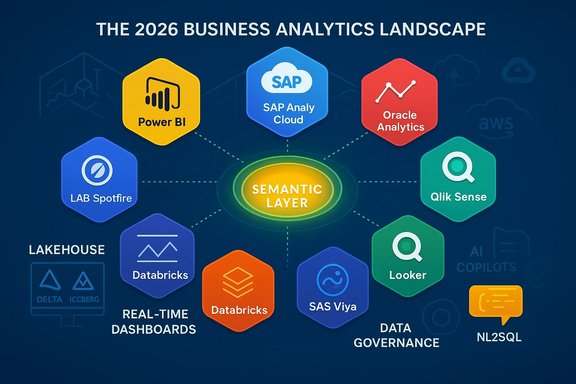
Microsoft’s Power BI, Tableau (Salesforce), SAP Analytics Cloud, Oracle Analytics Cloud, IBM Cognos, Qlik Sense, Google’s Looker + BigQuery, SAS Viya, Databricks, and TIBCO Spotfire define the business analytics landscape in 2026 — each delivering distinct trade-offs between accessibility, scale, governance, and advanced AI-driven capabilities that organizations must weigh when choosing a platform to power data-driven decisions.
Business analytics has moved well beyond static dashboards and ad-hoc reporting. Today’s enterprise needs include real-time operational intelligence, governed semantic layers for consistent metrics, automated machine learning and forecasting, natural-language and conversational interfaces, and architectures that support both analytics and AI at petabyte scale. Vendors on the 2026 short‑list reflect those market demands: some emphasize broad adoption and seamless ecosystem integration, others prioritize statistical rigor and regulated-industry controls, and a growing set of products targets the data engineering and lakehouse layer that underpins modern analytics.
The list of ten companies covered here captures the diversity of approaches that matter to enterprise buyers in 2026:
The era of analytics in 2026 is defined by platforms that bring AI to the data — not the other way around. Selecting the right vendor now requires equal parts technical due diligence and a pragmatic, outcome-driven deployment plan that keeps governance and trust at its core.
Source: inventiva.co.in Top 10 Business Analytics Companies In 2026 - Inventiva
 Background
Business analytics has moved well beyond static dashboards and ad-hoc reporting. Today’s enterprise needs include real-time operational intelligence, governed semantic layers for consistent metrics, automated machine learning and forecasting, natural-language and conversational interfaces, and architectures that support both analytics and AI at petabyte scale. Vendors on the 2026 short‑list reflect those market demands: some emphasize broad adoption and seamless ecosystem integration, others prioritize statistical rigor and regulated-industry controls, and a growing set of products targets the data engineering and lakehouse layer that underpins modern analytics.The list of ten companies covered here captures the diversity of approaches that matter to enterprise buyers in 2026:
- Microsoft (Power BI + Fabric / Azure Synapse)
- Tableau (Salesforce)
- SAP (SAP Analytics Cloud)
- Oracle (Oracle Analytics + Autonomous AI Database)
- IBM (Cognos + watsonx)
- Qlik (Qlik Sense + Data Integration)
- Google (Looker + BigQuery)
- SAS (SAS Viya)
- Databricks (Lakehouse + Delta Lake)
- TIBCO (Spotfire)
How this list was validated
The product statements and technical claims in this analysis have been cross-checked against current vendor product documentation, recent product release notes, and widely reported industry announcements available in 2025–2026. Product feature sets (for example, Power BI’s AI-driven Copilot, Databricks’ Delta Lake ACID guarantees and time travel features, Oracle’s Select AI NL2SQL capabilities, and Looker’s semantic modeling) were verified against vendor documentation and product updates to ensure accuracy. Any market-position or “industry standard” claims are presented with caution when they rely on perception rather than hard, auditable metrics.Microsoft — Power BI (and Azure Synapse / Microsoft Fabric)
Microsoft continues to make analytics broadly accessible while integrating analytics into the operational fabric of enterprises.What Microsoft brings
- Power BI offers a familiar, low-friction entry point for business users with drag-and-drop reporting and a broad gallery of visualizations.
- Copilot and embedded generative AI features accelerate report creation, natural-language queries, and automated narrative summaries.
- Azure Synapse Analytics (and Microsoft Fabric) provide the scalable backplane for large-scale data warehousing, big-data processing, and machine learning.
- Tight integration with Microsoft 365, Azure, Dynamics 365, and Microsoft Purview gives Microsoft customers a unified governance and identity story.
Strengths
- Ease of adoption: Power BI’s UI and licensing tiers make it an easy first choice for many teams.
- Ecosystem frictionless: Organizations already on Microsoft technology capture more value faster.
- Broad AI capabilities: Copilot and Fabric integrations enable automated insights and model-driven report generation.
Risks and caveats
- Vendor consolidation risk: Heavy reliance on Microsoft stacks increases vendor lock‑in risk for organizations wanting multi-cloud neutrality.
- Feature fragmentation: As Microsoft folds features into Fabric, some legacy capabilities change or get deprecated; roadmap vigilance is required.
- For organizations with strict non‑Microsoft dependency policies, alternative architectures may be preferable.
Tableau (Salesforce)
Tableau remains synonymous with exploratory visual analytics, but now sits squarely inside a CRM-first vendor strategy.What Tableau brings
- Market-leading visual exploration and interactive dashboards that support deep, ad-hoc data discovery.
- Tableau Prep for data preparation and a thriving community of pre-built dashboards, connectors, and training resources.
- Integration with Salesforce Customer 360 and broader Salesforce AI/Agent ecosystems — enhancing customer-centric analytics scenarios.
Strengths
- Best-in-class visual analysis: Tableau’s design and interactivity remain a major differentiator for analysts and executives who prioritize story-driven dashboards.
- Enterprise adoption and community: Large install base, training ecosystem, and marketplace assets accelerate deployment.
Risks and caveats
- Integration costs: Organizations outside the Salesforce ecosystem can still use Tableau, but leveraging full enterprise value often requires additional integration work.
- Licensing complexity: Enterprise deployments that require embedding, broad consumption, or close CRM integration should model licensing carefully.
SAP — SAP Analytics Cloud (SAC)
SAP positions SAC as the analytical control plane for enterprises running SAP S/4HANA and broader SAP landscapes.What SAP brings
- A unified analytics + planning + predictive platform that connects directly to SAP HANA, S/4HANA, and SAP Datasphere.
- Augmented analytics and planning features designed for finance, supply chain, and HR scenarios where SAP is often the system of record.
Strengths
- Operational integration: SAC enables analytics that are operationally close to core business processes (for example, financial close and xP&A).
- Industry accelerators: Pre-built models and templates reduce time-to-value for common enterprise planning use cases.
Risks and caveats
- Best fit for SAP customers: The ROI for SAC is strongest when SAP is already a major part of the enterprise stack.
- Complexity of transformation: Organizations migrating off legacy SAP platforms need to plan for data harmonization and model rework.
Oracle — Oracle Analytics Cloud + Autonomous AI Database
Oracle couples analytics with a database-first strategy focused on in-database AI and enterprise performance.What Oracle brings
- Oracle Analytics Cloud for visual analytics and governed semantic models.
- Autonomous AI Database and innovations like Select AI that enable natural-language-to-SQL (NL2SQL), in-database agent frameworks, and synthetic data generation.
- Increasing support for open table formats (Iceberg) and multi-cloud access models in the Oracle AI Lakehouse strategy.
Strengths
- In-database AI: Bringing NL2SQL and agentic workflows into the database reduces data movement and accelerates developer productivity.
- Enterprise-grade database capabilities: Mature security, performance tuning, and scaling for complex financial and transactional workloads.
Risks and caveats
- Complexity and cost profile: Oracle’s enterprise focus and advanced features come with integration, licensing, and operational complexity.
- Vendor lock-in considerations: While Oracle is adopting more openness (Iceberg support), organizations should still evaluate multi-cloud interoperability and exit strategies.
IBM — Cognos Analytics + watsonx
IBM surfaces generative AI and governance features on top of its long-standing Cognos reporting foundation.What IBM brings
- Cognos Analytics for entrenched enterprise reporting and regulatory-grade BI.
- watsonx integrations for large-scale AI, agent orchestration, conversational interfaces, and hybrid deployment options.
Strengths
- Governance and hybrid flexibility: Strong deployment controls for regulated data, on-premise requirements, and hybrid cloud models.
- Enterprise AI tools: watsonx provides tools for model management, agent orchestration, and integration with enterprise workflows.
Risks and caveats
- Modernization path: Long-term value often depends on how successfully organizations modernize legacy Cognos assets to watsonx-enhanced capabilities.
- Skill requirements: Large-scale watsonx deployments can require specialist skills in data engineering and model governance.
Qlik — Qlik Sense and Active Intelligence
Qlik’s associative engine and active intelligence strategy focus on exploratory analytics and real-time data activation.What Qlik brings
- Associative analytics engine that enables free-form exploration without relying solely on predefined query paths.
- Qlik Data Integration for real-time replication, CDC, and streaming pipelines that power continuous analytics.
- A strategic focus on actionable, real-time insights (Active Intelligence) and integrations with major cloud providers.
Strengths
- Discovery-first UX: The associative model supports serendipitous insights and fast root-cause analysis.
- Real-time ingestion: Strong data movement capabilities enable operational analytics and alerting.
Risks and caveats
- Architectural fit: Best value when combined with real-time pipelines and event-driven use cases; may be overkill for purely historical reporting needs.
- Operational maturity: Real-time architectures require investment in pipeline monitoring and governance.
Google — Looker + BigQuery
Google’s combination emphasizes semantic consistency and scalable cloud analytics.What Google brings
- Looker's semantic modeling (LookML) to centralize definitions and metric logic.
- BigQuery for virtually unlimited, serverless analytical scale and integrated BigQuery ML for embedded model training.
- Tight integration with Google Cloud services and Vertex AI for advanced ML workflows.
Strengths
- Semantic governance: Looker’s model layer reduces metric sprawl and improves AI/LLM trustworthiness.
- Scale and ML integration: BigQuery delivers high-concurrency analytics and enables model training with SQL-oriented workflows.
Risks and caveats
- Data gravity: Organizations already distributed across other clouds should evaluate cross-cloud data access strategies.
- Skill alignment: Getting full value requires data engineering capabilities to design efficient partitioning and cost-aware query patterns.
SAS — SAS Viya
SAS remains the domain specialist for statistical rigor, regulated industries, and advanced forecasting.What SAS brings
- SAS Viya as a cloud-native analytics and AI platform with strong statistical modeling, forecasting, and model governance.
- Pre-built analytic models and tools tailored for regulated sectors such as healthcare, financial services, and government.
Strengths
- Analytical depth: SAS’s library and time-series/forecasting capabilities are hard to match for complex quantitative tasks.
- Auditability and compliance: Strong model validation, explainability, and audit trails suited to regulated environments.
Risks and caveats
- Accessibility for non‑statisticians: SAS historically targets expert users; bridging to citizen analytics requires investment in tooling and training.
- Cost and modernization: SAS can be costly at scale and requires clear use cases where statistical rigor yields measurable ROI.
Databricks — Unified Lakehouse and Delta Lake
Databricks champions the lakehouse: converging data engineering, science, and analytics on a single platform.What Databricks brings
- Delta Lake for ACID transactions, time travel, and reliable table semantics on cloud object stores.
- Collaborative notebooks and multi-language support (SQL, Python, R, Scala) that unify roles across the analytics lifecycle.
- Unity Catalog and lakehouse governance to help manage metadata and access controls.
Strengths
- Scalable data platform: Well suited for petabyte-scale analytical and ML workloads.
- Open table formats and portability: Delta Lake and Iceberg support reduce silo risk and enable multi-engine access.
Risks and caveats
- Platform maturity vs. BI tooling: Databricks is not a drop-in replacement for self-service BI; integration with visualization layers is required.
- Operational complexity: Proper governance and cost controls are essential to avoid runaway cloud spend in large deployments.
TIBCO — Spotfire
Spotfire provides a strong option where high-performance, in-memory analytics and streaming are core requirements.What TIBCO brings
- Spotfire for fast in-memory exploration, advanced geospatial analytics, and streaming analytics.
- Integration with TIBCO’s event processing and data virtualization products for operational, sensor-driven analytics.
Strengths
- Operational and geospatial analytics: Excels in industries with heavy sensor data or spatial analysis needs (energy, manufacturing, telco).
- Streaming and decisioning: Strong real-time alerting and event-driven analytics capabilities.
Risks and caveats
- Ecosystem breadth: Organizations seeking a broad enterprise BI ecosystem may need to plan integrations for centralized governance and semantic consistency.
- Product lifecycle changes: Recent product consolidations and retirements require careful migration planning for cloud-based Spotfire customers.
Cross‑vendor patterns and technology trends in 2026
The market converges on a few repeatable architectural principles that buyers should evaluate.- Semantic layers are mandatory: Whether it’s LookML, semantic models in Oracle/SAP, or curated Power BI datasets, a governed metric layer is essential for consistent reporting and trustworthy AI.
- AI moves closer to data: Vendors embed NL2SQL, RAG, and agent frameworks directly in databases or platforms to reduce data copying and improve latency.
- Lakehouse and open formats: Delta Lake and Apache Iceberg have become mainstream patterns for balancing performance with openness and interoperability.
- Hybrid and multicloud realities: Enterprises demand hybrid deployments, which pushes vendors to support on-prem, cloud, and multicloud integration without forcing lock‑in.
- Operationalization and MLOps: The ability to deploy, monitor, and govern models in production is now a table-stakes capability, especially for regulated sectors.
Selection checklist: match capability to outcome
- Define the primary analytics use cases (reporting, operational alerts, forecasting, embedded analytics).
- Map existing data gravity (Azure, AWS, GCP, on-prem) and identify integration costs.
- Establish governance requirements (column-level security, lineage, audit, regulatory controls).
- Decide the AI posture (assistive Copilot-style features vs. full agentic automation).
- Model total cost of ownership: licenses, cloud compute, integration, training.
- Plan a phased adoption path: pilot → center of excellence (CoE) → enterprise rollout.
Implementation and governance best practices
- Start with a governed semantic layer to eliminate metric inconsistency across reports and AI agents.
- Implement role-based access control and data catalogs early; retrospective governance is costly.
- Treat ML and generative AI outputs as decision-support: build model validation, explainability, and human-in-the-loop gates.
- Monitor usage and cost with real-time telemetry — cloud analytics can generate surprising spend if left unchecked.
- Invest in a CoE and readiness programs to drive adoption and literacy — technology alone won’t change decision culture.
Risks every buyer must plan for
- Hallucination and trust: LLM-based features accelerate productivity but can produce incorrect conclusions. Mitigate with RAG, provenance, and human review.
- Data privacy and compliance: Embedding AI with sensitive data requires careful control of models, logs, and data residency rules.
- Vendor lock-in: Prioritize open formats, exportable semantic layers, and ability to run workloads outside a single vendor’s cloud.
- Hidden migration costs: Migrating models, reports, and operational logic between platforms often uncovers technical debt and custom connectors.
- Skill gaps: The organizational capability to operate data mesh, MLOps, and governed AI is often the limiting factor, not the product.
Quick comparative summary (at-a-glance)
- Best for broad self-service adoption and Microsoft shops: Power BI (+ Fabric).
- Best for visual-first exploration and analyst productivity: Tableau.
- Best for SAP-centric enterprises and integrated planning: SAP Analytics Cloud.
- Best for in-database performance, NL2SQL, and enterprise DB features: Oracle.
- Best for regulated, hybrid, and AI-driven governance: IBM (Cognos + watsonx).
- Best for associative exploration and real-time pipelines: Qlik.
- Best for semantic governance and cloud-scale SQL analytics: Google (Looker + BigQuery).
- Best for statistical rigor, forecasting, and regulated industries: SAS Viya.
- Best for modern lakehouse, data engineering and MLOps: Databricks.
- Best for streaming, in-memory, geospatial and operational analytics: TIBCO Spotfire.
How to run a pilot that proves value (6 steps)
- Identify a high-impact, mid-complexity use case (monthly close automation, supply chain exception alerts, or customer churn predictive model).
- Allocate a cross-functional team: data engineer, BI developer, business owner, and IT security lead.
- Implement a small governed semantic model and a single dashboard/report; ensure traceability to source systems.
- Enable AI assistive features (NL2SQL or Copilot) in a controlled environment and measure accuracy vs. human baseline.
- Track KPIs: time-to-insight, decision latency, and business metric impact (revenue, cost, risk reduction).
- Evaluate operational overhead and project the scaled cost and skills required for enterprise rollout.
Final analysis and recommendations
The 2026 business analytics market is no longer a simple choice between visualization tools — it’s an architecture decision that spans data ingestion, governance, analytics, and AI. Each vendor on the top‑ten list leads in one or more critical dimensions: usability, scale, statistical power, operational analytics, or in-database AI. The right platform for any organization depends on five practical priorities: existing cloud and application stack, governance and compliance needs, primary analytics use cases, required AI maturity, and total cost of ownership.- For organizations already embedded in the Microsoft or Google ecosystems, Power BI and Looker + BigQuery respectively offer the fastest path to scale with built-in semantic governance and cloud-native analytics.
- For enterprises with heavy SAP or Oracle footprints, SAP Analytics Cloud and Oracle Analytics + Autonomous AI Database provide the closest operational integrations for planning and in-database analytics.
- Where statistical depth and regulatory auditability matter most, SAS Viya still sets the standard for analytical rigor.
- For modern data platforms focused on unified engineering and ML production, Databricks and Delta Lake remain the core of scalable analytics and reproducible data pipelines.
- If the business needs interactive discovery and real-time operational insights, Tableau, Qlik, and Spotfire each bring specialized strengths that are hard to replicate with one-size-fits-all tools.
The era of analytics in 2026 is defined by platforms that bring AI to the data — not the other way around. Selecting the right vendor now requires equal parts technical due diligence and a pragmatic, outcome-driven deployment plan that keeps governance and trust at its core.
Source: inventiva.co.in Top 10 Business Analytics Companies In 2026 - Inventiva
