

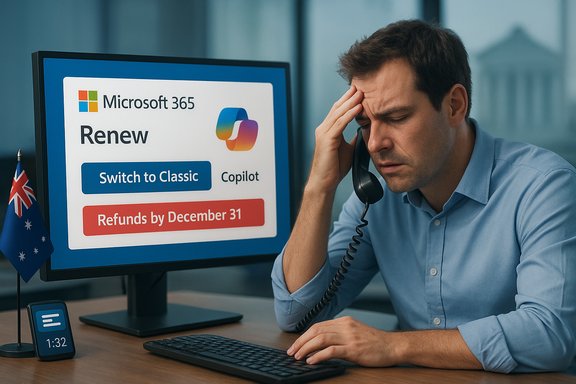
Microsoft’s customer-facing M365 portal briefly buckled under a surge of refund requests after the company rolled out an apology and a remediation offer for subscribers unhappy with the Copilot add‑on — a move prompted by the Australian Competition and Consumer Commission’s (ACCC) allegation that Microsoft misled roughly 2.7 million Australians by obscuring a lower‑cost, non‑AI “Classic” option at renewal.
The ACCC’s Federal Court action alleges that Microsoft’s renewal communications to auto‑renewing Microsoft 365 Personal and Family subscribers conveyed a binary choice — accept Copilot and the higher renewal price, or cancel — while failing to clearly disclose a contemporaneous alternative: Microsoft 365 Personal/Family Classic, which preserves the pre‑Copilot pricing and feature set. The regulator quantified the potentially affected cohort at approximately 2.7 million Australian subscribers and highlighted headline price moves from A$109 → A$159 for Personal and A$139 → A$179 for Family. Microsoft publicly acknowledged it “fell short” in its communications to affected subscribers and announced a remediation pathway: customers in Australia who switch to the Microsoft 365 Classic SKU by 31 December 2025 will be eligible for refunds of the price difference dating back to renewals after 30 November 2024, with refunds processed to the payment method on file within 30 days of eligibility confirmation. Microsoft described the Classic plans as not including Copilot and may not receive new feature updates. The ACCC has emphasised that Microsoft’s refund offer is not a settlement of the regulatory proceedings and that the regulator continues to seek penalties, injunctions, declarations, effective consumer redress and costs from the court. The legal process therefore continues even as Microsoft engages in remediation.
Source: iTnews M365 portal buckling as demand for Copilot refunds soar
 Background / Overview
The ACCC’s Federal Court action alleges that Microsoft’s renewal communications to auto‑renewing Microsoft 365 Personal and Family subscribers conveyed a binary choice — accept Copilot and the higher renewal price, or cancel — while failing to clearly disclose a contemporaneous alternative: Microsoft 365 Personal/Family Classic, which preserves the pre‑Copilot pricing and feature set. The regulator quantified the potentially affected cohort at approximately 2.7 million Australian subscribers and highlighted headline price moves from A$109 → A$159 for Personal and A$139 → A$179 for Family. Microsoft publicly acknowledged it “fell short” in its communications to affected subscribers and announced a remediation pathway: customers in Australia who switch to the Microsoft 365 Classic SKU by 31 December 2025 will be eligible for refunds of the price difference dating back to renewals after 30 November 2024, with refunds processed to the payment method on file within 30 days of eligibility confirmation. Microsoft described the Classic plans as not including Copilot and may not receive new feature updates. The ACCC has emphasised that Microsoft’s refund offer is not a settlement of the regulatory proceedings and that the regulator continues to seek penalties, injunctions, declarations, effective consumer redress and costs from the court. The legal process therefore continues even as Microsoft engages in remediation. What Microsoft announced — the company’s apology, the refund mechanics, and limitations
The apology and the three choices Microsoft set out
Microsoft’s regional message to subscribers framed the situation as a communications failure. The company presented three consumer choices in its outreach:- Stay on the Copilot‑enabled Microsoft 365 Personal/Family plan at the new price.
- Switch to Microsoft 365 Personal/Family Classic (no Copilot) and receive a refund for eligible renewals if the switch is made by 31 December 2025.
- Cancel the subscription entirely.
Scope and eligibility — what Microsoft’s message actually guarantees
Microsoft’s communication is precise in its scope: refunds apply to Australian subscribers who received the regional outreach and who switch to Classic by the stated deadline. It does not, as Microsoft itself stressed, represent a legal settlement with the ACCC; rather, it is a consumer‑facing remediation step intended to reduce harm while the legal dispute proceeds. The ACCC has acknowledged the customer outreach but reiterated it will continue to pursue remedies through the Federal Court.The on‑the‑ground experience: demand spikes, portal failures, and denied refunds
Surge in support demand and portal strain
Shortly after Microsoft’s email campaign announcing refunds and switching instructions, customer support channels were overwhelmed. Multiple media outlets and community forums reported significant spikes in wait times and malfunctioning or misleading links from the emails sent to affected subscribers. One outlet described the M365 portal as “buckling” under the volume of users trying to switch or claim refunds. Microsoft acknowledged that customer support wait times were higher than expected following its refund offer and said teams were working to respond; the company later reported the volume had subsided.Reports of broken links, wrong regions, and the missing downgrade path
Independent reporting and numerous support forum threads document practical obstacles subscribers encountered when trying to exercise the switch‑and‑refund option. Common reports include:- Links in Microsoft’s emails directing users to the wrong country or to renewal pages that do not show a “Switch to Classic” option.
- The “Switch to Classic” button leading to a Microsoft Store or renewal page that does not surface the Classic refund pathway.
- Support hours and routing that forced customers in some time zones to engage during US business hours to get human assistance.
Verification and limits of the anecdotal evidence
Multiple independent outlets (national public broadcaster, Reuters, and industry reporting) corroborate the pattern of user frustration and misdirected links; however, full systemic metrics — such as the exact number of denied refunds, the percentage of links that failed, or precise queue lengths — are not publicly available at this time. Where individual customers claim outright denial of refunds, the public record mostly consists of published anecdotes and forum threads; those reports are credible indicators of friction, but the aggregate scale of failed claims remains unquantified in the public domain. These gaps should be treated as caveats when measuring Microsoft’s operational performance on this remediation.Legal stakes and regulatory posture
What the ACCC is asking the Federal Court to do
The ACCC’s proceeding seeks declarations that Microsoft’s conduct was misleading, injunctions to prevent future similar conduct, effective consumer redress and penalties. Under Australian Consumer Law, maximum penalties for each contravention can be substantial — for corporations, the greater of A$50 million, three times the benefit obtained, or 30% of adjusted turnover for the breach period — though the precise penalty, if any, will depend on the Court’s findings. The ACCC has lodged a concise statement and supporting screenshots as part of its initiating documents.Microsoft’s legal position and the remedial calculus
Microsoft has publicly stated it is reviewing the ACCC’s allegations and has taken the step of offering refunds and clearer messaging to customers. From a legal strategy perspective, offering remediation can reduce reputational damage and limit the number of individual customer claims escalating into separate legal actions — but it does not eliminate regulatory liability. The ACCC has been explicit that the refund offer does not equate to settlement and that the regulator will continue to pursue penalties and declarations in court. This places Microsoft in the familiar position of mitigating consumer harm while contesting regulatory allegations on the legal merits.Why the dispute matters: choice architecture, dark patterns, and AI monetisation
Choice architecture under legal scrutiny
The ACCC’s argument is not primarily about Microsoft adding features or raising prices; rather, it centers on how those changes were framed to consumers. Regulators increasingly treat interface design and the discoverability of options as part of communications that must be accurate and non‑misleading. If an essential alternative is only visible after initiating cancellation, many auto‑renewing customers will never encounter it at the decision point — and regulators view that as an omission that can mislead a reasonable consumer. This case therefore tests how consumer protection law applies to design choices that materially alter what information is presented at critical decision moments.The AI monetisation angle
Microsoft’s integration of Copilot into consumer M365 plans is representative of a broader industry trend: vendors adding AI capabilities to core subscription products and capturing incremental revenue. That shift raises a regulatory question that extends beyond Australia: when AI is used to justify material price rises, how must companies communicate alternative pricing or functionality to long‑standing subscribers? The outcome of this dispute will be watched globally as a potential precedent for how regulators treat paid AI upgrades in subscription services.Practical guidance for affected subscribers and for administrators
The widespread confusion around the downgrade flow means many customers need clear, step‑by‑step guidance. The following is a practical checklist for consumers and a short playbook for administrators responsible for family or shared accounts.For consumers: step‑by‑step (priority actions)
- Sign in to account.microsoft.com with the account used to purchase Microsoft 365 and go to Subscriptions.
- If you received Microsoft’s regional email, follow the Switch to Classic prompt in that message; if the link does not work, proceed to Step 3.
- From the Manage subscription page, select Cancel subscription and continue through the cancellation flow — the Classic option has been surfaced historically in that flow for customers switching back, though timing and UI vary by region and account. If you cannot find the Classic option, proceed to Step 4.
- Record screenshots and timestamps of the pages you see. If the UI does not offer Classic, escalate via Microsoft Support and supply screenshots and the text of Microsoft’s email demonstrating eligibility for the refund.
- If self‑service fails, use Microsoft’s official support channels (chat and phone). Due to reported high volumes, expect longer wait times and persist in requesting an eligibility check referencing the Microsoft message and refund terms.
For shared / Family subscription managers
- Confirm whether the Family subscription primary account is the same Microsoft ID that received the refund offer; switching to Classic typically applies at the primary subscription level and then propagates to family members, but UI differences have been reported. Keep records of family member emails and screenshots.
Documentation to keep when claiming refunds
- Copy of Microsoft’s regional email or blog text acknowledging the availability of Classic and refund eligibility.
- Screenshots of the subscription pages you visited (include timestamps and the URL).
- Payment method and renewal dates showing when the increased charge was applied.
- Any support ticket numbers or chat transcripts.
Technical and operational reasons for the friction
Several factors likely contributed to the portal friction experienced by customers:- High concurrency: millions of subscribers were suddenly prompted to perform an account action; even moderate participation rates can overwhelm web forms and routing. Microsoft itself acknowledged elevated support volumes.
- Regional navigation differences: subscription management UI and store routing differ by country, browser, and account history; email links that hard‑redirect to region‑specific storefronts or that rely on session cookies can misroute users. Multiple user reports described being taken to a wrong‑region page.
- Choice discoverability baked into cancellation flows: if the Classic option was intentionally housed inside cancellation flows, many auto‑renewing consumers would never see it — a structural UX choice that is precisely what the ACCC alleges was misleading.
Critical analysis — strengths, weaknesses, and likely outcomes
Notable strengths in Microsoft’s approach
- Immediate remediation: Microsoft’s apology and refund offer are clear signals that the company recognises reputational vulnerability and is attempting to limit consumer harm proactively. The refund mechanics are concrete (deadline, retroactivity window and processing timeframe), which can speed individual resolutions for many customers.
- Operational clarity where it exists: Microsoft’s FAQ‑style messaging that spells out the tradeoffs (no Copilot, potential lack of new feature updates) reduces future ambiguity for consumers who opt for Classic.
Structural weaknesses and persistent risks
- Poor execution of the remediation flow: the critical failure point is operational: broken or misdirected links, regional misrouting and overloaded support channels undermine trust and create additional consumer harm. Reports of users being denied refunds or unable to find the downgrade option feed the regulatory narrative and may strengthen the ACCC’s case about systemic issues.
- Choice architecture remains under scrutiny: even with refunds, the central regulatory claim is about the initial communications and whether the Classic option was reasonably discoverable at the renewal decision point. Offering a post‑hoc remedy does not erase the alleged prior omission in the eyes of the regulator. The ACCC has stated the refund offer does not resolve its court action.
- Precedent risk: a finding against Microsoft could raise the bar for how companies introduce paid AI features into existing subscriptions, forcing more transparent simultaneous disclosure of alternatives and new regulatory scrutiny across jurisdictions.
Likely procedural arc
- The Federal Court will examine Microsoft’s renewal emails, blog posts, and the account UI flows cited by the ACCC.
- Evidence from both sides — including screenshots, customer complaints and internal Microsoft documents (if produced in discovery) — will determine whether the omission is actionable under Australian Consumer Law.
- Regardless of the legal outcome, expect regulatory scrutiny to accelerate worldwide; other consumer protection agencies are likely to scrutinise similar product‑design choices.
Recommendations for product teams, regulators, and subscribers
- For product teams: design subscription changes with simultaneous and prominent alternatives exposed at the initial notification/re‑confirmation point; burying a materially different option in a cancellation flow is a design risk that regulators and courts may treat as a deceptive omission.
- For compliance and legal teams: treat major subscription changes tied to price increases as legal events — route communications through compliance review and clearly document the discoverability tests and UX audit trail.
- For regulators: the ACCC’s action is a useful test case; regulators should define clear principles for discoverability and disclosure when technology features drive price changes.
- For subscribers: take screenshots, save email copies, and act quickly on Microsoft’s deadline if you prefer the Classic plan; use the cancellation flow as a fallback, and persist with official support if self‑service fails.
Conclusion
This episode is a high‑profile convergence of product design, subscription economics and regulatory rigour. Microsoft’s swift apology and refund offer provide a practical path for many consumers, but operational missteps in executing that remediation — broken links, overloaded support, and anecdotal denials of refunds — amplify the reputational and legal risk. The ACCC’s case focuses on choice architecture and the timing of disclosures, not on the existence of the AI feature itself; that framing elevates the dispute from a pricing quarrel to a test of how modern subscription UX must be governed by consumer law. The Federal Court’s eventual findings will be watched closely by product managers, legal teams and regulators worldwide as a precedent for how paid AI features ought to be presented to existing customers.Source: iTnews M365 portal buckling as demand for Copilot refunds soar
