

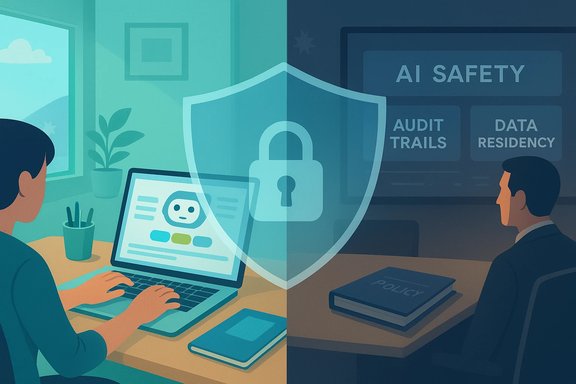
Australia’s experience with AI is splitting along a private/public line: while the majority of knowledge workers in Australia and New Zealand are experimenting and building confidence with AI at home, they are asking employers, unions and government for clear rules, stronger controls and safer workplace rollouts before they will fully embrace the same tools at work.
Salesforce’s recent YouGov survey of 2,132 knowledge workers across Australia and New Zealand — reported in Australian media this week and summarised from the survey results — captures this tension. The research found that 86% of those surveyed use AI in their personal lives, and 71% said personal AI experience increased their trust in AI at work; yet many respondents still want greater transparency, control and strict security and privacy rules from emplooll the technology into professional workflows. These worker views arrive while two policy-and-industry moves are unfolding in Australia. The federal government published its National AI Plan, committing funding to an AI Safety Institute and outlining a “GovAI” approach for secure public-sector use. The plan’s release reflects a push to move public services and national capabilities toward safer, locally governed AI. At the same time, Microsoft Australia has signed a framework agreement with the Australian Council of Trade Unions (ACTU) to embed workers’ voices into AI deployment and training — a notable private-sector step toward cooperative governance. This article summarises the Salesforce/YouGov findings, places them in the broader Australian policy and industry context, verifies and crclaims against independent sources, and then analyses the practical, technical and organisational implications for IT teams ae for rolling AI into everyday workflows.
This informal learning path matters for IT leaders: user fluency often originates outside corporate training programs. If employers ignore those private experiences, they risk a disconnect between whether staff want to use AI and how they want it governed inside work systems. The shadow‑IT equivalent here is “shadow AI”: employees will use consumer tools if employers don’t provide safe, sanctioned alternatives. Independent industry analysis has repeatedly flagged this BYOAI dynamic as a primary source of data leakage risk.
For IT leaders and boards, the imperative is clear: convert the energy of personal experimentation into enterprise value without sacrificing data security, employee rights or traceability. That will require disciplined pilot design, beefed-up procurement and accountability frameworks, and a sustained investment in the human skills that make AI outputs defensible and useful. The alternative — leaving adoption to shadow AI and ad hoc consumer use — will deliver inconsistent benefits and higher operational risk. The workers surveyed have signalled their willingness to move forward; they’re only asking the people who lead work to put the guardrails in place now.
Source: theqldr.com.au Aussies are using AI at home but want rules at work
 Background / Overview
Salesforce’s recent YouGov survey of 2,132 knowledge workers across Australia and New Zealand — reported in Australian media this week and summarised from the survey results — captures this tension. The research found that 86% of those surveyed use AI in their personal lives, and 71% said personal AI experience increased their trust in AI at work; yet many respondents still want greater transparency, control and strict security and privacy rules from emplooll the technology into professional workflows. These worker views arrive while two policy-and-industry moves are unfolding in Australia. The federal government published its National AI Plan, committing funding to an AI Safety Institute and outlining a “GovAI” approach for secure public-sector use. The plan’s release reflects a push to move public services and national capabilities toward safer, locally governed AI. At the same time, Microsoft Australia has signed a framework agreement with the Australian Council of Trade Unions (ACTU) to embed workers’ voices into AI deployment and training — a notable private-sector step toward cooperative governance. This article summarises the Salesforce/YouGov findings, places them in the broader Australian policy and industry context, verifies and crclaims against independent sources, and then analyses the practical, technical and organisational implications for IT teams ae for rolling AI into everyday workflows.What the survey actually found: a concise summary
- The survey covered **2,132 knowledge worsuch as law, finance, marketing, technology, research and consulting.
- 86% of respondents their personal lives (consumer chatbots, planning assistants, hobby tools).
- 71% reported that personal AI use boosted their trust in workplace AI — workers felt better about AI after hands-on- 76% had experimented with multi‑step AI agents or assistants that perform several tasks.
- Despite growing familiarity, sizable proportions demanded safeguards: 47% wanted greater transparency and control over workplace AI and 43% wanted strict rules on security and privacy.
Why personal AI use boosts workplace trust — and where that trust stops
Hands-on learning beats top-down evangelism
Workers report that tinkering with AI at home — planning events with chatbots, using consumer assistants to draft personal messages, experimenting with home produ low-risk environment to learn model behaviour, spot hallucinations, and test prompts. That active learning increases confidence in how AI behaves, including an appreciation of its limits. Salesforce’s regional vice-president framed the pattern as “personal experimentation” translating into more realistic expectations about what AI can and cannot do.This informal learning path matters for IT leaders: user fluency often originates outside corporate training programs. If employers ignore those private experiences, they risk a disconnect between whether staff want to use AI and how they want it governed inside work systems. The shadow‑IT equivalent here is “shadow AI”: employees will use consumer tools if employers don’t provide safe, sanctioned alternatives. Independent industry analysis has repeatedly flagged this BYOAI dynamic as a primary source of data leakage risk.
But confidence has boundaries: trust ≠ permissionless use
The survey shows increased conditional trust — employees understand when and why AI fails (hallucinations, missing context) — but they are not asking for unfettered access. Workers want explainability, audit trails, role-based controls and privacy guarantees before they elevate AI outputs to decision-grade status. These are practical, testable demands: transparency about model provenance, logging of prompts and outputs, and the ability to control what data an assistant can fetch. The public and private policy moves in Australia — the National AI Plan’s call for testing and the ACTU‑Microsoft framework — directly respond to those worker expectations.Cross‑checking the claims: verification and corroboration
- The survey numbers and quotes published in Australian press reports are consistent across multiple outlets and mirror the AAP wire coverage that many newsrooms republished. That provides reasonable corroboration that Salesforce commissioned a YouGov poll and that the figures reported (2132 respondents; 86% personal AI use; 71% increased trust) reflect what was released to media.
- The government’s National AI Plan, including the $29.9 million commitment to establish an Australian AI Safety Institute, is documented in ministerial releases and the Department of Industry page; the plan’s core goals (capturing opportunity, spreading benefits, keeping Australians safe) and the GovAI concept are explicit in official materials. This confirms that policy attention at the federal level is already focused on safe adoption and public-sector provisioning.
- The Microsoft-ACTU memorandum and framework agreement is documented in the ACTU media release and covered in trade press, confirming the collaboration and its stated priorities of worker skilling, embedding worker voice and co-design — an industry-level response that aligns with the worker demand for guardrails.
The regulatory and industrial context: what Australia is doing
National AI Plan — centralised safety and GovAI
The federal government’s National AI Plan is a practical manoeuvre to accelerate adoption while attempting to put safety mechanisms in place. The plan’s commitments include:- Establishing an AI Safety Institute (with initial funding and an operational target in early 2026) to evaluate models, develop testing frameworks, and coordinate advice.
- A GovAI strategy: a secure, government‑hosted platform for public servants to use generative tools without exposing sensitive national or citizen data to uncontrolled public models.
Microsoft + ACTU — a labour‑industry approach to deployment
Microsoft’s agreement with the ACTU is significant for two reasons: it acknowledges union and worker representation in AI governance, and it commits Microsoft to collaborate on worker training and voice mechanisms. This is a practical acknowledgement that adoption is not just a technical problem — it’s a social and industrial one that implicates job design, reskilling and collective bargaining. Multiple trade outlets reported the MOU and fratly after it was signed. Together, the public plan and the private accord suggest a coustrial stakeholders (unions), platform providers (Microsoft) and national policymakers are all signalling that *AI rollouts must be governed, auditable and accompanied by workPractical implications for IT leaders and Windows administrators
The Salesforce findings plus the policy moves create an operational blueprint for organisations that w familiarity into safe, productive deployments. The following checklist is distilled from the survey’s signals, public policy direction, and independent industry guidance.Immediate steps (0–3 months)
- *Inven a rapid survey and log review to understand which consumer models employees are already using (ChatGPT, consumer Copilots, mobile assistants). Shadow AI is the biggest immediDesignate a default, sanctioned assistant**: choose an enterprise-grade Copilot or tenant-grounded assistant and provision it with role‑based access. Provide short-term incentives for employees to migrate from consumer tools to sanctioned tools.
- Apply least‑privilege connectors: restrict which data stores assistants can query (SharePoint/OneDrive/approved repos only) and enforce connector approval workflows.
- Extend DLP and Purview couts: ensure prompts containing PHI, legal matters, IP or sensitive financial data are blocked or logged for review.
Medium term (3–12 months)
- Create proification checklists: convert employee experimentation into shared playbooks; require human‑in‑the‑loop verification for outputs used externally.
- Instrument and measure outcomes: track time saved, error rates, and rework. Measure quality, not just usage. Reward validated outcomes rather than raw query counts.
- Set governance for agents: treat internal agents as products with owners, SLOs and lifecycle governance (retire, update, audit). Add runtime monitoring for agent behaviour.
Longer term (12+ months)
- Invest in role transformation and reskilling: pair prompt-design training with domain validation skills; create career pathways for AI-adjacent roles (prompt designers, data stewards, model auditors).
- Contractual and procurement upgrades: demand vendor SLAs on non‑training guarantees, provenance, retention and independent testing for high‑risk workloads.
- **Participate in sectoral safety workunions, regulators and industry bodies to shape local standards — as Microsoft and ACTU have begun to do — so rollouts account for workplace impacts and rights.
Strengths and opportunities: what employers can unlock
- Faster task completion and better first drafts: Embedding copilots into familiar apps (Word, Excel, Outlook, Teams) reduces friction and produces measurable time-savings on structured tasks like summarisation and drafting. That makes AI adoption a productivity lever rather than a novelty.
- Democratisation of skills: Consumer experimentation means many employees arrive with baseline fluency. Organisations can convert that into enterprise capability through short, targeted enablement programs and shared prompt libraries.
- Opportunities to improve accessibility and inclusion: AI features (real-time captioning, scaffolding for drafts, translation) help neurodivergent employeekers, improving day‑to‑day work quality.
- A chance to reframe roles: With mundane tasks automated, organisations can invest in higher-value judgment, synthesis and customer-facing activities — if they intentionally redesign roles and reward the new skills.
Risks and open questions
No rollout is risk-free. The Salesforce findings and the Australian policy moves highlight persistent hazards that need concrete mitigation.- Hallucinations and legal exposure: Generative models can invent facts. Without provenance and human verification, organisations risk publishing incorrect or misleading recommendations that cause legal, reputational or regulatory harm. The survey respondents’ demand for transparency reflects this core risk.
- Data leakage from consumer models: When employees paste confidential text into public chatbots, the risk of sensitive data being used for model training or exposed externally increases. Enterprise non‑training guarantees and tenant-grounded solutions are a necessary control.
- Fragmented governance and patchy procurement: Without standardised testing and independent audits, organisations will adopt different practices across departments — which creates systemic exposure at scale. That is a central motivation for the Government’s AI Safety Institute. ([minister.industry.gov.au](https://www.minister.industry.gov.a...plan-empowering-all-australians?utm_source=oe disruption and distributional effects**: While many roles will be augmented, some routine roles could contract. The survey suggests workers expect positive effects within two years, but the pace and distribution of change depends on reskilling investments and collective bargaining outcomes. The Microsoft-ACTU framework attempts to place workers into that transition.
- Vendor transparency and independent verification shortfall: The industry is moving fast; independent, third‑party test regimes and clear contractual obligations are still evolving. For higher‑risk deployments, demand external audits and insist on explicit retention and non-training clauses.
How to translate worker expectations into governance that scales
Turning employee trust from personal experimentation into safe workplace adoption requires institutions to act on three fronts simultaneously: technology, policy and people.Tech: build defensible stacks
- Use tenant-grounded copilots or private‑deployment models for regulated data.
- Enforce connectors and DLP to limit spontaneous copying into public models.
- Log prompts and outputs where outputs feed decisions; ensure immutable audit trails.
Policy: define acceptable use and escalation
- Publish a short, role-specific acceptable‑use policy (AUP) that complements technical controls.
- Define approval gates for using AI in customer-facing, legal or clinical outputs.
- Require disclosure and human sign-off for any AI-derived external communication.
People: train, certify and involve workers
- Run short, targeted workshops that teach verification skills (how to check citations, red flags for hallucinations).
- Capture employee-created prompts and workflows into corporate playbooks to turn private innovation into shared capability.
- Give unions and worker representatives a seat at governance tables where policy affects roles, pay or duties. The Microsoft‑ACTU accord shows that cooperative engagement is feasible and can accelerate responsible adoption.
A shortlist of actionable policies for boards and CIOs
- Mandate human verification for all AI outputs used in external communication or decision-making.
- Require vendors to provide non‑training guarantees and data residency commitments for sensitive use.
- Institute prompt and output logging with retention policies aligned to compliance needs.
- Establish a cross‑functional AI governance board that includes legal, HR, security and worker representatives.
- Fund role-based reskilling and create visible career pathways for employees who develop AI‑adjacent skills.
Conclusion
The Salesforce‑YouGov findings are a practical reminder: consumer AI adoption is fertile ground for workplace capability, but it is not a substitute for organisational governance. Australian workers are experimenting and gaining confidence in AI at home, and they expect their employers to match that readiness with transparency, control and security at work. That worker expectation is being echoed across policy and industry actions — the National AI Plan’s investment in an AI Safety Institute and Microsoft’s agreement with unions both point to a future where technology rollout must be accompanied by testing, training and shared governance.For IT leaders and boards, the imperative is clear: convert the energy of personal experimentation into enterprise value without sacrificing data security, employee rights or traceability. That will require disciplined pilot design, beefed-up procurement and accountability frameworks, and a sustained investment in the human skills that make AI outputs defensible and useful. The alternative — leaving adoption to shadow AI and ad hoc consumer use — will deliver inconsistent benefits and higher operational risk. The workers surveyed have signalled their willingness to move forward; they’re only asking the people who lead work to put the guardrails in place now.
Source: theqldr.com.au Aussies are using AI at home but want rules at work
