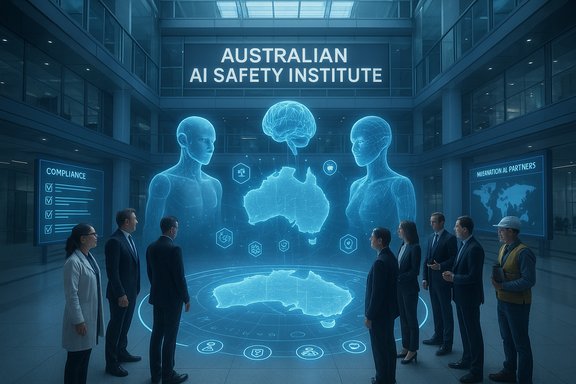
The federal government has moved from consultation to a concrete delivery on AI governance with the announcement that it will establish an Australian AI Safety Institute to evaluate emerging AI capabilities, coordinate technical assessments, and recommend legal and regulatory updates — an initiative the government says will sit at the centre of its forthcoming National AI Plan and act as a single hub for assessing AI risks and assuring compliance with Australian law.
The announcement, made on 25 November 2025 by the Minister for Industry, Innovation and Science, Tim Ayres, positions the Australian AI Safety Institute as a government-backed technical and regulatory resource designed to do three broad things: evaluate new AI capabilities, advise on where laws and regulations need updating, and provide technical assessments that support enforcement and public trust. The government framed the move as a way to capture AI’s productivity benefits while guarding against “malign uses” and harms. The institute is being presented as a national node that will also work with international partners — including the National AI Centre and the International Network of AI Safety Institutes — to align Australia’s approach with global standards and to simplify multilateral cooperation on AI risks and standards. The government says this work will feed into a National AI Plan due before the end of 2025. At the same time, an industry study from Adobe’s Digital Government Index warned that many Australian government agencies remain only basically AI-ready, scoring 61.7 on the index’s AI readiness measure and highlighting the risk that citizens and AI tools could be served out-of-date or fragmented information from government websites. The Adobe findings underline that technical assessment and institution-building will need to be matched by substantive investments in digital infrastructure and content hygiene.
Adobe’s assessment of government digital readiness — including the 61.7 AI readiness score — is a timely reminder that an institute’s technical findings must be matched by operational investment: canonical APIs, modernised content publishing practices, and improved digital service maturity if Australia is to avoid the twin dangers of misinformation and uneven public service experience. For IT professionals and Windows administrators, the near-term imperative is pragmatic: start or accelerate data inventories, harden procurement terms, plan for immutability in AI logging, and rehearse red-team and independent audit engagements. The institute will likely produce the national standards and templates that organisations will be expected to meet — preparing now will make compliance and competitive advantage easier to achieve.
The announcement marks a transition point from consultation to institutionalisation. Whether the institute becomes the agile, independent technical engine that the policy moment requires will be decided by its governance design, resourcing and the political will to convert evidence into enforceable protections.
Source: Benalla Ensign | Benalla Ensign
 Background / Overview
The announcement, made on 25 November 2025 by the Minister for Industry, Innovation and Science, Tim Ayres, positions the Australian AI Safety Institute as a government-backed technical and regulatory resource designed to do three broad things: evaluate new AI capabilities, advise on where laws and regulations need updating, and provide technical assessments that support enforcement and public trust. The government framed the move as a way to capture AI’s productivity benefits while guarding against “malign uses” and harms. The institute is being presented as a national node that will also work with international partners — including the National AI Centre and the International Network of AI Safety Institutes — to align Australia’s approach with global standards and to simplify multilateral cooperation on AI risks and standards. The government says this work will feed into a National AI Plan due before the end of 2025. At the same time, an industry study from Adobe’s Digital Government Index warned that many Australian government agencies remain only basically AI-ready, scoring 61.7 on the index’s AI readiness measure and highlighting the risk that citizens and AI tools could be served out-of-date or fragmented information from government websites. The Adobe findings underline that technical assessment and institution-building will need to be matched by substantive investments in digital infrastructure and content hygiene. What the Institute will (and will not) do
Mandate as announced
- Evaluate emerging AI capabilities and produce timely technical assessments to inform policy decisions.
- Recommend legal and regulatory changes where current frameworks are insufficient to manage new AI risks.
- Support enforcement and vendor compliance, by ensuring companies operating in Australia uphold legal standards around fairness, transparency and other statutory protections.
- Coordinate internationally to harmonise approaches and participate in networks of AI safety institutes.
Not an immediate regulator
The government’s messaging indicates the institute will provide expert advice, assessments and coordination rather than instantly becoming a regulator with unilateral licensing powers. The actual regulatory instruments and statutory powers that will be proposed remain to be detailed in the National AI Plan and subsequent policy documents. That distinction — advisory and technical hub versus statutory regulator — is significant for how quickly the institute can take enforcement action and how its recommendations will be converted into binding obligations.Reactions from industry, unions and academia
The announcement drew immediate support from a mix of industry and civil society voices. Major technology companies and security officers welcomed the independent, expert advice the institute promises to offer, and trade unions framed the institute as a potential bulwark against “bad-faith” commercial uses of generative AI that can undermine workers’ rights, creative attribution and livelihoods. Unions specifically flagged creative theft and job displacement as top concerns to be addressed. Academic and research institutions also endorsed the idea of a specialised centre to coordinate technical assessment and public-facing research, noting that comparable institutes in the UK, US and Japan have helped connect technical evaluation with policy. At least one university institute welcomed the announcement as fulfilling earlier commitments made at international fora where Australia had pledged to establish an AI safety institute.Why this matters: strengths and immediate opportunities
Australia’s decision to create a dedicated AI safety institute is meaningful for several practical reasons:- Centralised technical capability: Governments often struggle with distributed, inconsistent technical expertise across agencies. A dedicated institute can provide reproducible assessments, standardised testing protocols, and technical certifications that agencies can lean on rather than re-inventing capability in every department.
- Faster legislative triage: Emerging AI capabilities expose gaps in laws (privacy, copyright, online safety, competition). An institute that systematically evaluates technologies can identify which gaps are urgent and provide technical evidence to fast-track legislative updates.
- International leverage: By joining global networks and sharing assessment frameworks, Australia can both learn from larger jurisdictions and punch above its weight in multilateral standards-setting. This is particularly valuable for cross-border model governance and procurement norms.
- Worker protections and policy design: Union support underscores a political opening to pair safety oversight with labour protections — for example, rules on authorship attribution, rights around model-trained material, and reskilling funding — that help make AI adoption socially sustainable.
- Public confidence and transparency: If the institute publishes technical reports, red-team results and guidelines openly, it can help rebuild trust in institutions tasked with both enabling innovation and protecting citizens. Transparency and accountability are central to public acceptance of AI in government.
Key risks, weaknesses and unanswered questions
The creation of an institute is a necessary but not sufficient step. Several material risks could blunt its effectiveness unless they are actively managed.1. Ambiguous powers and enforcement
The institute has been described primarily as an advisory and assessment body. Without statutory enforcement powers or a clear connection to regulators, its recommendations might be slow to translate into legally binding protections. The government must clarify whether the institute will have investigatory powers, the ability to compel evidence, or standing to initiate compliance actions.2. Resourcing and staffing
A credible AI safety institute requires a sustained budget, a pipeline of technical talent (model auditors, safety engineers, MLOps experts) and independence from capture by commercial interests. The announcement did not publish initial budget figures or governance safeguards to guarantee its technical independence. Without those, the institute risks being underpowered or perceived as industry-aligned.3. Overlap and coordination with existing bodies
Australia already has regulators and programs dealing with parts of the AI risk landscape — privacy, consumer protection, online safety, and competition law. How the institute will interoperate with the OAIC, ACCC, eSafety, the National AI Centre, and other agencies must be defined to avoid duplication and bureaucratic friction. Independent advisory advice is only effective if channels to regulators are clear and efficient.4. Speed vs. rigor trade-off
AI development moves faster than legislation. The institute must strike a balance between rapid technical triage and rigorous, reproducible assessment methodologies. There is a real danger that early, shallow assessments become the basis for weak rules that lock in poor standards. Conversely, overcautious, slow reviews allow harms to proliferate unaddressed. The institute must design agile but robust testing and reporting procedures.5. Data sovereignty and vendor lock-in
If the institute endorses or validates certain vendor architectures without demanding contractual safeguards (non-training clauses, telemetry controls, onshore processing), Australia could become dependent on a small number of international vendors for critical public systems. That would create legal and operational vulnerabilities, especially given cross-border access laws. The institute must prioritise procurement rules that protect public data and ensure competition.6. Government digital fragmentation and misinformation risk
Adobe’s Digital Government Index warns that government web fragmentation and low AI readiness can lead to outdated or inaccurate content surfacing through commercial AI tools — exposing citizens to misinformation. The institute can advise on technical fixes, but the underlying problem will require cross-jurisdictional investment in content hygiene, APIs for authoritative data, and dataset versioning. Without that, the institute’s technical reports will identify problems but not fix the day-to-day information flows that matter to users.Practical implications for IT professionals, Windows administrators and procurement teams
The institute’s work will ripple through public and private IT procurement, vendor contracts and governance practices. Practitioners should prepare for new expectations and leverage this moment to harden AI governance at the organisation level.Immediate actions for IT leaders
- Inventory and classify: Conduct a full data inventory and classification ahead of vendor conversations. Identify datasets that must not be shared with external LLMs.
- Contractual guardrails: Require non-training clauses, telemetry limits, data residency guarantees and audit rights in all AI vendor contracts. Treat these as negotiable procurement standards, not optional extras.
- Human-in-the-loop for high risk: Define processes where human sign-off is mandatory for any output used in regulatory, legal or safety-critical contexts. Embed attestation workflows in document pipelines.
- Immutable logging: Implement tamper-evident prompt and response logging for AI-assisted workflows to support auditability and FOI responses. Plan retention policies consistent with records law.
- Red-team and independent audits: Budget for independent adversarial testing and third-party audits before deploying models into production. These audits should test for hallucinations, data leakage and prompt-injection vulnerabilities.
What Windows-based enterprises should watch for
- Copilot and desktop assistants: As Microsoft and other vendors continue to integrate generative features into productivity suites and Windows itself, expect contractual and technical guidance from the institute that touch endpoint telemetry, memory defaults, and enterprise policy settings. Administrators should prepare to update group policies, MDM profiles, and endpoint data loss prevention (DLP) rules.
- On-prem vs. cloud trade-offs: For high-sensitivity workloads, on-prem or sovereign cloud-hosted model instances may become the recommended standard. Organisations should evaluate the cost and operational implications of running private model instances or working with vendors who guarantee onshore processing.
A suggested roadmap for the Australian AI Safety Institute (practical checklist)
To be credible and effective, the institute should prioritise the following within its first 12–18 months:- Publish a transparent mandate, governance charters and an initial budget to demonstrate technical independence.
- Release methodology standards for testing models (red-team protocols, benchmark tasks, provenance checks) so industry and agencies can prepare to meet the same bar.
- Create a model registry and a public “assurance” framework mapping risk levels to regulatory expectations for specific use cases.
- Coordinate with regulators to define enforcement pathways — how institute findings trigger regulatory review, recall, or sanctions when non-compliance is detected.
- Run a government-wide content hygiene program to supply authoritative APIs and canonical content sources for AI tools that scrape government sites. This will reduce misinformation risk highlighted by Adobe’s index.
- Pilot a vendor audit lab with independent auditors, offering a fast-track certification for models that meet Australian technical and legal standards.
- Fund public-facing education and reskilling programs tied to the institute’s work, focusing on sectors most likely to be disrupted and on public-sector workers whose jobs will change with AI adoption.
How this links to the broader government AI agenda
The institute is being launched against a backdrop of other government AI moves: the APS AI Plan and agency-level pilots that have already exposed real-world governance questions (for example, the use of Copilot in drafting official materials and the creation of a GovAI platform). Those exercises show clear productivity gains but also reveal unanswered questions about prompt logging, FOI exposure, and the legal status of AI-assisted drafting — issues the institute will almost certainly be asked to resolve or advise upon. The institute’s credibility will depend on producing clear, implementable guidance that aligns legal obligations with technical controls.Three realistic scenarios for the institute’s impact
- High-impact, well-resourced start: The institute receives strong funding, appoints independent technical leadership, and its assessments quickly inform binding regulatory changes (e.g., mandatory non-training clauses for public procurement, certification standards for high-risk models). Outcome: improved public trust, reduced vendor risk, and clearer pathways for safe AI adoption.
- Advisory-only, under-resourced outcome: The institute produces high-quality reports but lacks enforcement or coordination power. Agencies and industry adopt some recommendations voluntarily, but systemic gaps (data sovereignty, procurement) persist. Outcome: incremental improvements but continued fragmentation and risk exposure.
- Symbolic and politically constrained: The institute becomes a centre for industry engagement without independence or technical muscle. Recommendations are slow and diluted; vendor and agency practices continue to outpace governance. Outcome: regulatory lag, potential high-profile incidents, and erosion of public trust.
Final assessment and what to expect next
The establishment of an Australian AI Safety Institute is a strategically important move that aligns Australia with other major jurisdictions that have recognised the need for dedicated technical capacity to manage frontier AI risks. The institute can create value by standardising assessments, advising on legal fixes, and coordinating internationally. However, its success will depend on concrete elements that remain unspecified in the announcement: clear statutory powers or formal regulatory linkages, robust and sustained resourcing, independent technical leadership, and an operational plan for rapid coordination across agencies.Adobe’s assessment of government digital readiness — including the 61.7 AI readiness score — is a timely reminder that an institute’s technical findings must be matched by operational investment: canonical APIs, modernised content publishing practices, and improved digital service maturity if Australia is to avoid the twin dangers of misinformation and uneven public service experience. For IT professionals and Windows administrators, the near-term imperative is pragmatic: start or accelerate data inventories, harden procurement terms, plan for immutability in AI logging, and rehearse red-team and independent audit engagements. The institute will likely produce the national standards and templates that organisations will be expected to meet — preparing now will make compliance and competitive advantage easier to achieve.
The announcement marks a transition point from consultation to institutionalisation. Whether the institute becomes the agile, independent technical engine that the policy moment requires will be decided by its governance design, resourcing and the political will to convert evidence into enforceable protections.
Source: Benalla Ensign | Benalla Ensign