

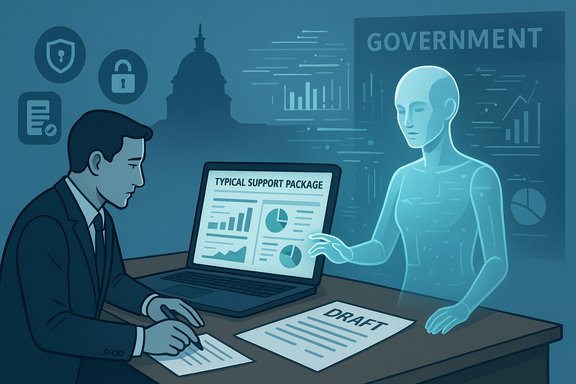
The Australian government’s disability planner quietly turned to algorithms: Freedom-of-information documents published this week reveal that the National Disability Insurance Agency (NDIA) has been using machine learning to generate initial draft budgets — “Typical Support Packages” — for first-time NDIS participants, even as the agency trials Microsoft Copilot for staff productivity and the federal government prepares a whole-of-government AI rollout.
The material released under FOI and reported publicly shows two parallel threads: one, a pre-existing machine-learning system used to propose draft support budgets based on participant profile data; and two, a six‑month staff trial of Microsoft Copilot — a generative AI assistant — involving hundreds of agency employees that focused on internal productivity tasks such as drafting emails and meeting transcription. The NDIA’s internal policy documents state that human delegates make final decisions on plans and that AI must not access participant records without express authorisation. This development sits inside a larger policy shift: on the same day the NDIA material was reported, the federal government published a Whole‑of‑Government AI Plan that promises access to generative AI tools, training, and a new GovAI platform for public servants — an effort aimed at scaling productivity while attempting to address data governance and oversight concerns.
The right response is neither reflexive prohibition nor uncritical scaling. It is a pragmatic, evidence‑based approach that combines: transparent disclosure to participants, rigorous impact assessments, enforceable contractual and technical safeguards (non‑training clauses, least‑privilege indexing, immutable logs), independent auditing, and genuine resourcing for planners so human judgement is not overwhelmed by throughput pressures. The federal whole‑of‑government AI Plan sketches many of these elements, but the test will be in the execution — whether agencies harden information governance before expansion and whether public oversight mechanisms can independently verify that the systems operate fairly and safely. If implemented with discipline and with participants at the centre, ML and generative tools can responsibly augment planners’ work. If adopted without those safeguards, there is a real risk of reproducing past harms under a new technical gloss. The line between helpful automation and disempowering bureaucracy is thin — and in the NDIS context, the consequences demand the highest standards of transparency, explainability and human accountability.
Source: The Guardian Government using machine learning to help create draft plans for NDIS participants, documents reveal
 Overview
The material released under FOI and reported publicly shows two parallel threads: one, a pre-existing machine-learning system used to propose draft support budgets based on participant profile data; and two, a six‑month staff trial of Microsoft Copilot — a generative AI assistant — involving hundreds of agency employees that focused on internal productivity tasks such as drafting emails and meeting transcription. The NDIA’s internal policy documents state that human delegates make final decisions on plans and that AI must not access participant records without express authorisation. This development sits inside a larger policy shift: on the same day the NDIA material was reported, the federal government published a Whole‑of‑Government AI Plan that promises access to generative AI tools, training, and a new GovAI platform for public servants — an effort aimed at scaling productivity while attempting to address data governance and oversight concerns. Background: what the documents say
Machine learning used for draft budgets
According to briefing material prepared for Senate estimates and obtained under FOI, the NDIA has been using machine learning to create initial budget recommendations for first plans. The agency described the algorithm as a tool that produces recommendations from participant profile data; human delegates then review and make the final determinations. The FOI files framed the role of the algorithm as assistive — speeding initial analysis to provide quicker resolutions for participants. Machine learning, in this usage, is the statistical practice of training models on historical data to make predictions or recommendations. It is distinct from generative AI assistants (large language models) that produce free‑form text on demand; ML systems for budgeting typically match participant attributes to historical support-package patterns and output a suggested “typical” package. Authoritative glosses from government AI guidance define machine learning as a subset of AI that extracts patterns from data to make predictions or classifications.The Copilot trial and internal findings
The documents reported show the NDIA ran a Copilot pilot spanning six months beginning in January of last year, involving roughly 300 staff. The trial’s internal evaluation reportedly recorded improvements in document- and email‑preparation productivity and favourable satisfaction scores among staff — including accessibility gains such as live transcription benefits for hearing‑impaired employees. The NDIA emphasised Copilot’s use was restricted to non‑client‑facing activities and said AI was not used in systems that determine eligibility or funding. Independent cross‑government trials and departmental pilots have shown similar patterns: generative assistants can accelerate summarisation and drafting tasks, but they also expose latent weaknesses in document classification, access control and provenance — weaknesses that can lead to accidental exposure of sensitive materials if not hardened first. The government’s new AI plan explicitly references lessons from those pilots and proposes a staged rollout via a government‑managed GovAI platform and mandatory training for staff.Why this matters: scale, stakes and context
Lives are at stake
NDIS plans are not administrative checkboxes — they set budgets that determine a participant’s support levels, therapy access, mobility aids, and daily personal‑care hours. Decisions about frequency of support, equipment, or assistance with essential daily activities materially affect independence, health and wellbeing. Any tool that touches the drafting or triage of these plans operates in a high‑stakes space where errors can cause real harm. The NDIA’s insistence on human final decision‑making is therefore essential; whether it is sufficient depends on the quality of governance, auditability and staff capacity to scrutinise algorithmic recommendations.Political and legal memory: robodebt
Australia’s public institutions carry a political memory of the robodebt scandal and the Royal Commission that followed, which specifically criticised automated decision‑making and urged stronger oversight, transparency and audit powers for automated systems used by government. The royal commission’s recommendations stress that when automated systems affect entitlements or rights, there must be clear review pathways and publication of the underlying rules and business logic. Those recommendations now form a backdrop to any use of ML or AI in welfare‑adjacent settings.Technical verification and what is or isn’t corroborated
- The public report that the NDIA used machine learning to generate draft budgets, and that the Copilot trial ran with 300 staff, comes from FOI documents reported by the Guardian. That article is the primary public account of the specific NDIA FOI materials as currently available in the media. The broader pattern — government pilots of Copilot‑style assistants and a subsequent whole‑of‑government AI plan — is corroborated by the Finance Minister’s public release of the APS AI Plan.
- Specific performance metrics reported in the FOI summary — such as the Copilot trial producing a 20% reduction in task completion times and a 90% staff satisfaction rating — are cited in the FOI‑based coverage but are not yet published by the NDIA as stand‑alone technical reports or datasets available publicly. Those figures should be treated as claimed measurements drawn from internal evaluation materials until the agency releases the underlying evaluation files or independent reviewers confirm them. Treat the precise percentages as provisional.
- The NDIA’s stated policy that “AI tools must not access participant records” without CIO authorisation is documented in its April 2024 AI policy extract quoted in the FOI materials. That policy line is consistent with publicly prescribed APS guardrails: agencies are encouraged to avoid allowing external LLMs access to personal or classified data and to use on‑prem or government‑tenant models for sensitive tasks where possible. However, the practical enforcement mechanisms and technical architecture that ensure an ML system cannot indirectly infer or access participant data are not yet visible in public documents.
Strengths and immediate benefits
- Faster intake and triage: ML that produces initial draft budgets can reduce repetitive tasks and shorten time to first draft, freeing planners to spend time on nuance and participant engagement rather than baseline calculations. Where models are reliable on straightforward, archetypal cases, they can reduce backlogs and time‑to‑service.
- Productivity and accessibility: Trials of generative assistants across the public sector repeatedly show gains in summarisation, drafting and meeting transcription. Those features can improve productivity and support inclusivity for staff with disabilities (for example, live transcription for hearing‑impaired employees). The government’s APS AI Plan explicitly aims to capture these gains while institutionalising training and tooling.
- Evidence‑based pilots: The NDIA’s apparent staged approach — piloting low‑risk assistive ML and internal Copilot use before expanding to higher‑risk workflows — reflects contemporary best practice in public‑sector experimentation. When executed with rigorous impact assessments, pilots can inform safer, incremental adoption.
Risks, failure modes and systemic harms
Black‑box decisions and automation bias
Machine learning models — especially those trained on historical administrative data — reflect past decisions and distributions. They can encode systemic biases (geographic, socio‑economic, disability type) and obscure which features drove a given recommendation. Researchers warn that ML struggles with nuance: atypical cases, intersectional disabilities, or culturally specific needs may not be well served by pattern‑matching approaches. Focusing on the “average” risks misclassifying people who do not fit the historical norm. There is also automation bias: practitioners under time pressure, constrained by KPIs, or trusting a model’s efficiency gains may defer to algorithmic recommendations rather than exercise professional judgment. The political and operational incentives inside an agency matter as much as the quality of the model.Data leakage and provenance
Generative assistants and ML systems increase the surface area for accidental data exposure unless data classification, tenancy, and logging are hardened. Pilots across government have repeatedly surfaced misconfiguration issues where AI tools inadvertently indexed sensitive documents, enabling access beyond intended privileges. Immutable logging, least‑privilege indexing, and contractual non‑training clauses are necessary mitigations but are not magic bullets by themselves.Accountability and legal risk
If an ML recommendation materially affects a budget allocation or the level of essential supports, the legal and administrative mechanisms for review and appeal must be clear. The Royal Commission emphasised transparency, independent auditing and the right of affected individuals to contest automated processes used in government services — requirements that map directly onto the NDIS context.Workforce effects and equity
Even when labelled “augmentation,” new AI tools change job content. Administrative tasks may shrink; expectations for throughput may rise; and entry‑level roles — disproportionately occupied by women in many public administrations — might be reshaped. Agencies must plan for retraining, role redesign and transparent consultation with unions and staff to avoid adverse distributional impacts.Practical technical and governance safeguards (a checklist)
The evidence and expert commentary point to a pragmatic set of controls that should be rapidly adopted if ML or generative AI touches NDIS workflows.- Data governance
- Conduct a full data inventory and classification before any AI indexing. Place participant records and other high‑risk corpora outside any model’s retrieval or training feed unless explicit, auditable authorisation is granted.
- Human‑in‑the‑loop (HITL)
- Enforce mandatory human sign‑off on any decision or funding outcome influenced by an algorithm. Make HITL processes auditable and part of routine QA sampling.
- Transparency and explainability
- Publish, in plain English, the nature of algorithmic assistance used in planning (what it does and what it does not). For automated recommendations that materially impact participants, provide a mechanism for participants to request explanation of how a recommendation was derived.
- Immutable logs and provenance
- Record model version, prompt/context snapshots, input sources and post‑editing logs for every AI‑assisted draft. Retain logs under a defensible retention schedule and make them available for audit on demand.
- Contractual protections
- Require vendor non‑training clauses, data residency guarantees, and explicit telemetry/retention terms in all supplier contracts. Ensure vendors cannot reuse tenant inputs to train public models without express approval.
- Independent audit and oversight
- Implement third‑party red‑teaming and code/data audits for high‑risk models. Consider a permanent monitoring body or expand an existing regulator to review government automated decision‑making, consistent with the Robodebt recommendations.
- Workforce and participant safeguards
- Provide targeted training for planners on algorithmic limits and cognitive biases; roll out participation guarantees so planners have time and resources to meaningfully engage with participants rather than rubber‑stamp algorithmic drafts.
A closer look at plausible failure scenarios
- A planner under deadline pressure accepts an ML‑generated Typical Support Package without sufficient local verification, leaving a participant with inadequate care hours or wrong equipment — causing harm and triggering appeals.
- A misconfigured index allows the Copilot or GovAI model to surface sensitive participant details to staff without authorization, exposing personal information and creating privacy liabilities.
- An ML model trained on historical budgets inherits policy‑bias (for example, systematically lower allocations for certain cohorts), locking in inequities unless regularly audited and re‑weighted.
How to evaluate whether the NDIA (or any agency) is ready to scale AI assistance for NDIS plans
- Publish an algorithmic impact assessment (AIA) for any ML system used in planning: scope, training data, performance metrics, and identified biases.
- Make internal evaluation data available for independent researchers under appropriate confidentiality terms so claims (e.g., 20% time savings) can be validated and stress‑tested. If claimed benefits rely on unpublished internal metrics, treat them as provisional until validated.
- Require a statutory or chartered oversight role with the mandate to audit high‑risk automated decision systems in social services — aligned with the Royal Commission’s proposal for oversight of automated decision‑making.
- Publish simple participant‑facing explanations: when an algorithm was used in plan preparation, what it did, and how the human decision was reached.
What participants and advocates should demand
- Clear, accessible notice whenever an algorithm has contributed to a draft plan.
- The right to an explanation of the basis for any allocation affecting entitlements.
- Guaranteed time with a trained planner who can explain, modify and, where necessary, override algorithmic recommendations.
- Public reporting on audit findings and remedial steps taken where biases or incidents are uncovered.
Conclusion
The NDIA’s adoption of machine learning to assist with NDIS draft budgets and its internal Copilot trial are part of a broader Australian public‑service pivot toward generative AI and productivity tooling. The potential benefits — faster service, better staff accessibility, and routine task automation — are real and attractive. But the stakes in disability planning are also unusually high: these technologies do not merely optimise workflows; they touch people’s daily lives.The right response is neither reflexive prohibition nor uncritical scaling. It is a pragmatic, evidence‑based approach that combines: transparent disclosure to participants, rigorous impact assessments, enforceable contractual and technical safeguards (non‑training clauses, least‑privilege indexing, immutable logs), independent auditing, and genuine resourcing for planners so human judgement is not overwhelmed by throughput pressures. The federal whole‑of‑government AI Plan sketches many of these elements, but the test will be in the execution — whether agencies harden information governance before expansion and whether public oversight mechanisms can independently verify that the systems operate fairly and safely. If implemented with discipline and with participants at the centre, ML and generative tools can responsibly augment planners’ work. If adopted without those safeguards, there is a real risk of reproducing past harms under a new technical gloss. The line between helpful automation and disempowering bureaucracy is thin — and in the NDIS context, the consequences demand the highest standards of transparency, explainability and human accountability.
Source: The Guardian Government using machine learning to help create draft plans for NDIS participants, documents reveal
