

Artificial Intelligence is now a near‑constant study partner for millions of students — but every chat, draft, and correction has an environmental and operational cost that is rarely visible on the screen or in the syllabus.
AI tools such as ChatGPT, Google Gemini, Microsoft Copilot, Claude and other large language models have rapidly moved from novelty to classroom staple because they speed writing, generate study summaries, and assist with ideation. That convenience, however, rides on a global infrastructure of GPUs, networks, and cooling systems whose energy and capital requirements are large and growing. The energy consumed to train, host, and serve modern models scales nonlinearly with model size and demand; that scaling is already reshaping electricity grids and investment strategies worldwide. Understanding these costs is essential for students, instructors, and campus IT teams who must balance the pedagogical benefits of AI with institutional budgets, academic integrity, and the climate commitments many universities have adopted.
By treating AI as a shared resource — one that has monetary, carbon and ethical footprints — students and educators can keep the pedagogical promise of these tools while minimizing unintended environmental and fiscal consequences. Conscious prompts, careful policies, and transparent procurement will ensure that AI remains a tool for learning rather than a hidden drain on budgets and the planet.
Source: The Hindu What students must know about the hidden costs of using AI
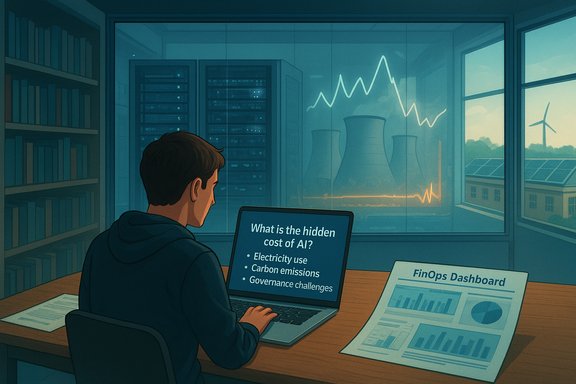 Background: why “hidden costs” matter for students and educators
AI tools such as ChatGPT, Google Gemini, Microsoft Copilot, Claude and other large language models have rapidly moved from novelty to classroom staple because they speed writing, generate study summaries, and assist with ideation. That convenience, however, rides on a global infrastructure of GPUs, networks, and cooling systems whose energy and capital requirements are large and growing. The energy consumed to train, host, and serve modern models scales nonlinearly with model size and demand; that scaling is already reshaping electricity grids and investment strategies worldwide. Understanding these costs is essential for students, instructors, and campus IT teams who must balance the pedagogical benefits of AI with institutional budgets, academic integrity, and the climate commitments many universities have adopted.The technical spine: training, inference, and data‑center realities
What consumes energy: training vs inference
- Training a state‑of‑the‑art model is intensely energy‑heavy: it requires thousands of accelerator-hours, vast storage, and repeated experimental runs. Training a single frontier model can burn megawatt‑hours of electricity over weeks.
- Inference — the moment a model answers a student’s query — is far less costly per interaction, but it happens millions or billions of times. When these small costs scale, they become substantial.
How much power does a single query use?
Estimates vary by model size, hardware, and service optimizations, but independent measurements and vendor‑level analyses converge on a useful range for text‑only queries:- Efficient, modern inference stacks often consume on the order of tenths of a watt‑hour per short text prompt (roughly 0.1–0.4 Wh). This is comparable to powering a small LED bulb for 30–60 seconds.
- Other analyses show higher per‑query values for larger context windows, chain‑of‑thought reasoning modes, or less‑optimized serving pipelines — numbers that can rise into the single watt‑hour range in some cases. This variability means per‑prompt energy should be presented as a range, not a single definitive number.
Real‑world disclosure: the scale problem
Berkeley Lab’s national assessment found that U.S. data centers consumed roughly 4.4% of U.S. electricity in their most recent measurement and projected that, under high‑growth scenarios driven largely by AI workloads, the share could rise to between about 6.7% and 12% by the end of this decade. That degree of growth has major implications for grid planning, electricity prices, and regional decarbonization plans. At the investment level, independent industry analysis projects trillions of dollars of capital flow into data‑center expansion to meet AI demand — a reminder that AI’s footprint is financial as well as environmental.What students should know: the practical impacts on learning, budgets and the planet
1) Everyday choices add up
A short “thank you” or an extra clarifying sentence looks trivial. But every additional token passed through a live model requires compute cycles and therefore electricity. OpenAI’s CEO has publicly quipped that politeness “costs” the company millions in electricity annually — a remark that highlighted how small user behaviors multiply at planetary scale. Independent measurements that break down per‑response energy confirm the arithmetic: many small interactions become a measurable load. This is not an argument to stop using AI; it is a call to use it deliberately.2) Academic institutions carry shared responsibility
Surveys and institutional reports show that students are among the most frequent regular users of generative AI tools, and many education systems still lack clear, enforceable policies about acceptable use. The result is a double pressure on campuses: they must govern sensitive data and assessment integrity while also provisioning for rising compute and licensing costs. In practice, that means procurement, contract language, and FinOps become academic priorities.3) Budget and carbon accounting
When administrators provision campus AI services or sign enterprise licenses with Copilot‑style assistants, the total cost of ownership includes not only software fees but also the energy and infra costs behind those services. Institutions planning for AI must budget for usage‑based billing, monitoring, and possible spikes in consumption during peak assessment windows. The macro picture — multitrillion dollar investments in AI‑ready infrastructure — shows why operational budgets for higher education will feel these effects.New approaches — from behaviour changes to moonshot engineering
Practical, immediate student practices (low effort, high impact)
- Batch prompts: Combine related questions into a single interaction instead of many separate queries.
- Be precise: Use concise, well‑scoped prompts to avoid needing long follow‑ups.
- Use reviews, not re‑queries: Where platforms allow, give a simple thumbs‑up or thumbs‑down rather than crafting a new prompt for small feedback.
- Prefer hosted institutional instances: Use campus‑provisioned AI services that include contractual data protections, rather than public consumer endpoints for sensitive work.
- Offline first: Use downloaded materials and local tools for tasks that don’t require generative AI.
Institutional levers for sustainability and governance
- Negotiate non‑training and retention clauses in vendor contracts so student prompts aren’t ingested into vendor training corpora unless explicitly allowed.
- Implement tenant‑level controls and DLP to prevent sensitive uploads to consumer models.
- Adopt FinOps practices with per‑user caps, alerts for anomalous usage, and consumption dashboards.
- Redesign assessment to reward process, provenance, and oral defenses so the incentive to outsource learning decreases.
- Publish transparent governance summaries so students and staff know what a given vendor agreement actually allows.
The far‑out solution: compute in space
Longer term, companies are exploring radical ways to shift the energy burden off Earth. Google’s Project Suncatcher, publicly announced and framed as a research “moonshot,” explores deploying solar‑powered AI compute in orbit, with prototype satellites planned as early tests. The idea is to harness abundant sunlight and avoid terrestrial cooling and water constraints. The technical, economic and orbital‑safety challenges are enormous, but the initiative shows the length to which firms will go to tackle compute‑scale sustainability. Space computing is not a near‑term cure for today’s carbon emissions, but it is a notable strategic response to systemic limits on Earth.The evidence: what independent research confirms (and where caution is needed)
Confirmed and well‑supported claims
- U.S. data‑center electricity share and growth projections: Berkeley Lab’s national analysis documents both the 4.4% baseline figure and the 6.7–12% 2028 range under different growth scenarios. These figures are backed by the Department of Energy briefings that accompanied the report.
- Large capital investments in AI‑ready infrastructure: Industry analysis projects multiple trillions of dollars in data‑center and compute investments through 2030 as platforms expand capacity for AI workloads. These financial forecasts are widely reported by major consulting firms.
- Per‑query energy is small but material at scale: Multiple independent measurements show that an individual short text response commonly uses a fraction of a watt‑hour in optimized inference; other studies measuring different models and contexts report higher values, explaining the range. This range—and its dependence on model architecture and serving stack—has now become a standard framing in energy narratives about AI.
Claims that require nuance or are currently unverifiable
- Exact share of global AI usage by students (the “38–52%” band): public surveys and sector reports agree that students are major consumers of generative AI, but the exact portion of regular AI users attributed to the education sector varies widely across surveys and methodologies. Different sampling frames (regional vs global, K–12 vs higher ed) produce very different percentages. Treat single‑figure claims as indicative rather than definitive; institutions should consult source methodology before using such numbers to set policy.
- Per‑prompt cost calculations expressed as company liabilities: public remarks by industry leaders (for example, the OpenAI CEO’s comment about “tens of millions” attributable to polite phrases) are useful signals but often playful or rhetorical. Back‑of‑the‑envelope computations show that the same headlines can overstate or understate actual monetary figures depending on assumptions about daily volume, token counts, and model mix. Use such quotes to illustrate scale — not as precise financial accounting.
Classroom policy and pedagogy: redesigning learning around mindful AI use
Five policy actions for every course syllabus
- State permitted AI uses: Be explicit: brainstorming allowed; final drafts must be original; citations required for AI‑assisted claims.
- Require a short AI disclosure annex for any major submission (tool used, prompt text or screenshots, how output was verified).
- Design process‑based assessments (staged drafts, annotated logs, oral follow‑ups) so the route to the grade is as important as the product.
- Offer alternatives for students who opt‑out (privacy, religious, or other concerns) and make equitable access to institutional AI tooling a priority.
- Document prompt histories when campus tools permit — these logs help resolve disputes and provide pedagogical evidence.
Teacher practices that conserve energy and preserve learning
- Teach prompt literacy — better prompts mean fewer iterations and less compute.
- Use AI to augment feedback, not replace mentoring: ask students to critique AI output critically.
- When using AI for grading support, run batches at off‑peak times and enforce sensible rate limits.
- Incorporate exercises that explicitly require independent work — scaffolding mastery before allowing AI polishing.
Risks beyond kilowatt‑hours: fairness, privacy and institutional exposure
- Privacy: Pasting student records, identifiable data, or proprietary research into consumer chatbots may violate FERPA, sponsor agreements, or ethics approvals. Contractual assurances from vendors matter.
- Inequity: Paid vs free access, device quality, and bandwidth divide students into unequal users; central provisioning reduces but does not eliminate this gap.
- Skill erosion: Over‑reliance on AI to draft or reason can erode critical thinking; curriculum redesign is the antidote.
- Vendor lock‑in and hidden operational cost: Consumption billing models, per‑token pricing, and premium feature segmentation can make seemingly low‑cost pilots expensive at scale. Institutions should model scale scenarios before broad rollouts.
A pragmatic checklist for students, instructors and IT leaders
- For students:
- Batch and document your AI interactions.
- Avoid pasting PII or exam content into public models.
- Treat AI output as draft material: verify and cite.
- Prefer campus‑provisioned AI accounts for graded work.
- For instructors:
- Update syllabi to specify permissible AI use and require AI‑use declarations.
- Redesign assessments to surface process and iterative learning.
- Provide short workshops on prompt design and verification.
- For IT / Procurement:
- Require non‑training clauses and clear retention policies in vendor contracts.
- Implement tenant controls, DLP, and FinOps dashboards.
- Pilot consumption caps and monitor usage patterns before mass enablement.
Conclusion: use AI — but use it consciously
AI is reshaping education with powerful productivity gains and personalized learning opportunities. Those gains do not imply cost‑free operation; the compute behind every reply uses electricity, occupies capital, and creates governance obligations. The right response is not avoidance, but conscious use: small behavioural changes by students, responsible procurement and governance by institutions, and continued public scrutiny of large infrastructure projects.By treating AI as a shared resource — one that has monetary, carbon and ethical footprints — students and educators can keep the pedagogical promise of these tools while minimizing unintended environmental and fiscal consequences. Conscious prompts, careful policies, and transparent procurement will ensure that AI remains a tool for learning rather than a hidden drain on budgets and the planet.
Source: The Hindu What students must know about the hidden costs of using AI
