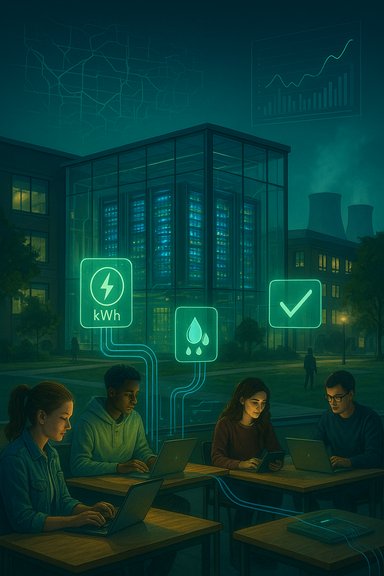
Artificial Intelligence is reshaping classrooms, research labs, and study habits — but every quick prompt, revision and “thank you” carries a measurable environmental and operational cost that students, educators and campus leaders can no longer afford to ignore.
Background
AI tools such as ChatGPT, Google Gemini, Microsoft Copilot, Claude and Perplexity are rapidly becoming everyday study partners. They speed literature scans, draft essays, suggest code fixes and automate repetitive grading tasks. That convenience, however, depends on a global infrastructure of GPUs, TPUs, dense server racks and elaborate cooling systems — an infrastructure that consumes large quantities of electricity, water and capital. The total footprint includes both the one‑time costs of training large models and the recurring, distributed costs of inference when users interact with deployed systems.Understanding the hidden costs of AI — the energy, water, hardware lifecycle and governance burdens that sit behind a friendly chat window — is essential for anyone designing curricula, running labs, or simply using these tools to study. The next sections explain how those costs arise, quantify key figures, and recommend practical measures students and institutions can adopt to reduce impact while preserving pedagogical value.
How AI’s energy bill is created
Training vs inference: two very different cost profiles
Large Language Models (LLMs) are developed in two broad stages, each with distinct resource profiles. Pre‑training involves running massive datasets through thousands of accelerators for days or weeks, consuming megawatt‑hours of electricity and generating substantial heat that must be removed. Fine‑tuning and Reinforcement Learning from Human Feedback add further compute and human review cycles. These training phases are the capital‑intensive episodes that push vendors to invest in hyperscale GPU farms.Inference — the moment a model answers a student’s prompt — is far less energy‑intensive per interaction, but it occurs billions of times every day. Even a short exchange activates a large portion of the model’s neural infrastructure and triggers server‑side computation, disk access and networking overheads. When tiny per‑query costs are multiplied by millions of users, the aggregate demand becomes substantial and persistent.
How much energy does a single prompt use?
Estimates vary by model, context window, serving stack and hardware, but independent analyses converge on a useful range: modern, efficient inference stacks commonly use on the order of 0.1–0.4 watt‑hours per short text prompt. That is roughly the energy to light a 10‑watt LED bulb for 30–60 seconds or to power a laptop for 10–15 seconds. While trivial per interaction, those fractions of a watt‑hour scale quickly at global use levels.A critical caveat: per‑prompt energy depends heavily on configuration. Long context windows, chain‑of‑thought reasoning, multimodal inputs (images, video), and less optimized serving pipelines can push per‑query consumption into the single watt‑hour range or higher. Present per‑prompt figures as a range, not a single point estimate.
Data‑center scale: the grid‑level problem
National and international studies show data‑center electricity demand is already material. One national analysis found U.S. data centres consumed about 4.4% of the nation’s electricity, with high‑growth AI scenarios projecting a rise to between roughly 6.7% and 12% by 2028. Independent industry forecasts also highlight multitrillion‑dollar investments in AI‑ready infrastructure, underscoring both the fiscal and environmental scale of the shift. These are not speculative numbers — utilities and grid planners now treat AI campuses as system‑level actors.Water, hardware lifecycle and community impacts
Energy is only the most visible line item. At AI data‑center scale, cooling choices and hardware lifecycle decisions can create secondary but consequential burdens.- Water: High‑density racks commonly require water‑assisted cooling (evaporative systems, chilled water loops or direct liquid cooling). This converts electricity demand into a water problem at sites where evaporative cooling or make‑up water is used. Some conservative accounting methods attribute several hundred millilitres of water to every few dozen conversational prompts once both on‑site cooling and water embedded in electricity generation are included. Local water allocations and municipal politics can thus become friction points when AI campuses proliferate.
- Lifecycle and e‑waste: Leading AI accelerators (for example H100‑class boards and successors) are expensive and refreshed frequently to stay competitive. Public market figures commonly list such accelerators in the tens of thousands of dollars per board; at hyperscale, replacement cycles and secure decommissioning turn hardware refresh into recurring multi‑billion‑dollar items and significant e‑waste streams. The costs of secure data erasure and certified recycling are real operational items that communities should expect in permit review and environmental assessments.
- Grid interaction and local economics: High‑density AI campuses can require substation upgrades, long‑lead transmission work, or on‑site firm‑capacity arrangements. If new demand is met by fossil‑fired generation during peak periods, a vendor’s PPAs or renewable purchases on paper may not translate into low‑carbon dispatch when and where the compute load is highest. Planners and local communities therefore need transparent, auditable commitments, not only glossy sustainability claims.
Why students and educators matter more than they might think
Multiple surveys and institutional reports indicate that the education sector accounts for a large share of regular AI use. While precise percentages vary by methodology and sample, students are consistently shown to be among the heaviest consumers of generative AI for study tasks — one collated range places regular student users in the 38–52% band of all regular AI users, with researchers and teachers contributing additional shares. This concentration means behavior changes in classrooms can meaningfully reduce aggregate demand.This prevalence generates several implications for campuses:
- Institutional budgets: When universities provision Copilot‑style assistants or sign enterprise SLAs, the total cost of ownership includes usage‑based compute, licensing, monitoring, and the energy or capacity charges that vendors pass through at scale. What starts as a inexpensive pilot can balloon into a substantial operational line item if adoption surges.
- Data protection and compliance: Pasting student records, proprietary research data or exam content into public consumer models can violate FERPA, sponsor agreements or IRB protocols. Institutional procurement must explicitly address retention, telemetry and non‑training clauses. Marketing assurances are insufficient without auditable contractual guarantees.
- Pedagogy and integrity: Traditional assessments built around production of final artifacts become brittle in an AI‑augmented world. Redesigning assessments to value process, provenance and oral defense is a practical way to reduce incentives for misuse while preserving learning gains.
Practical actions students can take today
Responsible AI use in education is not about abstinence — it is about intentionality. Small, habitual changes multiply when adopted across tens of thousands of learners.- Batch related questions into single prompts to reduce repeated inference cycles.
- Use precise, scoped prompts to avoid long follow‑ups. Better prompt design reduces the number of iterations needed.
- Prefer thumbs‑up/thumbs‑down or lightweight rating controls when available instead of re‑prompting with minor edits. These controls often avoid a full round of model computation.
- Avoid pasting personally identifiable information, exam content or proprietary material into public endpoints; use campus‑provisioned instances for sensitive work.
- Treat AI output as a draft: verify facts, trace citations and cite both human and AI contributions as required by course policy.
- Document the interaction: keep a short prompt history and a one‑line note describing how the AI output was used. This habit builds transparency and protects students in integrity disputes.
Institutional levers: what colleges and IT leaders should do
Institutions must pair access with governance. Without safeguards, procurement missteps and policy gaps will generate legal, fiscal and reputational risks.- Negotiate non‑training and retention clauses: require vendors to specify whether prompts may be used for model training and insist on deletion rights and telemetry audit access.
- Deploy tenant‑level controls and DLP: use role‑based access, content classification and data loss prevention to prevent unauthorized uploads of sensitive data.
- Implement FinOps and consumption dashboards: monitor active users, per‑course consumption spikes and anomalous usage patterns. Usage alerts and caps help avoid bill shocks.
- Redesign assessment and require prompt disclosure: make process evidence (staged drafts, annotated logs, oral presentations) a core part of grading rubrics. Require students to attach brief AI‑use disclosures to major submissions.
- Pilot with measurable KPIs: run bounded pilots with representative courses, measure learning outcomes, integrity incidents and operational costs before scaling to campus‑wide enablement.
- Form cross‑functional governance board (IT, academic affairs, legal, disability services, student government).
- Classify institutional data and map sensitivity levels.
- Pilot tenant‑contained AI services in a controlled set of courses.
- Publish a transparent governance summary for students and faculty showing retention, training and audit commitments.
- Scale if KPIs show learning gains and manageable operational costs.
Technical and strategic innovations on the horizon
Industry, academia and governments are exploring long‑term engineering and policy responses to AI’s sustainability challenge.- Efficiency improvements at the software and hardware level — model sparsity, quantization, more efficient serving stacks and specialized accelerators — can cut per‑query costs substantially over time. These engineering gains matter, but they do not eliminate the need for behavioral and policy levers.
- Novel cooling and reuse architectures — closed liquid cooling, heat capture for district heating and water‑efficient designs — can lower the secondary environmental footprint in water‑stressed regions. These approaches trade off capital expense for operational savings and may not be practical everywhere.
- Radical ideas: space‑based compute. Google’s Project Suncatcher explores orbiting solar‑powered compute nodes that could, in principle, harvest abundant sunlight and avoid terrestrial cooling constraints. While technically provocative, orbital compute faces enormous economic, regulatory and operational hurdles; it is not a near‑term cure for today’s emissions. Treat such announcements as long‑term research threads rather than immediate solutions.
Critical analysis: strengths, gaps and risks
Strengths of the current narrative
- The argument that small per‑query costs add up at scale is robust and well supported by independent energy accounting and data‑center studies. The arithmetic is simple and compelling: fractions of a watt‑hour per prompt multiplied by millions of daily prompts equals terawatt‑hour class demand.
- Practical mitigation strategies — prompt batching, institutional provisioning and process‑based assessment redesign — are low‑friction and high‑impact when adopted collectively. These behaviors allow continued educational benefit without catastrophic cost escalation.
- Institutional governance levers (contract language, DLP, FinOps) are actionable and fit well into existing procurement and IT practices. They move risk management from aspirational policy into contractual and technical controls.
Important caveats and unresolved issues
- Variability and uncertainty in headline numbers: single‑figure claims (for example, exact percent of electricity consumed or precise student share of global AI use) depend heavily on assumptions and survey design. Treat ranges and indicative bands as more reliable than precise single numbers; where possible, require auditable vendor disclosures rather than press claims. The commonly cited 0.1–0.4 Wh per prompt is a useful rule‑of‑thumb but not a universal constant.
- Training footprints remain opaque: many training cost estimates for frontier models are reconstructed from FLOP counts and hardware assumptions and lack operator disclosures. Reports that present specific GWh figures for training runs should be treated cautiously unless backed by auditable vendor data. Transparency here is still limited.
- Vendor promises vs reality: declarations of “carbon‑neutral” or “data not used for training” require contractual backing and external audit. Marketing language alone is insufficient, and institutional procurement must insist on clauses that can be verified.
- Equity and access: institutionally provisioned AI can reduce inequality among students, but it does not solve disparities in device quality, bandwidth or digital literacy. Any campus rollout must be paired with device lending, low‑bandwidth options and training to avoid deepening education gaps.
A compact checklist for responsible AI use in education
- For students: batch prompts, avoid pasting PII, document prompt histories, verify AI outputs and prefer campus‑provisioned instances for graded work.
- For instructors: update syllabi to define acceptable AI uses, require short AI disclosure annexes for major assignments, and redesign assessments to emphasize process evidence.
- For IT and procurement: demand non‑training clauses, enable tenant DLP, instrument usage with FinOps dashboards, pilot with measurable KPIs and publish governance summaries.
Conclusion
Generative AI offers real educational value: faster feedback, scaffolding for difficult concepts, and new forms of personalized learning. Those benefits are not free. Every interaction with an LLM has a footprint — in electricity, water, hardware and institutional governance. The right response is neither technophobia nor blind optimism; it is conscious use.By adopting simple student habits, rethinking assessment design, and demanding contractual and technical transparency from vendors, campuses can preserve AI’s pedagogical promise while limiting its environmental and fiscal downsides. Small, deliberate changes in how students and educators interact with AI — combined with robust procurement and measurement practices at the institutional level — will do more to bend the curve of AI’s hidden costs than dramatic technology bets alone. Treat AI as a shared resource with a visible ledger: that is the practical path to keeping learning aligned with sustainability.
Source: The Hindu What students must know about the hidden costs of using AI