

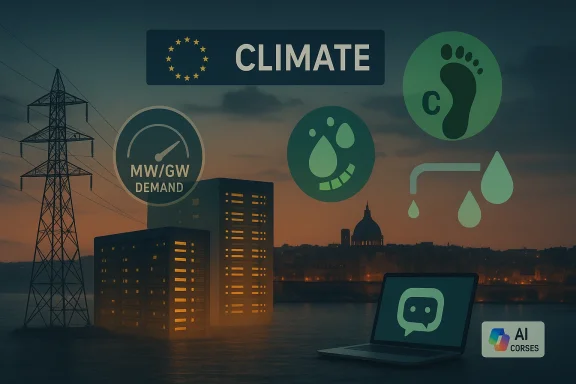
AI’s rapid expansion is no longer just a story about software, productivity, and hype. It is also a story about power grids, water systems, and the physical footprint of the digital economy, with data centres now emerging as one of the most consequential industrial loads on the planet. For Malta, where climate vulnerability is not theoretical but structural, that makes the country’s enthusiastic turn toward AI a far more complicated policy choice than the usual rhetoric suggests.
The recent debate over AI’s environmental cost lands at exactly the moment when Malta is accelerating its own digital transformation. The article’s central warning is straightforward: AI is not environmentally neutral, and its growth is tied to electricity demand, water consumption, and carbon emissions in ways that are easy to overlook when the public conversation focuses only on convenience and innovation. That is why the Maltese response from the Malta Digital Innovation Authority and University of Malta professor Alexiei Dingli matters: both acknowledge that these externalities need to be actively managed rather than ignored. tant. Malta has announced a €100 million investment in digitalisation and AI, the launch of free nationally certified AI courses, and a €4 million rollout of Microsoft Copilot across the public service. Those initiatives signal a clear strategic bet that AI will become part of the country’s administrative and economic backbone. But the environmental side of that bet is not receiving the same political attention, even though the underlying infrastructure is already under strain elsewhere in the world.
That strain is realnergy Agency says data centres accounted for about 1.5% of global electricity consumption in 2024, or 415 TWh, and projects that demand from data centres will roughly double to around 945 TWh by 2030 in its base case. The IEA also projects global electricity generation for data centres rising from 460 TWh in 2024 to over 1,000 TWh in 2030 and 1,300 TWh in 2035. In other words, AI is no longer a niche load hidden inside the digital sector; it is becoming one of the main structural drivers of future electricity demand.
Malta is especially exposed to the broader implications because Eurostat says the country is the most water-stressed among the EU member states in that category, with annual water resources at only about 100 cubic metres per inhabitant. That is far below the UN’s water-stress threshold of 1,700 cubic metres per person. Even if Malta does not host hyperscale AI data centres locally, its citizens still contribute to global demand every time they use large AI services, and the island bears the climate-policy reputational cost of embracing a technology whose hidden footprint is still expanding. (ec.europa.eu)
There is also a competitive element. Countries that rush to attract AI investment often end up competing for the same scarce resources: grid capacity, cooling water, land, and permitting certainty. Once those constraints bite, governments must decide whether AI is a strategic asset worth subsidizing or a luxury load that should carry stricter conditions. Malta’s current posture suggests ambition first and mitigation later, which is a risky order of operations.
That matters because AI usage is not linear in its physical cost. A lightweight query may be small; a complex multimodal task or a large-scale training run can be much more demanding. The more AI shifts from occasional novelty to continuous workplace infrastructure, the more its aggregate footprint becomes a system-level issue rather than a consumer-side inconvenience. That is the true “dirty secret” behind digital convenience.
The IEA’s latest modeling makes clear that data centres are becoming one of the most important new electricity consumers in advanced economies. The agency says growth in global electricity demand from data centres is being driven especially by accelerated servers used for AI, with renewables and natural gas expected to provide much of the incremental supply. That is a notable mix: even as the grid gets cleaner overall, AI demand is large enough that gas remains a major stopgap in the near term.
This creates a classic policy tension. Governments want the productivity gains of AI, but they also inherit the emissions profile of the power system feeding it. If the local grid is clean, AI can look relatively benign; if it is not, the technology becomes a multiplier of existing carbon intensity. The article’s references to the United States and China are useful here because they illustrate how the same AI product can have very different environmental costs depending on where the compute is hosted.
It also avoids the common mistake of treating AI’s benefits and harms as mutually exclusive. The same tools that consume energy can help optimize irrigation, improve waste sorting, and support conservation work. That duality is what makes the policy debate so difficult: AI can be part of the solution, but only if its own footprint is controlled. That caveat is easy to say and hard to operationalize. nd and the Grid Problem
The most obvious environmental burden of AI is electricity. The IEA’s numbers show just how quickly this has become a grid issue rather than a tech-industry footnote. Data centres already used hundreds of terawatt-hours of electricity in 2024, and the agency expects the total to keep climbing sharply through the end of the decade. That is enough to reshape planning for utilities, regulators, and investors.
The article’s comparison between AI energy use and Malta’s own electricity production is especially striking. Even if some of the article’s specific cross-country comparisons are better treated as illustrative than precise, the basic point stands: AI’s electricity appetite is now measured at a scale that dwarfs the annual output of small states. That scale mismatch should force policymakers to ask whether AI expansion is being matched by matching investments in clean generation and grid resilience.
The article’s discussion of the United States and China reflects this broader reality. Both countries have enormous AI and data-centre ecosystems, and both rely on generation portfolios that can still include substantial fossil-fuel components. The exact mix varies by region, but the strategic conclusion is the same: the enI is partly a power-sector problem.
There is a lesson here from the history of computing. Every major efficiency improvement eventually led to more usage, not less, because lower costs invite broader adoption. AI is following the same pattern. Better engineering will help, but only governance can ensure that efficiency gains translate into lower absolute impact. *Otherwise, progress simply feeds growth.rcity and Cooling Risk
If electricity is the visible cost of AI, water may be the less obvious but equally consequential one. Data centres need cooling, and many of the cooling systems used in AI infrastructure can be water-intensive, especially when heat density is high. The article notes that potable water is sometimes used because cooling loops require water with low corrosive content, which creates a particularly awkward tension in already water-stressed regions.
The IEA and OECD legitimate environmental metric in AI infrastructure discussions, and for good reason. The OECD has discussed the importance of tracking water use and energy use across AI compute resources, while the IEA’s broader energy analysis recognizes the infrastructure burden behind data-centre growth. These are not speculative concerns; they are planning variables for operators who must keep systems from overheating.
This is where Malta’s vulnerability becomes especially salient. A place that already has chronic water stress cannot afford to romanticize any industry that normalizes more consumption of high-quality water, even if the direct use happens abroad. The policy question is not only whether Malta has AI data centres on its soil, but whether its digital strategy fully accounts for the resource burden it helps stimulate elsewhere. (ec.europa.eu)
Still, mitigation is not the same as elimination. Even advanced cooling systems need engineering, oversight, and investment, and they work best when planned from the beginning rather than retrofitted later. That is why environbe integrated into AI procurement and infrastructure planning instead of bolted on as PR after the fact. The earlier the planning, the lower the cost.
The upside is obvious. AI can improve efficiency, shorten turnaround times, and help a small state punch above its weight administratively. A country with a constrained labour pool can gain a lot from well-deployed automation and decision support. But the public sector may normalize heavy AI use before it has fully examined the sustainability trade-offs involved.
This is a point many governments still miss. They tend to measure the success of digital transformation in terms of adoption rates and efficiency savings, while treating sustainability as a separate cabinet brief. In AI, that separation no longer holds. The technology stack itself has environmental consequences, and the suyer. That makes the government a market-shaper as well as a user.
There is also a branding opportunity. Countries that want to be digital hubs increasingly need to show they understand ESG expectations as well as innovation goals. If Malta can frame itself as a place where digital services are not only efficient but also accountable, it may gain credibility with investors and institutions looking for stable, forward-looking jurisdictions. That is a harder pitch than “AI-fritronger one.
That changes competitive dynamics. Companies that can secure clean power, efficient cooling, and favorable permitting will gain an operational edge. Those that cannot may still grow, but at higher cost and with more scrutiny. In this environment, sustainability is no longer just a reputational flourish; it is a capacity strategy.
This split matters because the real environmental burden will probably come from persistent enterprise use, not just sporadic consumer queries. Workflows scale. Once AI is wired into document drafting, customer service, code generation, and public administration, it becomes a permanent load rather than an occasional one. That is where the business case and the environmental caly. The more indispensable AI becomes, the harder it is to ignore its footprint.
Still, the market has a habit of adding layers rather than replacing them. Smaller models may reduce some workloads, but frontier systems will continue to drive the premium end of the market. The likely future is not one model type replacing another, but a mixed ecosystem where efficiency gains coexist with ever-heavier flagship systems. That is progress, but it is not a free pass.
There is also an opportunity here for governments and vendors alike. If the sector responds with better reporting, cleaner hosting, and more efficient model design, AI can still expand without locking in the worst environmental outcomes. Malta, because of its size and climate exposure, could become a useful testbed for responsible deployment.
Another opportunity lies in public trust. Citizens are more likely to embrace new tools when the government explains both the benefits and the costs honestly. If Maltese policymakers acknowledge the resource footprint of AI while still pursuing productivity gains, they are more likely to retain legitimacy than if they oversell the technology as costless pros and Concerns
The biggest risk is complacency. AI can be framed as a clean, immaterial service because users never see the data centre, the cooling pipes, or the electricity meter behind the interface. That illusion makes overuse easier and regulation harder. If governments and consumers keep treating AI as though it has no physical footprint, the environmental costs will be borne elsewhere and later.
There is also a policy risk for Malta specifically. A country with severe water stress cannot afford to ignore any technology that encourages greater dependence on water- and energy-intensive infrastructure, even indirectly. If AI demand keeps rising globally, Malta may find itself supporting a system that intensifies the very resource pressures it already struggles with.
There is a similar risk in political messaging. Governments can announce digital transformation while quietly outsourcing the environmental burden to cloud providers and remote data centres. That may look clean on the national balance sheet, but it is not the same as eliminating the footprint. Transparency must include scope, not just slogans.
For Malta, the central challenge is to keep the economic upside while refusing to pretend that AI is free of externalities. That means more than speeches about innovation. It means procurement standards, vendor accountability, and a serious framework for measuring environmental impact. If the country wants to be a digital leader, it should also want to be an honest one.
Source: The Malta Independent AI’s dirty secret: The hidden environmental cost of the digital boom - The Malta Independent
 Overview
The recent debate over AI’s environmental cost lands at exactly the moment when Malta is accelerating its own digital transformation. The article’s central warning is straightforward: AI is not environmentally neutral, and its growth is tied to electricity demand, water consumption, and carbon emissions in ways that are easy to overlook when the public conversation focuses only on convenience and innovation. That is why the Maltese response from the Malta Digital Innovation Authority and University of Malta professor Alexiei Dingli matters: both acknowledge that these externalities need to be actively managed rather than ignored. tant. Malta has announced a €100 million investment in digitalisation and AI, the launch of free nationally certified AI courses, and a €4 million rollout of Microsoft Copilot across the public service. Those initiatives signal a clear strategic bet that AI will become part of the country’s administrative and economic backbone. But the environmental side of that bet is not receiving the same political attention, even though the underlying infrastructure is already under strain elsewhere in the world.That strain is realnergy Agency says data centres accounted for about 1.5% of global electricity consumption in 2024, or 415 TWh, and projects that demand from data centres will roughly double to around 945 TWh by 2030 in its base case. The IEA also projects global electricity generation for data centres rising from 460 TWh in 2024 to over 1,000 TWh in 2030 and 1,300 TWh in 2035. In other words, AI is no longer a niche load hidden inside the digital sector; it is becoming one of the main structural drivers of future electricity demand.
Malta is especially exposed to the broader implications because Eurostat says the country is the most water-stressed among the EU member states in that category, with annual water resources at only about 100 cubic metres per inhabitant. That is far below the UN’s water-stress threshold of 1,700 cubic metres per person. Even if Malta does not host hyperscale AI data centres locally, its citizens still contribute to global demand every time they use large AI services, and the island bears the climate-policy reputational cost of embracing a technology whose hidden footprint is still expanding. (ec.europa.eu)
Why this story matters now
This is not an abstract sustainability essay. It is a policy story about what happens when governments adopt AI at speed while the physical costs of AI are still scaling faster than the industry’s mitigation tools. The article’s strongest point is that environmental damage is often displaced geographically: the benefits of AI are visible locally, but the electricity burn and water draw may occur somewhere else entirely. That tically easy to ignore and environmentally hard to contain*.There is also a competitive element. Countries that rush to attract AI investment often end up competing for the same scarce resources: grid capacity, cooling water, land, and permitting certainty. Once those constraints bite, governments must decide whether AI is a strategic asset worth subsidizing or a luxury load that should carry stricter conditions. Malta’s current posture suggests ambition first and mitigation later, which is a risky order of operations.
- AI adoption is accelerating faster than the environmental policy framework around it.
- Malta is betting hard on AI infrastructure and AI literacy.
- Water stress makes the country unusually sensitive to hidden resource costs.
- The broader AI economy depends on energy systems that are still heavily fossil-fuelled in key markets.
The hidden infrastructure behind the chatbot
People experience AI as an app, but the real system is industrial. Large language models, image generators, and agentic platforms run on fleets of servers, chips, power supplies, cooling loops, and network gear. The article correctly emphasizes that this hardware can consume vast amounts of electricity and often requires water-intensive cooling to keep temperatures wranges.That matters because AI usage is not linear in its physical cost. A lightweight query may be small; a complex multimodal task or a large-scale training run can be much more demanding. The more AI shifts from occasional novelty to continuous workplace infrastructure, the more its aggregate footprint becomes a system-level issue rather than a consumer-side inconvenience. That is the true “dirty secret” behind digital convenience.
Background
The environmental critique of AI did not appear out of nowhere. It emerged as the industry moved from experimentation to mass deployment, and as the public started asking what it actually takes to keep these systems always on. Early AI debates focused on ethics, bias, hallucinations, and copyright; the infrastructure debate arrived later, once the world understood that every prompt rides on real hardware that must be powered and cooled. That shift is now visible in both research and policy circles.The IEA’s latest modeling makes clear that data centres are becoming one of the most important new electricity consumers in advanced economies. The agency says growth in global electricity demand from data centres is being driven especially by accelerated servers used for AI, with renewables and natural gas expected to provide much of the incremental supply. That is a notable mix: even as the grid gets cleaner overall, AI demand is large enough that gas remains a major stopgap in the near term.
This creates a classic policy tension. Governments want the productivity gains of AI, but they also inherit the emissions profile of the power system feeding it. If the local grid is clean, AI can look relatively benign; if it is not, the technology becomes a multiplier of existing carbon intensity. The article’s references to the United States and China are useful here because they illustrate how the same AI product can have very different environmental costs depending on where the compute is hosted.
Malta’sMalta’s challenge is not that it has giant data centres today. The challenge is that it is normalizing a technology whose demand curve is global while its own resource base is tiny. With only around 100 cubic metres of water per inhabitant, Malta has almost no room for complacency when it comes to any new digital load that indirectly increases water and energy demand. That makes the island a good test case for whether AI policy can be economically ambitious and environmentally honest at the same time. (ec.europa.eu)
The article also highlights a subtle but important point: even if the servers are overseas, local user behaviour still matters. Every time a resident uses a generative AI service, that interaction contributes to the demand curves pushing more compute into the system. The marginal impact of one query is tiny, but the aggregate impact of millions of queries is not. That is a classic tragedlem in digital form.- AI started as a software story but has become an infrastructure story.
- The environmental cost depends heavily on the electricity mix of the host region.
- Malta’s water scarcity makes indirect impacts especially salient.
- User behaviour scales into system-wide demand when AI becomes default infrastructure.
What the article gets right
One of the article’s strongest features is that it does not claim AI is uniquely evil. Instead, it frames the issue as one of managed externalities. That is a far more credible position than simple alarmism. The point is not to halt AI altogether; it is to acknowledge that deployment choices have environmental consequences that should be measured, disIt also avoids the common mistake of treating AI’s benefits and harms as mutually exclusive. The same tools that consume energy can help optimize irrigation, improve waste sorting, and support conservation work. That duality is what makes the policy debate so difficult: AI can be part of the solution, but only if its own footprint is controlled. That caveat is easy to say and hard to operationalize. nd and the Grid Problem
The most obvious environmental burden of AI is electricity. The IEA’s numbers show just how quickly this has become a grid issue rather than a tech-industry footnote. Data centres already used hundreds of terawatt-hours of electricity in 2024, and the agency expects the total to keep climbing sharply through the end of the decade. That is enough to reshape planning for utilities, regulators, and investors.
The article’s comparison between AI energy use and Malta’s own electricity production is especially striking. Even if some of the article’s specific cross-country comparisons are better treated as illustrative than precise, the basic point stands: AI’s electricity appetite is now measured at a scale that dwarfs the annual output of small states. That scale mismatch should force policymakers to ask whether AI expansion is being matched by matching investments in clean generation and grid resilience.
Fossil fuels still matter
One reason the AI debate cannot be separated from climate politics is that the fastest source of additional power is often still gas. The IEA says natural gas is the largest source of additional supply for data centres in the near term, even as renewables remain the fastest-growing source overall. That means the industry’s immediate expansion phase is still likely to carry a fossil-fuel tail, especially in markets where clean power is constrained or slow to permit.The article’s discussion of the United States and China reflects this broader reality. Both countries have enormous AI and data-centre ecosystems, and both rely on generation portfolios that can still include substantial fossil-fuel components. The exact mix varies by region, but the strategic conclusion is the same: the enI is partly a power-sector problem.
- AI’s energy footprint is no longer marginal.
- Grid availability is becoming a strategic bottleneck.
- Natural gas remains the main near-term backstop in many markets.
- The carbon intensity of AI depends on where and how compute is hosted.
Why efficiency alone is not enough
Efficiency gains matter, but they can be overwhelmed by demand growth. More efficient chips, better cooling, and smarter scheduling all help reduce the per-query footprint, yet total consumption can still rise if usage explodes faster than efficiency improves. That is why the article’s optimism about smaller models in the future should be welcomed but not overinterpreted. Smaller models may help, but scale can still swallow savings.There is a lesson here from the history of computing. Every major efficiency improvement eventually led to more usage, not less, because lower costs invite broader adoption. AI is following the same pattern. Better engineering will help, but only governance can ensure that efficiency gains translate into lower absolute impact. *Otherwise, progress simply feeds growth.rcity and Cooling Risk
If electricity is the visible cost of AI, water may be the less obvious but equally consequential one. Data centres need cooling, and many of the cooling systems used in AI infrastructure can be water-intensive, especially when heat density is high. The article notes that potable water is sometimes used because cooling loops require water with low corrosive content, which creates a particularly awkward tension in already water-stressed regions.
The IEA and OECD legitimate environmental metric in AI infrastructure discussions, and for good reason. The OECD has discussed the importance of tracking water use and energy use across AI compute resources, while the IEA’s broader energy analysis recognizes the infrastructure burden behind data-centre growth. These are not speculative concerns; they are planning variables for operators who must keep systems from overheating.
Cooling is the hidden multiplier
The article’s strongest environmental point is that cooling is not just a technical afterthought. It is part of the load. Once you build a dense compute environment, you are not only powering chips; you are also moving heat other layer of resource demand. That makes the operational footprint of AI meaningfully larger than many users assume.This is where Malta’s vulnerability becomes especially salient. A place that already has chronic water stress cannot afford to romanticize any industry that normalizes more consumption of high-quality water, even if the direct use happens abroad. The policy question is not only whether Malta has AI data centres on its soil, but whether its digital strategy fully accounts for the resource burden it helps stimulate elsewhere. (ec.europa.eu)
- Cooling is a core operational cost, not a side issue.
- Water quality matters as much as water quantity in data-centre design.
- Water-stressed countries should treat AI demand as a resource-policy issue.
- Indirect consumption still has moral and political consequences.
Beyond worst-case narratives
It would be a mistake to assume every AI deployment is water-wasteful in the same way. Some data centres use more efficient cooling strategies, and some locations can reuse waste heat in useful ways. The article notes that northern European facilities cnearby villages, and some companies are trying to return water to rivers after use. Those examples matter because they show mitigation is possible, even if not yet standard.Still, mitigation is not the same as elimination. Even advanced cooling systems need engineering, oversight, and investment, and they work best when planned from the beginning rather than retrofitted later. That is why environbe integrated into AI procurement and infrastructure planning instead of bolted on as PR after the fact. The earlier the planning, the lower the cost.
Malta’s AI Strategy and Public-Sector Rollout
Malta’s recent AI push suggests a government that sees digitalisation as an economic necessity rather than a luxury. The €100 million investment, the free certified AI courses, and the Copilot public-service rollout all point in the same direction: AI is being embedded into the machinery of the state. That is a major policy AI becomes part of public administration, its costs and benefits become public policy issues, not just private-sector preferences.The upside is obvious. AI can improve efficiency, shorten turnaround times, and help a small state punch above its weight administratively. A country with a constrained labour pool can gain a lot from well-deployed automation and decision support. But the public sector may normalize heavy AI use before it has fully examined the sustainability trade-offs involved.
Public-sector adoption is not environmentally neutral
When a government rolls out AI across a large workforce, it is not just buying software. It is helping create steady demand for downstream infrastructure, including cloud services, model hosting, network transit, and data-centre capacity. Even if the marginal impact of one civil servant’s AI use is tiny, the aggregate effect across an entire public service can be signirocurement policy should include environmental criteria, not just functionality and cost.This is a point many governments still miss. They tend to measure the success of digital transformation in terms of adoption rates and efficiency savings, while treating sustainability as a separate cabinet brief. In AI, that separation no longer holds. The technology stack itself has environmental consequences, and the suyer. That makes the government a market-shaper as well as a user.
- Public-sector AI procurement creates real downstream demand.
- Government adoption can set norms for the whole economy.
- Environmental criteria should be part of digital procurement.
- Efficiency gains do not erase footprint concerns.
Why Malta could lead by example
Malta actually has an opportunity here. Because its scale is small, it can move faster than larger states in setting standards for responsible AI adoption. That could mean requiring carbon reporting from major AI vendors, insisting on cleaner hosting arrangements, or building sustainability conditions into public tenders. Doing so would not stop AI adoption; it would make adoption more honest.There is also a branding opportunity. Countries that want to be digital hubs increasingly need to show they understand ESG expectations as well as innovation goals. If Malta can frame itself as a place where digital services are not only efficient but also accountable, it may gain credibility with investors and institutions looking for stable, forward-looking jurisdictions. That is a harder pitch than “AI-fritronger one.
The Broader Technology Market
The AI environmental debate is not only about Malta. It is part of a larger reappraisal of the digital boom, especially among hyperscalers, chip vendors, and cloud providers. The IEA’s data make clear that AI is one of the main drivers of new electricity demand growth, which means the industry’s next phase will be judged not just on model quality but on infrastructure discipline.That changes competitive dynamics. Companies that can secure clean power, efficient cooling, and favorable permitting will gain an operational edge. Those that cannot may still grow, but at higher cost and with more scrutiny. In this environment, sustainability is no longer just a reputational flourish; it is a capacity strategy.
Enterprises versus consumers
For consumers, AI often looks like a frictionless service: instant answers, better images, faster drafts. For enterprises, the picture is different. Companies face direct costs for usage, compliance obligations, and infrastructure planning, and they are increasingly asked to justify how AI fits their sustainability goals. That means enterprise adoption will likely move toward more governance, while consumer adoption remains more casual and less scrutinized.This split matters because the real environmental burden will probably come from persistent enterprise use, not just sporadic consumer queries. Workflows scale. Once AI is wired into document drafting, customer service, code generation, and public administration, it becomes a permanent load rather than an occasional one. That is where the business case and the environmental caly. The more indispensable AI becomes, the harder it is to ignore its footprint.
- Infrastructure access is becoming a competitive moat.
- Clean power and cooling efficiency will matter more over time.
- Enterprise use will likely drive the largest sustained loads.
- Consumer convenience can mask system-wide cost growth.
Why smaller models may change the game
Professor Dingli’s point that the future may lie in smaller, more efficient models is worth taking seriously. The industry is moving toward edge deployment, on-device inference, and more task-specific systems that do not require every prompt to hit a giant remote cluster. If tha the energy and water profile of AI could improve materially.Still, the market has a habit of adding layers rather than replacing them. Smaller models may reduce some workloads, but frontier systems will continue to drive the premium end of the market. The likely future is not one model type replacing another, but a mixed ecosystem where efficiency gains coexist with ever-heavier flagship systems. That is progress, but it is not a free pass.
Strengths and Opportunities
The article’s biggest strength is that it treats AI sustainability as a real policy issue rather than a moral abstraction. It connects the global data-centre boom to Malta’s local vulnerabilities, and that linkage is exactly what makes the piece compelling. By placing environmental cost alongside digital ambition, it creates a more complete picture of what AI adoption actually entails.There is also an opportunity here for governments and vendors alike. If the sector responds with better reporting, cleaner hosting, and more efficient model design, AI can still expand without locking in the worst environmental outcomes. Malta, because of its size and climate exposure, could become a useful testbed for responsible deployment.
- The article correctly ties AI to physical infrastructure.
- It gives Malta-specific relevance to a global trend.
- It recognizes that mitigation is possible, not merely aspirational.
- It opens the door to smarter procurement standards.
- It highlights the value of smaller, more efficient models.
- It encourages a more realistic sustainability conversation.
Strategic upside for Malta
For Malta, the opportunity is not to reject AI but to build a smarter framework around it. The country can use its digital transition to set expectations for transparency, efficiency, and environmental accountability. That would turn a potential liability into a governance advantage. Small states can sometimes ones.Another opportunity lies in public trust. Citizens are more likely to embrace new tools when the government explains both the benefits and the costs honestly. If Maltese policymakers acknowledge the resource footprint of AI while still pursuing productivity gains, they are more likely to retain legitimacy than if they oversell the technology as costless pros and Concerns
The biggest risk is complacency. AI can be framed as a clean, immaterial service because users never see the data centre, the cooling pipes, or the electricity meter behind the interface. That illusion makes overuse easier and regulation harder. If governments and consumers keep treating AI as though it has no physical footprint, the environmental costs will be borne elsewhere and later.
There is also a policy risk for Malta specifically. A country with severe water stress cannot afford to ignore any technology that encourages greater dependence on water- and energy-intensive infrastructure, even indirectly. If AI demand keeps rising globally, Malta may find itself supporting a system that intensifies the very resource pressures it already struggles with.
- The biggest danger is treating AI as immaterial.
- Water stress makes indirect demand politically sensitive.
- Carbon impacts can be displaced into less visible geographies.
- Efficiency gains may be offset by surging usage.
- Public-sector rollouts can normalize unsustainable habits.
- Procurement without ESG rules can lock in weak outcomes.
The danger of greenwashing
A second risk is that the industry responds with shallow sustainability claims. Tech companies are already skilled at packaging efficiency gains as climate wins, even when absolute demand continues rising. If AI vendors talk only about “smarter models” while refusing to disclose the full lifecycle footprint, policymakers may mistake partial progress for real decarbonization. That would be a serious error.There is a similar risk in political messaging. Governments can announce digital transformation while quietly outsourcing the environmental burden to cloud providers and remote data centres. That may look clean on the national balance sheet, but it is not the same as eliminating the footprint. Transparency must include scope, not just slogans.
Looking Ahead
The next phase of the AI story will be defined less by novelty and more by infrastructure realism. Governments will need to decide whether they want AI to scale on the assumption that electricity and water will always be available, or whether they want to bake sustainability into deployment from the outset. The IEA’s projections suggest that the question is not hypothetical; the grid implications are already material, and they will get larger through 2030 and beyond.For Malta, the central challenge is to keep the economic upside while refusing to pretend that AI is free of externalities. That means more than speeches about innovation. It means procurement standards, vendor accountability, and a serious framework for measuring environmental impact. If the country wants to be a digital leader, it should also want to be an honest one.
What to watch next
- Whether Malta adds environmental criteria to AI procurement and public-sector rollout decisions.
- Whether AI vendors in Europe increase disclosure on energy and water use.
- Whether smaller, task-specific AI models begin displacing some high-cost workloads.
- Whether governments treat data-centre access as a sustainability issue, not just a growth issue.
- Whether citizens start demanding clarity on the carbon and water cost of everyday AI use.
Source: The Malta Independent AI’s dirty secret: The hidden environmental cost of the digital boom - The Malta Independent
