
 Malta Turns the AI Subsidy Into Public Policy
For years, governments have spoken about artificial intelligence as though the decisive act were drafting a strategy, appointing a task force, or funding a research cluster. Malta’s move is more blunt. It gives people the tools first, attaches a minimal educational gate, and asks the market, schools, households, and workplaces to discover what happens next.
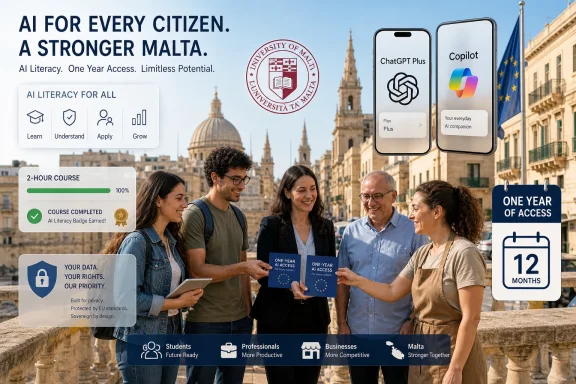
That makes the deal politically legible in a way many AI initiatives are not. A citizen does not need to understand model architectures, procurement frameworks, or Europe’s industrial-policy anxieties to understand the offer: finish a short course and receive a year of access to paid AI services. This is not abstract capacity building. It is a consumer-grade benefit wrapped in the language of national competitiveness.
The government’s framing is deliberately inclusive. Economy Minister Silvio Schembri presented the “AI for Everyone” course as a way to ensure that citizens, regardless of background, gain confidence and skills for a digital world. That is the right political vocabulary for a country trying to avoid the familiar pattern in which the affluent, the technically curious, and the already productive adopt new tools first while everyone else gets lectures about disruption.
But the structure of the deal also reveals the tension at the heart of AI adoption in 2026. A state can promote digital literacy, but the most capable tools are owned, priced, and continuously altered by private companies. Malta is therefore making two bets at once: that mass exposure will help its citizens, and that dependence on OpenAI and Microsoft is an acceptable price for accelerating that exposure.
The Two-Hour Course Is a Gate, Not a Guardrail
The University of Malta’s role gives the program more legitimacy than a straight promotional giveaway would have had. A two-hour course can introduce basic concepts: what generative AI is, where it fails, how prompts shape outputs, why hallucinations matter, and how users should treat sensitive data. That kind of baseline literacy is better than handing premium AI accounts to an entire population and hoping common sense scales.
Still, no one should confuse a short online course with a comprehensive civic education in machine intelligence. Two hours can teach caution, but it cannot create judgment. It can explain that a chatbot may be wrong, but it cannot make users recognize a wrong answer in a field they do not understand.
That matters because ChatGPT Plus and Copilot are not passive databases. They are writing tools, summarizers, coding assistants, tutors, research companions, image generators, workflow accelerators, and, increasingly, agents capable of taking actions on a user’s behalf. The more useful they become, the easier it is for users to outsource not just repetitive work but the evaluation of whether the work is any good.
The Maltese model is therefore a useful compromise, not a complete solution. The course signals that access should come with education, which is a healthier instinct than pure technological boosterism. But the deeper literacy will come only through repeated use, institutional norms, and, inevitably, mistakes.
OpenAI Gets a Country-Sized On-Ramp
For OpenAI, Malta is a showcase. The company has described the arrangement as a world-first national partnership to roll out ChatGPT Plus to all Maltese citizens, and it fits neatly into a broader strategy of dealing directly with governments. Once AI companies have spent vast sums on chips, data centers, staff, and model development, the business challenge becomes painfully simple: turn occasional curiosity into habitual, paid use.
A national program solves several problems at once. It reduces friction for users who might never pay for ChatGPT Plus themselves. It puts the product into schools, small businesses, homes, and public conversation. It also gives OpenAI a powerful case study when speaking to larger countries that may be more cautious but are watching for evidence that population-scale AI access produces measurable benefits.
The company is not alone in that pursuit. AI vendors want governments because governments confer legitimacy, aggregate demand, and create social proof. Once a tool becomes part of a national skills program, it is no longer merely an app. It becomes an endorsed route into the future of work.
That is the marketing genius of the Malta deal. OpenAI is not just selling a subscription. It is associating ChatGPT Plus with citizenship, education, and national modernization. That is a much stronger position than competing for attention in the crowded consumer software market.
Microsoft’s Copilot Play Is More Familiar and More Strategic
Microsoft’s presence in the Maltese program makes the deal especially relevant to WindowsForum readers. Copilot is not just another chatbot wearing a different badge. It is Microsoft’s attempt to thread generative AI through Windows, Edge, Microsoft 365, Teams, Outlook, Word, Excel, PowerPoint, and the broader identity and cloud stack that many organizations already depend on.
The Maltese scheme reportedly gives participants access to Microsoft’s Copilot offering, with local reporting describing Microsoft 365 Personal Copilot as the relevant option. That distinction matters. A personal subscription is not the same as an enterprise Microsoft 365 Copilot deployment with organizational data controls, compliance boundaries, admin policies, and tenant-level governance. For citizens and small businesses, however, it may be enough to normalize AI inside the productivity apps they already know.
Microsoft has spent decades mastering this pattern. It gets software into schools, homes, small offices, and government-adjacent programs, then lets familiarity do the rest. The Windows and Office empires were built not only on technical capability but on habit, training, file formats, and network effects. Copilot is being pushed through the same channels, only this time the prize is the default interface for everyday knowledge work.
For users, that can be convenient. For IT leaders, it is also a warning. The more employees learn to rely on consumer or personal AI tools before organizations have mature governance in place, the harder it becomes to draw clean boundaries later. Malta’s public rollout is aimed at citizens, but the habits it creates will walk directly into workplaces.
Europe Wants AI Adoption Without American Dependence
The Maltese announcement lands in a Europe that is trying to move faster on AI while worrying about who owns the rails. EU policymakers want citizens and businesses to adopt AI because productivity growth is no longer a polite academic concern. It is a strategic one. If American and Chinese firms use AI to compress workflows, automate services, and accelerate software development, Europe cannot afford to treat adoption as an optional lifestyle upgrade.
At the same time, the continent is already uncomfortable with its dependence on American cloud providers. Microsoft, Amazon, and Google dominate much of the infrastructure on which European digital life runs. OpenAI, Anthropic, Google, and other US companies dominate much of the frontier-model conversation. In that context, a national program built around OpenAI and Microsoft is both pragmatic and politically awkward.
European alternatives exist, most prominently Mistral in France, and several governments have explored or promoted local AI options. But performance, ecosystem maturity, language coverage, enterprise integration, and developer familiarity all matter. Governments may want strategic autonomy, but citizens and businesses tend to gravitate toward tools that work well today.
This is the uncomfortable reality behind Malta’s choice. The country can wait for a perfectly sovereign European AI stack, or it can give people access to the strongest widely available tools and manage the dependencies later. It has chosen the second path. Many larger countries may privately envy the clarity, even if they would phrase it more cautiously.
The Data-Sovereignty Pitch Is Now Part of the Product
OpenAI and Microsoft understand European suspicion, which is why the language around data location, privacy, and regional commitments has become central to AI sales. It is no longer enough to say the model is powerful. Vendors must explain where data goes, who can access it, whether it trains future models, and how the service complies with European law.
OpenAI has been trying to reassure European customers that their data need not cross the Atlantic, echoing similar commitments from major cloud companies. Microsoft has spent years adapting cloud, security, and compliance promises for European customers and public-sector buyers. These assurances matter because AI systems intensify old cloud concerns: prompts can include personal data, business secrets, legal drafts, medical worries, code, credentials, and internal documents.
But data residency is not the whole story. Even if data stays in Europe, the service may still be designed, operated, priced, governed, and updated by companies headquartered elsewhere. The dependency is operational as much as geographic. A government can negotiate terms, but it cannot fully control product direction.
Malta’s program should therefore be read as a test of trust as much as access. Citizens are being encouraged by the state to use foreign AI platforms for everyday tasks. If the experience is positive, the political appetite for such partnerships will grow. If privacy concerns, misinformation episodes, or procurement opacity dominate the public narrative, the backlash will travel faster than the productivity gains.
A Free Year Is Long Enough to Build Habits and Short Enough to Hide the Bill
The most interesting number in the announcement is not the subscription price. It is the duration. One year is long enough for students to use AI across an academic cycle, for workers to fold it into recurring tasks, for small-business owners to try it on marketing copy, invoices, customer replies, and planning, and for families to experiment with tutoring, translation, travel, and administration.
It is also short enough to leave the next question unresolved. What happens in month thirteen? Do users pay? Does the government renew? Do OpenAI and Microsoft offer discounted continuation plans? Does the program become a recurring public expense, or was the first year an adoption accelerator designed to seed future private subscriptions?
That uncertainty is not incidental. Freemium economics have trained the software industry to treat the first year as the habit-forming period. If the tool becomes part of someone’s daily workflow, removing it later feels like a loss. For governments, that can become politically awkward: a benefit introduced as digital inclusion may become a subsidy that is difficult to withdraw.
The undisclosed cost of the Maltese partnership makes the issue sharper. Without knowing the financial terms, outsiders cannot judge whether Malta secured a bargain, accepted a vendor-funded promotion, or committed public money at meaningful scale. The opacity is not unusual in commercial-government deals, but it weakens the public’s ability to evaluate the policy on its merits.
The Windows Angle Is Not the Button on the Taskbar
For Windows users, Copilot has often appeared as a visible icon before it has felt like a solved product. Microsoft has embedded, renamed, repositioned, and reimagined Copilot across Windows and Microsoft 365, sometimes faster than users and administrators can form stable expectations. That has created a strange split: AI is everywhere in Microsoft’s messaging, but the practical value varies sharply depending on license, app, region, account type, and workflow.
The Malta program cuts through some of that confusion by making access itself the story. Instead of asking whether users will discover Copilot because it appears in Edge or on a Windows desktop, the government is explicitly steering them toward AI tools as part of a national literacy push. That may be more effective than any default placement in an operating system.
For administrators, the lesson is less cheerful. Employees exposed to AI through personal national programs may arrive at work expecting similar convenience. If enterprise IT responds only with prohibition, users will route around controls. If it responds with unmanaged enthusiasm, sensitive data may end up in tools and contexts that were never approved.
The practical middle ground is policy before panic. Organizations need to define which AI tools may be used, what data may be entered, how outputs should be reviewed, and whether personal subscriptions are acceptable for work. Malta’s program makes that conversation more urgent, not only for Maltese employers but for any organization watching national AI access schemes spread.
Small Countries Can Move Before Large Ones Finish Debating
Malta’s size is part of the story. A nation of roughly half a million people can pilot a universal-access program in a way Germany, France, Italy, or Spain cannot easily replicate overnight. Smaller states often function as policy laboratories because their scale makes coordination easier and their visibility makes experimentation attractive.
That does not make the experiment trivial. In fact, small countries can expose the real-world effects of technology more quickly because the social graph is tighter. If the AI course is useful, people will hear about it. If the redemption process is clumsy, people will hear about that too. If students, workers, and small businesses find concrete benefits, anecdote will become political evidence.
The risk is that the program gets judged by the wrong metrics. Subscription activations are easy to count. Course completions are easy to count. Productivity, skill formation, critical thinking, educational quality, and business impact are much harder. A country can boast impressive enrollment figures while learning very little about whether citizens are using AI well.
The better measure will be whether Malta can move from access to capability. Do schools integrate AI responsibly rather than merely tolerate it? Do small firms learn to automate low-value work without flooding the world with generic content? Do public agencies develop staff competence without leaking sensitive information? Those are harder questions, but they are the ones that decide whether the program is policy or publicity.
The Productivity Promise Has a Measurement Problem
The strongest argument for Malta’s program is productivity. Generative AI can draft, summarize, translate, brainstorm, code, explain, and reformat at a speed that makes many routine tasks feel newly negotiable. For a small economy, broad access to such tools could help workers and businesses punch above their weight.
The problem is that productivity is not the same as activity. AI can help a worker write ten emails faster, but if the emails did not need to exist, the gain is mostly cosmetic. It can produce reports, decks, posts, lesson plans, and code snippets at scale, but organizations still need judgment to decide what is useful, accurate, ethical, and worth doing.
This is why the literacy component matters more than the free subscription headline suggests. The countries that benefit most from AI will not necessarily be those with the most accounts. They will be those that teach citizens when to use AI, when not to use it, and how to verify its work. The dangerous version of mass adoption is a society that mistakes fluent output for competence.
Malta’s approach at least acknowledges that adoption and education belong together. That is more mature than pretending AI tools are self-explanatory. But the real work begins after the certificate, when users face the daily temptation to accept plausible answers because checking them takes longer.
Schools Will Feel the Shock First
Education is likely to be one of the earliest pressure points. Students with free ChatGPT Plus access will have a powerful assistant for writing, revision, explanation, translation, coding, and research. Teachers will have to decide whether to ban, permit, structure, or require AI use across assignments that were often designed for a pre-ChatGPT world.
The old plagiarism frame is inadequate. Generative AI does not merely copy; it collaborates, rewrites, suggests, and scaffolds. A student can use it to cheat, but also to understand a difficult concept, practice a language, debug code, or improve a weak draft. The educational challenge is to distinguish substitution from support.
Malta’s national approach could help if schools treat the course as a floor rather than a finish line. Educators need shared norms about disclosure, assessment design, oral defense, process documentation, and the acceptable use of AI in different subjects. Otherwise, the free-subscription year will accelerate a transition many classrooms were already struggling to manage.
There is also an equity argument in favor of the program. If AI tools are becoming part of how educated families support homework and exam preparation, public access narrows a gap that would otherwise be widened by subscription fees. The risk is not that students use AI. The risk is that only some students learn to use it well.
Public Money, Private Platforms, and the New Shape of Digital Dependency
Every generation of computing has produced a version of this bargain. Governments and schools adopt powerful private platforms because they are useful, affordable, or already dominant. Over time, those choices shape curricula, procurement, professional skills, and user expectations. The public sector gains capability, while vendors gain lock-in.
AI makes the bargain more consequential because the tool is not just a productivity suite or an operating system. It mediates language, knowledge work, search, coding, planning, and decision support. A population trained on a particular AI assistant may develop habits that are portable in some ways and deeply platform-specific in others.
That does not mean Malta’s decision is wrong. A refusal to engage with leading AI systems would also be a choice, and probably a costly one. But governments should be honest about the trade. Public AI access programs are not neutral pipelines into a generic future. They are channels into particular ecosystems, with particular incentives and constraints.
The healthiest version of Malta’s model would be pluralistic. Citizens should learn concepts that transfer across tools, not just prompts that work in one interface. Schools and agencies should compare systems, discuss limitations, and keep open-source and European options in view. A national AI literacy program should make people more independent, not merely more loyal.
The Real Test Comes After the Giveaway
For now, Malta has captured attention because the offer is concrete. Free ChatGPT Plus and Copilot access for a year is easier to understand than another declaration about digital transformation. It gives citizens something they can use this month, and it gives policymakers elsewhere a clear experiment to watch.
The experiment’s success will depend less on the announcement than on the mundane details that follow. Enrollment must be simple. The course must be good enough to change behavior. The redemption process must work. Privacy terms must be understandable. Schools, employers, and public agencies must quickly translate the national offer into local rules.
Most of all, the government will need to explain what happens when the year ends. If the goal is temporary acceleration, officials should say so. If the goal is a durable AI entitlement, that deserves a budgetary and democratic debate. If the expectation is that citizens will pay afterward, then the program is partly a publicly endorsed customer-acquisition funnel.
That last possibility is not scandalous, but it should not be hidden under utopian language. Many useful technologies spread through exactly this kind of hybrid arrangement. The question is whether citizens get enough skill, opportunity, and protection in return.
Malta’s AI Year Will Be Judged by What Sticks
Malta’s announcement is easy to caricature as either visionary or naïve. It is more interesting than that. It is a compact, high-visibility test of whether democratic governments can move AI from elite adoption to mass literacy without surrendering the public interest to vendor strategy.
- Malta is offering a year of free premium AI access to eligible citizens and residents who complete a short University of Malta course.
- The program makes AI literacy a condition of access, but a two-hour course can only begin the work of building judgment.
- OpenAI and Microsoft gain a national showcase at a time when AI companies are trying to convert infrastructure spending into dependable usage.
- European concerns over cloud dependence, data sovereignty, and US platform power remain unresolved by the convenience of the offer.
- Employers and schools should expect personal AI access to reshape expectations inside classrooms and workplaces almost immediately.
- The unanswered cost and renewal terms will determine whether the program is best understood as public infrastructure, a temporary subsidy, or a vendor-backed adoption campaign.
Malta has done something many larger governments have avoided: it has made an AI policy that ordinary people can actually touch. That does not settle the sovereignty debate, the privacy debate, the education debate, or the productivity debate, but it moves all of them out of conference rooms and into daily life. If the next year shows that broad access plus basic literacy can create real capability rather than dependency, Malta will look less like an outlier and more like a preview. If it becomes another free trial that citizens are expected to pay for after habits form, Europe will have learned something too — just not the lesson the press releases intended.
