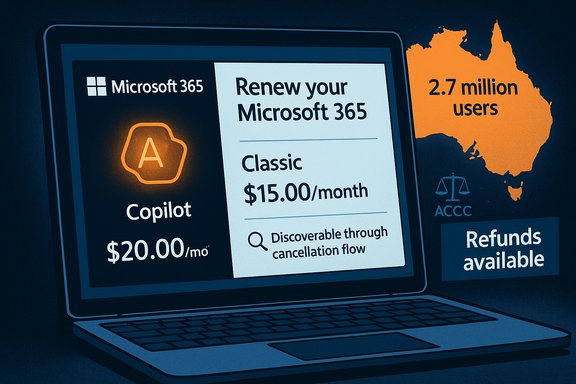
Microsoft has been forced into a rapid‑fire damage‑control exercise in Australia after the competition regulator took the company to federal court, alleging that the way Microsoft bundled its Copilot AI into consumer Microsoft 365 plans misled as many as 2.7 million Australians and nudged customers into higher‑priced subscriptions — a dispute that has already prompted public apologies, refund offers and legal exposure that could run into the tens or hundreds of millions of dollars.
Microsoft rolled Copilot — its generative AI assistant — into consumer Microsoft 365 Personal and Family plans in late 2024, and applied price increases to reflect the new bundled offering. The ACCC says the integration took effect for Australian consumers on 31 October 2024 and that Microsoft communicated the change to affected, auto‑renewing subscribers via two targeted emails and a blog post. The Australian Competition and Consumer Commission (ACCC) commenced Federal Court proceedings on 27 October 2025, alleging that Microsoft’s renewal communications conveyed a binary choice — accept Copilot and the higher renewal price, or cancel — while failing to contemporaneously disclose a third, lower‑cost alternative: the Microsoft 365 Personal Classic and Family Classic plans that did not include Copilot and preserved the pre‑increase pricing. The ACCC’s case is grounded on omission and choice‑architecture theory under Australian Consumer Law: the regulator says an available option was effectively hidden until customers started the cancellation flow. Headline price moves cited in the ACCC materials are stark: Microsoft 365 Personal rose from A$109 to A$159 (≈ +45%), and Microsoft 365 Family from A$139 to A$179 (≈ +29%). The ACCC estimates the potential cohort of affected Australian subscribers at roughly 2.7 million. Those figures are central to the regulator’s claim that millions may have renewed at materially higher prices as a result of the company’s communications.
Key constraints on headline exposure:
For product managers and compliance officers, the takeaway is direct: disclose early, make opt‑outs easy to find, and treat upgrade notifications as legal documents, not marketing copy. The resolution of this case will be watched by regulators, product teams and consumer advocates worldwide because it will help define the boundaries between lawful product evolution and conduct that misleads by omission.
Microsoft’s Copilot bundling saga in Australia is an instructive example of how product, legal and communications decisions intersect — and how regulators will increasingly scrutinize not just what companies sell, but how they present choices and defaults to consumers. The Federal Court proceedings will determine more than damages; they will shape the compliance playbook for how paid AI features are rolled into subscription services in markets where auto‑renewal and default settings govern everyday consumer behaviour.
Source: iTnews Microsoft in damage control over Copilot bundling bungle
 Background / Overview
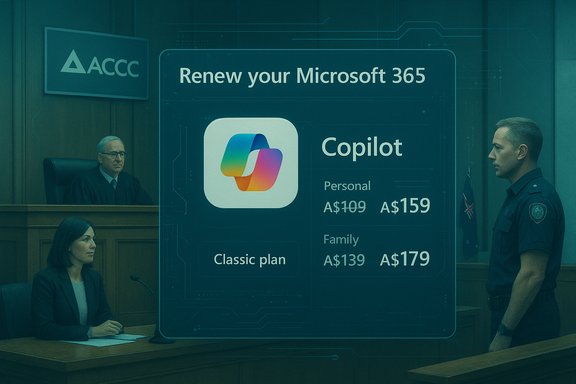
Microsoft rolled Copilot — its generative AI assistant — into consumer Microsoft 365 Personal and Family plans in late 2024, and applied price increases to reflect the new bundled offering. The ACCC says the integration took effect for Australian consumers on 31 October 2024 and that Microsoft communicated the change to affected, auto‑renewing subscribers via two targeted emails and a blog post. The Australian Competition and Consumer Commission (ACCC) commenced Federal Court proceedings on 27 October 2025, alleging that Microsoft’s renewal communications conveyed a binary choice — accept Copilot and the higher renewal price, or cancel — while failing to contemporaneously disclose a third, lower‑cost alternative: the Microsoft 365 Personal Classic and Family Classic plans that did not include Copilot and preserved the pre‑increase pricing. The ACCC’s case is grounded on omission and choice‑architecture theory under Australian Consumer Law: the regulator says an available option was effectively hidden until customers started the cancellation flow. Headline price moves cited in the ACCC materials are stark: Microsoft 365 Personal rose from A$109 to A$159 (≈ +45%), and Microsoft 365 Family from A$139 to A$179 (≈ +29%). The ACCC estimates the potential cohort of affected Australian subscribers at roughly 2.7 million. Those figures are central to the regulator’s claim that millions may have renewed at materially higher prices as a result of the company’s communications. What happened, step by step
The product change and pricing
- Microsoft integrated Copilot into consumer Microsoft 365 Personal and Family plans; the company publicly explained the integration and accompanying worldwide price adjustments in January 2025 on the Microsoft 365 blog. Microsoft also documented a limited‑time Classic SKU option for existing subscribers who preferred not to receive Copilot.
- For Australian subscribers the effective date used by the ACCC is 31 October 2024, the date the company began communicating that Copilot would be added and that renewals would occur at the new price. The ACCC’s press release and concise statement are explicit on those dates and on the pricing bands.
The communications at issue
- The ACCC’s case focuses on three customer‑facing items: two targeted emails sent to auto‑renewing subscribers and a Microsoft blog post that announced Copilot’s inclusion and the related price changes. The regulator alleges those materials conveyed only two apparent options: accept the Copilot‑enabled plan at the higher price or cancel the subscription.
- The Classic plans — according to the ACCC — were effectively discoverable only after a customer initiated the cancellation flow, i.e., the lower‑cost, no‑AI option only surfaced inside a trajectory that the customer had to start to leave the service. The ACCC says that choice architecture materially affected consumer decisions.
The regulator’s legal theory
- The ACCC asserts Microsoft engaged in misleading or deceptive conduct by omission under the Australian Consumer Law, because failing to disclose a contemporaneous, materially different option created a false impression about consumers’ realistic choices. The regulator is seeking declarations, injunctions, costs and consumer redress, and it has highlighted the potentially large maximum civil penalties available under the law.
Microsoft's immediate response and refunds
Microsoft has publicly said it is reviewing the ACCC’s claims and, in messaging to some Australian subscribers, acknowledged it "could have been clearer" about subscription options and offered eligible customers the opportunity to switch back to Classic plans and receive a refund. That customer outreach and the wording of the company’s email to subscribers have been reported in industry press and in coverage of the unfolding court proceeding.- Microsoft’s official blog and support pages had already documented options for existing subscribers to switch to non‑AI plans (Basic) or, for a limited period, to the classic SKUs. But the ACCC’s complaint is not that the Classic SKUs did not exist — it is that Microsoft’s specific renewal notices omitted mention of the Classic option, and that the Classic choice was not presented in the same place or at the same time as the price change notice.
- Reports vary about the precise terms of Microsoft’s refund offer and the time window for claiming it; some outlets reported Microsoft would process refunds for customers who switch back by a specified cut‑off date, while the regulator’s filings make clear that the volume of potentially affected accounts is large. The company’s own support documentation confirms the existence of the Classic plans but does not define the mechanics of a mass remediation program. Where Microsoft’s public statements diverge from the ACCC’s account, the dispute has shifted to the courtroom.
Verification of the core facts (what is independently corroborated)
- The ACCC filed proceedings in the Federal Court alleging misleading conduct and omission in relation to Microsoft’s Copilot integration and pricing in Microsoft 365 Personal and Family subscriptions. This is recorded in the ACCC media release dated 27 October 2025.
- The ACCC’s complaint identifies the consumer Copilot integration date as 31 October 2024 and cites annual retail price increases of A$109 → A$159 for Personal and A$139 → A$179 for Family. Those numbers are repeated in major international and Australian press reporting of the ACCC’s filing.
- The ACCC’s estimate of the affected cohort (approximately 2.7 million Australian subscribers) appears in the regulator’s concise statement and in independent reporting. That number describes the universe of potentially affected subscribers, not the number who will claim refunds or who were forced into paying more.
- Microsoft’s public blog announcing Copilot’s inclusion and the availability of Classic SKUs is on the Microsoft 365 blog and on Microsoft support pages; those materials explicitly note options exist for customers who do not want Copilot. The legal dispute concerns whether those options were adequately disclosed in the renewal communications.
- Microsoft has communicated to some Australian subscribers and made statements acknowledging shortcomings in clarity and offering refunds — coverage of that messaging appears in industry reporting and in some outlet coverage of Microsoft’s response. The detail of the remediation program (who qualifies, exact refund amounts to be paid, total exposure) has not yet been determined by the court or confirmed by a single reconciled Microsoft public filing.
Critical analysis: strengths, liabilities and evidentiary battlegrounds
Strengths in the ACCC’s position
- Clear evidence trail. The ACCC lodged a concise statement and included screenshots taken from Microsoft’s account flows showing the Classic option only surfacing after cancellation was initiated. Those screenshots, together with consumer complaints and forum evidence, make for a concrete evidentiary starting point.
- Legal fit with omission doctrine. Australian Consumer Law targets misleading conduct by omission as well as by affirmative misrepresentation. If the ACCC can show the omitted fact (availability of Classic) was material to a reasonable consumer’s decision at renewal, that legal pathway is well‑established and powerful.
- Scale and public interest. The large number of potentially affected subscribers — and the fact this is an everyday consumer product used for productivity — amplifies both the legal stakes and the regulator’s interest in deterrent remedies.
Microsoft’s defensible positions
- Published opt‑out materials. Microsoft’s blog and support pages do mention available alternatives (Basic, Classic) and explain controls to disable Copilot in apps. Microsoft can point to those contemporaneous disclosures to argue it provided options to consumers.
- Product design nuance. Microsoft can argue that the Classic SKUs were limited‑time and operationally constrained (e.g., availability depending on acquisition channel or timing), and that the mere existence of product pages and support articles satisfies disclosure duties. The company might also dispute the ACCC’s characterization of discoverability in the UX.
- Consumer choice and consent. Microsoft can emphasize users who actively sought to keep Classic or who upgraded will have chosen the new plan consciously; disentangling voluntary upgrades from conduct caused by omission will be central to liability and quantum.
The evidentiary battlegrounds to watch
- Timing and prominence of disclosures. The court will assess whether the Classic option was contemporaneously and adequately disclosed in the very notices that the ACCC says drove renewals — not merely whether a Classic SKU existed somewhere on the web.
- Internal product analytics and intent. Discovery is likely to produce internal test logs, UX decision memos, click‑through data and email‑targeting lists. These documents will determine whether the placement of the Classic option was deliberate UX design to reduce opt‑outs, or an unintended byproduct of lifecycle flows.
- Actual consumer harm. The ACCC will need to link the communications to quantifiable consumer loss for redress — who actually paid more because they were misled versus who knowingly stayed. Microsoft will press on segmentation and intent.
Quantifying exposure — realistic scenarios (and limits)
Several media outlets and commentators have run rough calculations suggesting that if a significant proportion of the 2.7 million affected accounts elected to switch to Classic retroactively, Microsoft’s immediate refund exposure could be substantial. Industry reporting has floated six‑ and seven‑figure figures; one industry story suggested a headline cap of around A$175 million as a potential—not confirmed—upper bound based on full reparation for a large cohort. That number is an estimate, not a confirmed liability, and should be treated with caution until either the parties settle or a court orders redress with precise accounting.Key constraints on headline exposure:
- The ACCC’s 2.7 million figure describes potentially affected accounts, not the number who paid excess price unknowingly, so refunds will likely be a subset of that pool.
- The maximum statutory civil penalty under Australian law for each contravention is substantial (greater of A$50m, three times the benefit obtained, or 30% of adjusted turnover), but penal outcomes depend on proof of contravention and calculation of benefit. The court will apply established factors in determining penalties if liability is found.
- Any remediation program Microsoft runs voluntarily may be narrower than the universe the ACCC seeks in court; conversely, a court‑ordered redress program could expand or contract exposure depending on the remedy ordered.
Broader implications for product teams, UX designers and subscription businesses
This case is a bellwether on several fronts:- Choice architecture matters legally. How subscription changes are presented — timing, prominence, and friction — now sits under sharper regulatory scrutiny. Designers must treat discoverability of opt‑outs and downgrade alternatives as a compliance requirement, not a UX afterthought.
- AI monetization is not a free pass. Regulators will expect clear, contemporaneous disclosures when AI features are monetized inside previously stable consumer offerings. Adding AI to a product and increasing price without transparent, accessible downgrade paths invites enforcement risk.
- Global product changes trigger local law. Multinational product teams must map their rollout communications to local consumer protection regimes and ensure synchronization between product messaging, billing flows and legal disclosures across jurisdictions. The ACCC’s action signals that national regulators will hold global companies to local standards in practice and communication.
What consumers and resellers should do now
- For consumers: review renewal notices and account settings immediately, and document any communications or screenshots related to pricing and renewal. If a renewal already occurred and the user believes they were misled, keep receipts and correspondence; these materials will be important if a complaint or claim is lodged. The ACCC’s public guidance and Microsoft’s support pages provide step‑by‑step instructions for switching to Classic where available.
- For resellers and SMBs: audit customer renewal notices and account‑management flows to ensure downgrade and legacy options are discoverable and plainly presented at the point consumers make renewal decisions. Product and legal teams should run jurisdictional reviews of subscription‑change notices as part of any global AI rollout.
Likely legal trajectory and timetable
- Early interlocutory hearings will set discovery timetables and interlocutory disputes. The ACCC’s concise statement indicates the regulator expects to pursue documentary discovery into Microsoft’s targeting lists, internal UX testing and analytics. Both parties will likely commission expert reports on reasonable consumer impressions and UX discoverability.
- The litigation may settle at any stage through negotiated remediation and process changes — regulators often prefer settlements that secure redress and compliance improvements — but a contested hearing would examine internal Microsoft decision‑making and telemetry in detail. The outcome will influence industry practice regardless of whether a court judgment is ultimately entered.
Final read: why this matters beyond Australia
This dispute is not only about one product or one regulator. It tests how consumer law applies when large platforms fold paid AI into everyday services and then adjust pricing. The question before the Federal Court is fundamentally one of disclosure and timing: in subscription markets where auto‑renewal is the norm, companies must make downgrade options as discoverable and actionable as the upgrade path if they expect to avoid regulatory intervention.For product managers and compliance officers, the takeaway is direct: disclose early, make opt‑outs easy to find, and treat upgrade notifications as legal documents, not marketing copy. The resolution of this case will be watched by regulators, product teams and consumer advocates worldwide because it will help define the boundaries between lawful product evolution and conduct that misleads by omission.
Caveats and open questions
- Exact numbers for refunds paid, the proportion of affected customers who will opt for Classic, and the ultimate penalty (if any) remain unresolved and subject to court determination and potential settlement. The A$175 million figure reported in some outlets as a possible headline exposure is an industry estimate and has not been confirmed as a legal liability by Microsoft, the ACCC, or the Federal Court. Treat such figures as indicative, not definitive.
- Internal intent at Microsoft — whether design choices were produced to reduce opt‑outs or were the result of product lifecycle constraints — remains an allegation until revealed in discovery. That factual record will be decisive in a finding of deliberate misleading conduct.
Microsoft’s Copilot bundling saga in Australia is an instructive example of how product, legal and communications decisions intersect — and how regulators will increasingly scrutinize not just what companies sell, but how they present choices and defaults to consumers. The Federal Court proceedings will determine more than damages; they will shape the compliance playbook for how paid AI features are rolled into subscription services in markets where auto‑renewal and default settings govern everyday consumer behaviour.
Source: iTnews Microsoft in damage control over Copilot bundling bungle