

Australian small businesses have moved quickly from curiosity to routine use of generative AI: a fresh survey by Small Business Loans Australia (SBLA) finds four in five firms now use AI tools, and many report large reductions in labour time.
The snapshot behind the headlines is straightforward: SBLA surveyed 200 Australian business owners and decision-makers about current AI use, estimated time savings, and expectations for future profitability if AI were “perfected” across core business functions. The study reports ts say they use AI in some form today.
That number tracks with other recent industry reporting showing accelerated AI adoption among SMEs in Australia over the last 12–18 months, particularly for generative text tools, embedded AI features in productivity software, and chatbots. The SBLA results join a string of surveys that point to the same directional shift: AI is migrating from experimental proof‑of‑concepts into everyday workflows.
Two practical lessons flow from the regional spread:
For WindowsForum readers who operate the systems and sets of policies that will govern this transition, the practical takeaway is clear: force integration, measure rigorously, govern deliberately, and reskill proactively. Do those four things and the time savings the survey reports can translate into sustainable profitability rather than ephemeral hype.
The SBLA numbers give a useful signal: adoption has broadened, managers feel productivity gains, and the path forward is integration rather than novelty. That signal is powerful, but it should trigger disciplined pilots, robust governance and an honest effort to quantify outcomes — not a rush to decommission human judgement. The firms that combine technical controls, human oversight, and continuous measurement will be the ones that turn perceived time saved into durable competitive advantage.
Source: ecommercenews.com.au https://ecommercenews.com.au/story/ai-tools-slash-labour-time-for-four-out-of-five-firms/
 Background
The snapshot behind the headlines is straightforward: SBLA surveyed 200 Australian business owners and decision-makers about current AI use, estimated time savings, and expectations for future profitability if AI were “perfected” across core business functions. The study reports ts say they use AI in some form today.That number tracks with other recent industry reporting showing accelerated AI adoption among SMEs in Australia over the last 12–18 months, particularly for generative text tools, embedded AI features in productivity software, and chatbots. The SBLA results join a string of surveys that point to the same directional shift: AI is migrating from experimental proof‑of‑concepts into everyday workflows.
What the survey found — the headline metrics
The SBLA survey packs several striking claims that deserve careful unpacking.- 80% of businesses in the 200‑respondent sample reported current use of AI tools.
- 41% of AI users estimated AI saves at least 25% of total labour time, and 17.5% claimed AI saves more than half of labour time for some tasks.
- A further 29% estimated 11–25% time savings.
- Regionally, Western Australia recorded the highest adoption rate in the sample at 91%, with other large states ranging from mid‑70s to low‑80s.
- When asked about a hypothetical “perfected AI” implemented across five business functions, respondents were most bullish about administration and workflow (77% expected a profitability lift) and writing & communication (75% expected gains).
Where businesses say they’re getting value today
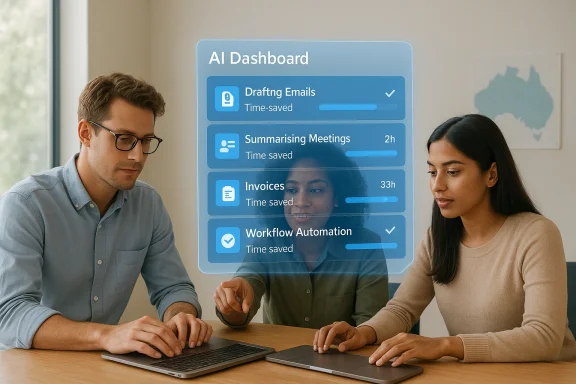
The survey groups practical AI wins into three broad buckets where SMBs consistently report concrete time savings:- **Administration and workflow ad documents, routine approvals, invoice handling, and simple data entry are being sped up or automated. This category is the clearest near‑term productivity play.
- Writing and communication — drafting emails, proposals, marketing copy, and summarising meeting notes are frequent use cases that reduce iteration time and blunt repetitive tasks.
- Customer-facing automation — embedded chatbots and AI features in CRMs are triaging routine queries, generating first‑pass responses, and reducing agent workload.
Regional differences — why WA shows higher adoption
SBLA’s sample shows Western Australia at the top with 91% AI use. That difference is plausible but should be interpreted cautiously: regional adoption rates can reflect industry mix, the sample composition, and the concentration of particular firm types (for example, mining services or resource‑linked professional services can adopt different toolsets). Survey snapshots capture momentum but not full representativeness. ([itbrief.com.om.au/story/ai-tools-slash-labour-time-for-four-out-of-five-firms)Two practical lessons flow from the regional spread:
- High local adoption often correlates with sectors that already use digital field tools and cloud services, making integration of new AI features simpler.
- Conversely, lower adoption in another state may indicate structural barriers such as smaller firm size, lower digital literacy, or tighter margins that limit investment in new tooling.
Reading the time‑savings numbers with healthy skepticism
The most eyebrow‑raising claim — that a notable minority of firms report AI saves more than half their total labour time in some tasks — demands careful interpretation.- The survey is self‑reported and therefore measures perceived time savings rather than time tracked against a pre‑AI baseline. Perception often outpaces calibrated measurement.
- “Time saved” can be calculated many ways. A writing assistant that cuts drafting from 60 to 30 minutes produces a 50% time reduction on that task but only a fractional reduction in total labour for the whole role. The difference between task‑level and role‑level savings matters.
- Small samples (200 respondents) give useful directional insight but are not substitutes for longitudinal, instrumented measurement that tracks cycle times, error rates, and quality metrics across teams.
Strengths: where the ROI is easiest to capture
Generative AI delivers clear advantages in certain, well‑defined contexts:- Rapid content generation and editing that eliminates repetitive drafting.
- Automated summarisation of long documents and meetings, speediRule‑based routing and triage in customer service that reduces first‑response time and frees human agents for complex cases.
- Embedded AI inside established apps (for example, assistants inside document editors, CRM plugins, or accounting tools) lowers friction and accelerates adoption.
Risks and blind spots — what SMBs must watch for
Rapid gains come with measurable hazards. The survey’s optimism must be squared with several operational, legal, and ethical risks:- Hallucinations and accuracy problems. Generative models can fabricate plausible‑sounding but incorrect outputs. For compliance, financial, or legal content, that can be costly.
- Data privacy and leakage. Sending customer‑sensitive or proprietary data to third‑party models without controls risks regulatory and reputational damage. Many models and vendors have differing terms on data reuse.
- Vendor lock‑in and portability. Tight coupling to a single vendor’s embedded AI features can create migration friction and exposure to price or policy changes.
- Uneven adoption and skill gaps. Time savings concentrate where staff are comfortable using tools. Without coordinated upskilling, benefits will be patchy.
- Operational maintenance and model drift. AI components are software: they need monitoring, retraining, ang them as “set and forget” introduces long‑term risk.
- Regulatory uncertainty. Rules for AI transparency, liability, and consumer protection are evolving; businesses may face retroactive compliance costs.
Practical governance checklist (short, actionable)
Before expanding AI across mission‑critical workflows, leaders should confirm the basics:- Have you classified the sensitivity of data processed by AI and restricted what can be shared with external models?
- Do contracts with vendors explicitly state data ownership, reuse rights, and retention policies?
- Are there human‑in‑the‑loop procedures and escalation paths for high‑risk outputs?
- Is logging and versioning in place so decisions produced by AI are auditable?
- Have privacy and security assessments been completed and recorded?
A practical, phased roadmap for SMBs ready to embed AI
For readers who run IT or operations in small and medium businesses, a staged approach reduces risk while delivering compound gains:- Start with high‑frequency, low‑risk processes (stad reports, invoice processing).
- Define measurable KPIs up front: baseline cycle time, error rate, cost per transaction, and CSAT.
- Choose integration‑first tools — prefer AI features embedded into apps you already use (document editors, CRM, helpdesk).
- Pilot aggressively but time‑box the pilot and instrument results for objective measurement.
- Build data governance and vendor safeguards simultaneously.
- Train staff with role‑specific, short sessions and appoint change champions.
- Scale iteratively with explicit SLAs, monitoring, and escape clauses in vendor contracts.
- Translate time saved into financial KPIs quarterly and hold leaders accountable.
Technical guidance for Windows‑centric IT teams
WindowsForum readers — particularly sysadmins, endpoint engineers, and IT managers — should translate the roadmap into concrete technical controls:- Prioritise AI that integrates with Microsoft 365, Teams, and the Windows desktop: embedded Copilot‑style features produce faster adoption and reduce context switching.
- Enforce Conditional Access, SSO, and device‑based policies before enabling third‑party chat plugins that accept PII or customer data.
- Use data classification at the endpoint and gateway level so that se blocked from being submitted to public LLMs.
- Implement dedicated audit trails and logging for AI‑produced recommendations; save model inputs/outputs for a reasonable retention period to support investigations and compliance.
- Consider hybrid deployment patterns: keep proprietary data on‑premises or in a private cloud and use hosted models only on de‑identified or synthetic inputs when possible.
- Monitor usage patterns centrally; instrument the number of API calls, token costs, and error rates to ensure model economics remain favorable.
Workforce and reskilling: lead with clarity, not fear
The SBLA findings show time saved — but that’s not the whole story for people. Organisations that approach adoption as a redesign opportunity fare better than those that treat AI as a headcount lever.- Design reskilling paths that move human roles toward judgement‑heavy, trust, and relationship tasks.
- Communicate clearly about role changele progress metrics for staff who retrain.
- Use AI augmentation to raise the floor of productivity and enable smaller teams to do higher‑value work rather than simply compress labour costs.
What the next 12–24 months are likely to bring
The SBLA survey captures a moment where generative AI has crossed into routine use for many SMEs. Over the coming 12–24 months expect three converging dynamics:- Deeper integration: vendors will bake AI more tightly into core business apps, making it the default rather than an opt‑in experience.
- Shift from access to governance: conversations will pivot from “how do we get tools?” to “how do we manage, measure, and secure them?”
- A growing gap between early integrators and ad‑hoc users: firms investing in governance, measurement and training will compound returns; point‑solution users will see less sustainable benefits.
Final analysis — what this means for practitioners
SBLA’s survey adds a local, timely datapoint to a global shift: small and medium businesses are no longer simply experimenting with generative AI — many now use it as a daily productivity tool. The most credible wins are concentrated in routine, repeatable work where the error cost is low and the volume is high. However, the survey’s headline savings figures are perception‑based and must be validated with instrumentation before leaders build long‑term strategy on them.For WindowsForum readers who operate the systems and sets of policies that will govern this transition, the practical takeaway is clear: force integration, measure rigorously, govern deliberately, and reskill proactively. Do those four things and the time savings the survey reports can translate into sustainable profitability rather than ephemeral hype.
The SBLA numbers give a useful signal: adoption has broadened, managers feel productivity gains, and the path forward is integration rather than novelty. That signal is powerful, but it should trigger disciplined pilots, robust governance and an honest effort to quantify outcomes — not a rush to decommission human judgement. The firms that combine technical controls, human oversight, and continuous measurement will be the ones that turn perceived time saved into durable competitive advantage.
Source: ecommercenews.com.au https://ecommercenews.com.au/story/ai-tools-slash-labour-time-for-four-out-of-five-firms/
