

Australian classrooms are already moving into the AI era — with Australian teachers among the fastest adopters worldwide — but the shift is bookended by measurable classroom benefits and deep, unresolved questions about integrity, bias, and readiness.
The latest international survey cycles and multiple institutional reports show a rapid increase in educators using generative and assistive AI for everyday teaching tasks. Data from comparative surveys put Australian uptake ahead of many peers: roughly two in three lower‑secondary teachers and around half of primary teachers report classroom use of AI tools, with younger teachers disproportionately likely to experiment. These patterns reflect global trends where adoption outpaces training and governance.
This article summarises the evidence, evaluates the pedagogical trade‑offs, and sets out practical, policy and technical guardrails schools must prioritise to capture AI’s upside while limiting harms. It draws on international survey results, district case studies, and education‑sector analyses to offer a forensic account that is both constructive and sceptical.
Practical assessment redesign strategies that are emerging in district playbooks include:
Key governance principles:
A high‑impact PD model includes:
Practical day‑one moves schools can make include centralising contracts with explicit non‑training language, launching teacher pilots with clear outcome metrics, redesigning assessments to foreground process, and investing in short, curriculum‑focused PD. Done with those guardrails, AI can become a powerful assistant to teachers; done without them, it will be a costly distraction. The next two years will not decide whether AI enters classrooms — it has — but they will determine whether it improves learning or simply reshuffles workload and risk.
Source: The Educator Teachers turn to AI, but doubts linger
 Background
The latest international survey cycles and multiple institutional reports show a rapid increase in educators using generative and assistive AI for everyday teaching tasks. Data from comparative surveys put Australian uptake ahead of many peers: roughly two in three lower‑secondary teachers and around half of primary teachers report classroom use of AI tools, with younger teachers disproportionately likely to experiment. These patterns reflect global trends where adoption outpaces training and governance.This article summarises the evidence, evaluates the pedagogical trade‑offs, and sets out practical, policy and technical guardrails schools must prioritise to capture AI’s upside while limiting harms. It draws on international survey results, district case studies, and education‑sector analyses to offer a forensic account that is both constructive and sceptical.
What teachers say: uses, benefits and the adoption profile
How teachers are using AI day‑to‑day
Teachers report three primary classroom uses for AI tools:- Lesson planning and content summarisation — teachers ask AI to generate drafts of lesson plans, learning objectives, and summaries of curriculum units.
- Differentiation and scaffolding — systems are used to adjust reading complexity and produce varied practice items for students at different levels.
- Individual support and feedback — teachers use AI to generate formative tasks, feedback language, and personalised study prompts that can be tailored rapidly.
Who is adopting and where
Adoption skews toward:- Younger teachers and digital natives who feel more comfortable prompting and refining model outputs.
- Teachers in better‑resourced systems that have easier enterprise procurement and device access.
- Subjects and tasks amenable to automation, such as writing scaffolds, reading comprehension practice, and rubric drafting.
Benefits: what AI can realistically deliver for teachers and students
AI’s most reliable, repeatable advantages in education are practical, incremental and pedagogically useful when human oversight is present:- Time and workload reduction. Automating routine tasks — drafting lesson skeletons, generating formative quizzes, preparing parent communications — can save teachers multiple hours per week when outputs are vetted. This is one of the clearest, most replicable benefits reported in district pilots.
- Scalable differentiation. AI can generate multiple versions of practice problems and tailor explanations to different reading levels, making personalised practice feasible in larger classes. This capability supports mastery learning when combined with teacher‑directed feedback loops.
- Faster assessment cycles. Automated scoring and formative item generation compress feedback loops, enabling quicker remediation and targeted small‑group instruction. Several deployments report markedly faster turnaround on formative checks.
- Accessibility and inclusion. Translation, plain‑language rewrites, and multimodal outputs (audio, simplified text, diagram walkthroughs) can lower barriers for English‑language learners and students with special educational needs when used intentionally.
- Workplace‑relevant literacies. Teaching students how to prompt, verify, and ethically use AI builds transferable skills for modern workplaces and civic life. Structured AI literacy can be an explicit learning objective, not only a tool.
Concerns and limitations that matter now
The potential upside is tempered by risks that are immediate, recurrent and sometimes systemic.Academic integrity and the “invisible shortcut”
Educators consistently report that the most worrying consequence is students presenting AI‑generated work as their own. Teachers observe increased instances where polished final products mask a lack of process evidence and critical revision. Detection tools are imperfect, and bans are often porous because students can access consumer models outside of school networks. Effective responses so far favour assessment redesign rather than pure detection.Hallucinations and factual reliability
Generative models can produce fluent but incorrect or misleading answers — hallucinations that look authoritative. In classroom contexts where accuracy matters (science, history, maths), these errors can produce learning harms if not corrected. Teachers must be taught to treat AI output as provisional and model verification behaviours explicitly for students.Algorithmic bias and reinforcement of misconceptions
Large language models reflect patterns in their training data, including common misconceptions. Examples include math misconceptions reproduced by chatbots or biased language that amplifies stereotyped viewpoints. Without deliberate critical inquiry, personalized algorithms can entrench skewed perspectives. Structured classroom activities where students interrogate algorithmic outputs can be pedagogically powerful countermeasures.Data privacy, vendor governance and contractual exposure
Vendor contracts vary greatly on whether student inputs are used to train models, how long telemetry is retained, and what audit rights institutions retain. Centralised procurement with explicit non‑training and deletion clauses is now a basic risk‑management requirement. Schools that adopt consumer services without clear contractual protections risk exposing student data to unknown downstream uses.Equity and the digital divide
High adoption correlates with device access, bandwidth, and informal peer networks that teach prompting skills. Without active equity measures (institutional licences, device loan programs, offline modes), AI risks amplifying existing achievement gaps. Evidence shows adoption is uneven by socioeconomic status and subject area.Teacher training gaps
Many teachers report limited or no formal professional development on AI. Where training exists, it ranges from short briefings to intensive bootcamps, producing widely varying outcomes. The most successful implementations pair technical prompt training with pedagogical redesign workshops focused on assessment and verification.Redesigning assessment: preserving learning validity
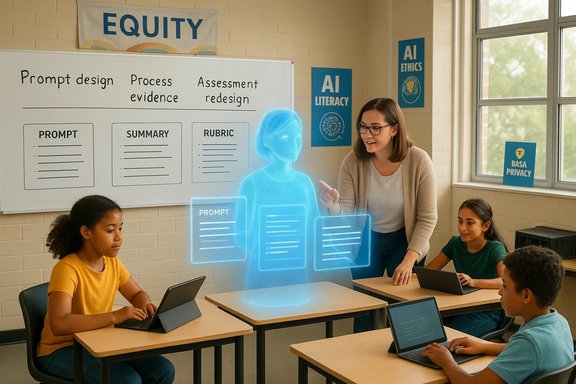
Assessment is the immediate policy battleground. If tasks reward final polished products rather than process and reasoning, students will have strong incentives to outsource work.Practical assessment redesign strategies that are emerging in district playbooks include:
- Require staged submissions and draft logs so teachers can see development and iteration.
- Use oral defenses and viva‑style assessments for summative tasks to probe understanding.
- Adopt portfolios and annotated revisions that ask students to critique AI contributions and show verification steps.
- Implement prompt‑logging in LMS tools so the role of AI in a submission is visible to assessors.
Governance, procurement and technical safeguards
Sound procurement and governance are the backbone of any responsible rollout.Key governance principles:
- Centralise procurement for core AI services to obtain education‑grade contracts with non‑training and deletion clauses.
- Insist on audit and export rights for telemetry so districts can verify vendor claims and investigate incidents.
- Role‑based access and tenant isolation to keep student accounts separated from consumer product flows.
- Pilot before scale — small teacher‑led pilots allow testing of pedagogy, data flows and admin controls before systemwide adoption.
- Turn on enterprise education SKUs that explicitly block training on tenant prompts where available.
- Configure retention and access controls for generated materials and student submissions.
- Enforce least‑privilege connectors to limit third‑party access to school data.
Professional learning: making teachers the centre of design
The evidence is clear: teacher‑led co‑design produces better outcomes than top‑down mandates. Effective professional development is short, practical and task‑oriented.A high‑impact PD model includes:
- Micro‑modules on prompt design, hallucination detection and vendor privacy settings.
- Pedagogical workshops that redesign assignments and co‑create rubrics that require process evidence.
- Peer networks and repositories of shared prompts, lesson templates and verified AI‑aware rubrics.
- Protected time and incentives for teachers to pilot and share results with peers.
Classroom practice: pragmatic rules teachers can use tomorrow
- Treat AI outputs as drafts, not answers. Always model verification behaviour.
- Require students to annotate where and how they used AI in their work.
- Build tasks that make process visible: include checkpoints, reflective prompts, and annotated sources in rubrics.
- Use AI for low‑stakes scaffolding (practice items, summaries), but keep summative checks human‑led where possible.
- Teach students explicit AI literacy: how models are trained, common hallucination patterns, and how to cross‑check claims against primary sources.
Case studies and international comparisons
Several real‑world deployments illuminate the breadth of outcomes:- Brisbane Catholic Education reported scaled Copilot rollouts with substantial weekly time savings for staff when combined with ethical guidelines and admin controls. Time reclaimed was explicitly framed as instructional capacity rather than punitive automation.
- National programs that pair procurement with teacher upskilling — for example, certain reading assessment rollouts in large jurisdictions — show rapid assessment gains when the technology is operationalised alongside PD and verification workflows.
- Comparative survey evidence highlights regional variation in student adoption rates (from mid‑50s to high‑80s percent depending on sample and question framing). These differences caution against over‑generalised headlines; local context, wording and cohort all matter.
Policy recommendations for district and school leaders
- Centralise procurement for core AI services and require binding non‑training clauses, clear retention policies and audit rights.
- Pilot with measurable learning outcomes: track time saved, active user counts, interactions per active user, and task mix (planning, grading, student study).
- Redesign assessment before scale: adopt staged submissions, oral checks, and portfolio evidence to preserve learning validity.
- Mandate short, practical PD for all teachers that pairs prompt engineering with assessment redesign sessions.
- Provide equitable access: device loaner schemes, offline learning pathways, and provisioned institutional licences to avoid a two‑tier classroom.
- Communicate transparently with families and students about what tools do, how data are handled and how misuse will be addressed.
Where evidence is still thin — and what to watch
There are plausible claims with limited replicable evidence:- Long‑term effects on knowledge retention, independent reasoning and higher‑order skills are under‑researched. Many published gains come from small pilots or vendor case studies with limited methodology disclosure; these should be treated as promising but provisional.
- Precise national adoption percentages vary by survey method and timing. Headlines that present a single global figure should be treated with caution.
- Legal and procurement developments that require vendors to disclose training uses and telemetry practices.
- Longitudinal peer‑reviewed studies that measure whether AI‑aided instruction improves retention and higher‑order thinking, not just short‑term test lifts.
- Whether accreditation and quality frameworks begin to demand process‑based assessment evidence in AI‑permeated classrooms.
Critical analysis: strengths, blind spots and trade‑offs
Strengths- AI delivers scalable differentiation and time savings that are operationally valuable for overwhelmed teachers.
- When teachers remain the final arbiter, AI acts as a productivity multiplier that can free time for high‑value instruction.
- Over‑reliance on vendor promises without contractual guarantees exposes student data and institutional exposure.
- Short PD and ad‑hoc adoption can steer classrooms toward efficiency at the expense of pedagogical depth (the “pedagogical drift” problem).
- Tighter restrictions reduce risk but may blunt pedagogical utility for older students. Blanket bans can drive use underground and lose the chance to teach AI literacy. The pragmatic middle path is pedagogy‑first managed adoption paired with assessment redesign.
Conclusion
The evidence is unambiguous on one front: AI is here to stay in schools. Australian teachers are experimenting at high rates, and where implementation combines enterprise procurement, teacher‑led pilots and thoughtful assessment redesign, the gains are measurable and meaningful. Yet the transition is fragile. Without binding procurement terms, scalable PD that pairs technical skills with pedagogical design, and assessment systems that privilege process evidence, AI will amplify existing inequities and weaken the core educational work of cultivating independent reasoning.Practical day‑one moves schools can make include centralising contracts with explicit non‑training language, launching teacher pilots with clear outcome metrics, redesigning assessments to foreground process, and investing in short, curriculum‑focused PD. Done with those guardrails, AI can become a powerful assistant to teachers; done without them, it will be a costly distraction. The next two years will not decide whether AI enters classrooms — it has — but they will determine whether it improves learning or simply reshuffles workload and risk.
Source: The Educator Teachers turn to AI, but doubts linger
