

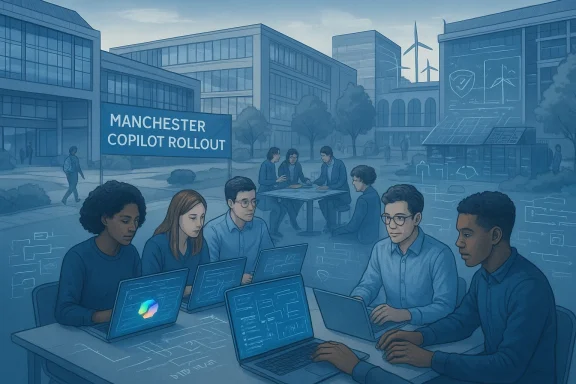
The University of Manchester’s decision to roll out full Microsoft 365 Copilot access and training to its entire campus community—some 65,000 students and staff, with the programme due to complete by summer 2026—has crystallised a national debate about the role of large technology providers in public higher education. The announcement, described by the university and Microsoft as a “world‑first” move to give universal Copilot access, promises clear benefits: coordinated AI literacy, equitable access to advanced productivity tools, and time‑saving capabilities for research and administration. Yet the response on campus has been sharply divided. Students and activist groups have raised substantive concerns about environmental impact, academic independence, pedagogy and vendor lock‑in—issues that universities must now manage if they are to adopt AI at scale responsibly.
The University of Manchester framed the partnership as a strategic extension of its AI legacy and an equity initiative: by offering Microsoft 365 Copilot licences to every student and staff member, the university says it will close an “emerging digital divide” and equip graduates with the practical skills employers expect. The rollout includes Copilot‑integrated Word, Excel, PowerPoint, Outlook and Teams features, plus specialised agents marketed for research workflows (for example, summarisation and exploratory data analysis). The university also commits to a training programme to teach responsible and effective use.
Microsoft, for its part, positions Copilot as the productivity layer for knowledge work and has been promoting broad enterprise adoption. Public filings and product updates over the last two years show aggressive Copilot feature growth and widespread enterprise uptake, which underpins the university’s employability argument: many large employers now expect incoming graduates to be comfortable using AI‑enabled productivity tools.
Across campus reaction divides into three broad camps: staff and students who welcome practical tools and added skills; administrators focused on efficiency gains; and activists, student societies and academics who warn this is a step toward corporate capture of key campus functions and ask for stronger governance.
That combination of universal access plus training is a plausible model for an ethical deployment—but the devil is in the detail. Who decides the acceptable uses in assessment? Which data connectors will be enabled by default? How will telemetry be handled? Those practical questions determine whether benefits materialise and risks are mitigated.
What does this mean for Manchester? The university’s statement that Microsoft’s sustainability commitments influenced the selection is factually accurate as a rationale, but commitments are not the same as immediate impact reductions. A responsible institutional deployment requires transparency from Microsoft and the university about:
Key pedagogical risks and required responses:
Practical questions that the University of Manchester and Microsoft must answer publicly:
Risks include:
Potential impacts include:
If the university truly intends to set a global example, it will do more than distribute licences. It must publish transparent technical and contractual details, rebuild curricula to teach AI judgement, create clear opt‑outs and data protections for sensitive research, and offer independent sustainability reporting on the deployment’s real-world impacts. Done well, the partnership can deliver empowered graduates who know the limits as well as the uses of AI. Done poorly, it risks accelerating dependency, hollowing out learning outcomes, and shifting costs—environmental and institutional—onto students and the public sector. The choice facing Manchester is not whether to use AI, but how to use it in a way that protects the university’s public mission while reaping deserved benefits.
Source: The Tab Uni of Manchester students criticise world-first AI partnership with Microsoft
 Background
The University of Manchester framed the partnership as a strategic extension of its AI legacy and an equity initiative: by offering Microsoft 365 Copilot licences to every student and staff member, the university says it will close an “emerging digital divide” and equip graduates with the practical skills employers expect. The rollout includes Copilot‑integrated Word, Excel, PowerPoint, Outlook and Teams features, plus specialised agents marketed for research workflows (for example, summarisation and exploratory data analysis). The university also commits to a training programme to teach responsible and effective use.Microsoft, for its part, positions Copilot as the productivity layer for knowledge work and has been promoting broad enterprise adoption. Public filings and product updates over the last two years show aggressive Copilot feature growth and widespread enterprise uptake, which underpins the university’s employability argument: many large employers now expect incoming graduates to be comfortable using AI‑enabled productivity tools.
Across campus reaction divides into three broad camps: staff and students who welcome practical tools and added skills; administrators focused on efficiency gains; and activists, student societies and academics who warn this is a step toward corporate capture of key campus functions and ask for stronger governance.
Why Manchester made this deal: practical rationales and institutional claims
The university’s public statement lists three main rationales:- Equity: giving every student access to Copilot avoids a situation where only those who can pay privately have advanced AI assistants.
- Employability: exposure to mainstream productivity AI is framed as a marketable graduate skill.
- Research and productivity: Copilot’s agents are sold as accelerants for routine tasks—literature searching, drafting, data summarisation—freeing researchers for higher‑value work.
That combination of universal access plus training is a plausible model for an ethical deployment—but the devil is in the detail. Who decides the acceptable uses in assessment? Which data connectors will be enabled by default? How will telemetry be handled? Those practical questions determine whether benefits materialise and risks are mitigated.
Student pushback: not just technophobia
Student dissent reported in local outlets and campus conversations is not a reflexive opposition to technology. Instead, three principled objections recur:- Environmental concerns. Students point to the energy cost of training and operating modern generative AI models and question whether a mass roll‑out is compatible with campus sustainability goals. The argument is both global (AI’s energy footprint is large and rising) and local: data centres powering AI workloads still draw significant electricity in many regions from non‑renewable sources.
- Academic independence and corporatisation. Several students worry that deepening dependence on a large commercial vendor risks reorienting university priorities toward measurable, productivity‑centric metrics at the expense of critical thinking and independent scholarship. “It’s a business now,” one postgraduate told campus outlets, echoing a broader unease about private‑sector influence over public institutions.
- Pedagogical impact and outsourcing of learning. Students and representatives from campus societies argue that easy access to drafting and summarisation tools may encourage students to outsource cognitive labour—drafting essays, generating code, or synthesising complex arguments—before they have mastered foundational skills.
The environmental argument: evidence, nuance and what the numbers mean
Environmental impact is one of the most tangible and verifiable critiques. The broad claim—that training and operating large AI systems consumes significant energy and produces notable greenhouse gases—is supported by multiple independent studies and industry analyses.- Academic work dating back to 2019 showed that training very large transformer models can emit carbon quantities comparable to several car lifetimes. Later industry estimates for flagship models vary by architecture, training efficiency, hardware and the regional electricity mix, but commonly range from tens to hundreds of metric tons of CO2 equivalent for training a single large model. Operational costs—serving millions of queries every day—add ongoing energy consumption beyond the one‑off training event.
- Independent NGOs and research groups tracking data‑centre expansion estimate that AI workloads will materially increase global data‑centre power demand over the coming years; they highlight that the location of data centres matters because many regions still rely heavily on fossil fuels for grid electricity.
- Even technology companies with ambitious sustainability pledges have seen their reported emissions rise as capacity to support AI has grown—an important reality check that editing strategy documents doesn’t automatically solve operational carbon.
What does this mean for Manchester? The university’s statement that Microsoft’s sustainability commitments influenced the selection is factually accurate as a rationale, but commitments are not the same as immediate impact reductions. A responsible institutional deployment requires transparency from Microsoft and the university about:
- Which Azure regions and data centres will host the Copilot workload for University of Manchester users.
- How much of the electricity powering those data centres is contracted from renewable sources and whether matching renewables are procured locally.
- Any emissions or water‑use reporting tied to the university’s Copilot tenancy and a timeline for reduction.
Academic integrity, assessment design and learning outcomes
Large language models change the shape of assignments the way calculators changed arithmetic. If advanced drafting and summarisation is available to every student, assessment practices must adapt.Key pedagogical risks and required responses:
- Plagiarism and ghostwriting: AI can produce plausible text that a student could submit as their own. Universities must decide which uses are permitted, how students must declare AI assistance, and what constitutes malpractice.
- Assessment design: Superficial, output‑based assessments (short essays, basic literature summaries) are vulnerable. More robust assessment—oral examinations, in‑person supervised tasks, portfolios with process evidence, and assignments that require personal reflection or lab work—reduces cheating incentives.
- AI literacy and critical verification skills: Students must learn prompt design, source verification, and citation practices for AI outputs. The University of Manchester has existing guidance on referencing AI tools; embedding such skills into curricula is essential.
- Staff workload and marking: Automated or AI‑assisted marking tools create risks if staff lean on AI to assess student work without recalibrating rubrics for AI‑augmented output.
Data governance, privacy and technical controls
When universities adopt vendor AI platforms, the topology of access matters. Copilot is designed to integrate with organisational data stores and services—which is powerful but risky without careful control.Practical questions that the University of Manchester and Microsoft must answer publicly:
- Data connectors and scope: Which internal systems (learning management systems, personal drive folders, HR systems) will Copilot be allowed to read? Will default settings expose sensitive administrative data to Copilot agents?
- Telemetry and retention: Are prompts, documents and system logs retained by Microsoft, used to improve models, or subject to other analysis? What are retention periods and dispute mechanisms?
- Academic confidentiality: How will Copilot be prevented from inadvertently producing outputs that echo sensitive or proprietary research data?
- Access controls and conditional policies: Will staff and postgraduate researchers working on sensitive projects be able to opt out of Copilot or restrict data flow? Technical gating (DLP, conditional access, tenant‑level restrictions) must be documented and usable.
Commercialisation, vendor lock‑in and institutional autonomy
A long‑term risk with deep single‑vendor dependencies is vendor lock‑in. Once staff, students and administrative systems are wired around a vendor’s agentic features, migrating away becomes difficult and costly.Risks include:
- Procurement dependence: Ongoing contracts can create budgetary obligations—what starts as a “free” student benefit could create renewal costs or pressure to adopt additional paid services.
- Ecosystem alignment: Curricula and administrative tools tuned to specific Copilot behaviours may fall behind if the vendor changes terms, pricing or data policies.
- Research agendas: Large providers can influence the priorities of campus technology roadmaps and research partnerships—this can be positive if managed transparently, but problematic if it narrows independent research choices.
Operational and organisational impacts for staff
Administrators frame Copilot adoption as productivity‑enhancing for professional services and academic staff. That can be true—automating routine report drafts or meeting notes frees time—but it also reshapes job roles.Potential impacts include:
- Changes to job descriptions as routine drafting tasks are automated.
- Requirements for staff to learn new workflows and oversight responsibilities.
- Trade union concerns about workload, deskilling, and managerial misuse of productivity metrics derived from Copilot outputs.
Recommendations: how a large university can make a vendor AI roll‑out responsible
A workable stewardship model exists and combines technical, contractual and pedagogical measures. Manchester (and other universities considering similar deals) should:- Publish a clear deployment charter that explains:
- The exact Copilot features to be provisioned.
- Data flows and the Azure regions that will process university workloads.
- Retention, telemetry and model‑improvement policies tied to the tenancy.
- Negotiate contractual safeguards:
- Rights to export and remove university data in standard formats.
- Audit rights over data handling and energy/water use reporting where relevant.
- Price caps and clear renewal terms to avoid surprise budget pressure.
- Tighten technical controls:
- Use tenant‑level governance to restrict which data sources Copilot can access.
- Provide opt‑out mechanisms for staff and researchers handling sensitive work.
- Deploy robust DLP (data loss prevention), conditional access, and logging.
- Redesign assessments and embed AI literacy:
- Update assessment rubrics and design to account for AI availability.
- Ensure every undergraduate programme includes modules on critical evaluation of AI outputs, proper citation of AI assistance, and prompt literacy.
- Train tutors and examiners alongside students.
- Be transparent on sustainability:
- Require the vendor to disclose where workloads are hosted and the energy mix powering those facilities.
- Publish expected emissions and a plan to offset or reduce them via renewables procurement, efficiency measures, or verified removals not relied upon in lieu of operational reductions.
- Maintain pluralism:
- Avoid single‑vendor lock‑in by piloting and supporting open alternatives where pedagogically appropriate.
- Support research into energy‑efficient models and open ecosystems that give students options.
What university leaders and vendors often miss
In many campus debates the focus narrows to either technological enthusiasm (“this will prepare students for jobs”) or moral panic (“AI will destroy education”). The middle ground is policy and practice. Two mistakes are common:- Treating access alone as sufficient. Tools alone don’t teach judgement. Without curricular reform, students will either misuse AI or miss opportunities to learn how to use it critically.
- Assuming corporate sustainability pledges absolve local responsibility. Vendor commitments matter, but institutional purchasers must demand granular operational transparency and independent verification.
Conclusion
The University of Manchester’s Microsoft Copilot rollout is a high‑profile test case for how modern universities integrate commercial AI into teaching, learning and research. The potential upsides—equitable access, employability, and research productivity—are real and attractive. But the student scepticism heard in Manchester is not simply alarmist: the environmental footprint of contemporary AI, threats to academic independence, data governance gaps and the need to redesign assessment are concrete challenges that must be managed.If the university truly intends to set a global example, it will do more than distribute licences. It must publish transparent technical and contractual details, rebuild curricula to teach AI judgement, create clear opt‑outs and data protections for sensitive research, and offer independent sustainability reporting on the deployment’s real-world impacts. Done well, the partnership can deliver empowered graduates who know the limits as well as the uses of AI. Done poorly, it risks accelerating dependency, hollowing out learning outcomes, and shifting costs—environmental and institutional—onto students and the public sector. The choice facing Manchester is not whether to use AI, but how to use it in a way that protects the university’s public mission while reaping deserved benefits.
Source: The Tab Uni of Manchester students criticise world-first AI partnership with Microsoft
