

The University of Manchester’s decision to give every student and staff member campus‑wide access to Microsoft 365 Copilot, paired with a structured training programme, marks a pivotal moment in higher education’s shift from AI anxiety to institutional AI literacy and managed adoption — and it raises as many practical governance questions as it does pedagogical opportunities.
Generative AI changed the conversation in higher education from "How do we stop students using ChatGPT?" to "How do we teach students to use AI responsibly and effectively?" Universities around the world have experimented with bans, permissive policies, and managed‑access models; Manchester has chosen the latter at scale by provisioning Microsoft 365 Copilot to roughly 65,000 students and staff with an aim to complete rollout by summer 2026. The university frames the move as both an equity intervention — closing the digital divide — and a strategic investment in graduate employability and research productivity.
This is not merely a product procurement. According to Manchester and Microsoft materials summarized in sector coverage, the deal pairs tenant-contained Copilot access (integrated across Word, Excel, PowerPoint, Outlook and Teams, and surfaced via agent features such as Researcher and Analyst) with a campus‑wide literacy programme and governance structures co‑designed with student and staff stakeholders. The university’s messaging stresses lessons learned from 2024–2025 pilots, where high early adoption was reported and where the institution refined use cases and governance guardrails.
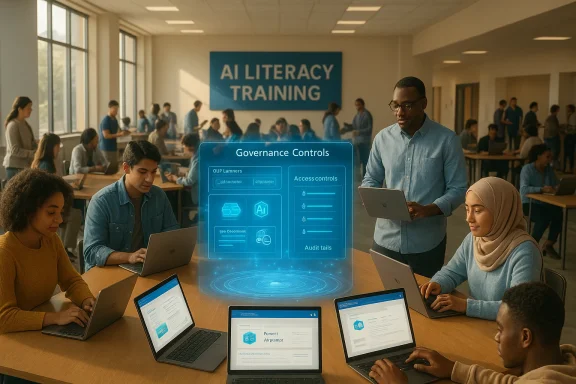
Key training elements Manchester and peer institutions recommend:
Crucial governance controls:
Higher education must seize the chance to move past fear and build enduring competence: AI literacy is not an optional add‑on but a core dimension of 21st‑century academic practice — provided institutions treat tool provisioning as the beginning of an ongoing investment in pedagogy, governance and public accountability.
Source: Cloud Wars From AI Anxiety to AI Literacy: Redefining Responsible GenAI in Higher Education
 Background / Overview
Generative AI changed the conversation in higher education from "How do we stop students using ChatGPT?" to "How do we teach students to use AI responsibly and effectively?" Universities around the world have experimented with bans, permissive policies, and managed‑access models; Manchester has chosen the latter at scale by provisioning Microsoft 365 Copilot to roughly 65,000 students and staff with an aim to complete rollout by summer 2026. The university frames the move as both an equity intervention — closing the digital divide — and a strategic investment in graduate employability and research productivity.This is not merely a product procurement. According to Manchester and Microsoft materials summarized in sector coverage, the deal pairs tenant-contained Copilot access (integrated across Word, Excel, PowerPoint, Outlook and Teams, and surfaced via agent features such as Researcher and Analyst) with a campus‑wide literacy programme and governance structures co‑designed with student and staff stakeholders. The university’s messaging stresses lessons learned from 2024–2025 pilots, where high early adoption was reported and where the institution refined use cases and governance guardrails.
What Microsoft 365 Copilot Brings to Campus
Core capabilities in practice
Microsoft 365 Copilot is not a single app but an integrated set of AI features and agents embedded in Microsoft 365. In a higher‑education context these translate into immediately practical capabilities:- Drafting and editing assistance inside Word and Outlook (first drafts, summaries, rewriting).
- Data interrogation and analysis helpers in Excel (natural language summaries, visualisation suggestions).
- Meeting and teamwork automation in Teams (summaries, action items, calendar follow‑ups).
- Research assistants / agents that synthesise documents and connect to institutional content stores (Researcher, Analyst).
Pilot adoption metrics: what Manchester has reported
Manchester cites pilot cohorts from 2024–2025 showing rapid adoption: 90% of licensed users activated Copilot within 30 days and approximately 50% used it several times a week in early pilots. While these metrics are compelling as early signals of engagement, they are vendor‑ and institution‑reported figures and should be contextualised with independent KPIs (correction rates, DLP flags, accuracy checks, and pedagogical outcomes).Why This Is Strategic: Equity, Employability, Research
Universities that equip students and staff with institutional AI tools make three broad claims that anchor the Manchester rationale:- Equity: Universal licensing removes cost barriers that would otherwise create unequal access to AI productivity tools.
- Employability: Graduates who can use Copilot effectively enter the workforce with practical, demonstrable experience in AI‑augmented productivity workflows.
- Research acceleration: Agentic synthesis and exploratory analysis can reduce time on routine tasks, enabling faster iteration and broader collaboration.
AI Literacy: Training, Assessment, and the New Curriculum
From access to competence
Providing licences alone does not create literacy. Manchester pairs tool access with a structured training programme emphasizing responsible use, prompting technique, verification, and data hygiene. This mirrors a broader sector pattern: universities that succeed adopt a three‑pillar approach — tool provisioning, policy creation, and literacy development — baked into onboarding and course design.Key training elements Manchester and peer institutions recommend:
- Plain‑English explanations of how generative models create outputs and where hallucinations occur.
- Prompting workshops that teach how to structure requests, chain prompts and iterate outputs.
- Assessment redesign guidance so instructors test process and provenance (staged submissions, annotated AI logs, viva or oral checks).
- Data safety modules explaining what not to paste into models and how institutional protections apply.
Pedagogical redesign: preserving learning outcomes
The central pedagogical risk is unchanged: if assessments remain unchanged while students have AI assistants, degrees risk becoming badges of delegation rather than mastery. Practical strategies include:- Redesigning tasks to evaluate reasoning and process (not just final text).
- Embedding AI‑use rubrics that require students to document prompt history, verification steps and source checking.
- Introducing AI‑specific outcomes into modules (e.g., "use an assistant to locate, annotate and critique three primary sources").
Governance, Privacy, and Security: The Hard Engineering Work
Data governance is central
Copilot’s utility depends on access to institutional content (Microsoft Graph: SharePoint, OneDrive, Exchange). That power introduces risk vectors: accidental data exposure, prompt injection, and telemetry concerns. Manchester’s public materials stress DLP, conditional access, and auditability as prerequisites — but institutions must operationalise these technically and contractually.Crucial governance controls:
- Role‑based entitlements that restrict Copilot access to sensitive datasets.
- DLP policies that prevent structural PII or research secrets from being surfaced to agents.
- Tenant‑level telemetry agreements and contractual guarantees about whether prompts/responses are used for vendor model training.
- Audit trails and retention rules for AI interactions to support academic integrity investigations and incident response.
Contractual clarity and vendor guarantees
The marketing line that enterprise Copilot "won’t be used to train public models" depends on procurement language, tenancy, and contractual enforcement. Institutions should demand explicit deletion, non‑training clauses and telemetry access for audits. Without them, privacy assurances are aspirational.Risks and Unintended Consequences
Academic integrity and the persistence of shortcuts
Even with training, students will use AI. If assessments don’t test the skills AI can’t provide — critical judgement, synthesis across messy data, oral defence — degrees will lose signal. Institutions must treat AI assistance as a new submission vector and design detection, disclosure and verification workflows accordingly.Vendor lock‑in and concentration risk
A campus‑wide Microsoft deployment offers integration benefits but concentrates institutional knowledge and workflows into a single vendor ecosystem. That creates negotiation asymmetry and potential migration cost if the institution later wishes to switch platforms. Procurement must include migration planning and explicit data portability commitments.Uneven feature availability and student experience
Copilot features are rolled out regionally, gated by device or regulatory status, and subject to staged feature flags. Students across disciplines and campuses may experience different capabilities, producing an uneven learning experience unless expectations are carefully set and alternative workflows provided.Environmental and ethical externalities
Large AI deployments have non‑negligible compute footprints. Manchester has pledged to discuss environmental transparency with Microsoft, but operational carbon impact depends on workload patterns and hosting choices; independent monitoring will be necessary to validate sustainability claims.Comparative Context: How Other Universities Are Approaching Managed Adoption
Manchester’s move fits a visible trend: institutions are moving from prohibitions to managed provisioning. Examples include:- University of Phoenix’s Center for AI Resources: a student‑facing hub that integrates policy, prompting guidance, privacy rules and course expectations — a model for embedding literacy in student pathways.
- University of Wisconsin–Madison: an institutional Copilot rollout to NetID‑authenticated users, emphasising contract protections and enterprise telemetry clauses. This approach highlights the legal and tenancy trade‑offs that matter to research universities.
- Penn State Smeal College of Business: curriculum redesign and faculty development to embed AI into courses and operations — a blueprint for schools seeking to make AI a core competency rather than an optional add‑on.
Practical Roadmap: How Institutions Should Run a Responsible Copilot Rollout
Below is a condensed operational checklist distilled from Manchester’s public materials, sector playbooks and documented pilot learnings. It is written as a sequence but many tasks run in parallel.- Prepare (Weeks 0–4)
- Inventory high‑value data sources (HR, finance, student records, research datasets).
- Appoint executive sponsor, data stewards and an AI governance board including student representation.
- Draft an initial acceptable‑use policy and a staged risk register.
- Pilot (Month 1–3)
- Scope Copilot access to a controlled cohort (30–300 users) with clearly defined use cases.
- Pair licences with short workshops and role‑specific prompt templates.
- Track KPIs: activation rates, MAU, correction rates, DLP flags, user satisfaction.
- Harden (Month 3–6)
- Implement DLP and conditional access for Copilot‑enabled apps and lock down connectors.
- Publish course‑level guidance for academic integrity and acceptable AI use.
- Run tabletop exercises for prompt‑injection and exfiltration scenarios.
- Scale (Months 6+)
- Staged, transparent rollout with region/device caveats documented.
- Ongoing monitoring dashboards for adoption, incidents and student outcomes.
- Public reporting of outcomes (adoption, incidents, energy usage, student experience metrics).
- Quick wins: embed short Copilot labs into orientation, create faculty “office hours” for prompt design, and deliver bite‑sized microcredentials certifying AI literacy.
Critical Analysis: Strengths, Limitations, and What to Watch
Strengths
- Operationalising access at scale turns what could be a shadow tool problem into a manageable, governed service. Manchester’s approach reduces shadow IT and centralises risk management.
- Pairing licences with training is the right pedagogical posture: it treats AI as a skill to be taught rather than a rule to be policed.
- Research and employability rationales are credible: hands‑on experience with agents is a sellable competency if validated through assignments and assessment redesign.
Limitations and caveats
- “World‑first” claims should be read cautiously. The phrase is an institutional claim about being the first to combine universal Microsoft 365 Copilot access and training across an entire university, but exhaustive confirmation would require cross‑checking every global announcement. Treat such claims as rhetorical unless independently verified.
- Vendor‑reported metrics need independent KPIs. Adoption percentages are encouraging, but they do not by themselves prove pedagogical improvement or long‑term research benefits without longitudinal outcome data.
- Governance is the durable cost. Licences are a headline number; the ongoing investment in DLP, audit, pedagogy, faculty development and contractual oversight will determine whether benefits persist or degrade into unmanaged risk.
What to watch next
- Whether Manchester publishes transparent outcome metrics (not just activation stats) such as correction rates, incidents, student satisfaction and learning outcomes.
- How contract terms address telemetry and model‑training assurances, and whether these terms are auditable by the university or third parties.
- Evidence that assessment redesigns actually preserve or strengthen learning outcomes rather than merely accommodating tool use.
Recommendations for Campus Leaders
- Insist on concrete contractual guarantees (non‑training, deletion, telemetry access) and involve legal counsel in procurement.
- Make AI literacy mandatory for course instructors and provide microcredentials for students who complete laboratory modules.
- Redesign a sample of assessments per faculty to test whether AI‑assisted workflows preserve learning outcomes before broadening tool access.
- Publish an annual transparency report covering adoption, incidents, energy usage and pedagogical impact — make procurement terms and governance frameworks available to campus stakeholders.
Conclusion
The University of Manchester’s campus‑wide Microsoft 365 Copilot rollout is a pragmatic, ambitious instantiation of the managed‑adoption model in higher education. By pairing universal access with structured training and governance promises, Manchester is staking a claim that responsible GenAI at scale is a differentiator, not merely a compliance headache. The proof will not be licence counts or early activation metrics alone; it will be in sustained, transparent evidence of improved student learning, maintained research integrity, robust data governance, and published outcomes that other institutions can evaluate and adopt.Higher education must seize the chance to move past fear and build enduring competence: AI literacy is not an optional add‑on but a core dimension of 21st‑century academic practice — provided institutions treat tool provisioning as the beginning of an ongoing investment in pedagogy, governance and public accountability.
Source: Cloud Wars From AI Anxiety to AI Literacy: Redefining Responsible GenAI in Higher Education
