

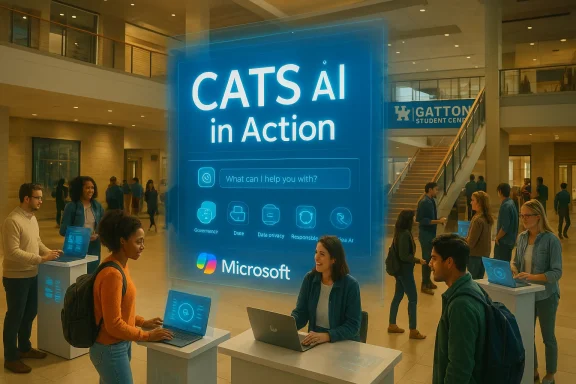
The University of Kentucky will put its campus-level AI strategy on public display on Thursday, Feb. 26 with a day-long showcase — UK x Microsoft: CATS AI in Action — that promises to blend demos, hands‑on engagement zones and executive conversation about how Microsoft tools could accelerate teaching, research, health care and operations across the university community.
The event, scheduled to begin at 10:00 a.m. in Ballroom A at the Gatton Student Center and then to expand into hands‑on engagement zones across the center’s social staircase, is the first major public activation of the University’s Commonwealth AI Transdisciplinary Strategy (CATS AI). University spokespeople say the day will include presentations from both Microsoft and UK leaders, demonstrations from campus AI innovators, and practical support from UK Information Technology Services for signing up to Microsoft offerings that the campus will make available under the CATS AI framework.
CATS AI is described by UK as a university‑wide framework to coordinate, connect and scale AI projects across its 17 colleges, libraries, UK HealthCare and research institutes; the initiative is oriented toward responsible integration of AI into education, research, care and administrative operations. The university also says Microsoft joined the Advancing Kentucky Together (AKT) Network as a corporate partner in late 2025 and that the Microsoft–UK partnership will be implemented through CATS AI. This event is the first major, open, on‑campus activation intended to let students, faculty, staff and community members explore those joint offerings.
But success is not automatic. The risks — privacy, academic integrity, vendor dependence and mismatched expectations about feature availability — are real and require ongoing, resourced attention. A one‑day showcase is a powerful beginning; sustained institutional will, transparent policies and measurable outcomes are the essential next steps.
Source: Mirage News UK To Feature 'AI In Action' At Feb. 26 Event
 Background
The event, scheduled to begin at 10:00 a.m. in Ballroom A at the Gatton Student Center and then to expand into hands‑on engagement zones across the center’s social staircase, is the first major public activation of the University’s Commonwealth AI Transdisciplinary Strategy (CATS AI). University spokespeople say the day will include presentations from both Microsoft and UK leaders, demonstrations from campus AI innovators, and practical support from UK Information Technology Services for signing up to Microsoft offerings that the campus will make available under the CATS AI framework.CATS AI is described by UK as a university‑wide framework to coordinate, connect and scale AI projects across its 17 colleges, libraries, UK HealthCare and research institutes; the initiative is oriented toward responsible integration of AI into education, research, care and administrative operations. The university also says Microsoft joined the Advancing Kentucky Together (AKT) Network as a corporate partner in late 2025 and that the Microsoft–UK partnership will be implemented through CATS AI. This event is the first major, open, on‑campus activation intended to let students, faculty, staff and community members explore those joint offerings.
What the event will show and why it matters
Demonstrations and engagement zones
Attendees can expect two complementary formats:- A morning speaking program with university and Microsoft representatives outlining the partnership goals and how CATS AI frames AI adoption across campus.
- A hands‑on afternoon of “engagement zones” where campus teams demonstrate real projects that use AI for education, research, clinical care, operations, and creative work.
Why this is more than a product fair
This kind of on‑campus showcase is significant because it frames AI not as a single product purchase but as a coordinated ecosystem activity: training, governance, policy, infrastructure and operational support must all land together if AI is to become a stable campus capability rather than a string of one‑off pilots. Universities that have moved beyond the pilot phase emphasize three things: broad access paired with training, governance structures that address privacy and academic standards, and meaningful pilots that preserve research integrity and patient confidentiality in clinical settings. These themes are central to how other large institutions have framed Microsoft Copilot rollouts — with an emphasis on training and governance as much as technology.Overview of the University–Microsoft alignment
What UK says it will provide through CATS AI
According to event material provided by UK, the campus will offer students, faculty and staff access to:- Microsoft Copilot integrated across Microsoft 365 apps for drafting, summarizing and productivity assistance;
- Copilot Studio and tools for building domain‑specific copilots and agents;
- Access to the Agent Store and associated agent features; and
- Training and support from UK Information Technology Services to register and use these tools on campus systems.
Microsoft’s role in campus deployments
Microsoft’s commercial play in higher education in recent years has combined product access with support and training commitments, and often includes governance or responsible‑AI guidance packages. In practice, enterprise Copilot deployments are typically staged — with pilot programs, phased rollouts and substantial support for IT and instructional staff — because feature availability and regulatory/contract requirements vary by region and tenant configuration. Universities that have publicly disclosed large Copilot programs emphasize this measured approach.What CATS AI seeks to accomplish
Strategic goals
CATS AI is framed around several interlocking objectives:- Coordinate AI initiatives across UK’s academic and clinical units so projects share infrastructure, standards and governance.
- Amplify promising research and pedagogical experiments so the whole campus benefits.
- Train students, faculty and staff in responsible, practical use of AI tools to improve productivity, research outcomes and patient care.
- Govern AI deployment with institution‑level policies that address privacy, data handling, academic integrity and clinical safety.
Tangible campus outcomes to watch for
- Curriculum updates that integrate AI literacy and tool use across disciplines.
- Research accelerators that use copilots/agents for literature review, code scaffolding and data summarization.
- Clinical pilot projects that examine AI‑assisted workflows while preserving patient privacy and regulatory compliance.
- Operational automation (e.g., scheduling, document triage) that reduces staff burden but requires careful access controls.
Strengths and opportunities
1. Democratising access to advanced productivity tools
A campus‑wide offer of Copilot and related services reduces inequality in access: students who can’t afford commercial subscriptions gain exposure to the same productivity and research tools as their peers. Institutional-scale access is also a practical employability play: graduates familiar with Copilot‑augmented workflows are likely to have a resume advantage. Other universities that publicized universal Copilot programs framed the move as both equitable and strategically valuable for students’ career readiness.2. Cross‑disciplinary research acceleration
Copilot features and agent builders can reduce time spent on literature synthesis, exploratory data analysis and repetitive documentation tasks. When configured with robust governance, these capabilities can accelerate interdisciplinary projects by lowering the friction of information discovery and early analysis.3. Practical training and adoption support
The hands‑on engagement zones and UK ITS presence at the event suggest the university understands that adoption requires on‑ramps — practical demonstrations, signup support and immediate guidance on policies and best practices. That is consistent with best practices other institutions have used during large rollouts.4. Visibility and stakeholder engagement
By inviting community members as well as faculty, staff and students, UK is signaling that AI deployment is a shared civic project — not an opaque procurement. Public showcases create shared understanding and permit early stakeholder feedback that governance bodies can incorporate.Risks, open questions and blind spots
No campus scale AI program is risk‑free. The UK x Microsoft showcase is an important step, but it must be followed by rigorous policy work and transparency.1. Data governance and privacy
- Sensitive data — especially clinical and research datasets — must be protected under HIPAA (for clinical data) and institutional review board (IRB) requirements.
- Integrations with cloud products raise questions about data residency, telemetry, and the policies that govern what data is sent to third‑party models.
2. Academic integrity and assessment design
Generative AI tools can meaningfully change how students complete assignments. Universities that rush into broad access without rethinking assessment design risk undermining learning outcomes and creating inequities that are difficult to detect. A successful campus deployment pairs access with updated pedagogical approaches, honor‑code modifications and instructor training.3. Overreliance and deskilling
There is a risk that users will lean on Copilot for tasks that require domain judgment, causing skill atrophy. The right mitigation is augmented workflows design: require human verification, create audit trails, and embed tool‑use literacy into curricula.4. Vendor lock‑in and contractual transparency
Large platform partnerships can accelerate capability, but they also concentrate dependency on a single vendor for core productivity services. Universities should be transparent about contractual terms, data use clauses and exit strategies. Peer institutions have framed these as negotiation points in their own Microsoft agreements.5. Feature availability and expectation management
Not every Copilot or agent feature is universally available the day an institution signs an agreement: Microsoft’s rollouts are typically staged by region, tenant configuration and regulatory clearance. Institutions must set realistic timelines for when advanced features will appear and communicate those timelines to the campus community to avoid confusion.Governance: what good practice looks like
For a campus‑wide program to sustain value, governance must be multi‑layered and participatory.Core governance components
- Institutional AI policy that clarifies permissible data, use cases, and review processes.
- Operational guardrails for IT teams integrating third‑party tools with campus systems.
- Academic oversight through deans or curriculum committees to manage assessment and learning outcomes.
- Clinical governance that aligns AI pilots with IRB and HIPAA requirements in UK HealthCare units.
- Student and staff representation in governance structures to ensure voices from unions and student government are heard.
Practical advice for attendees and campus stakeholders
Whether you plan to visit Gatton Student Center on Feb. 26 or are watching from afar, here are practical steps to make the most of the showcase:- Bring a concrete question or use case. Demonstrations are most helpful when tethered to a real problem (teaching assignment redesign, grant proposal drafting, research data triage).
- Talk to the ITS table about registration and the university’s access model — ask specifically about data retention, telemetry and how to request exclusions for sensitive workloads.
- Seek out the clinical demos if you work in health care; they should outline how patient privacy and compliance are managed.
- Join governance conversations — typical university rollouts include committees where faculty, staff and students can influence policy.
- Request training: large‑scale tool access is only useful if paired with guided training and competence frameworks.
How to judge success
The first public showcase is an early milestone, not a finish line. Watch for metrics and follow‑through:- Adoption metrics that show meaningful use (not just signups).
- Documented training completion rates across student and staff cohorts.
- Clear, public governance documents and FAQ materials.
- Evidence of pilot evaluation in clinical and research settings with safety checks.
- Funding and staffing commitments to sustain the technical and governance work beyond the initial rollout.
How this fits a broader higher‑education trend
The University of Kentucky’s event is part of a larger movement in higher education where institutions partner with major vendors to embed AI into campus life. Recent large‑scale academic projects show three consistent patterns:- Product access is paired with training and governance.
- Pilot programs precede full rollouts and are used to iron out privacy and compliance issues.
- Institutions articulate the move as both an equity play (universal access) and an employability play (graduate readiness with AI‑augmented tools).
Notable strengths of the UK approach
- Public, inclusive launch that allows community members to learn and provide feedback.
- Practical IT support on site to help users register and start using the tools immediately.
- Cross‑campus framing via CATS AI that aims to prevent siloed, duplicative projects.
- Focus on responsible use as a named objective — responsible AI governance is the right unit of focus for scaling.
Where further transparency is needed
Some claims in the campus materials — for example, that Microsoft is the first corporate partner to join the AKT Network in late 2025 — are significant if confirmed. At present, comparable institutional announcements elsewhere focus on universal Copilot access accompanied by governance and training; however, any single claim about "firsts" or unique contractual terms should be supported by accessible documentation such as a memorandum of understanding (MOU) or press release with contracting details. We flag such claims as important to verify in the university’s public communications and the AKT Network’s records. Until those documents are published or made available, treat “first partner” claims with cautious interest rather than as settled fact. Seek the university’s posted MOU or an official AKT Network notice for confirmation.Final analysis: cautious optimism
UK x Microsoft: CATS AI in Action is an encouraging, pragmatic model for how a large public university can begin to operationalize AI. The structure — an open, hands‑on day; ITS support; and a named institutional strategy (CATS AI) — aligns with the best practices other major institutions have used when deploying generative AI and Copilot services at scale. If the university follows through with transparent governance, robust training, staged pilots for high‑risk uses (clinical, IRB‑governed research) and clear contract terms, the program could become a model for responsibly embedding AI in higher education.But success is not automatic. The risks — privacy, academic integrity, vendor dependence and mismatched expectations about feature availability — are real and require ongoing, resourced attention. A one‑day showcase is a powerful beginning; sustained institutional will, transparent policies and measurable outcomes are the essential next steps.
What to watch next
- Publication of UK’s detailed CATS AI governance documents and FAQs describing permitted data flows and training requirements.
- A timeline for the Copilot and Copilot Studio rollout and clarity on what features will be available at which dates.
- Evidence of training completion rates and concrete pedagogical changes tied to AI tool use.
- Updates from UK HealthCare about how any clinical pilots address HIPAA and IRB compliance.
- Public documentation of the Microsoft–AKT Network agreement that clarifies the partnership scope and data governance obligations.
Source: Mirage News UK To Feature 'AI In Action' At Feb. 26 Event
