

Australian small businesses have moved decisively past curiosity: a fresh survey from Small Business Loans Australia finds four in five firms are now using AI tools, and many claim these tools are cutting labour time by meaningful margins.
The headline numbers are straightforward: of 200 business owners and decision-makers surveyed, 80% report using AI in some form, 41% estimate at least a 25% reduction in total labour time from AI, and 17.5% say AI saves more than half of their labour time for some tasks. The survey points to administration, workflow automation, and writing and communication as the most fruitful areas so far—and signals that the next phase of adoption will hinge on integration rather than mere access to tools.
Small Business Loans Australia (SBLA) commissioned a quantitative snapshot of 200 Australian firms to understand current AI adoption, where time savings are occurring, and what managers expect from a future “perfected” AI capability across five business functions. The sample size is modest but timely; responses name both standalone generative models (for example, large language models) and AI features bundled inside mainstream software products as the most common tools in use.
Key survey findings reported by industry outlets:
These numbers aren’t surprising to practitioners who have watched generative AI move from experiment to daily tool in the last 18–24 months; what’s new is the scale of claimed time savings and the specific call for integration—businesses want AI to be less a point tool and more a connective fabric across workflows.
First, the data are self-reported estimates. Business leaders often measure perceived time saved rather than time tracked against a rigorous baseline. That makes the numbers useful as indicators of confidence and direction but weaker as precise performance metrics.
Second, time saved on isolated tasks doesn’t translate automatically to proportional reductions in payroll or overhead. Time saved must be reinvested or reallocated to higher-value activities—if it isn’t, the productivity dividend remains hypothetical.
Third, short-term time savings can mask longer-term costs. Automation can introduce maintenance overheads, require prompt fixes for model drift and hallucinations, and demand ongoing content moderation and governance to keep outputs acceptable.
To convert promising estimates into defensible business outcomes, organisations need measurement frameworks that track both operational metrics and financial endpoints:
These expectations are useful as directional sentiment: business leaders see the clearest near-term monetary benefit from automating routine operational work. But several caveats are necessary:
Why integration matters:
Three realistic pathways typically emerge:
Key takeaways for practitioners:
Source: IT Brief Australia https://itbrief.com.au/story/ai-tools-slash-labour-time-for-four-out-of-five-firms/
The headline numbers are straightforward: of 200 business owners and decision-makers surveyed, 80% report using AI in some form, 41% estimate at least a 25% reduction in total labour time from AI, and 17.5% say AI saves more than half of their labour time for some tasks. The survey points to administration, workflow automation, and writing and communication as the most fruitful areas so far—and signals that the next phase of adoption will hinge on integration rather than mere access to tools.
 Background and overview
Small Business Loans Australia (SBLA) commissioned a quantitative snapshot of 200 Australian firms to understand current AI adoption, where time savings are occurring, and what managers expect from a future “perfected” AI capability across five business functions. The sample size is modest but timely; responses name both standalone generative models (for example, large language models) and AI features bundled inside mainstream software products as the most common tools in use.Key survey findings reported by industry outlets:
- 80% of respondents reported using AI tools in some form.
- 41% estimated that AI reduces at least 25% of total labour time; 17.5% of respondents claimed AI saved more than 50% of labour time for some operations.
- 29% estimated time savings between 11% and 25%.
- Administration and workflow was seen as the area with the largest potential profitability uplift if AI were “perfected,” with 77% expecting a lift and 20% forecasting gains of 21–30%.
- Writing and communication followed closely, with 75% expecting profit improvements.
These numbers aren’t surprising to practitioners who have watched generative AI move from experiment to daily tool in the last 18–24 months; what’s new is the scale of claimed time savings and the specific call for integration—businesses want AI to be less a point tool and more a connective fabric across workflows.
Where businesses are getting value today
The SBLA respondents identify three primary pockets of value where AI is already making a measurable impact:- Administrative work and workflow management. Routine tasks—data entry, standard document drafting, invoice processing, and simple approvals—are being automated or accelerated with AI templates, auto-summarisation and intelligent routing.
- Writing and communication. Drafting emails, producing client proposals, editing marketing copy, and summarising meeting notes are the most frequently cited wins for generative models.
- Customer interactions and support. Embedded chatbots and AI-assisted help desks are handling routine inquiries, triaging tickets, and generating suggested responses for human agents.
Regional variations and what they mean
Regional differences in adoption—such as Western Australia’s reported 91% uptake in the SBLA sample—are instructive but should be treated with nuance. Adoption rates can vary because of industry mix (mining and services in WA, for example), sample composition, or local vendor ecosystems. Where adoption is high, businesses are often using AI features embedded in existing enterprise software rather than stand-alone AI platforms—this lowers the activation cost and reduces implementation friction.What “time saved” actually measures (and what it doesn’t)
Survey claims about time savings—particularly headline figures like “more than half” of labour time saved—require careful interpretation.First, the data are self-reported estimates. Business leaders often measure perceived time saved rather than time tracked against a rigorous baseline. That makes the numbers useful as indicators of confidence and direction but weaker as precise performance metrics.
Second, time saved on isolated tasks doesn’t translate automatically to proportional reductions in payroll or overhead. Time saved must be reinvested or reallocated to higher-value activities—if it isn’t, the productivity dividend remains hypothetical.
Third, short-term time savings can mask longer-term costs. Automation can introduce maintenance overheads, require prompt fixes for model drift and hallucinations, and demand ongoing content moderation and governance to keep outputs acceptable.
To convert promising estimates into defensible business outcomes, organisations need measurement frameworks that track both operational metrics and financial endpoints:
- Track cycle time before and after AI for specific processes (e.g., average time to process an invoice).
- Measure error rates, rework, and customer satisfaction alongside throughput.
- Tie time savings to revenue or cost metrics—e.g., marketing output per head, support tickets closed per hour, or decrease in agency spend.
Profitability expectations and the “perfected AI” thought experiment
SBLA asked respondents to consider a hypothetical “perfected” AI and estimate possible profitability lifts across five functions: writing and communication; administration and workflow; sales and customer service; decision-making and analytics; and creative work. Administration and workflow scored highest, with 77% expecting profit gains; writing and communication scored 75%.These expectations are useful as directional sentiment: business leaders see the clearest near-term monetary benefit from automating routine operational work. But several caveats are necessary:
- The “perfected AI” framing is inherently speculative. Predictions about a hypothetical, idealised tool are habitually optimistic and biased toward desirable outcomes.
- Surveyed profitability gains are forward-looking beliefs, not measured outcomes. They reflect expectation more than hard evidence.
- Gains in areas requiring complex judgement—like strategic analytics, high-touch sales, or nuanced customer service—are more uncertain. The SBLA results show lower confidence in those functions, which aligns with broader evidence that AI-driven judgment remains less reliable today than automation of rote tasks.
Integration: the hinge between novelty and routine
Alon Rajic, founder of SBLA, summed up what many businesses now recognise: the biggest productivity gains come when AI is embedded into existing workflows rather than used as a one-off tool. This emphasis on integration should shape how leaders approach adoption.Why integration matters:
- Embedded AI reduces friction. When an AI assistant appears in the workflow users already rely on—CRM, ticketing systems, document editors—adoption jumps and value accrues faster.
- Integrated models can leverage internal data flows while respecting governance. That can improve contextual relevance and reduce repetitive manual transfers between tools.
- Connected AI enables cascading benefits. Time saved in a single task compounds across linked processes—shorter approval cycles lead to faster sales closes, fewer status calls, and reduced escalation.
Key risks and limitations businesses must confront
Rapid gains from AI come with real and measurable risks. The survey’s optimism should be balanced against practical threats:- Accuracy and hallucination. Generative models occasionally produce incorrect or fabricated outputs. For tasks that affect compliance, contracts, or financial reporting, hallucinations can create real legal and financial exposure.
- Data privacy and leakage. Feeding sensitive customer or operational data into third-party models can create compliance risks. Many organisations have rules that limit what can be shared with external LLMs.
- Vendor lock-in and dependency. Heavy reliance on a single vendor’s embedded AI features can make switching costly and complex. Businesses should weigh portability and contractual protections.
- Skill gaps and uneven adoption. Surveys from other industry players show many workers lack formal AI training and perceive organisational constraints. Without coordinated upskilling, adoption will be bumpy and benefits uneven.
- Regulatory and ethical uncertainty. Regulators are actively considering AI transparency, safety, and consumer protection rules. Businesses must navigate a shifting landscape. Public concerns—about privacy, bias, and the pace of change—can also shape customer and employee trust.
- Operational maintenance and model drift. Like any software, AI components require maintenance, updates, and monitoring. Expectations that models “set and forget” can lead to overlooked degradation and rising costs.
Labour market effects: displacement, augmentation, and reskilling
When a substantial share of routine work is automated, labour dynamics shift. The SBLA findings—where many firms report double-digit labour-time savings—raise two immediate questions: what happens to displaced hours, and how should businesses invest the freed capacity?Three realistic pathways typically emerge:
- Reallocation to higher-value work. The ideal outcome is that employees move from routine tasks to customer-facing, creative, or analytical roles. That raises productivity and job satisfaction if reskilling is supported.
- Staffing compression. In some firms, AI can reduce headcount or slow hiring for repeatable roles. This produces short-term cost savings but can erode morale and institutional knowledge.
- Hybrid augmentation. Most organisations will move toward hybrid models, where AI handles low-complexity work and humans supervise, refine, and take responsibility for outcomes.
- Clear reskilling and upskilling programs tied to measurable role transitions.
- Transparent communication around how AI will affect jobs.
- Job redesign that elevates tasks requiring judgement, trust-building, and deep domain expertise.
A practical, phased roadmap for SMBs ready to scale AI
For small and medium-sized firms ready to move from ad-hoc use to integrated capability, here’s a practical, sequential plan to embed AI safely and effectively:- Start with high-frequency, low-risk processes. Pick operations where errors are low-cost and volume is high—standard emails, templated reports, invoice processing.
- Define measurable KPIs up front. Establish baseline cycle time, error rate, costs per transaction, and customer satisfaction. Use these to evaluate ROI.
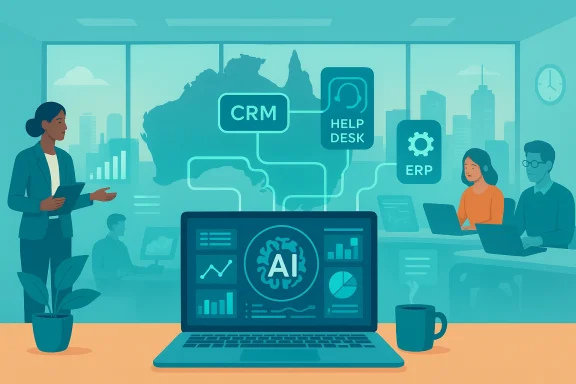
- Select integration-first tools. Prefer AI features embedded in your existing software stack (CRM, helpdesk, ERP) to reduce adoption friction.
- Design a data governance framework. Classify data sensitivity, set sharing rules with vendors, and enforce logs and access controls.
- Pilot and monitor. Run a time-boxed pilot, monitor outputs closely, and collect both quantitative and qualitative feedback from users.
- Train users and change agents. Invest in short, role-specific training and appoint process owners who can champion adoption.
- Scale iteratively with guardrails. Roll out to adjacent teams only after quality and governance checks pass. Use escalation paths for ambiguous outputs.
- Measure financial impact quarterly. Translate time savings into revenue gains or cost reductions and hold leaders accountable to targets.
- Review contracts and escape clauses. Ensure SLAs, data ownership terms, and exit provisions are explicit with AI vendors.
- Plan for continuous improvement. Treat AI as a platform that requires tuning, model refreshes, and process rework as use cases evolve.
Vendor selection and technical considerations
Choice of provider matters. Firms repeatedly mention both standalone generative platforms and embedded features in mainstream productivity tools. When evaluating vendors, consider:- Data handling practices. Does the vendor retain customer prompts? Can you opt out of data retention used to train models?
- Model transparency and explainability. How does the tool surface confidence and provenance for outputs?
- Security certifications and compliance. Look for vendors with recognised security standards and contractual commitments to data protection.
- Integration APIs and orchestration. Confirm the tool supports programmatic access and can be orchestrated with existing workflows and RPA systems.
- Costs and pricing clarity. Many vendors tier pricing by usage; understand how costs grow with scale and which features are billable.
Legal and compliance checklist for risk-aware adoption
Before expanding AI across mission-critical workflows, firms should confirm readiness against this checklist:- Have you classified the sensitivity of the data you will process with AI?
- Are there contractual clauses limiting the vendor’s right to reuse or retain your data?
- Have you documented human-in-the-loop procedures for high-risk outputs?
- Is there a clear audit trail for decisions or recommendations produced by AI?
- Have you completed a privacy impact assessment and a security risk assessment?
- Do you have liability allocations defined for incorrect or harmful AI outputs?
What the next 12–24 months are likely to bring
The SBLA survey captures a moment where generative AI has moved from novelty to routine in many Australian SMEs. Looking ahead over the next 12–24 months, expect three converging trends:- Deeper integration. Vendors will embed AI more tightly into core business applications—CRM, accounting, HR—making AI the default experience rather than an add-on.
- Shift from access to governance. The adoption conversation will move from “how do we get tools” to “how do we manage, measure, and secure them.”
- Widening gap between early integrators and ad-hoc users. Organisations that invest early in governance, training, and measurement will compound returns; those that rely on point solutions will see more modest, less sustainable benefits.
Final analysis: why this matters for WindowsForum readers
For IT leaders, system administrators, and pro users in the Windows ecosystem, the SBLA findings reinforce an urgent operational truth: AI will deliver the most value when it’s engineered into everyday apps and processes, not tacked onto them. That has direct implications for system design, vendor procurement, endpoint security, and change management.Key takeaways for practitioners:
- Prioritise integrations that reduce context switching for users—AI features inside the apps people already use deliver faster adoption.
- Treat time-savings claims as hypotheses to be tested with instrumentation and measurement.
- Build governance into the technical stack from day one—data classification, logging, versioning, and human oversight are not optional.
- Invest in reskilling and role redesign now; the productivity gains only become sustainable when human work moves up the value chain.
Source: IT Brief Australia https://itbrief.com.au/story/ai-tools-slash-labour-time-for-four-out-of-five-firms/
