

Microsoft will bring its OS-level AI upscaling, Automatic Super Resolution (Auto SR), to the ROG Xbox Ally X in a public preview early in 2026 — a move that aims to make Windows 11 a far stronger platform for handheld PC gaming by using the Ally X’s on‑die NPU to upscale low-resolution game frames to sharper, higher-resolution outputs with minimal developer work.
Microsoft introduced Auto SR (Automatic Super Resolution) as part of its Copilot+ PC initiative, initially shipping the technology on Snapdragon X‑series Copilot+ machines where the feature runs on the device’s Hexagon NPU. Auto SR is an OS‑level, neural upscaler that reduces a game’s internal render resolution to boost framerate and then uses an on‑device neural model to reconstruct a higher-resolution image for the display. The company has explicitly stated the feature will be extended to additional NPU‑equipped hardware, with a public preview targeting the ROG Xbox Ally X in early 2026. This announcement sits inside a broader Microsoft push to address Windows 11’s role in PC gaming — from background workload management and power and scheduling improvements to graphics stack optimizations and tighter driver coordination. The goal is a more consistently responsive and battery‑efficient gaming experience across PC form factors, especially handhelds. Microsoft has also expanded the Xbox Full Screen Experience to more Windows 11 devices as part of that strategy.
Whether Auto SR will materially dent the adoption of vendor SDK upscalers depends on continued quality improvements, hardware NPU proliferation, and whether vendors like AMD and Nvidia bring competitive NPU‑accelerated options or broader in‑driver support for system‑level scaling. Current public data suggest AMD’s newer FSR iterations and other vendors continue to evolve, but there is no certainty that every upscaler will land on every handheld form factor. Claims that “FSR 4 will never come to handhelds” are speculative and should be treated cautiously until AMD or partners publish clear hardware/SDK compatibility statements.
That said, platform trust will depend on measured, verifiable benefits. The industry will want to see:
At the same time, Auto SR is not a silver bullet. It trades some of the advantages of temporal upscalers (access to motion vectors, frame history) for universality and ease of deployment. Early tests suggest good visual gains in many scenarios but also reveal practical limits: added latency, occasional softness of UI elements, and uncertain battery impact. These are measurable, testable risks that will determine whether Auto SR becomes a standard expectation on NPU‑equipped Windows handhelds or remains a useful but niche feature.
For Windows‑centric handheld gaming, however, Auto SR shifts the balance: OEMs selling NPU‑equipped devices like the ROG Xbox Ally X now have a compelling OS‑level tool to help players get higher framerates and sharper visuals without waiting for per‑title engine support. If Microsoft continues to expand compatibility, refine the model’s handling of UI/HDR, and optimize runtime latency, Auto SR could rapidly become one of the most consequential platform innovations for handheld PC gaming in the near term.
Source: TweakTown Windows 11 will add AI upscaling for the ROG Xbox Ally X in early 2026
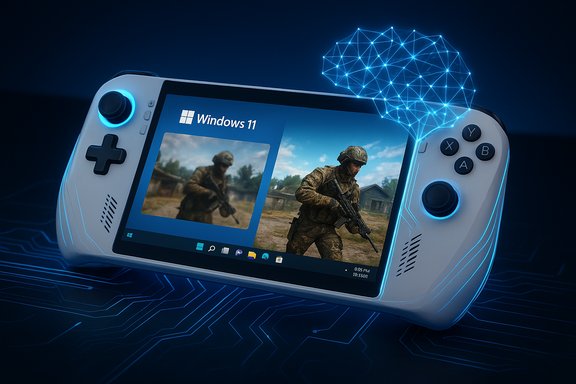 Background
Microsoft introduced Auto SR (Automatic Super Resolution) as part of its Copilot+ PC initiative, initially shipping the technology on Snapdragon X‑series Copilot+ machines where the feature runs on the device’s Hexagon NPU. Auto SR is an OS‑level, neural upscaler that reduces a game’s internal render resolution to boost framerate and then uses an on‑device neural model to reconstruct a higher-resolution image for the display. The company has explicitly stated the feature will be extended to additional NPU‑equipped hardware, with a public preview targeting the ROG Xbox Ally X in early 2026. This announcement sits inside a broader Microsoft push to address Windows 11’s role in PC gaming — from background workload management and power and scheduling improvements to graphics stack optimizations and tighter driver coordination. The goal is a more consistently responsive and battery‑efficient gaming experience across PC form factors, especially handhelds. Microsoft has also expanded the Xbox Full Screen Experience to more Windows 11 devices as part of that strategy. What Auto SR is — technical overview
OS-level, NPU-accelerated upscaling
Auto SR is an operating-system‑level post‑processing upscaler that runs a trained neural network on the system’s NPU to reconstruct image detail. Rather than requiring per‑title SDK integration (like DLSS, XeSS, or FSR when implemented in a game engine), Auto SR intercepts rendered frames and applies the neural model at the OS graphics layer, making it potentially compatible with a wide set of DirectX 11 and DirectX 12 titles without developer changes. Key technical traits:- The model is a spatial super‑resolution neural network (a convolutional architecture) that processes the final rendered frame output rather than individual engine buffers.
- Auto SR is executed on an NPU (Neural Processing Unit), which offloads work from GPU and CPU and reduces impact on those subsystems.
- It primarily targets full-screen, DirectX 11/12 titles; older runtimes (DirectX 9), Vulkan and OpenGL are generally not supported at present. A 1080p or higher display is required for operation.
How it differs from DLSS, XeSS, and FSR family upscalers
Auto SR is best characterized as a spatial post‑processing upscaler rather than a temporal reconstruction system. Modern temporal upscalers (DLSS 3/4 family, XeSS, FSR 2.x/3.x) often rely on additional inputs — motion vectors, depth buffers, and past frame data — to reconstruct subpixel detail, stabilize temporal artifacts, and produce higher‑quality results. Auto SR, by design, uses the frame’s final image as input and relies on the neural model to infer and restore detail. That makes Auto SR more broadly compatible (it doesn’t need engine access to motion vectors), but also means it is inherently different in quality tradeoffs and artifact behavior compared with temporal methods.Why the ROG Xbox Ally X matters
Hardware: Ryzen AI Z2 Extreme with an NPU
The ROG Xbox Ally X ships with AMD’s Ryzen AI Z2 Extreme SoC — an x86‑based handheld APU that includes an on‑die NPU rated (by OEM disclosures) at up to tens of TOPS of neural throughput. That hardware enables Auto SR to run on non‑Arm, x86 handheld hardware for the first time, moving the technology beyond the initial Snapdragon Copilot+ laptop deployments. Multiple OEM and press specifications confirm the Ally X’s NPU-equipped Z2 Extreme design and the device’s positioning as a premium 7‑inch, 120Hz, 1080p handheld running Windows 11.Handhelds are the sweet spot for OS-level upscaling
Handheld gaming PCs operate under strict thermal and power constraints. Running modern AAA titles at native 1080p or higher is often impractical at handheld power envelopes without heavy GPU/CPU throttling. Auto SR’s model — render at a lower internal resolution (for example, ~720p) and then use the NPU to upscale to the panel’s native 1080p — directly addresses the handheld tradeoff between frame rate and sharpness. Because Auto SR lives in Windows, it can be applied across many games without per‑title patches, which is a valuable property for handheld buyers who run large, diverse libraries.What to expect in early 2026 (public preview)
Microsoft has scheduled a public preview of Auto SR for the ROG Xbox Ally X in early 2026. The preview is expected to:- Be distributed via Windows Update/Auto SR package or through the Microsoft Store update mechanism already used for Copilot+ Auto SR on Snapdragon systems.
- Initially support a curated set of titles where Microsoft’s model demonstrably improves perceived quality and framerate; additional opt‑in titles will be available for manual testing.
- Run on the Ally X’s NPU, not the GPU, reducing GPU overhead while adding a modest processing latency inherent to the neural model’s runtime.
Compatibility, constraints and the whitelist model
Auto SR’s current system requirements and constraints are explicit:- Requires an NPU‑equipped Copilot+ machine (initially Snapdragon X on Arm; Ally X’s Ryzen AI on x86 for preview).
- Windows 11 v24H2 or later and the latest graphics + neural drivers installed.
- Display resolution >= 1080p.
- Works with many DirectX 11/12 titles; some titles (with certain HDR/data formats) are not supported. Vulkan, OpenGL, and DX9 are mostly out of scope at launch.
Early evidence — quality and performance seen so far
Independent testing and press coverage of Auto SR on Copilot+ laptops show promising results and clear caveats:- Visual quality: In many scenes Auto SR can deliver visibly improved edge clarity and anti‑aliasing over a simple bilinear upscale from a low render resolution. It often outperforms older spatial-only scalers like FSR 1 in perceived detail. However, HUD and UI text can sometimes appear softer because the model treats everything in the rendered frame.
- Performance: Offloading to the NPU means the GPU can run games at a lower internal resolution with higher framerates while the NPU performs the heavy lifting. The net system effect is often a meaningful fps uplift for constrained hardware.
- Latency and input feel: Tests have reported an added neural runtime latency in the low‑double‑digit millisecond range (≈12ms on tested Snapdragon systems). That’s usually acceptable for single‑player or controller‑focused gaming, but could be noticeable for esports and ultra‑low‑latency scenarios.
Strengths: where Auto SR gives Windows handhelds an edge
- Broad compatibility (for supported runtimes): Because Auto SR works at the OS level and processes final frames, it can apply to many titles without developer changes. That is crucial for handhelds where users run a wide range of legacy and modern games.
- NPU offload: Using the NPU preserves GPU/CPU cycles for game rendering, allowing better raw framerates without added GPU power draw. This is particularly useful in thermally constrained handheld designs.
- Integrated experience: Auto SR’s management via Windows Settings (Graphics > Automatic super resolution) and the whitelist/opt‑in workflow mean the feature can be made unobtrusive and safe for end users.
- Potential to raise base experience: For many AAA titles that lack modern temporal upscalers, Auto SR can deliver a step‑up versus naïve lower-resolution rendering on handhelds, boosting perceived fidelity and playability.
Risks, limitations and unanswered questions
- Spatial vs temporal tradeoffs: Because Auto SR is spatial and lacks access to motion vectors/past‑frame buffers, it cannot match the temporal stability of DLSS/FSR2/3/XeSS in all situations. That can lead to flicker or unstable fine detail in motion compared with temporal reconstruction upscalers. Observers have noted that Auto SR is not a replacement for fully integrated temporal upscalers in all scenarios.
- HUD/text softness and UI handling: When the neural model processes the entire final image, small UI elements and text may be softened or altered in ways that reduce legibility. This is a practical issue on small handheld screens and will need per‑title filtering or heuristics to mitigate.
- Latency: The model runtime adds measurable latency. While modest on tested hardware, that added delay can be problematic for competitive, high‑input‑precision games. The actual impact on the Ally X will depend on Ryzen AI NPU throughput and Windows pipeline optimizations.
- Battery and thermal behavior: NPUs consume power. Running Auto SR continuously may increase battery draw and thermal output compared with native low‑res rendering, and the net battery impact versus GPU work remains to be measured on Ally X hardware in real game sessions. This is an area warranting independent benchmarking.
- Platform fragmentation and vendor lock‑in: Auto SR will only operate on devices with a supported NPU and compatible Windows build. That creates a benefit for users of NPU‑equipped handhelds but also adds another axis of fragmentation (NPU vs non‑NPU) in the PC ecosystem. Microsoft’s whitelist model also centralizes control over where Auto SR is applied.
How Auto SR fits into the upscaling landscape
Auto SR doesn’t replace engine‑level solutions; it complements them. For games that already implement high‑quality temporal upscalers (DLSS 3/4, XeSS, FSR 2.x/3.x), an engine‑integrated solution is often superior because it uses richer inputs. Auto SR shines where an engine lacks such a feature, or where a user plays many different titles that would be impractical to patch individually.Whether Auto SR will materially dent the adoption of vendor SDK upscalers depends on continued quality improvements, hardware NPU proliferation, and whether vendors like AMD and Nvidia bring competitive NPU‑accelerated options or broader in‑driver support for system‑level scaling. Current public data suggest AMD’s newer FSR iterations and other vendors continue to evolve, but there is no certainty that every upscaler will land on every handheld form factor. Claims that “FSR 4 will never come to handhelds” are speculative and should be treated cautiously until AMD or partners publish clear hardware/SDK compatibility statements.
Practical takeaways for ROG Xbox Ally X owners and prospective buyers
- Expect a public preview of Auto SR on Ally X in early 2026; this will be an opportunity to see how Ryzen AI’s NPU handles real‑world titles on the device’s hardware.
- If you prioritize competitive, input‑sensitive gaming, treat Auto SR’s latency and handling of UI elements as important test criteria before relying on it for fast twitch play.
- For single‑player or narrative AAA experiences, Auto SR could be a significant quality‑of‑life upgrade that increases steady framerates while preserving much of the perceived detail.
- To preview features like the Xbox Full Screen Experience and other Windows gaming improvements, join the Xbox Insider and Windows Insider programs for early access builds and preview packages. These channels are how Microsoft plans to roll out the new handheld‑focused features.
Broader implications for Windows 11 gaming
Auto SR, Advanced Shader Delivery (ASD), the Xbox Full Screen Experience and other platform moves show Microsoft pushing to reclaim momentum in the handheld and console‑like PC market segments. Integrating NPU‑accelerated workloads into the OS graphics pipeline is a clear strategic bet: as NPUs proliferate in client devices, OS‑level ML features can deliver cross‑title benefits that previously required engine‑level work.That said, platform trust will depend on measured, verifiable benefits. The industry will want to see:
- Reproducible, independent benchmarks for fps, quality and input latency on actual retail handhelds.
- Clear policies for UI/HUD handling and HDR behaviors that avoid degrading core usability.
- Transparent power/thermal metrics showing whether NPU offload yields real battery life wins compared to GPU‑heavy approaches.
Final assessment
Auto SR’s arrival on the ROG Xbox Ally X is an important milestone: it demonstrates Microsoft’s intent to make Windows 11 more than a desktop OS by delivering OS‑level AI features that meaningfully address handheld constraints. The feature’s strengths — NPU offload, OS integration, and broad compatibility for supported DirectX titles — are real advantages for the fragmented handheld market.At the same time, Auto SR is not a silver bullet. It trades some of the advantages of temporal upscalers (access to motion vectors, frame history) for universality and ease of deployment. Early tests suggest good visual gains in many scenarios but also reveal practical limits: added latency, occasional softness of UI elements, and uncertain battery impact. These are measurable, testable risks that will determine whether Auto SR becomes a standard expectation on NPU‑equipped Windows handhelds or remains a useful but niche feature.
For Windows‑centric handheld gaming, however, Auto SR shifts the balance: OEMs selling NPU‑equipped devices like the ROG Xbox Ally X now have a compelling OS‑level tool to help players get higher framerates and sharper visuals without waiting for per‑title engine support. If Microsoft continues to expand compatibility, refine the model’s handling of UI/HDR, and optimize runtime latency, Auto SR could rapidly become one of the most consequential platform innovations for handheld PC gaming in the near term.
Source: TweakTown Windows 11 will add AI upscaling for the ROG Xbox Ally X in early 2026
