
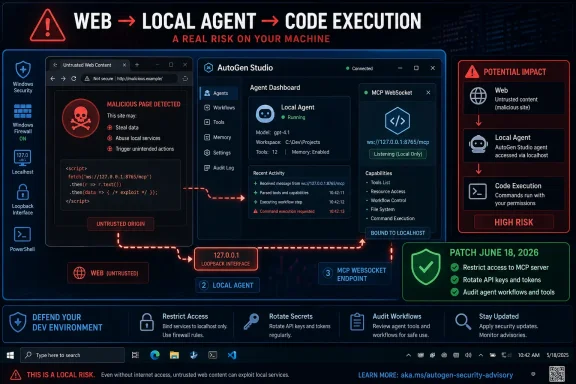
Microsoft disclosed and fixed AutoJack on June 18, 2026, after researchers found an AutoGen Studio development-branch exploit chain that could let a malicious webpage trigger code execution through a local MCP WebSocket on the machine running the agent. If you run AutoGen Studio, the practical answer is simple: update immediately, stop exposing it beyond localhost, and audit any instance that ever touched real API keys, internal tools, or shared development infrastructure. This is not just another “Microsoft patched a bug” story. It is a warning that agent-building workbenches now deserve the same suspicion administrators already apply to CI dashboards, hypervisor consoles, and cloud control planes.
The immediate action is to get off the vulnerable development branch and onto Microsoft’s fixed AutoGen Studio code. Microsoft says it disclosed and fixed the AutoJack issue on June 18, 2026, and the exploit chain targeted a development-branch path rather than a normal production deployment. That distinction matters, but it should not become an excuse for inertia.
For administrators, the response should begin with inventory. Find every workstation, lab VM, jump box, shared developer server, and cloud-hosted test environment where AutoGen Studio has been installed, cloned, run, reverse-proxied, tunneled, or left listening for convenience. If the answer is “we only used it locally,” verify that with process listings, shell history, firewall rules, container definitions, port-forwarding configuration, and developer documentation rather than relying on memory.
Then remove the risky deployment shape. AutoGen Studio should not be reachable from the public internet, a broad corporate subnet, a VPN pool, or a shared lab network simply because it was convenient during prototyping. If it must remain available, put it behind explicit authentication, network allowlisting, and monitoring, and treat it as an administrative interface capable of influencing code, credentials, tools, and agent behavior.
The safest response for a team that exposed AutoGen Studio is not “we patched, so we’re done.” It is patch, restrict, rotate, and re-audit. That means updating the code, limiting access, reviewing whether API keys were visible or retrievable, and checking whether agent configurations, tools, or workflows were modified in ways that could persist after the original exposure was closed.
That is the architectural trap. Localhost has long been treated as a softer zone where developer tools can skip some of the ceremony expected from internet-facing software. It is where dashboards bind, debug servers listen, notebooks run, and experimental control channels live. In the agent era, however, a local browser session controlled or influenced by an agent can become a bridge between an untrusted webpage and a supposedly local-only service.
Microsoft’s research described a malicious webpage triggering code execution through a local MCP WebSocket. MCP, or Model Context Protocol, is designed to let agents connect to tools and context providers. That makes it powerful, but it also means an MCP endpoint is not “just a socket” when the other side can invoke actions, pass parameters, or influence execution paths.
The phrase local RCE can sound contradictory, so it is worth being precise. The code execution happens on the host running the local AutoGen Studio environment, but the trigger can originate from remote web content consumed by an agent. In operational terms, that is bad enough: a webpage can become the delivery mechanism, and the victim’s own local agent stack becomes the confused deputy.
This is where WindowsForum readers should be more skeptical than the average headline. Development-only exposure is not theoretical in real environments. Researchers, consultants, data science teams, and product groups often clone active branches to test new features, then leave them running on a workstation, cloud VM, or internal server because the demo becomes useful.
That “temporary” service may end up with real model credentials, access to internal repositories, or paths into ticketing, document stores, shell tools, and deployment scripts. Once an agent workbench can coordinate tools, launch code, or hold API keys, it is no longer comparable to a static local web page. It is closer to a lightweight admin surface wearing a developer-tool costume.
The impact therefore depends less on whether the vulnerable branch was officially released and more on how teams actually used it. If AutoGen Studio lived only on an isolated throwaway machine with no secrets and no browser-capable agents pointed at untrusted content, the blast radius is likely limited. If it was reachable across a network, connected to paid AI services, or used to orchestrate internal tools, the response should be significantly more serious.
Microsoft’s May guidance said AutoGen Studio ships without authentication enabled by default. It also warned that exposed instances can be tampered with or leak linked AI service API keys. That is the sentence every team should now paste into its internal AI tooling checklist.
The default-authentication detail is not a minor footnote. Developers often hear “not publicly exposed by default” and mentally translate that into “safe enough.” But a tool can avoid public exposure by default and still become dangerous the moment someone binds it to a broader interface, publishes it through a tunnel, places it behind a weak proxy, or runs it on a shared host.
The security lesson is especially sharp because AutoGen Studio sits at the intersection of low-code convenience and powerful agent orchestration. A user interface for configuring agents, model connections, skills, and workflows can expose secrets and behavior. If that surface lacks authentication, the question is not whether it is elegant or experimental; the question is who can reach it and what they can make it do.
Run it as if compromise is plausible. Use a dedicated, low-privilege account. Keep it out of privileged administrator sessions. Avoid running it on a workstation that also holds domain admin tools, production cloud credentials, signing keys, or unrestricted repository tokens. If the agent environment needs code execution, separate that execution from the host as aggressively as practical.
Network scoping is the next layer. Bind local development services only to loopback unless there is a documented reason not to. Do not expose AutoGen Studio through ngrok-style tunnels, public cloud security groups, broad inbound firewall rules, or “temporary” reverse proxies without authentication and logging. Temporary exposure is exactly the kind of decision that becomes permanent enough for attackers to find.
Secrets deserve their own review. If AutoGen Studio was linked to AI service API keys, rotate those keys when exposure is uncertain. If it had access to internal tools or data connectors, review the permissions and logs for those systems as well. The safest assumption is that any exposed agent workbench may reveal more than the UI initially suggests.
Sysadmins already understand this with Jenkins, GitHub Actions runners, Azure DevOps agents, and remote management consoles. A CI dashboard with no authentication is an incident waiting to happen because it can run jobs, touch secrets, and deploy artifacts. An agent studio with no authentication can occupy a similar risk class when it has model keys, tool definitions, and execution capabilities.
The analogy also clarifies ownership. This is not only a developer problem. If an AI team runs AutoGen Studio on infrastructure connected to corporate networks, then infrastructure, security, and identity teams have a stake in how it is exposed. If it touches paid API keys, finance and platform teams have a stake. If it can reach internal content, data governance has a stake.
That does not mean every prototype needs a six-month enterprise onboarding process. It does mean prototypes need boundaries. A disposable local experiment is one thing; a shared service with secrets and tool access is another. AutoJack is a reminder that the boundary between those two states is often crossed without anyone filing a change request.
If your team never ran the affected development code, your exposure to this specific chain is likely low. If you did run it but never allowed agents to browse untrusted pages, never connected meaningful tools, and never exposed the service outside a locked-down local machine, your practical risk may also be limited. But if those assurances are based on convention rather than evidence, they need verification.
The most dangerous environments are the ones that blurred development and operations. A shared AutoGen Studio instance on an internal VM, connected to real model credentials, reachable by multiple developers, and used to test agents against live web content is exactly the kind of setup that deserves a serious review. It may not be “production” on paper, but attackers do not care how the asset is labeled.
This is also why the local-versus-remote distinction should be handled carefully. The vulnerable service may be local, yet the trigger can be remote content. The attacker’s path is not “log into the box first”; it is “get the agent to process a hostile page that can reach a local control channel.” For defenders, that is close enough to remote exploitation to justify urgency.
The industry has spent years teaching developers not to trust input from webpages, email attachments, documents, and chat messages. Agentic systems complicate that lesson because the “input” may be a page the agent browses, a prompt embedded in content, a tool response, or a workflow artifact. The boundary is no longer a single HTTP request hitting a server. It is a chain of interpretation and action.
That is why generic advice like “be careful with prompt injection” is insufficient. The key question is what a manipulated agent can reach. If it can only summarize text in a sandbox, the consequences are limited. If it can speak to a local MCP server that can launch processes, fetch secrets, or call internal APIs, the consequences escalate quickly.
For Windows administrators, the parallels to older platform security stories are obvious. Macros became dangerous because documents could do more than display text. Browser plugins became dangerous because pages could cross into privileged capabilities. Agent tools risk repeating that pattern unless their local control planes are authenticated, authorized, isolated, and monitored.
Start with endpoint visibility. Identify machines running AutoGen Studio or related AutoGen development branches. Look for long-lived Python processes, developer shell scripts, containers, scheduled tasks, startup entries, and open listening ports. On Windows, pay special attention to developer workstations that also run WSL, Docker Desktop, SSH tunnels, browser automation, or local web apps.
Then map credentials. Determine which AI service keys, environment variables, local files, browser sessions, and internal connectors were available to the process. If an instance was exposed beyond localhost, assume credentials linked to it may need rotation. The unpleasant work of key rotation is still cheaper than discovering later that an agent configuration leaked access to a paid model endpoint or internal system.
Finally, check persistence. Agent workflows can store configuration, skills, tool definitions, and prompts. If an exposed interface could be tampered with, reviewing only process logs is not enough. You need to inspect saved agent configurations for unexpected tools, modified endpoints, strange commands, or newly introduced behaviors that could survive after the vulnerable code is updated.
But the development-branch detail should not become a cultural escape hatch. AI engineering teams are often encouraged to move quickly, clone upstream repositories, test nightly code, and wire experimental tools into real workflows. That is not inherently reckless. It becomes reckless when those experiments inherit production credentials and network reachability without production-grade controls.
The better standard is simple: the more power a tool has, the less the “dev” label should comfort you. A development build of a calculator is one thing. A development build of an agent orchestration studio connected to API keys, browsers, and tool servers is another. The latter can sit in the blast radius of real systems even when no customer-facing service depends on it.
This is the gap many short AutoJack summaries miss. The story is not merely that Microsoft found and fixed an RCE chain. The story is that experimental agent surfaces are already powerful enough to require administrative treatment, and many organizations have not updated their internal categories to reflect that.
The forum’s earlier discussions around AutoJack and Microsoft developer-tool security fit the same practical theme. Enthusiasts want to know whether their local lab is at risk. Sysadmins want to know whether developers quietly exposed something on a shared network. Security teams want to know whether “localhost” was treated as a security boundary after agents were given browsers and tools.
That last question is the one to carry forward. Localhost has never been magic, but it was often good enough for a narrow class of developer assumptions. Agentic browsing breaks those assumptions because the browser is no longer merely a human-operated viewer. It can become part of an automated workflow that ingests hostile instructions and then reaches inward.
The answer is not to treat every local port as internet-facing in the literal sense. It is to treat local agent control channels as sensitive interfaces. If they can cause actions, they need authentication. If they can launch tools, they need authorization. If they can touch secrets, they need isolation. If they are exposed beyond one machine, they need logging and ownership.
That collapse is manageable if teams name it clearly. An agent workbench is not merely a UI. An MCP server is not merely a local socket. A development branch is not harmless once it has real credentials and network reachability. And a browser-capable agent is not just a browser when it can take actions through local services.
Microsoft’s disclosure gives administrators a useful forcing function. Inventory the tools, patch the code, restrict the network, rotate exposed secrets, and write down who owns the surface. The organizations that do that now will treat AutoJack as a cheap rehearsal. The ones that wave it away as “just a local dev bug” may discover, in the next agent incident, that their local tools were already part of the production attack surface.
 Patch First, Then Decide Whether AutoGen Studio Should Have Been Running There at All
The immediate action is to get off the vulnerable development branch and onto Microsoft’s fixed AutoGen Studio code. Microsoft says it disclosed and fixed the AutoJack issue on June 18, 2026, and the exploit chain targeted a development-branch path rather than a normal production deployment. That distinction matters, but it should not become an excuse for inertia.For administrators, the response should begin with inventory. Find every workstation, lab VM, jump box, shared developer server, and cloud-hosted test environment where AutoGen Studio has been installed, cloned, run, reverse-proxied, tunneled, or left listening for convenience. If the answer is “we only used it locally,” verify that with process listings, shell history, firewall rules, container definitions, port-forwarding configuration, and developer documentation rather than relying on memory.
Then remove the risky deployment shape. AutoGen Studio should not be reachable from the public internet, a broad corporate subnet, a VPN pool, or a shared lab network simply because it was convenient during prototyping. If it must remain available, put it behind explicit authentication, network allowlisting, and monitoring, and treat it as an administrative interface capable of influencing code, credentials, tools, and agent behavior.
The safest response for a team that exposed AutoGen Studio is not “we patched, so we’re done.” It is patch, restrict, rotate, and re-audit. That means updating the code, limiting access, reviewing whether API keys were visible or retrievable, and checking whether agent configurations, tools, or workflows were modified in ways that could persist after the original exposure was closed.
The Localhost Assumption Is the Vulnerability Microsoft Actually Put on Trial
AutoJack is easy to misread if you reduce it to a single bug. The more important finding is that the attacker did not need to begin with traditional remote access to the developer machine. The chain used the strange new position of browser-capable agents: they can read hostile web content and, in the same operating environment, talk to local services that developers assumed were insulated from the web.That is the architectural trap. Localhost has long been treated as a softer zone where developer tools can skip some of the ceremony expected from internet-facing software. It is where dashboards bind, debug servers listen, notebooks run, and experimental control channels live. In the agent era, however, a local browser session controlled or influenced by an agent can become a bridge between an untrusted webpage and a supposedly local-only service.
Microsoft’s research described a malicious webpage triggering code execution through a local MCP WebSocket. MCP, or Model Context Protocol, is designed to let agents connect to tools and context providers. That makes it powerful, but it also means an MCP endpoint is not “just a socket” when the other side can invoke actions, pass parameters, or influence execution paths.
The phrase local RCE can sound contradictory, so it is worth being precise. The code execution happens on the host running the local AutoGen Studio environment, but the trigger can originate from remote web content consumed by an agent. In operational terms, that is bad enough: a webpage can become the delivery mechanism, and the victim’s own local agent stack becomes the confused deputy.
The Affected Path Was Development-Branch Code, but the Operational Risk Is Broader
Microsoft’s June 18 disclosure points to a development-branch AutoGen Studio path. That should calm organizations worried that a mainstream packaged release was silently compromised. It should not calm organizations that routinely run development branches from GitHub, especially in AI labs where the distance between “experiment” and “internal tool” is often one reverse proxy away.This is where WindowsForum readers should be more skeptical than the average headline. Development-only exposure is not theoretical in real environments. Researchers, consultants, data science teams, and product groups often clone active branches to test new features, then leave them running on a workstation, cloud VM, or internal server because the demo becomes useful.
That “temporary” service may end up with real model credentials, access to internal repositories, or paths into ticketing, document stores, shell tools, and deployment scripts. Once an agent workbench can coordinate tools, launch code, or hold API keys, it is no longer comparable to a static local web page. It is closer to a lightweight admin surface wearing a developer-tool costume.
The impact therefore depends less on whether the vulnerable branch was officially released and more on how teams actually used it. If AutoGen Studio lived only on an isolated throwaway machine with no secrets and no browser-capable agents pointed at untrusted content, the blast radius is likely limited. If it was reachable across a network, connected to paid AI services, or used to orchestrate internal tools, the response should be significantly more serious.
Microsoft Had Already Warned That AutoGen Studio Ships Without Authentication Enabled by Default
The June 18 AutoJack fix landed just over a month after Microsoft’s May 14, 2026 guidance on exploitable misconfigurations in AI applications. That earlier guidance matters because it framed AutoGen Studio not as a one-off bug, but as part of a class of AI tools whose deployment posture can turn configuration into vulnerability.Microsoft’s May guidance said AutoGen Studio ships without authentication enabled by default. It also warned that exposed instances can be tampered with or leak linked AI service API keys. That is the sentence every team should now paste into its internal AI tooling checklist.
The default-authentication detail is not a minor footnote. Developers often hear “not publicly exposed by default” and mentally translate that into “safe enough.” But a tool can avoid public exposure by default and still become dangerous the moment someone binds it to a broader interface, publishes it through a tunnel, places it behind a weak proxy, or runs it on a shared host.
The security lesson is especially sharp because AutoGen Studio sits at the intersection of low-code convenience and powerful agent orchestration. A user interface for configuring agents, model connections, skills, and workflows can expose secrets and behavior. If that surface lacks authentication, the question is not whether it is elegant or experimental; the question is who can reach it and what they can make it do.
The Real Fix Is Isolation, Not Just an Updated Commit
Patching closes the known AutoJack path. Isolation reduces the chance that the next path matters. Those are different controls, and AutoGen Studio now belongs in the category of tools where both are required.Run it as if compromise is plausible. Use a dedicated, low-privilege account. Keep it out of privileged administrator sessions. Avoid running it on a workstation that also holds domain admin tools, production cloud credentials, signing keys, or unrestricted repository tokens. If the agent environment needs code execution, separate that execution from the host as aggressively as practical.
Network scoping is the next layer. Bind local development services only to loopback unless there is a documented reason not to. Do not expose AutoGen Studio through ngrok-style tunnels, public cloud security groups, broad inbound firewall rules, or “temporary” reverse proxies without authentication and logging. Temporary exposure is exactly the kind of decision that becomes permanent enough for attackers to find.
Secrets deserve their own review. If AutoGen Studio was linked to AI service API keys, rotate those keys when exposure is uncertain. If it had access to internal tools or data connectors, review the permissions and logs for those systems as well. The safest assumption is that any exposed agent workbench may reveal more than the UI initially suggests.
Admins Should Treat Agent Workbenches Like CI/CD Dashboards
The mental model for AutoGen Studio should shift from “developer convenience app” to “control plane.” That may sound severe, but it matches the direction of travel. Agent tools do not merely display information; they can select tools, pass instructions, chain actions, and sometimes execute code.Sysadmins already understand this with Jenkins, GitHub Actions runners, Azure DevOps agents, and remote management consoles. A CI dashboard with no authentication is an incident waiting to happen because it can run jobs, touch secrets, and deploy artifacts. An agent studio with no authentication can occupy a similar risk class when it has model keys, tool definitions, and execution capabilities.
The analogy also clarifies ownership. This is not only a developer problem. If an AI team runs AutoGen Studio on infrastructure connected to corporate networks, then infrastructure, security, and identity teams have a stake in how it is exposed. If it touches paid API keys, finance and platform teams have a stake. If it can reach internal content, data governance has a stake.
That does not mean every prototype needs a six-month enterprise onboarding process. It does mean prototypes need boundaries. A disposable local experiment is one thing; a shared service with secrets and tool access is another. AutoJack is a reminder that the boundary between those two states is often crossed without anyone filing a change request.
The Exploitability Question Turns on Reachability, Agent Behavior, and Trust Boundaries
The most useful way to assess real-world exposure is to ask what had to line up. The exploit chain targeted a development-branch path. It involved a local MCP WebSocket. It depended on a malicious webpage influencing an agent or browsing context that could reach the local service. Those prerequisites narrow the field, but they do not make the issue academic.If your team never ran the affected development code, your exposure to this specific chain is likely low. If you did run it but never allowed agents to browse untrusted pages, never connected meaningful tools, and never exposed the service outside a locked-down local machine, your practical risk may also be limited. But if those assurances are based on convention rather than evidence, they need verification.
The most dangerous environments are the ones that blurred development and operations. A shared AutoGen Studio instance on an internal VM, connected to real model credentials, reachable by multiple developers, and used to test agents against live web content is exactly the kind of setup that deserves a serious review. It may not be “production” on paper, but attackers do not care how the asset is labeled.
This is also why the local-versus-remote distinction should be handled carefully. The vulnerable service may be local, yet the trigger can be remote content. The attacker’s path is not “log into the box first”; it is “get the agent to process a hostile page that can reach a local control channel.” For defenders, that is close enough to remote exploitation to justify urgency.
AI Security Guidance Is Catching Up to What Developers Have Already Built
Microsoft’s broader AI security research has warned that exposed AI applications with weak or missing authentication can lead to remote code execution, credential theft, and access to internal tools or data. AutoJack gives that warning a concrete shape. It shows how the agent stack itself can become the route from untrusted content to local execution.The industry has spent years teaching developers not to trust input from webpages, email attachments, documents, and chat messages. Agentic systems complicate that lesson because the “input” may be a page the agent browses, a prompt embedded in content, a tool response, or a workflow artifact. The boundary is no longer a single HTTP request hitting a server. It is a chain of interpretation and action.
That is why generic advice like “be careful with prompt injection” is insufficient. The key question is what a manipulated agent can reach. If it can only summarize text in a sandbox, the consequences are limited. If it can speak to a local MCP server that can launch processes, fetch secrets, or call internal APIs, the consequences escalate quickly.
For Windows administrators, the parallels to older platform security stories are obvious. Macros became dangerous because documents could do more than display text. Browser plugins became dangerous because pages could cross into privileged capabilities. Agent tools risk repeating that pattern unless their local control planes are authenticated, authorized, isolated, and monitored.
Windows Shops Need a Practical Audit, Not an AI Panic
The right response is not to ban every agent framework. The right response is to audit them with the same discipline already applied to remote management tools and developer infrastructure. AutoGen Studio is useful precisely because it lowers the friction of building multi-agent workflows, but lowered friction is not the same as lowered risk.Start with endpoint visibility. Identify machines running AutoGen Studio or related AutoGen development branches. Look for long-lived Python processes, developer shell scripts, containers, scheduled tasks, startup entries, and open listening ports. On Windows, pay special attention to developer workstations that also run WSL, Docker Desktop, SSH tunnels, browser automation, or local web apps.
Then map credentials. Determine which AI service keys, environment variables, local files, browser sessions, and internal connectors were available to the process. If an instance was exposed beyond localhost, assume credentials linked to it may need rotation. The unpleasant work of key rotation is still cheaper than discovering later that an agent configuration leaked access to a paid model endpoint or internal system.
Finally, check persistence. Agent workflows can store configuration, skills, tool definitions, and prompts. If an exposed interface could be tampered with, reviewing only process logs is not enough. You need to inspect saved agent configurations for unexpected tools, modified endpoints, strange commands, or newly introduced behaviors that could survive after the vulnerable code is updated.
The Development Branch Detail Should Change the Severity, Not the Standard
It is fair to distinguish between a vulnerable official release and a vulnerable development branch. Security triage depends on scope. Microsoft fixing an issue before it reached normal released builds is meaningfully different from a widely deployed product vulnerability with a CVE, exploit kits, and mass scanning.But the development-branch detail should not become a cultural escape hatch. AI engineering teams are often encouraged to move quickly, clone upstream repositories, test nightly code, and wire experimental tools into real workflows. That is not inherently reckless. It becomes reckless when those experiments inherit production credentials and network reachability without production-grade controls.
The better standard is simple: the more power a tool has, the less the “dev” label should comfort you. A development build of a calculator is one thing. A development build of an agent orchestration studio connected to API keys, browsers, and tool servers is another. The latter can sit in the blast radius of real systems even when no customer-facing service depends on it.
This is the gap many short AutoJack summaries miss. The story is not merely that Microsoft found and fixed an RCE chain. The story is that experimental agent surfaces are already powerful enough to require administrative treatment, and many organizations have not updated their internal categories to reflect that.
The WindowsForum Angle Is the Operational Mess Between Research and Reality
WindowsForum readers have seen this pattern before in Visual Studio, .NET, Copilot Studio, Office, and developer-tool vulnerabilities: the headline says “remote code execution,” but the real work begins with figuring out who actually runs the affected component, under what permissions, and with which adjacent secrets. AutoJack belongs in that family, even though the AI-agent mechanics are newer.The forum’s earlier discussions around AutoJack and Microsoft developer-tool security fit the same practical theme. Enthusiasts want to know whether their local lab is at risk. Sysadmins want to know whether developers quietly exposed something on a shared network. Security teams want to know whether “localhost” was treated as a security boundary after agents were given browsers and tools.
That last question is the one to carry forward. Localhost has never been magic, but it was often good enough for a narrow class of developer assumptions. Agentic browsing breaks those assumptions because the browser is no longer merely a human-operated viewer. It can become part of an automated workflow that ingests hostile instructions and then reaches inward.
The answer is not to treat every local port as internet-facing in the literal sense. It is to treat local agent control channels as sensitive interfaces. If they can cause actions, they need authentication. If they can launch tools, they need authorization. If they can touch secrets, they need isolation. If they are exposed beyond one machine, they need logging and ownership.
The Decision Tree for AutoGen Studio Is Shorter Than the Debate
Teams do not need a philosophical meeting before acting. The concrete decision path is direct, and it should be completed before anyone spends time debating whether AutoJack was “really remote” or “only local.”- If you ran AutoGen Studio from a development branch before Microsoft’s June 18, 2026 fix, update to fixed code and stop using the affected branch immediately.
- If AutoGen Studio was reachable beyond localhost, restrict it now and review the exposure as a security event rather than a harmless lab mistake.
- If the instance had linked AI service API keys, rotate those keys when you cannot prove the instance was isolated and untouched.
- If agents browsed untrusted web content while connected to local MCP tooling, review saved workflows, tool definitions, logs, and host activity for unexpected changes.
- If your organization plans to keep using AutoGen Studio, assign ownership for authentication, network access, secret handling, and periodic review before the next prototype becomes infrastructure.
The Next Agent Incident Will Punish Teams That Still Think “Local Tool” Means “Low Risk”
AutoJack should age less like a one-week vulnerability story and more like an early marker in the security model for agentic development. The specific AutoGen Studio flaw was fixed, and the development-branch scope limits the immediate population of affected systems. But the underlying pattern is bigger than one repository path: agents collapse distance between untrusted content and privileged local tools.That collapse is manageable if teams name it clearly. An agent workbench is not merely a UI. An MCP server is not merely a local socket. A development branch is not harmless once it has real credentials and network reachability. And a browser-capable agent is not just a browser when it can take actions through local services.
Microsoft’s disclosure gives administrators a useful forcing function. Inventory the tools, patch the code, restrict the network, rotate exposed secrets, and write down who owns the surface. The organizations that do that now will treat AutoJack as a cheap rehearsal. The ones that wave it away as “just a local dev bug” may discover, in the next agent incident, that their local tools were already part of the production attack surface.
References
- Primary source: learn.microsoft.com
Security Advisories | Microsoft Learn
learn.microsoft.com - Independent coverage: microsoft.com
When configuration becomes a vulnerability: Exploitable misconfigurations in AI apps | Microsoft Security Blog
Exposed UIs, weak authentication, and risky defaults could turn cloud-native AI apps on Kubernetes into potential targets by threat actors. Learn how exploitable misconfigurations lead to RCE and data leaks.www.microsoft.com - Independent coverage: techcommunity.microsoft.com
Act now: Secure Boot certificates expire in June 2026 - Windows IT Pro Blog
Get tips to prepare for the rollout of updated certificates across your organization. techcommunity.microsoft.com
- Independent coverage: developer.microsoft.com
Securing MCP: A Control Plane for Agent Tool Execution - Microsoft for Developers
The Model Context Protocol (MCP) is quickly becoming a common way for AI agents to discover and use tools. It provides a consistent interface todeveloper.microsoft.com - Independent coverage: support.microsoft.com
June 9, 2026—KB5095051 (OS Build 28000.2269) - Microsoft Support
 support.microsoft.com
- Primary source: WindowsForum
AutoJack: How AI Agents Turn Localhost Into an RCE Attack Surface (AutoGen Studio) | Windows Forum
Microsoft disclosed on June 18, 2026, that researchers found and fixed an AutoGen Studio development-branch exploit chain, dubbed AutoJack, that could let a...windowsforum.com