

We’re at the point where change management — the slow, paper-and-email-laden backbone of manufacturing — is getting a practical, agentic overhaul: Microsoft today opened public preview of the Product Change Management agent template, a Copilot Studio–built solution that promises to automate engineering change workflows, synchronize PLM and ERP systems, and shorten approval cycles from weeks to days. This article examines what the template actually does, how it plugs into existing enterprise stacks, where it matters most for manufacturers, and the risks operations and IT teams must manage before handing agents the keys to the digital thread.
Engineering change management (ECM) is the process manufacturers use to propose, review, approve, and implement changes to parts, processes, equipment, and software. Historically, ECM is highly collaborative but painfully manual: change requests move through spreadsheets, emails, tickets, and siloed systems. That fragmentation increases lead times, raises error rates, and creates audit headaches when traceability is required.
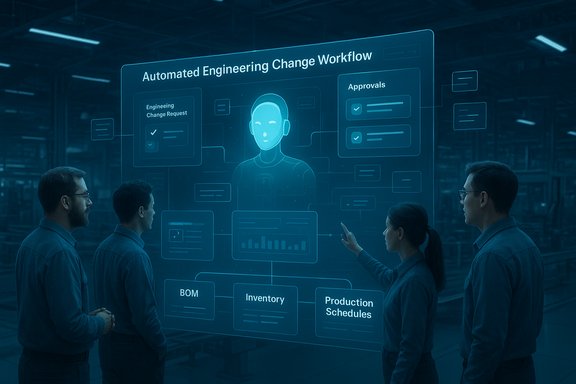
The new Product Change Management agent template is an AI-first orchestrator built in Microsoft Copilot Studio. It aims to turn ECM into an agentic workflow — a coordinated set of specialized AI sub-agents that can draft requests, run impact analysis, route approvals, and update systems of record such as PLM and ERP automatically. Microsoft positions the template as a managed, customizable accelerator that reduces repetitive work, improves traceability, and shortens approval windows.
This launch ties into several broader industry developments: the rise of multi-agent architectures in enterprise applications, the adoption of the Model Context Protocol (MCP) for standardized AI-to-system integrations, and new Copilot Studio features that give agents safer ways to act inside applications, including a controlled “computer use” capability for GUI automation.
MCP’s growing ecosystem reduces the “M×N” integration problem (many agents × many data sources) by enabling interoperable connectors that multiple agents can reuse.
A few items require caution:
However, the technology is not magic. Success depends on disciplined data governance, careful security controls, and a measured rollout that validates vendor claims in the customer’s own environment. Early customer stories are promising, but organizations should treat those narratives as directional evidence rather than guarantees. The right approach is to pilot with measurable KPIs, ensure human-in-the-loop safeguards for critical decisions, and leverage standards like MCP to reduce integration friction.
For manufacturers wrestling with tens of thousands of parts, complex BOMs, and distributed production footprints, agentic change management is no longer theoretical — it is an operational capability they can evaluate and measure. The next wave of industrial digital transformation will be defined by who can reliably automate the change process while preserving auditability, safety, and alignment across engineering and operations. The Product Change Management agent template gives teams a practical tool to explore that future; execution and governance will determine who wins.
Source: Microsoft Streamline manufacturing processes with AI-powered product change management - Microsoft Industry Blogs
 Background / Overview
Engineering change management (ECM) is the process manufacturers use to propose, review, approve, and implement changes to parts, processes, equipment, and software. Historically, ECM is highly collaborative but painfully manual: change requests move through spreadsheets, emails, tickets, and siloed systems. That fragmentation increases lead times, raises error rates, and creates audit headaches when traceability is required.The new Product Change Management agent template is an AI-first orchestrator built in Microsoft Copilot Studio. It aims to turn ECM into an agentic workflow — a coordinated set of specialized AI sub-agents that can draft requests, run impact analysis, route approvals, and update systems of record such as PLM and ERP automatically. Microsoft positions the template as a managed, customizable accelerator that reduces repetitive work, improves traceability, and shortens approval windows.
This launch ties into several broader industry developments: the rise of multi-agent architectures in enterprise applications, the adoption of the Model Context Protocol (MCP) for standardized AI-to-system integrations, and new Copilot Studio features that give agents safer ways to act inside applications, including a controlled “computer use” capability for GUI automation.
What the Product Change Management agent template does
The agent template packages a set of capabilities aimed specifically at ECM. These are the core features Microsoft highlights:- Automated workflow orchestration
The agent coordinates the full lifecycle of a change—from request submission to closure—automatically routing work, nudging reviewers via Teams and Outlook, and tracking approval progress. - System of record synchronization
Once changes are approved, the agent updates PLM and ERP record systems (for example, PTC Windchill and Microsoft Dynamics 365) so bill-of-materials (BOM), part metadata, and related records stay aligned without manual re-entry. - Collaborative stakeholder engagement
Natural-language interfaces in Microsoft Teams and Microsoft 365 Copilot let stakeholders review and comment in context. Intelligent routing ensures the appropriate roles are brought in at the right time. - Data-driven impact analysis
The agent can evaluate proposed changes across inventory, supplier lists, and production schedules to surface probable downstream impacts and flag potential risks before implementation. - Built-in compliance and traceability
Every action, decision, and artifact is recorded, supporting audit trails, regulatory reporting, and governance policies.
The technology stack: Copilot Studio, MCP, Windchill, Dynamics 365 and beyond
Copilot Studio as the agent development platform
Copilot Studio is Microsoft’s low-code/no-code and developer-focused environment for designing, testing, and publishing agents. Recent Copilot Studio updates introduced features that matter directly to ECM scenarios:- Computer use (preview/public preview in phases) gives agents the ability to interact with GUI-only systems via a virtual mouse and keyboard — a modern evolution of RPA that integrates reasoning and visual perception.
- Agent flows and reusable tools allow makers to compose complex, multi-step workflows and share reusable actions across agents.
- Channel publishing for Teams and Microsoft 365 Copilot enables agents to live where stakeholders already work.
Model Context Protocol (MCP) for safe, standardized integrations
MCP is an open protocol designed to standardize how AI applications access external data and services. By adopting MCP, Copilot Studio agents can connect to certified MCP servers and retrieve authoritative data with clearer boundaries and standardized semantics. For ECM, MCP servers can expose PLM datasets, supplier catalogs, and plant inventories so agents work from trusted inputs rather than scraped or transient information.MCP’s growing ecosystem reduces the “M×N” integration problem (many agents × many data sources) by enabling interoperable connectors that multiple agents can reuse.
PLM and ERP integrations: Windchill and Dynamics 365
The template emphasizes two classes of system integration:- PLM (Product Lifecycle Management) — e.g., PTC Windchill: agents can surface design data, parts relationships, and engineering baselines during impact analysis and ensure approved changes are reflected in the PLM system.
- ERP (Enterprise Resource Planning) — e.g., Microsoft Dynamics 365: agents can update BOMs, pricing, and procurement plans so operations and finance see the updated data in near real time.
Practical value: Why manufacturers should pay attention
Manufacturing organizations face three persistent pressures where an agentic ECM solution can deliver measurable value:- Time-to-market — Rapid changes in material availability, regulatory requirements, or customer demand require fast, reliable change processes. Automating drafting, impact analysis, and routing shortens approval cycle times.
- Operational resilience — Human handoffs and spreadsheet work invite misalignment between engineering and operations. Synchronized systems and automated traceability reduce rework, scrap, and downtime.
- Governance at scale — As product complexity and the volume of changes increase, manual processes become impossible to govern consistently. Agents can enforce policy gates, record decisions, and produce auditable trails.
- Fewer manual data re-entries and reduced human error.
- Faster approvals via automated routing and nudges.
- Quicker downstream updates to production planning and supply chain systems.
- Better auditability and compliance reporting.
- Potential reduction in production stoppages due to misapplied changes.
Case study: Coca‑Cola Beverages Africa (what’s verified and what isn’t)
Microsoft’s announcement cites Coca‑Cola Beverages Africa (CCBA) as an early adopter. Several corporate facts about CCBA are independently verifiable:- CCBA operates across multiple African territories (commonly cited as 14 territories in public materials) and runs dozens of bottling plants.
- Public corporate materials and industry coverage note CCBA serves hundreds of thousands of customer outlets across Africa and represents a large share of Coca‑Cola product volume on the continent.
A few items require caution:
- Microsoft’s article claims “Every year, CCBA makes more than 1,000 changes to its bottle molds alone.” That specific number appears in Microsoft’s customer narrative and is presented as CCBA’s operational detail. Public third-party documents confirming the precise “1,000” figure are not readily available; treat that as a vendor-sourced metric unless CCBA publishes its own operational statistics confirming it.
- Reported process improvements — for example, “actions that once took days now happen in hours” — are customer-reported outcomes. They are valuable as early evidence but are not independently audited. Organizations evaluating the template should plan a pilot with measurable KPIs to verify similar improvements in their own environment.
Strengths and notable design decisions
- Agentic orchestration over monolithic automation
The template’s use of specialized sub-agents (orchestrator + domain agents) aligns with modern software design: small, purpose-built components that can be tested, governed, and updated independently. - Work where people already collaborate
Native integration with Microsoft Teams and Microsoft 365 Copilot reduces friction: reviews and approvals happen in the apps engineers and planners already use. - MCP and standardized connectors
Adopting MCP and exposing formal connections to PLM/ERP makes system access less ad-hoc and easier to secure. This reduces brittle point-to-point integrations. - Hybrid automation (API + UI automation)
Combining API integrations with computer use (GUI automation) means agents can operate even when legacy systems lack APIs — an important practical advantage for many manufacturers. - Governance-first approach
Copilot Studio’s administrative controls, data policy enforcement, and audit logs address regulatory and corporate governance concerns from the outset.
Risks, limitations, and governance challenges
No enterprise AI deployment is risk-free. The Product Change Management template mitigates many problems but introduces others that manufacturing leaders must manage:- Data integrity and provenance
Agents rely on the data they are given. If PLM or ERP connectors expose partial or stale data, an agent’s impact analysis can be misleading. Strong data validation, canonical sources, and reconciliation processes remain essential. - Automation accuracy and unintended actions
Computer use automations emulate human interaction with UIs; ambiguous instructions or unexpected screen states can cause incorrect entries. Audit trails are necessary, but firms should also establish human-in-the-loop thresholds for critical updates. - Security and credential management
Granting agents access to ERP, PLM, and supplier portals requires robust secrets management, least-privilege access, and allow-listing — especially when agents can interact with external supplier systems or log into web portals. - Regulatory and audit exposure
In regulated industries, automatic changes to product data must be carefully controlled. Regulatory auditors will demand explanation of governance processes and traceability down to who authorized what and when. - Overreliance on vendor claims
Early case studies are promising, but organizations should not assume identical throughput or risk reduction in their environments. Pilot and measure: cycle time, error rate, and audit readiness must be tracked with objective KPIs. - Vendor lock-in and interoperability assumptions
While MCP and open standards reduce lock-in, real-world connectors and custom adapters can create new dependencies. Architecture reviews should plan for migration or replacement risk.
Implementation roadmap — practical steps for manufacturing teams
- Define success metrics (30–60–90 day KPIs)
- Approval cycle time reduction (target: e.g., 50% in pilot scope).
- Number of manual re-entries eliminated.
- Time to update BOM in ERP post-approval.
- Select a bounded pilot scope
- Start with a well-contained part family or packaging change process to limit blast radius and to make outcomes measurable.
- Map existing change processes and systems
- Identify PLM endpoints, ERP modules, and any GUI-only legacy apps that will need computer use or integration adapters.
- Set governance guardrails before go-live
- Define human review thresholds, activity logging, credential vaulting, and allowlists for the applications agents may interact with.
- Build and test using Copilot Studio
- Use prebuilt agent templates and tools, add MCP connections to canonical data sources, and simulate end-to-end flows in a non-production environment.
- Run a controlled pilot, measure, iterate
- Instrument the agent with observability and ROI metrics. Collect stakeholder feedback and refine routing rules and prompts.
- Expand with a staged rollout and continuous governance
- Broaden scope to additional product lines and factories after validating KPIs and control effectiveness.
Vendor and partner ecosystem: who’s involved and why it matters
The Product Change Management template is part of a broader ecosystem. Expect the following actors to play an ongoing role:- Platform vendors — Microsoft provides Copilot Studio, Teams, Dynamics 365, and governance tools.
- PLM vendors — PTC (Windchill) and similar PLM vendors will supply the engineering record connections and may publish native agents or connectors.
- Systems integrators and partners — Implementation will often require partners to map complex data schemas and embed governance controls.
- Standards bodies and open protocols — MCP’s adoption is key to cross-vendor interoperability; the more vendors support MCP, the easier multi-source agent architectures become.
What to watch next
- MCP adoption and certified connectors — The velocity of MCP connector development will determine how quickly agents can operate on authoritative enterprise systems without brittle adapters.
- Regulatory and audit reactions — Expect auditors and compliance teams to scrutinize agent decision trails; watch for industry-specific guidance on agent-driven changes.
- RPA vs. agentic automation outcomes — The degree to which computer use can replace traditional RPA without increasing risk will be an important discriminator for ROI arguments.
- Customer proof points — More independent, third-party audits or published metrics from early customers beyond vendor case studies will be critical to validate generalized claims.
Conclusion
The Product Change Management agent template is a significant, practical application of agentic AI to a classic industrial pain point: making engineering changes without production chaos. By combining Copilot Studio’s multi-agent orchestration, MCP-based integrations, and both API and GUI automation, Microsoft has delivered a template that can shorten cycle times, synchronize critical systems, and make change traceable and governable.However, the technology is not magic. Success depends on disciplined data governance, careful security controls, and a measured rollout that validates vendor claims in the customer’s own environment. Early customer stories are promising, but organizations should treat those narratives as directional evidence rather than guarantees. The right approach is to pilot with measurable KPIs, ensure human-in-the-loop safeguards for critical decisions, and leverage standards like MCP to reduce integration friction.
For manufacturers wrestling with tens of thousands of parts, complex BOMs, and distributed production footprints, agentic change management is no longer theoretical — it is an operational capability they can evaluate and measure. The next wave of industrial digital transformation will be defined by who can reliably automate the change process while preserving auditability, safety, and alignment across engineering and operations. The Product Change Management agent template gives teams a practical tool to explore that future; execution and governance will determine who wins.
Source: Microsoft Streamline manufacturing processes with AI-powered product change management - Microsoft Industry Blogs
