

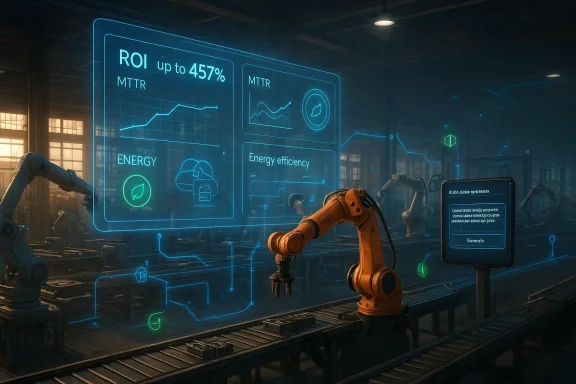
Microsoft’s recent industry briefing argues that artificial intelligence has moved from promise to payment—industrial AI now delivers measurable returns when manufacturers combine governed data, cloud scale, and purpose-built AI pipelines. The company’s January 22, 2026 manufacturing post highlights a Forrester Total Economic Impact™ (TEI) finding of up to 457% projected ROI over three years, alongside customer examples from KUKA, Schneider Electric and AIdi that show speed, reduced defects, and sustainability gains as practical outcomes of adoption.
Background
Manufacturing has long wrestled with four persistent problems: unplanned downtime, inconsistent quality, fragmented IT/OT data, and workforce skill gaps. Microsoft’s narrative reframes these constraints as opportunity: unify data, deploy AI models across operations, and embed intelligence into workflows so decisions happen faster and errors drop. The company packages this thesis through Azure AI, Azure AI Foundry (Foundry Models), Microsoft 365 Copilot and related platform services that promise to shorten the path from pilot to production. Independent and community analyses confirm the same directional trend: broad AI pilots and agent tooling, and increasing attention to governance and observability as the gating factors for real ROI. Community research and internal forum reviews caution that vendor‑commissioned studies (including some Microsoft‑sponsored research) require careful interpretation of methodology and sample framing before extrapolating headline multipliers to a specific plant or enterprise.Where the ROI is real: measurable use cases and numbers
The Forrester TEI headline — what it actually says
Forrester’s TEI for Microsoft’s industrial AI solutions modeled a composite manufacturing organization and reported benefit ranges that produced up to 457% ROI over three years, with NPV benefits in the millions depending on the organization profile. The study aggregated interviews and surveys of Microsoft customers to create a composite scenario, not a single real‑world accounting of one plant’s books. That means the upper‑bound ROI represents a modeled outcome under specific assumptions—valuable as a directional signal but not a guarantee for every implementation. Caveat: because this analysis is commissioned by Microsoft and constructed from a composite organization, the underlying assumptions (sample selection, baseline processes, and cost allocations) materially influence the final ROI. Treat the headline multiplier as a planning heuristic—not a boardroom mandate—until internal pilots reproduce comparable outcomes. Flagged as a vendor‑commissioned composite result.Where the big gains come from
Across vendor and analyst material the most commonly cited, high‑impact use cases are:- Predictive maintenance: fewer breakdowns, longer asset life, and lower spare‑parts inventories.
- Quality control and defect reduction: computer‑vision inspection and root‑cause analysis that cut scrap and rework.
- Inventory and supply chain optimization: AI forecasting to reduce stockouts and working capital.
- Workforce enablement: AI copilots and assistants that accelerate onboarding and let technicians resolve issues faster.
- Energy and emissions optimization: real‑time models that yield both sustainability and cost savings.
Case studies: what customers actually achieved
KUKA — democratizing robotics with natural‑language programming
KUKA used Azure AI and Foundry Models to build iiQWorks.Copilot, a natural‑language assistant that generates robot code and simulates workflows. Microsoft’s customer story reports programming for simple tasks up to 80% faster, expanding who can interact with industrial robots and reducing the bottleneck of specialized programmers. That speed‑to‑deploy effect is both tactical (faster jobs) and strategic (broader adoption of automation). The KUKA example is a clear illustration of how model‑assisted code generation plus simulation can transform a traditionally specialist activity into a broader capability. Why this matters: for manufacturers with high automation potential, shaving programming time by a large percentage directly accelerates throughput, reduces contractor dependence, and shortens project timelines—advantages that compound across multiple robot deployments.Schneider Electric — coupling sustainability with productivity
Schneider Electric has embedded Azure OpenAI and Azure Machine Learning across its EcoStruxure platform and internal engineering workflows. Public case materials describe productivity gains—such as code‑generation assistance for PLCs—as well as energy‑optimization solutions (EcoStruxure Microgrid Advisor, Resource Advisor) that combine real‑time data, forecasts and optimization models to reduce energy consumption and emissions. Schneider’s public statements show AI used as both a product differentiator and a customer enablement tool. Measured impact: Microsoft summarized survey results where customers expect large improvements in energy efficiency and emissions reductions when AI is deployed to optimize facility and grid behavior. Those expectations are corroborated in Schneider’s own press materials describing both internal gains and customer outcomes. However, the precise percent reductions achieved at scale will vary by portfolio, baseline energy mix, and on‑site system capabilities.Audi AG — enterprise assistants in weeks, not months
Audi deployed an HR self‑service assistant using Azure AI Foundry in just two weeks, citing faster access to information for employees and reduced routine queries for HR teams. Audi’s published customer story emphasizes how accelerators, modular architectures and platform‑level building blocks make secure, compliant deployments feasible at enterprise scale and at speed. The practical lesson: starting with an urgent, measurable operational problem (HR queries) can create a beachhead for broader agent deployment across the company. ([microsoft.com](https://www.microsoft.com/en/customers/story/24786-audi-ag-azure-ai-foundry?utm_source=oainability: AI as a profitability leverSustainability isn’t just compliance; it’s a cost center turned strategic advantage when AI reveals efficiencies across energy, materials and process flows. Microsoft’s survey of Azure customers in the industrial TEI indicated high expectations: large majorities expect improvements in energy consumption and efficiency when AI is applied to operations. Schneider’s case reinforces this, showing how EcoStruxure integrates AI models to manage microgrids and portfolio‑level energy usage. Real outcomes depend on measurable baselines, however: AI can only optimize what it can measure. ([tei.forrester.com](https://tei.forrester.com/go/microsoft/IndustrialAiRoi/?utm_sourcecs are straightforward: reducing energy and waste lowers operating expense while also cutting regulatory and carbon‑related costs—two levers executives can track directly in P&L and sustainability reports. Yet the environmental claims in vendor materials are frequently forward‑looking or expectation‑based, so organizations should require pilot results and conservative financial modeling before assuming portfolio‑wide emission reductions. Flagged as expectation‑driven until validated in a given set of plants.
People and productivity: AI as a workforce multiplier
AI copilots and agents are consistently framed as amplifiers, not replacements, in manufacturing. Microsoft’s materials cite automation of repetitive tasks, reduced onboarding time, and significant gains in frontline productivity when agents provide guided troubleshooting and contextual knowledge. Audi reported a fast, secure rollout that freed HR from routine queries. Broaded community dialogue echo similar productivity multipliers—but with an important qualification: most realized gains require well‑instrumented data, clearly defined KPIs, and governance to prevent drift and error. Typical measured improvements described in vendor briefings include:- Faster access to documentation and procedures
- Significant reductions in manual searching and query handling
- Shorter onboarding cycles via conversational assistants and guided workflows
The agentic era: from task automation to coordinated decisioning
The industry is shifting from narrow, task‑based automation to agentic models—AI systems that plan, coordinate workflows, and interact across systems. Microsoft’s stack (Agent 365, Foundry Models, Copilot Studio) focuses on orchestration, model choice and governance to make multi‑agent deployments practical. The architectural shift is critical: value compounds when agents connect production schedules, quality inspections, and supply chain forecasts to coordinate responses in near real‑time.Risks increase with agency: untested agent workflows can produce cascading errors, and connectors that reach into ERP, MES, and plant control systems create new attack surfaces. Well‑engineered observability, human‑in‑the‑loop checkpoints and rollback plans are mandatory as agentic systems move into production.
Practical roadmap: from pilot to scaled, measurable advantage
Operational AI fails most often for one reason: lack of a repeatable path from prototype to governed production. The following stepwise roadmap is distilled from vendor playbooks, Forrester’s TEI modeling approach, and real customer deployments.- Identify high‑impact use cases: prioritize predictive maintenance, quality control, and supply chain forecasting where outcome KPIs are measurable.
- Define success metrics: set KPI baselines and measurable targets (MTTR, defect rate, inventory turns, energy kWh/m2).
- Build the data foundation: unify IT and OT datasets, apply time synchronization, and normalize schema for models.
- Start small, scale fast: run focused pilots with strict metrics, then modularize solutions for reuse across lines and sites.
- Invest in governance and observability: implement telemetry, drift detection, and human‑in‑the‑loop approvals.
- Choose platform and partners: adopt cloud platforms that provide enterprise controls, model lifecycle tools, and integration accelerators.
- Measure and report: track financials and non‑financial KPIs in monthly cadence to iterate funding and rollout.
Implementation checklist: concrete actions for IT and operations leaders
- Inventory data sources: PLC logs, vibration and telemetry streams, quality inspection images, ERP transaction history.
- Establish a canonical time series layer: synchronize event timestamps across OT and IT systems.
- Create a model evaluation pipeline: A/B test models on holdback data, measure false positives/negatives, and track inference latency and cost.
- Set human‑in‑the‑loop thresholds: determine which recommendations require operator approval and which can be automated.
- Plan for edge and cloud balance: put latency‑sensitive inference at the edge, analytics and training in cloud.
- Negotiate enterprise licensing and SLAs: ensure availability and data residency meet regulatory needs.
- Train operators and data stewards: build adoption via role‑based training and clear escalation flowcharts.
Risks, governance and the credibility gap
Several credible risks accompany rapid industrial AI adoption:- Vendor‑sponsored evidence bias: commissioned studies (Forrester, IDC) often show high returns for modeled composites; independent replication on your assets is essential.
- Data quality and instrumentation: AI cannot compensate for missing or misaligned time series, poor labels, or inconsistent asset IDs.
- Operational safety and compliance: agents that tmust pass rigorous safety verification and fail‑safe design.
- Model drift and maintenance cost: production models age; plan for continuous monitoring, retraining pipelines and budgeted MLops.
- Cybersecurity exposure: new connectors to OT increase attack surface; treat AI rollout as a joint security and OT initiative.
Financial modeling: how to vet the 457% claim for your plant
When the Forrester TEI presents an upper bound like 457% ROI, treat it as a scenario. To convert it into an actionable financial plan:- Build a bottom‑up model using site‑level inputs: current downtime cost per ho, labor rates for maintenance, and energy spend.
- Set conservative capture rates: begin with a fraction (e.g., 10–30%) of the vendor’s optimistic improvements for initial years.
- Include lifecycle costs: cloud inference, edge devices, integration engineering, training and MLops support.
- Use a 3‑year horizon and calculate NPV and payback under base, conservative and aggressive scenarios.
Final analysis: strengths, weaknesses and when adoption becomes advantage
Strengths- Platform effect: integrated stacks (cloud, models, productivity suites) reduce integration friction and shorten deployment timelines.
- Domain acceleration: domain‑specific assistants (robotics code, PLC generation, EcoStruxure optimizers) deliver measurable operational gains when data foundations exist.
- Sustainability and cost alignment: energy optimization aligns environmental KPIs with OPEX reductions—two executive priorities in one initiative.
- Study provenance: commissioned studies produce useful signals but require internal verification before scaling budget commitments.
- Operational friction: without disciplined engineering (time sync, data normalization, retraining), pilots suffer from unreproducible results.
- Governance gaps: agentic AI amplifies risk if telemetry and human checks aren’t embedded from day one.
Adoption becomes a durable competitive advantage when three things line up:
- Data maturity — consistent, unified IT/OT datasets are available across multiple sites.
- Governed model lifecycle — observability, testing and retraining pipelines are productionized.
- Process integration — AI outputs drive automated or semi‑automated decisioning within core workflows (maintenance, quality, scheduling).
Conclusion
Industrial AI has crossed the threshold from promising pilot to measurable business capability—but realizing the value requires disciplined engineering, conservative financial modeling, and robust governance. Microsoft’s messaging, supported by Forrester’s TEI modeling and customer examples like KUKA, Schneider Electric and Audi, shows that material returns are possible when organizations unify data, choose the right use cases, and institutionalize model operations. The opportunity in manufacturing is not an abstract future; it’s an operational choice. Start with a tightly scoped use case, instrument it for measurable outcomes, validate benefits against your baseline, and then scale with the governance and telemetry that convert technical novelty into durable advantage. Community analyses and independent scrutiny reinforce one final practical maxim: treat vendor ROI claims as useful benchmarks, not certainties, and ensure every rollout has a measured path to production value.Source: Microsoft Scale and grow with AI for manufacturing - Microsoft Industry Blogs
