

TeKnowledge’s arrival on the Microsoft pavilion at WebSummit Qatar 2026 crystallizes a practical shift in the region’s AI story: vendors are no longer selling proofs of concept — they are selling end‑to‑end operationalization of agentic AI for governments and large enterprises, with the promises, safety controls, and measurable impact claims that such deployments demand.
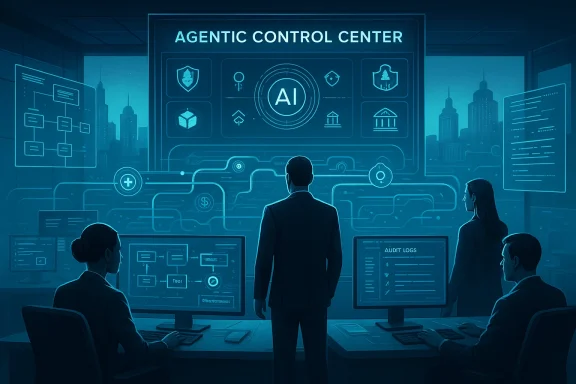
Agentic AI — software agents capable of planning multi‑step tasks, calling tools, and executing actions on behalf of users — has moved rapidly from research labs into enterprise marketing decks. Vendors and cloud providers now frame agentic systems as the logical next step beyond single‑turn copilots: they automate cross‑system workflows, scale expert knowledge, and accelerate decision cycles. At WebSummit Qatar 2026, Microsoft presented an Agentic Control Center and an enterprise accelerator called AI360, while partners such as TeKnowledge demonstrated vertical implementations and adoption playbooks built on Microsoft’s stack.
In parallel, TeKnowledge — a global systems integrator and managed services firm — positioned itself as the adoption and skilling engine for government and enterprise programs in Qatar, emphasizing rapid delivery, governance templates, and measurable productivity outcomes. The company’s own briefings and press coverage highlight use cases across healthcare, procurement, and citizen feedback analytics and report adoption metrics from a national Copilot rollout.
At the same time, headline adoption metrics and hours‑saved figures remain vendor‑reported programme outcomes until methodology is disclosed and independent verification occurs. For IT leaders, the practical path forward is clear: adopt with staged controls, require artifacted governance and measurement, invest in people as well as code, and insist on transparency before scaling authority to autonomous agents. When those conditions are met, agentic AI promises to deliver measurable efficiency, improved citizen experience and a credible step toward the ambitions many countries have under national visions like Qatar’s.
TeKnowledge’s showcase at WebSummit Qatar is a concrete expression of that inflection: a partner‑led attempt to marry Microsoft’s agentic infrastructure with operational playbooks that scale. The promise is real — and the safeguards required to make it durable are now visible and actionable.
Source: The Peninsula Qatar TeKnowledge brings enterprise‑ready Agentic AI to Web Summit Qatar 2026
 Background
Agentic AI — software agents capable of planning multi‑step tasks, calling tools, and executing actions on behalf of users — has moved rapidly from research labs into enterprise marketing decks. Vendors and cloud providers now frame agentic systems as the logical next step beyond single‑turn copilots: they automate cross‑system workflows, scale expert knowledge, and accelerate decision cycles. At WebSummit Qatar 2026, Microsoft presented an Agentic Control Center and an enterprise accelerator called AI360, while partners such as TeKnowledge demonstrated vertical implementations and adoption playbooks built on Microsoft’s stack. In parallel, TeKnowledge — a global systems integrator and managed services firm — positioned itself as the adoption and skilling engine for government and enterprise programs in Qatar, emphasizing rapid delivery, governance templates, and measurable productivity outcomes. The company’s own briefings and press coverage highlight use cases across healthcare, procurement, and citizen feedback analytics and report adoption metrics from a national Copilot rollout.
Why this matters: from pilots to production
Pilot projects show capability; production delivers outcomes. That difference has three operational dimensions:- Identity, security and auditability — agents must be identity‑bound, scoped, and auditable the way any privileged service account is today. Without this, autonomous actions become an unacceptable operational risk.
- Grounding and data lineage — agents must reason from validated enterprise data layers (not only web text) with clear provenance of the models and datasets that influence decisions.
- Adoption and behavior change — technology alone rarely produces impact at scale; skilling, change‑management, and internal champions are essential for sustained use. TeKnowledge stresses this, linking training and phased rollouts to measurable outcomes.
What TeKnowledge showed and claims
TeKnowledge’s messaging at the event and in its press materials centers on three claims:- It can deliver enterprise‑ready agentic AI across sectors (government, healthcare, banking, telco) by combining integration templates, governance playbooks, and skilling programs.
- It has operationalized Microsoft Copilot at national scale in Qatar, reporting more than 9,000 active users, 1.7 million Copilot‑powered actions, and productivity gains equivalent to roughly 240,000 work hours saved. Function‑level improvements included an 84% reduction in HR support time, a 66% acceleration in financial reporting, and an 87% reduction in infrastructure monitoring time.
- Its delivery model pairs rapid technical build (agents in weeks, not months) with adoption and governance frameworks to sustain usage and manage risk.
Cross‑referencing the claims: independent corroboration and gaps
When a vendor or government program reports large adoption numbers and hours‑saved metrics, rigorous reporters and IT leaders ask three questions: Where did the numbers come from? How were they measured? Who verified them?- Multiple independent outlets and the vendor’s own site repeat the headline numbers, supplying two independent reporting channels for the same claim: TeKnowledge’s press page and mainstream regional media coverage. That makes the figures reportedly consistent across sources.
- What is not publicly present in those items is a detailed measurement methodology: sampling frames, baseline definitions, the algorithm for attributing “Copilot‑powered actions” to hours saved, or third‑party audit confirmation. This makes the numbers credible as program statements but not independently audited findings. Procurement teams should therefore treat them as vendor‑reported outcomes that require methodological transparency before being contractually relied upon.
- Microsoft’s enterprise briefings at WebSummit supply the architectural and governance story — Agentic Control Center, identity integration with Entra, and governance primitives — which align with best practice. Those platform controls are necessary enablers but do not substitute for independent validation of program impact.
Use cases that are ready now (and those that are not)
TeKnowledge and Microsoft showcased several sector use cases that are plausible and operationally attractive. Below I break them into ready now and needs deeper validation.Ready now (high probability of safe, measurable benefit)
- Administrative healthcare workflows: automating scheduling, claims triage, documentation drafting and administrative coordination can yield immediate time savings while leaving clinicians in the loop for clinical decisions. TeKnowledge cites a unified Copilot interface for thousands of healthcare employees as a live deployment example.
- Procurement assistance: agents that draft RFPs, pre‑screen bids against pre‑defined rules, and assemble procurement dossiers can speed cycles and increase transparency when audit trails are enforced. The Intelligent Procurement Assistant TeKnowledge highlights fits this pattern.
- Citizen feedback analytics: using AI to aggregate and categorize large volumes of public input is low‑risk if datasets are anonymized and outputs are advisory rather than determinative. TeKnowledge cites a nationwide feedback analyzer as a public‑sector deployment.
Needs deeper validation (higher risk, higher cost to certify)
- Autonomous decisioning in benefits, entitlements or legal outcomes: when agents make or materially inform decisions that affect citizen rights, the bar for provenance, auditability, red‑team testing and legal accountability becomes very high. These deployments require transparent models, independent fairness testing, and legislative clarity.
- Operational control of physical assets: energy grid actions, industrial control, or field operations where automation can impact safety need rigorous safety cases, real‑time fail‑safe mechanisms and domain‑specific verification beyond what a typical SI can offer without long pilot phases. Partner pilots in energy were discussed at the summit, but these require careful certification.
Technical architecture checklist for enterprise‑ready agents
Translating agentic prototypes into production-grade services requires a concrete architecture. Below is a prioritized checklist to evaluate any vendor claim of “enterprise readiness”:- Identity‑bound agents: agents must be tied to short‑lived, scoped credentials and managed identities (Entra or equivalent).
- Grounding layers and semantic layers: agents should resolve to curated enterprise datasets (Fabric/semantic layers) rather than unvalidated web content.
- Immutable logging and tamper evidence: every agent action must be recorded with provenance and non‑repudiation features for audit windows.
- Model and dataset provenance: maintain lineage records for fine‑tuned models or grounding corpora used to inform agent outputs.
- Human‑in‑the‑loop gates: clearly defined approval thresholds and escalation paths for actions above risk thresholds.
- Monitoring and drift detection: real‑time anomaly detection that can quarantine agents showing behavioral drift.
- Change management and skilling: structured learning paths, centers of excellence, and internal champions to sustain adoption. TeKnowledge’s programmatic emphasis on training and phased rollouts is a practical template.
Governance, procurement and regulatory considerations
Agentic systems in the public sector raise policy questions beyond the purely technical. The following items should be part of procurement terms or regulatory guidance:- Require independent audits or third‑party verification of high‑impact deployments before full scale. Vendor metrics are helpful but insufficient without methodology disclosure.
- Insist on contractual exportability and portability of governance artifacts, audit logs and training data to avoid vendor lock‑in.
- Define retention and sovereignty rules for logs and data, including local residency where national policy requires.
- Enforce red‑team and fairness testing for agentic workflows that touch citizens or employment outcomes.
- Use pilot‑to‑scale stage gates: start with low‑risk workflows, measure impact with transparent baselines, and require go/no‑go reviews that include legal, privacy and security stakeholders.
The competitive landscape and who benefits
Agentic AI shifts the competitive balance among several vendor types:- Cloud platform providers (Microsoft Azure, etc.) add operational value by embedding identity, governance, and orchestration primitives that reduce integration friction. Microsoft’s demos at WebSummit show how platform‑level controls enable rapid partner deployments.
- System integrators and managed service providers (TeKnowledge among them) who can bind platforms to vertical processes, train workforces, and operate agent fleets 24/7. Their value is the “last mile” of adoption and governance.
- Niche startups offering domain-specific agent playbooks (healthcare triage, procurement bots) that can be faster to certify for specific tasks but may need platform partnerships for enterprise controls.
Practical recommendations for IT leaders and policy teams
If you are evaluating agentic AI initiatives, treat the decision as an IT modernization project rather than a software procurement. A pragmatic playbook:- Start with low‑risk, high‑value pilots (procurement triage, document classification, administrative healthcare tasks).
- Define clear baseline metrics (time per task, error rates, customer satisfaction) and a transparent method for attributing hours saved.
- Require the vendor to deliver artifacted governance (identity maps, audit log formats, red‑team results) as part of the SLA.
- Negotiate exit and data portability clauses upfront. Ensure you can export logs and governance artifacts without vendor gatekeeping.
- Invest in a Center of Excellence and skilling program to grow internal competence and reduce long‑term dependency. TeKnowledge’s phased training model is a concrete example of this approach.
Strengths and risks in TeKnowledge’s offering
Strengths
- End‑to‑end adoption focus: TeKnowledge emphasizes training, skilling and change management, which are often the keys to real adoption. Their reported scale of trained professionals and phased rollouts demonstrates operational focus.
- Platform alignment: By building on Microsoft Copilot and Azure governance primitives, TeKnowledge reduces integration complexity for organizations already invested in Microsoft technologies.
- Sectorized use cases: Demonstrations across healthcare, procurement, and citizen analytics align with where public‑sector automation can yield quick wins.
Risks and questions
- Methodology transparency for impact metrics: The reported adoption numbers and hours‑saved are compelling but need published methodology or third‑party validation before they can be considered procurement‑grade evidence.
- Operational risk from agent autonomy: Misconfigured agents can cascade errors across systems. Robust gating and fail‑safe mechanisms must be non‑optional.
- Privacy and trust: Public projects that analyze citizen feedback or automate services must have clear anonymization, consent and retention rules enforced contractually.
What to watch next
- Will government and vendor programs publish independent audits or measurement methodologies for the Copilot and agentic programs? Transparent reports would convert vendor claims into credible benchmarks.
- Will the Agentic Control Center and AI360 evolve into standardized enterprise features (exportable governance artifacts, standard audit schemas) that reduce vendor lock‑in risk? Microsoft’s platform positioning indicates that such features are a strategic priority, but practical interop standards will be needed.
- How will national regulators update procurement and data‑protection rules to account for agentic systems that make or heavily influence administrative decisions? This will determine whether ambitious pilots remain pilots or become durable public services.
Case study snapshot: the Qatar Copilot rollout (what’s public)
Public briefings and press coverage present a coherent narrative: a phased Copilot adoption program, thousands trained, and a large set of active users performing over a million actions, with headline productivity claims. These program statements are useful for understanding vendor capability and government ambition; however, procurement or audit teams should demand the following deliverables before scaling:- A published methodology for counting “Copilot‑powered actions.”
- Sampled task logs showing raw activity, anonymized and redacted for privacy, with linkage to claimed time savings.
- Third‑party or government audit confirming the attribution model used for hours‑saved calculations.
Conclusion
WebSummit Qatar 2026 made one thing clear: the narrative of agentic AI is no longer speculative. Microsoft’s platform demos and partner showcases — teed up by integrators like TeKnowledge — show a plausible route from pilot to production: identity‑bound agents, governance primitives, skilling programs and vertical playbooks. That architecture is exactly what large organizations and governments need to consider before embedding autonomous workflows into mission‑critical operations.At the same time, headline adoption metrics and hours‑saved figures remain vendor‑reported programme outcomes until methodology is disclosed and independent verification occurs. For IT leaders, the practical path forward is clear: adopt with staged controls, require artifacted governance and measurement, invest in people as well as code, and insist on transparency before scaling authority to autonomous agents. When those conditions are met, agentic AI promises to deliver measurable efficiency, improved citizen experience and a credible step toward the ambitions many countries have under national visions like Qatar’s.
TeKnowledge’s showcase at WebSummit Qatar is a concrete expression of that inflection: a partner‑led attempt to marry Microsoft’s agentic infrastructure with operational playbooks that scale. The promise is real — and the safeguards required to make it durable are now visible and actionable.
Source: The Peninsula Qatar TeKnowledge brings enterprise‑ready Agentic AI to Web Summit Qatar 2026
