

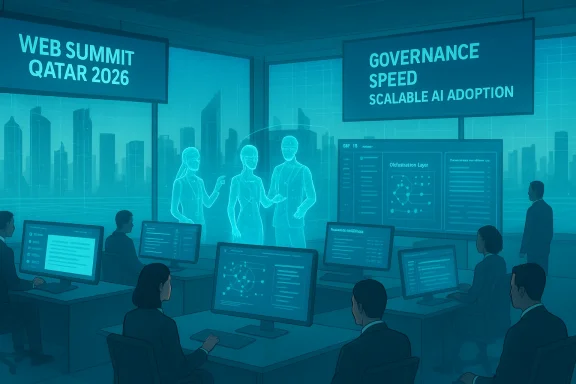
TeKnowledge’s appearance alongside Microsoft at WebSummit Qatar 2026 signals a practical push to take agentic AI out of the lab and into government and enterprise operations—promising rapid deployments, measurable productivity gains, and a governance-first playbook that aims to align Qatar’s digital ambitions with the operational realities of large-scale AI adoption.
Background / Overview
Qatar’s national strategy for digital transformation—anchored by Qatar National Vision 2030 and reinforced by a flurry of events and national programmes in 2024–2025—has set the stage for public-sector AI adoption at scale. Ministries and national initiatives have prioritized skills, infrastructure, and vendor partnerships to accelerate adoption of productivity tools such as Microsoft Copilot and more advanced agentic AI platforms. The rollout of broad Copilot programmes across government entities is a visible example of that strategy being operationalized.TeKnowledge, a global technology services firm focused on “AI First” transformations, is presenting what it calls enterprise-ready agentic AI at WebSummit Qatar 2026, positioning agent orchestration, governance playbooks, and adoption programs as the bridge from experimentation to production. The company’s messaging stresses speed (agents in weeks, not months), governance, and skilling—three elements public organizations cite as essential for sustainable automation.
What TeKnowledge Is Demonstrating at WebSummit Qatar 2026
TeKnowledge’s showcase is not a single product reveal but a composite story: agentic front ends built on Microsoft Copilot, orchestration layers that chain tools and systems into multi-step workflows, and organizational programs to train and scale user adoption.Key elements on display
- Agent orchestration for end-to-end workflows (procurement, incident remediation, reporting).
- Copilot-led unified interfaces for large employee cohorts, particularly in healthcare and government services.
- Governance, security, and auditability features integrated from day one.
- Skilling and adoption programs designed to create internal champions and sustain usage.
The Claims: Adoption Metrics and Reported Impact
TeKnowledge’s public statements—mirrored in government briefings and syndicated press coverage—list specific, ambitious metrics tied to Microsoft Copilot rollouts in Qatar:- More than 9,000 active Copilot users across government entities.
- Over 1.7 million Copilot-powered actions executed.
- Productivity gains totaling roughly 240,000 work hours saved.
- Function-level improvements reported as HR support time down 84%, financial reporting sped up 66%, and infrastructure monitoring time reduced 87%.
- More than 15,000 professionals trained in phase one, with a phase-two expansion adding 17 additional government and semi-government entities.
Why This Matters for Qatar National Vision 2030
Qatar’s Vision 2030 emphasizes a knowledge-based economy, advanced public services, and human-capital development. Scaling agentic AI in government is attractive because it promises to:- Increase operational productivity across high-volume administrative tasks.
- Improve citizen services through faster processing and more consistent responses.
- Free skilled staff from repetitive work to focus on policy, oversight, and higher‑value tasks.
- Build local capability—technical and managerial—needed for longer-term digital sovereignty.
Technical Architecture and Enterprise-Readiness Checklist
Agentic AI is not a single component: it is an architecture that must integrate identity, data grounding, tool access, observability, and human‑in‑the‑loop governance. Based on vendor materials and industry best-practice calls found in the reporting, enterprise-readiness should be judged against a concrete checklist:- Identity-bound agents and scoped credentials so agents never operate with broader privileges than necessary.
- Grounding and contextual data layers that ensure decisions are based on fresh, validated enterprise data rather than generic web content.
- Immutable logging and tamper‑resistant audit trails retained for compliance windows required by law or policy.
- Model provenance and dataset lineage to allow tracing of outputs to the training or grounding sources that influenced them.
- Monitoring, anomaly detection, and fail‑safe escalation that route uncertain or high‑impact decisions to humans automatically.
Use Cases Highlighted by TeKnowledge — Concrete and Strategic
TeKnowledge has publicised several government-grade use cases that illustrate where agentic AI can deliver measurable returns:- Unified Copilot interface for healthcare workflows: consolidating administrative tasks for thousands of health staff to reduce process friction and speed care coordination.
- Nationwide community feedback analyzer: an AI-driven pipeline that aggregates and synthesizes citizen input to inform policy design and service improvements.
- Intelligent Procurement Assistant: automating steps across tendering, vendor evaluation, and compliance checks to shorten procurement cycles and increase transparency.
Strengths in TeKnowledge’s Approach
- End-to-end adoption focus. TeKnowledge emphasizes skilling and change management as a first‑class part of the offering—training thousands and creating internal champions rather than merely delivering code. This is the kind of programmatic approach that increases the odds of sustained adoption.
- Integration with Microsoft stack. For organizations already standardized on Microsoft 365 and Azure, the integration path offers practical advantages: identity, policy enforcement, and cloud infrastructure are already present, reducing friction for rollout.
- Repeatable playbooks for high‑value workflows. Templates for procurement, HR, and monitoring accelerate deployments and allow organizations to replicate learnings across departments.
Real and Potential Risks — What CIOs and Policymakers Must Watch
Agentic AI introduces new classes of operational and governance risks that differ in kind—not just degree—from prior automation projects.1. Measurement and transparency risk
Headline productivity figures (tasks executed, hours saved) can create momentum but also obscure how measurements were taken. Without published methodologies—baseline definitions, task granularity, and validation approaches—numbers should be treated as program-reported indicators, not independently audited fact.2. Vendor lock‑in and portability
A tightly coupled Copilot-plus-agent stack accelerates deployment but can create dependency on a single vendor for runtime, updates, and feature direction. Contracts must include clear data and artifact exportability—including agent definitions, logs, and training artifacts—to permit migration or multi‑vendor resilience.3. Accountability and legal exposure
When agents inform policy decisions or execute procurement steps, governments must be able to explain and, if necessary, reverse automated actions. This requires immutable audit trails, human‑in‑the‑loop gates for critical decisions, and well‑defined redress paths for affected parties.4. Operational safety and “automation surprise”
Agentic systems can behave unpredictably when faced with rare edge cases or when contextual grounding is incomplete. Monitoring, confidence thresholds, and automatic escalation are essential to limit surprise actions that could have reputational or financial consequences.5. Skills gaps and change fatigue
Training 15,000 people is a major initial investment, but sustained success requires ongoing skilling, refresh cycles, and governance teams. Otherwise, early adoption can degrade into shadow processes or inconsistent usage patterns.Practical Guidance: How to Move From Pilot to Safe, Scalable Agentic AI
For IT leaders and policymakers evaluating agentic AI adoption, the following roadmap condenses practical best practices from implementation playbooks and the lessons emerging from Qatar’s early programmes.- Start with well‑scoped pilots:
- Define a single, measurable business objective (time-to-complete, error rate reduction, cost per transaction).
- Limit scope to a single department with a clear baseline measurement period.
- Build governance before granting privileges:
- Define approval gates, audit trail retention periods, and human escalation triggers for high‑impact actions.
- Insist on portability and contractual safeguards:
- Require exportable agent definitions, logs, and configurations; mandate runbooks and vendor exit plans.
- Instrument measurement and third‑party validation:
- Move beyond modeled hours-saved estimates to instrumented process metrics and, where possible, independent evaluation of claims.
- Harden identity and data controls:
- Use scoped, ephemeral credentials for agent actions; separate duties for agent operators vs. approvers.
- Deploy monitoring, drift detection, and rollback capability:
- Implement continuous observability to detect behavior drift, and build fast rollback or quarantine mechanisms.
- Plan for continuous skills development:
- Complement initial training cohorts with ongoing tracks, community-of-practice channels, and internal certification for champions.
- Prioritize citizen transparency:
- For public-facing decisions, include labels indicating AI involvement and clear appeal/redress procedures.
Sector-by-Sector Considerations
Healthcare
Agentic workflows in healthcare offer immediate administrative wins—streamlining scheduling, billing, and clinical documentation support—but require the highest standards for data residency, consent, and clinical governance. Agents that touch patient records must be auditable and subject to clinician sign‑off for diagnostic or treatment decisions.Procurement and Finance
Procurement automation can increase transparency and speed. But procurement rules and anti‑corruption safeguards demand immutable audit trails and the ability to demonstrate that agent recommendations adhered to procurement law and evaluation criteria. Agents should assist recommendations rather than replace adjudication for high-value contracts.Citizen Services and Policy Design
Analyzers that synthesize citizen feedback can surface patterns policymakers would otherwise miss. Yet where agent-driven insight informs policy choices, governments must ensure traceability, bias assessments, and publishing of methodology so policy decisions remain defensible and publicly accountable.Market Implications and the Competitive Landscape
The agentic AI push creates a competitive triad:- Cloud platform providers embedding agent orchestration into their ecosystems (speed to deploy).
- System integrators and managed service providers (like TeKnowledge) offering end‑to‑end implementation, governance templates, and adoption programs.
- Niche startups building industry‑specific agents for healthcare triage, procurement automation, or regulatory compliance.
What the Qatar Example Teaches the Region
Qatar’s Adopt Microsoft Copilot programme and partner-backed agentic pilots offer a replicable blueprint for other countries: pair infrastructure and licensing with large-scale training, define measurable KPIs, and expand iteratively from high-value use cases. However, the programme also surfaces the need for transparent measurement frameworks and contractual safeguards to prevent dependency and ensure public accountability.Practical lessons for regional planners:
- Invest in local skilling and certification programs alongside cloud and compute capacity.
- Publish measurement frameworks for major public‑sector AI programmes to build trust and enable independent evaluation.
- Frame vendor contracts around data portability, audit access, and local capacity transfer.
Critical Caveats and Verifiability
Many of the headline metrics in vendor and government releases are consistent and persuasive, but independent verification is limited in the public domain. Key claims—such as the precise calculation behind “240,000 work hours saved” or the distribution of the 1.7 million Copilot actions across sensitive versus routine tasks—are not accompanied by publicly accessible methodologies. Procurement and oversight teams should insist on transparent measurement protocols and third‑party evaluation for major programme expansions.Conclusion
TeKnowledge’s WebSummit Qatar 2026 showcase is both a milestone and a reminder. It is a milestone because the region now has concrete, scalable playbooks for moving from Copilot pilots to agentic production systems—packages that combine orchestration, governance, and training to deliver measurable business outcomes. It is a reminder because real transformation requires persistent attention to measurement transparency, portability, and public accountability.For Qatar, aligning agentic AI initiatives with Vision 2030 offers a clear pathway to improved government productivity and better citizen services. For IT leaders and policymakers across the region, the imperative is to match speed with structure: adopt fast where the business case is clear, but require robust governance, auditability, and exit options as the price of scale. When those conditions are met, agentic AI can be a powerful lever for national digital transformation; when they are not, fast adoption risks producing fragile, vendor-dependent systems that complicate—not simplify—public administration.
Source: Gulf Times Advancing Qatar National Vision 2030: TeKnowledge Brings Enterprise Ready Agentic AI to WebSummit Qatar 2026
