

Enterprises across the Middle East and beyond are pouring money into automation and artificial intelligence, but the story is no longer about whether automation works — it’s about how organisations fail to convert pilots into durable, enterprise-scale value. Daniel Dines, UiPath’s founder and CEO, puts the diagnosis bluntly: the breakdown rarely lies in technology capability or ambition, but in how organisations approach scale, governance and orchestration — the hard, unglamorous work that turns promising pilots into repeatable business outcomes.
Enterprise automation has matured fast. Early robotic process automation (RPA) solved narrow tasks; today, agentic AI — systems that can take multi-step actions, reason across documents, and coordinate with humans — promises to broaden that scope dramatically. Vendors respond by packaging orchestration, governance, and model management into unified platforms that claim to make “automation at scale” achievable across finance, operations, customer service and compliance. UiPath’s roadmap is an archetype of that strategy: a unified control plane for robots, AI agents and humans, an Automation Cloud offering tuned for local data residency, integrated test tooling, and governance features marketed as essential for regulated use cases. That market reality is visible in two converging trends:
UiPath’s platform play (Automation Cloud in-region, Test Cloud, AI Trust Layer, partners and certifications) maps directly to the barriers enterprises report. Those moves reduce procurement friction and provide governance accelerators, but they do not replace disciplined engineering and change management. Certifications like ISO/IEC 42001 add an important layer of independent assurance, and regional cloud availability reduces legal friction — yet both are complements to, not substitutes for, rigorous operational practice. For IT and business leaders the pragmatic path is clear:
Source: Gulf Business UiPath CEO on what breaks enterprise automation programmes
 Background / overview
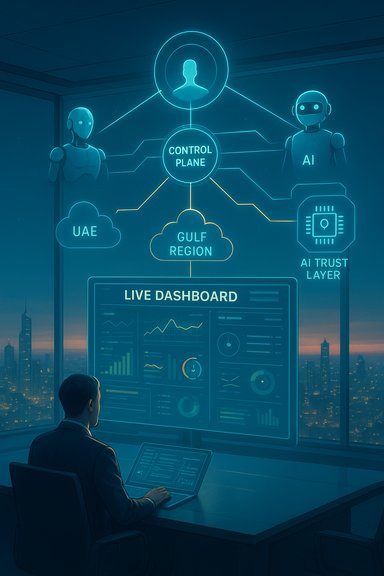
Enterprise automation has matured fast. Early robotic process automation (RPA) solved narrow tasks; today, agentic AI — systems that can take multi-step actions, reason across documents, and coordinate with humans — promises to broaden that scope dramatically. Vendors respond by packaging orchestration, governance, and model management into unified platforms that claim to make “automation at scale” achievable across finance, operations, customer service and compliance. UiPath’s roadmap is an archetype of that strategy: a unified control plane for robots, AI agents and humans, an Automation Cloud offering tuned for local data residency, integrated test tooling, and governance features marketed as essential for regulated use cases. That market reality is visible in two converging trends:- Vendors moving from point tools to platforms that promise orchestration, audit trails and lifecycle management.
- Customers shifting their sponsorship from IT alone to finance leaders (notably CFOs) and risk/compliance functions that prioritise measurable, bottom-line outcomes.
What breaks enterprise automation programmes
1. Treating automation as isolated point projects
Organisations often treat automation like a task-by-task procurement exercise: a department buys a point solution for a recurring problem, gets a visible win, then struggles to replicate that success elsewhere. The result is a landscape of disconnected pilots and brittle bots that deliver islands of efficiency but no systemic ROI.- Why this fails: Most enterprise processes — from procure-to-pay to claims handling — share repeatable steps. Siloed wins miss reuse potential and create maintenance overhead. Orchestration is the multiplier that converts local wins into enterprise leverage.
2. Choosing low-impact use cases
Pilot projects often focus on convenience over impact. High-visibility but low-value automation can produce optimistic dashboards while failing to move the bottom line. Under economic scrutiny, these projects are vulnerable to cuts.- Why this fails: Without measurable financial outcomes (cost per transaction, time-to-resolution, error reduction), automated pilots are easy to deprioritise. CFO sponsorship typically arrives only when pilots connect to the P&L in observable ways.
3. Underestimating orchestration and AgentOps
As organisations introduce LLM-powered agents that can act across systems, the need for orchestration — a centralized control fabric that coordinates agents, robots and humans — becomes the single most important scaling problem. Without orchestration, agent sprawl, privilege creep, unpredictable costs and auditing gaps multiply rapidly.- Why this fails: Agents behave non-deterministically. Treating them as simple scripts ignores lifecycle needs: identity, least privilege, observability, SLOs and runbooks. Organisations must build AgentOps the way they run any production service.
4. Weak governance, data leakage and regulatory blind spots
Data residency, encryption, lawful access, and auditable trails are not “nice-to-haves” for regulated industries — they are preconditions for scaling. Many pilots fail because their governance model does not scale with the reach and autonomy of agents.- Why this fails: Residency alone does not equal sovereignty; contracts, CMK options and real SLA commitments must be validated. Enterprises must insist on auditable logs, immutable provenance and recovery plans.
5. Human factors and change management
Technical success does not guarantee adoption. Shadow AI (employees using consumer tools), lack of reskilling, and misaligned incentives (rewarding launches rather than outcomes) kill many otherwise successful automations.- Why this fails: Automation projects need workforce development and role redesign built in — not tacked on. The organisations that win pair pilot engineering with reskilling, redeployment pathways and clear outcome metrics.
UiPath’s platform response: orchestration, governance and in-region infrastructure
UiPath has positioned its product strategy squarely on three pillars: centralised orchestration, governance for agentic AI, and regional cloud presence to satisfy data residency and sovereign requirements. The company’s public messaging and product announcements emphasise the need for a unified control plane to coordinate robots, agents and humans — a response to the failure modes listed above. Key elements of UiPath’s approach include:- A unified platform that supplies agent runtimes, Maestro orchestration, Action Center (human exception management), and an AI Trust Layer for model selection and policy enforcement. This approach aims to avoid the “fragmented point tools” trap.
- Automation Cloud in the UAE (Azure integrated) to meet local data residency and sovereign policy needs, shortening procurement cycles for Gulf public and private sector customers. UiPath’s regional cloud availability includes the platform, LLM gateway, Document Understanding and governance modules.
- Enterprise-grade compliance and third-party certification — including an ISO/IEC 42001 certification for their AI management system — positioned as independent proof that they have governance embedded across the platform rather than bolted on.
- Partnerships and connectors (for example, an integration service connector with NVIDIA) that aim to make generative model capabilities available within high-trust, on-prem and air-gapped environments. This is tailored for industries with strict controls.
Canon’s invoice project: a concrete example of how to convert pilot wins
Canon USA’s finance team faced up to 5,000 vendor invoices monthly, many paper-based and low-value, creating a high-touch, error-prone process. Working with UiPath Document Understanding and partner Greenlight Consulting, Canon moved from legacy regex extraction to a ML-driven extraction + Action Center exception flows. The result: less than nine months after deployment Canon processed roughly 40,000 invoices (around 4,500 monthly) and achieved about 90% straight-through processing, exceeding an initial 75% goal. That freed roughly 6,000 staff hours and allowed the team to redeploy staff to higher-value tasks. Why this matters:- The Canon case is a textbook example of picking a high-frequency, measurable use case where automation reduces unit cost and error rates.
- It combined document understanding, exception management and ERP integration — showing that automation success depends on integrating AI with deterministic orchestration, not just replacing a human with an LLM.
- It also illustrates why CFOs are natural champions: the business case was straightforward and measurable, so financial sponsorship followed.
The CFO-led automation thesis
UiPath and multiple industry practitioners note an observable shift: CFOs increasingly sponsor automation programmes. The reasoning is practical:- CFOs measure outcomes end-to-end and think in terms of cash flow, cycle time, and error-driven costs — the exact levers that automation moves.
- Finance processes are often high-volume, rule-based and audit-sensitive — fertile ground for automation that produces verifiable ROI and audit trails.
- When finance leads, projects tend to focus on measurable KPIs and enterprise-wide reuse, which helps avoid low-impact pilots.
Middle East strategy and sovereign concerns
The Gulf’s mix of large legacy estates and ambitious national AI strategies creates both opportunity and complexity. UiPath has:- Launched Automation Cloud integration with Microsoft Azure in the UAE to unlock local data residency for agentic AI workloads and to address procurement preferences for in-country infrastructure.
- Opened local offices (including Riyadh) and launched regional skilling initiatives (e.g., bootcamps) aimed at building talent and easing adoption friction. Those investments align with national AI plans and the region’s regulatory focus.
Partnerships and certifications: do they solve the core problems?
UiPath highlights two credibility plays:- ISO/IEC 42001 certification of its AI management system — framed as independent validation of governance across the platform. That is a meaningful signal: certification requires scope, controls and audit evidence performed by an external auditor. But certification is not a panacea — it proves process, not perfect outcomes — and should be a procurement checkpoint, not the sole acceptance criterion.
- NVIDIA integration connector for bringing generative AI features into high-trust environments, including on-prem and air-gapped setups. This helps regulated customers who need local inference and hardware-accelerated performance. It’s an important technical capability, but enterprises must still design validation, drift monitoring and cost controls for any model-in-the-loop automation.
Risks that still matter — and how to mitigate them
The platform moves address many barriers to adoption but also surface new failure modes. Key risks and practical mitigations:- Risk: Agent sprawl and privilege creep.
- Mitigation: enforce Entra (or enterprise IAM) identities for agents, implement automated attestation and retirement policies, and adopt least-privilege by default. Instrument attestation checks into the CI/CD pipeline for agents.
- Risk: Runaway model invocation costs.
- Mitigation: simulate token/invocation costs in pilot, implement model routing tiers (high-quality vs low-cost fallbacks), and apply quotas and chargebacks to business units before scaling.
- Risk: Non-deterministic outputs and hallucinations.
- Mitigation: use RAG, schema validation, human-in-the-loop thresholds for high-risk outputs, and robust negative testing suites in UiPath Test Cloud or equivalent testing frameworks.
- Risk: Data residency complacency.
- Mitigation: demand contractual clarity on key custody, subprocessor lists, and lawful access handling; validate that “in-region hosting” meets the exact regulatory definitions required for your sector.
- Risk: Operational maturity gap (AgentOps / SRE).
- Mitigation: treat agents as production software. Define SLOs, runbooks, telemetry, incident response procedures and automated rollback paths. Invest in observability that spans orchestration into model-hosting planes.
A practical 90–day playbook for converting pilots to scale
- Map and prioritise (Week 0–2)
- Inventory candidate processes and pick the top 1–3 by volume, manual hours and error cost.
- Measure baseline KPIs (cost per transaction, MTTR, exception rate).
- Design and pilot (Weeks 2–8)
- Build a narrow pilot with human-in-the-loop gates and explicit production acceptance criteria.
- Include end-to-end orchestration: agent, robot, and human exception flow.
- Simulate model invocation costs and set provisional quotas.
- Validate and govern (Weeks 8–12)
- Use test automation (UiPath Test Cloud or equivalent) to run regression and negative tests.
- Implement IAM, RBAC, audit trails and a model whitelist/blacklist policy.
- Define SLOs and create runbooks for incidents.
- Scale and fund (Months 3–6)
- Make the CFO sponsor the roadmap for cross-department rollout; require measurable P&L outcomes for each expansion.
- Set chargeback rules and cost visibility for business units.
- Institutionalise a Center of Excellence to capture reusable components and maintain design standards.
What to ask a vendor before you buy
- Where will my data and logs actually reside, and who can access them?
- Can you show production metrics (error rates, per-transaction cost, mean time to recovery) from customers in my regulated sector?
- What are the model lineage, prompt logs and artifact-retention controls you provide for audits?
- How do you integrate with enterprise IAM and enforce least-privilege for agents?
- What is your runbook for model drift, hallucination reports and high-severity mis-executions?
Conclusion — orchestration is the new battleground
The UiPath story — and the broader automation market — has moved from proving capability to proving repeatability and trust. Daniel Dines’s core point is right: treating automation as islands of point deployments guarantees limited impact. The next wave separates organisations that built orchestration, governance and AgentOps from those that ran out of budget and executive patience.UiPath’s platform play (Automation Cloud in-region, Test Cloud, AI Trust Layer, partners and certifications) maps directly to the barriers enterprises report. Those moves reduce procurement friction and provide governance accelerators, but they do not replace disciplined engineering and change management. Certifications like ISO/IEC 42001 add an important layer of independent assurance, and regional cloud availability reduces legal friction — yet both are complements to, not substitutes for, rigorous operational practice. For IT and business leaders the pragmatic path is clear:
- Start with high-frequency, measurable processes (finance and compliance are natural first steps).
- Fund automation from business outcomes, not feature excitement, and put the CFO or equivalent outcome owner in the driver’s seat.
- Treat agents as production services with identity, quotas, observability and runbooks.
- Demand real production metrics from vendors and verify them in your environment.
Source: Gulf Business UiPath CEO on what breaks enterprise automation programmes
