

Chris Avellone's blunt assessment that Bethesda "doesn’t fully understand [Fallout's] roots" has reopened an old wound in the franchise: a recurring split between players who prize the series' original CRPG sensibilities and those who prefer Bethesda's blockbuster, open-world reinventions. His comments — delivered publicly and amplified across gaming outlets this January — are simple, direct, and worth taking seriously because Avellone both helped shape the classic Fallout identity and later steered the franchise’s most widely praised modern entry, Fallout: New Vegas.
Bethesda’s Fallout 3 took a dramatic mechanical and tonal shift: moving the series into 3D first-person/third-person, streamlining skill systems, and emphasizing exploration and spectacle. That shift expanded the franchise’s commercial reach — Fallout 3’s success made Fallout mainstream in a way the earlier games’ critical cult status had not. Fallout 4 and Fallout 76 pushed the tone in different directions: brighter color palettes, more overt comedic beats, and, in the case of Fallout 4, a dialogue wheel and voiced protagonist that many fans saw as narrowing role-playing options. Avellone’s characterization of the modern entries as “theme park” is shorthand for that brighter, spectacle-driven stance.
Bethesda’s strengths in open-world construction and spectacle are real and have paid off commercially and culturally. Avellone’s critique is less about tearing down Bethesda than about insisting that those strengths need to be balanced by mechanics and narrative models that honor the franchise’s role-playing heritage. Whether Bethesda — or any future developer who holds the Fallout reins — chooses to take that advice will determine whether Fallout’s next chapter unites its audience or deepens the split between “theme park” and CRPG faithfuls. For now the franchise sits at a crossroads: its past remains beloved, its present continues to sell and entertain, and its future will depend on whether design leaders listen to voices who built the world they now steward.
Source: Windows Central New Vegas dev says Bethesda doesn't "fully understand" Fallout's roots
 Background
Who is Chris Avellone — and why his opinion matters
Chris Avellone cut his teeth at Interplay and Black Isle Studios in the 1990s, contributing as a designer on Fallout 2 and later co-founding Obsidian Entertainment. He joined Obsidian’s Fallout: New Vegas team as a senior designer and led much of the narrative work on its DLC, making him an authoritative voice on what made the classic Fallout games — and New Vegas — tick. Avellone’s career spans Planescape: Torment, KOTOR II, and many other narrative-first RPGs, and his track record explains why his critique carries weight inside and outside fandom. Avellone’s short public thread — prompted by debate around the Fallout TV series and the franchise's present direction — boils down to two claims. First: Bethesda does not hate Fallout, but it doesn't fully understand its roots and may not care enough to preserve them. Second: Bethesda’s take tends toward a “colorful, shallow theme park” sensibility, though he acknowledges occasional, stand-out DLCs and Bethesda’s strengths in open-world design. Those are pointed but measured criticisms, not a full denunciation of Bethesda’s work.How we got here: Bethesda’s acquisition of Fallout
The series' modern arc pivots on a legal and commercial shift in 2007: Bethesda purchased the Fallout intellectual property from Interplay for approximately $5.75 million. That sale gave Bethesda full control of the brand and ultimately set the stage for Fallout 3, Fallout 4, Fallout 76, and the franchise's expansion into other media. The acquisition is a historical pivot point: it rescued the IP from Interplay's financial crisis but also transferred creative stewardship away from the Black Isle/Interplay circle that produced the originals.What Avellone actually said — and how the industry reacted
The quote and its context
Avellone addressed a fan suggestion that Bethesda might "hate" Fallout. His response: he doesn’t think Bethesda hates the series but argued they "don't fully understand its roots and arguably, don't care — they own the franchise, and they just want to do their spin on Fallout and make that the norm." He then described Bethesda’s output as often translating to “a colorful, shallow theme park” while also recognizing that such design choices appeal to many players and that Bethesda has clear strengths — notably in open-world exploration. Multiple outlets picked up the comment and framed it as part of a broader conversation about tone, fidelity to the franchise’s origins, and the recent television adaptation’s alignment with Bethesda’s established aesthetic. The reaction online has been predictable: veterans of the original CRPGs and New Vegas supporters saw validation in Avellone’s words, while those who enjoy Bethesda’s take (and the wider audience it drew) framed his remarks as a stylistic preference rather than an indictment.Why industry voices care
Avellone’s critique matters because it comes from someone who has worked inside both camps: the isometric CRPG lineage of Black Isle/Interplay and Obsidian’s New Vegas, as well as collaborative ties with the studios that later reshaped Fallout. When a developer who influenced the franchise’s formative mechanics and narrative approach says the modern custodian misunderstands the series, it shifts the conversation from fan nostalgia to an insider appraisal of design philosophy.Fallout then and now: Tonal and structural shifts
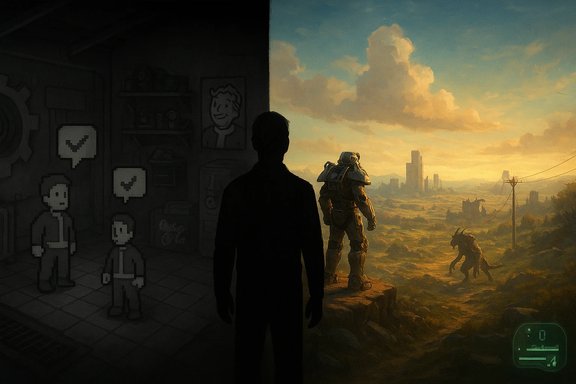
From CRPG desolation to theme-park color
The original Fallout games (Fallout 1 and 2) built a world that married black comedy and political satire with bleak, morally ambiguous scenarios. Gameplay emphasized skills, tactical choices, and conversation systems that supported multiple solutions to problems — the classic CRPG trade-offs that reward different character builds and playstyles.Bethesda’s Fallout 3 took a dramatic mechanical and tonal shift: moving the series into 3D first-person/third-person, streamlining skill systems, and emphasizing exploration and spectacle. That shift expanded the franchise’s commercial reach — Fallout 3’s success made Fallout mainstream in a way the earlier games’ critical cult status had not. Fallout 4 and Fallout 76 pushed the tone in different directions: brighter color palettes, more overt comedic beats, and, in the case of Fallout 4, a dialogue wheel and voiced protagonist that many fans saw as narrowing role-playing options. Avellone’s characterization of the modern entries as “theme park” is shorthand for that brighter, spectacle-driven stance.
- Key shifts between eras:
- Original CRPGs: skill-driven role-play, dense branching dialogue, grim satire and moral ambiguity.
- Bethesda era: first/third-person action focus, broader accessibility, heavier reliance on open-world systems and spectacle.
- Newer media (TV): tone often leans into humor and heightened absurdity, reflecting Bethesda’s modern aesthetic choices.
Structural differences: branching depth and player agency
New Vegas is widely cited as the franchise's most faithful heir to CRPG mechanics because of its dense branching quests, faction interplay, and choice-driven outcomes. Critics and players often contrast New Vegas’s nuanced faction systems and moral ambiguity with Bethesda’s more streamlined, on-rails storytelling in Fallout 4, where the main quests funnel players into a smaller set of outcomes and the dialogue system constrains expressiveness. Avellone’s criticism that Bethesda “does badly” at telling linear stories inside open worlds and mishandles speech/skill systems resonates with critiques that the modern Fallout entries sacrificed some role-playing complexity for accessibility and cinematic direction.What Avellone praises — and where he’s fair
Recognizing Bethesda’s strengths
While critical of tone and scriptcraft, Avellone explicitly acknowledged Bethesda’s strengths, particularly "open world exploration." This is not lip service: Bethesda’s technical and design expertise in delivering expansive, emergent open worlds is a central part of why Fallout 3 and Fallout 4 reached so many players. Vast, explorable spaces, memorable environmental set-pieces, and strong systems for player discovery remain Bethesda’s comparative advantage. He also singled out specific DLCs and exceptions where Bethesda’s work aligned more with the franchise’s darker or more interesting possibilities — Far Harbor, Point Lookout, and The Pitt — pointing to moments where the studio produced more substantial, thematically weighty narratives. Those DLCs are often noted by critics and players as standout attempts at recapturing the franchise’s more serious, moody, or unsettling elements.Admission of nuance
Importantly, Avellone stopped short of blanket condemnation. He acknowledged that “theme parks are fun for some folks,” and that every development team has trade-offs. That caveat matters: it frames his critique as a design-oriented assessment rather than a cultural attack. He’s arguing for fidelity to a set of mechanical and narrative principles he helped build, not for the abolition of Bethesda’s successful formula.Technical and design critiques worth unpacking
1) Dialogue systems and the spoken protagonist
Fallout 4 introduced a voiced protagonist and a condensed dialogue wheel — changes intended to make cinematic storytelling more immediate and emotionally resonant. Developers argued the approach improved narrative beats; critics and many long-time players countered that it reduced the granularity of role-play and removed many stat- or skill-gated solutions that rewarded character specialization. The trade-off is real: voice acting and cinematic pacing can heighten specific story moments, but they also incur a high development cost and often require simplifying branching dialogue to remain viable for recorded performance. That simplification matters for an RPG whose identity was once built on how you could talk your way or skill your way through problems.- Consequence: fewer meaningful skill checks tied to diverse stats; more binary outcomes tied to charisma/perks or scripted prompts. Many players report that the illusion of choice is stronger than the reality of divergent outcomes in Fallout 4.
2) Open world vs. authored narrative tension
Bethesda’s open-world design excels at environmental storytelling and emergent moments, but critics say the studio struggles when asked to deliver tight, branching, authored narratives that respect player decisions across a sprawling world. Avellone’s critique about Bethesda “telling linear stories in open world games” echoes a broader industry discussion: open worlds and authored branching stories are expensive to harmonize, and many successful implementations favor one approach over the other. Fallout: New Vegas tackled this challenge by building dense, player-responsive quest chains in a smaller, more compact map context; Bethesda scaled in the opposite direction.3) Speech and skill mechanics underutilized
Avellone and many fans point to the diminished role of the Speech skill (and other non-combat skills) in Bethesda’s modern Fallout entries. New Vegas and the classic Fallout games made conversation as much a tool as combat or stealth; a high Speech or relevant skillset could unlock unique resolutions. In Fallout 4, that mechanical diversity was curtailed by the dialogue wheel and perk-driven approach, which concentrates resolution into fewer mechanical avenues. Critics argue this reduces role-play variety and marginalizes non-combat character builds.The broader ecosystem: TV, remasters, and the future
Fallout on screen: a tone reflection
The Amazon Prime Fallout series — shaped in part by the visual and tonal template contemporary Bethesda games established — has amplified debates about the franchise’s modern voice. Showrunners and cast have emphasized the series’ dark comedy and absurdist elements; reviewers and fans remain split over whether that humor honors Fallout’s satirical roots or flattens the darker thematic bite. For many viewers, the show’s tonal oscillation mirrors the games: wry humor set against bleak, often political, underpinnings. But critics argue the adaptation favors the lighter, more accessible aesthetic that some say is now mainstream Fallout.Remasters and legacy releases: a partial remedy
The appetite for more faithful experiences has pushed publishers to revisit older games. Remasters and re-releases of New Vegas and Fallout 3 have been discussed and, in some cases, announced, giving players a chance to re-experience or discover the CRPG-style approach in a modern environment. These projects — when executed respectfully — can serve as both preservation and market testing for whether a “New Vegas-style” mainstream sequel would find a broad audience.Fallout 5: hope, speculation, and risk
Avellone’s comments are often packaged with a common refrain from the community: “Make Fallout 5 more like New Vegas.” That desire is understandable, but also simplistic. Re-centering the franchise around smaller, denser, branching narratives with sophisticated skill interplay is both a creative and a commercial gamble. Bethesda is now part of a larger corporate structure and faces different expectations than Obsidian did in 2010. If Bethesda chooses to blend New Vegas’ design virtues with its core strength in expansive, systemic worlds, the result could be the franchise’s healthiest evolution. If not, the risk is stagnation and a growing identity split between franchise enthusiasts and the broader audience that enjoys Bethesda’s approach. Any forecast here is speculative: publicly available evidence about Fallout 5’s design intentions remains limited. Where claims about the next game are made, they should be treated as provisional.Practical takeaways for players and industry watchers
- For players who want deep role-playing, branching outcomes, and conversation as a tool equal to combat: Obsidian’s New Vegas (and the early Interplay titles) remain the benchmark to revisit. Newer remasters and mods can help modernize those experiences without changing their DNA.
- For players who value open exploration, emergent moments, and environmental spectacle: Bethesda’s Fallout games continue to deliver strong, explorable worlds where incidental storytelling shines. Expect that to remain Bethesda’s staple.
- For developers: reconciling authored branching narratives with systemic open worlds is a hard design problem. Dev teams should explicitly choose trade-offs and communicate them to players; hybrid designs require resources and discipline that studios must plan for early. Avellone’s critique is, at heart, a reminder that mechanics and tone are inseparable in defining an RPG franchise.
Critical analysis: strengths, limitations, and risks in Avellone’s claim
Strengths of the critique
- Insider credibility: Avellone’s history across both eras lends legitimacy to his reading of Bethesda’s design choices. He’s not offering nostalgia alone; he’s pointing to tangible mechanics and scripting decisions that changed the franchise’s DNA.
- Focused, actionable observations: His critique targets specific systems — dialogue architecture, speech utility, and narrative structure — that are concrete levers studios can adjust without rewriting the IP’s aesthetics.
Limits and caveats
- Audience segmentation: Bethesda’s changes broadened Fallout’s audience. What some long-term fans perceive as dilution, others experience as accessibility and a welcome tonal shift. Avellone’s remarks foreground purity of lineage, which is a valid perspective but not the only metric for success.
- Commercial realities: Game production is constrained by budgets, timelines, and platform considerations. Recording a voiced protagonist or building hundreds of unique voice-acted branches for complex dialogue trees is expensive; some design decisions are economic as much as artistic. Avellone recognizes trade-offs, but the constraint remains real for any studio trying to reconcile both aims at scale.
Risks if the industry ignores the critique
- Alienation of core fans: If future titles continue to deprioritize mechanical role-play depth, the franchise risks fracturing into two audiences: the broader mass market and an increasingly marginalized core that only sees its preferred Fallout in remasters and mods.
- Narrative flattening: Over-reliance on spectacle and joke-driven tone can erode the franchise’s capacity for political satire and moral complexity, which historically gave Fallout its sharpest cultural edge. Avellone’s warning is effectively a plea to preserve the dark, satirical teeth of Fallout — a characteristic that made the series culturally resonant in the first place.
Conclusion
Chris Avellone’s observation that Bethesda “doesn’t fully understand [Fallout’s] roots” is a headline-worthy provocation precisely because it singles out technical, design-level choices that have reshaped a franchise beloved for its moral ambiguity, branching choices, and conversational gameplay. The larger story isn’t a feud; it’s a design dilemma the entire industry faces: how to reconcile dense, player-driven role-playing with cinematic, broadly accessible open-world design.Bethesda’s strengths in open-world construction and spectacle are real and have paid off commercially and culturally. Avellone’s critique is less about tearing down Bethesda than about insisting that those strengths need to be balanced by mechanics and narrative models that honor the franchise’s role-playing heritage. Whether Bethesda — or any future developer who holds the Fallout reins — chooses to take that advice will determine whether Fallout’s next chapter unites its audience or deepens the split between “theme park” and CRPG faithfuls. For now the franchise sits at a crossroads: its past remains beloved, its present continues to sell and entertain, and its future will depend on whether design leaders listen to voices who built the world they now steward.
Source: Windows Central New Vegas dev says Bethesda doesn't "fully understand" Fallout's roots
