
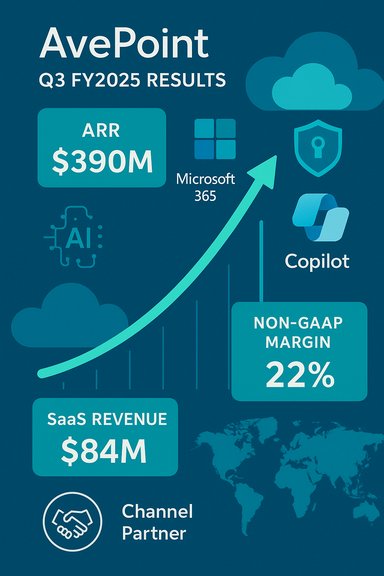
AvePoint’s third quarter fiscal 2025 results landed as a clear operational milestone: total revenue topped $109.7 million, SaaS revenue accelerated to $84.0 million (up 38% year‑over‑year), ARR reached $390.0 million, and non‑GAAP operating income expanded to $24.1 million (a 22.0% non‑GAAP operating margin) — a combination that prompted management to raise full‑year guidance and that analysts framed as validation of the company’s shift to a SaaS‑first model.
AvePoint is a Microsoft‑ecosystem specialist that sells data protection, governance, migration and resilience software across Microsoft 365 and adjacent cloud platforms. For years the company has been deliberately migrating its revenue base from perpetual and maintenance models into recurring, cloud‑delivered SaaS subscriptions — a transition that changes both revenue predictability and unit economics. That strategy underpins the significance of Q3: the quarter shows the recurring revenue engine gaining scale while the company begins to capture operating leverage.
The market for data governance, backup and compliance tools is heating up for reasons that matter to AvePoint’s product roadmap: enterprises are adopting generative AI features, expanding cloud footprints, and demanding stronger auditability and data residency controls. Vendors that combine governance, classification, backup and compliance within Microsoft‑centric workflows find a clear addressable market. AvePoint’s product suite — organized around Resilience (backup), Control (governance and compliance), and Modernization (migration/productivity) — is positioned to sell into that narrative.
For enterprise customers and Windows‑centric teams, AvePoint’s momentum suggests a more mature and stable partner to solve modern governance and resilience needs. For investors, the key question is whether Q3 is the start of a multi‑quarter compounding ARR story with sustained margin expansion. The next two quarters will likely answer that question. Caveat: All financial and operational figures quoted above were cross‑checked against AvePoint’s official third quarter 2025 financial release and independent market summaries; where the company’s forward‑looking guidance is referenced, those figures are management projections and should be interpreted with standard caution until realized in subsequent filings.
Source: The Edge Singapore https://www.theedgesingapore.com/ca...-tops-estimates-subscription-growth-and-cost/
 Background
AvePoint is a Microsoft‑ecosystem specialist that sells data protection, governance, migration and resilience software across Microsoft 365 and adjacent cloud platforms. For years the company has been deliberately migrating its revenue base from perpetual and maintenance models into recurring, cloud‑delivered SaaS subscriptions — a transition that changes both revenue predictability and unit economics. That strategy underpins the significance of Q3: the quarter shows the recurring revenue engine gaining scale while the company begins to capture operating leverage.The market for data governance, backup and compliance tools is heating up for reasons that matter to AvePoint’s product roadmap: enterprises are adopting generative AI features, expanding cloud footprints, and demanding stronger auditability and data residency controls. Vendors that combine governance, classification, backup and compliance within Microsoft‑centric workflows find a clear addressable market. AvePoint’s product suite — organized around Resilience (backup), Control (governance and compliance), and Modernization (migration/productivity) — is positioned to sell into that narrative.
The Q3 FY2025 scorecard — verified figures and what they mean
Revenue and SaaS mix
- Total revenue: $109.7 million, up 24% year‑over‑year.
- SaaS revenue: $84.0 million, up 38% year‑over‑year and now the dominant revenue stream.
ARR, retention and customer health
- Annual recurring revenue (ARR) as of quarter‑end: $390.0 million, up 26% year‑over‑year.
Profitability and cash generation
- Non‑GAAP operating income: $24.1 million, reflecting a 22.0% non‑GAAP operating margin (a record reported by management for the company).
- GAAP operating income: $8.1 million for the quarter.
- Cash, cash equivalents and short‑term investments: reported at $472.0 million as of September 30, 2025.
Guidance update
Following the quarter, AvePoint raised its full‑year guidance for revenue and non‑GAAP operating income, signaling management confidence that the outperformance was not one‑off but part of a persistent trajectory toward higher recurring revenue and operating profit. As always with mid‑year guidance raises, the credibility of the move will depend on next quarter’s retention and ARR cadence.Why the quarter mattered — drivers behind the beat
1) SaaS acceleration and ARR scale
SaaS revenue growing 38% while total revenue grew 24% is a positive signal: it shows that the higher‑margin recurring business is outpacing legacy revenue and that customers are increasingly buying subscriptioned, cloud‑native offerings. As recurring revenue becomes a larger share of the mix, the company benefits from revenue visibility and the mechanics of compounding ARR growth.2) Cost discipline and operating leverage
AvePoint reported a record non‑GAAP operating margin in the quarter, which management attributed to tighter expense control combined with a favorable revenue mix. The yardstick here is not just the headline margin but whether the company can sustain investment in product and go‑to‑market while preserving margin expansion. The cash balance provides optionality for continued R&D and partner programs without diluting near‑term profitability.3) Product‑market fit in a changing compliance landscape
The march of AI into enterprise productivity and the corresponding demand for governance, lineage, and data protection elevates the strategic value of AvePoint’s offerings. The company announced product extensions for data protection across commonly used productivity platforms and governance features tied to agent‑led automation, reinforcing the theme that governance and resilience tools are increasingly mission‑critical in modern Microsoft 365 environments.4) Channel and partner execution
AvePoint’s partner program and Microsoft alignment remain important growth levers: partner‑led distribution can scale SaaS adoption faster and more cost efficiently than a direct‑only model. The quarter’s commentary emphasized partner program enhancements intended to accelerate global reach and partner performance. That channel motion helps explain the strong net new ARR reported for the quarter.Strengths — what the quarter validated
- Recurring revenue momentum: Rapid SaaS growth improves predictability and valuation multiple frameworks for the business.
- Impressive ARR growth: ARR up 26% year‑over‑year reflects both new logos and expansion within existing customers.
- Operating leverage in evidence: A 22.0% non‑GAAP operating margin shows the cost base is now benefiting from scale.
- Strong liquidity: Nearly half a billion dollars in cash and marketable securities provides strategic optionality for product investment, M&A or defense against competitive moves.
- Product relevance: Suites that address backup, governance and migration are well positioned as enterprises strengthen data controls for cloud and AI initiatives.
Watchouts and risks — what could temper the optimism
Gross margin pressure and cloud delivery costs
While absolute gross profit increased, both GAAP and non‑GAAP gross margin percentages ticked down slightly year‑over‑year. Management attributes some of this to mix and investments in cloud delivery, but this is a sensitive area: if unit delivery costs rise faster than the company can price for them, margin expansion could stall. Investors should monitor cloud cost per customer and product gross margins in subsequent quarters.Retention and ARR quality
Top‑line ARR growth is only as durable as retention and expansion. AvePoint reports favorable net retention metrics but does not provide full cohort‑level disclosure in every release. If dollar‑based net retention slips or large renewals concentrate ARR, future growth could be more volatile than headline numbers indicate. Independent analysts emphasized that cohort retention by vintage is a key follow‑up.Customer and vertical concentration
Although AvePoint reports geographic and vertical diversification, exposure to large public sector or heavily Microsoft‑centric customers can introduce volatility in procurement cycles and revenue recognition. Concentration risk in a few large customers — if present — would increase execution risk relative to a highly diversified ARR base.Competitive pressure from hyperscalers and platform vendors
Big cloud and platform vendors have steadily expanded built‑in governance, discovery and compliance features. Microsoft itself has increasingly embedded controls into Microsoft 365 and Azure; while those features typically don’t cover the same breadth AvePoint offers, the presence of integrated alternatives can compress pricing and increase the bar for differentiation. AvePoint must continue to demonstrate measurable ROI and deep integrations to maintain pricing power.Execution risk on guidance
Management raised full‑year guidance, which is a positive signal if deliverable. But guidance raises require follow‑through: subsequent quarters must confirm stable retention, repeatable net new ARR cadence and continued margin discipline. Any deviation could re‑inflate investor skepticism.The competitive and market context
AvePoint sits in an ecosystem where three forces interact: hyperscaler feature expansion, specialist vendor depth, and channel‑driven distribution. Each of these forces shapes the competitive landscape:- Hyperscalers (notably Microsoft) can embed baseline governance and compliance capabilities into platform offerings; this increases customer expectations but also raises the level required for vendors to demonstrate incremental value.
- Specialist vendors differentiate on depth, enterprise controls, advanced retention/recovery capabilities, and partner ecosystems. AvePoint’s product breadth across resilience, control and modernization supports cross‑sell and upsell motions.
- Channel partners amplify distribution velocity, especially in large, distributed Microsoft estates where reseller credibility and systems integrator relationships matter. AvePoint’s partner program enhancements aim to capitalize on this channel advantage.
What this means for enterprise IT buyers and Windows‑centric teams
For IT organizations managing Microsoft 365 environments, AvePoint’s Q3 results are a signal that market‑tested governance and backup tooling is moving to a sustainable, subscription basis. Practical implications include:- Shorter procurement cycles for SaaS subscriptions versus capex projects, enabling faster adoption of modern governance controls.
- Improved product roadmaps for AI‑era data governance that integrate with copilot and agent workflows, which can help mitigate model‑training data risks and support lineage/auditability.
- A strengthened partner program that could make localized, managed services for backup and governance more accessible in regional markets.
Valuation and investor implications
From an investor’s perspective, the quarter checks several boxes that typically re‑rate a SaaS company: durable ARR growth, expansionary gross retention, improving margins and a cash cushion. Analysts and market writeups have framed the results as proof that AvePoint’s transition to SaaS is producing the classic SaaS bill of health. However, the market will price persistence, not a single quarter. Key valuation drivers to watch are:- Repeatable net new ARR and cohort retention by vintage.
- Stabilization or improvement of gross margins as cloud delivery scales.
- Guidance follow‑through over the next two quarters.
- Any evidence of customer concentration risk materially affecting ARR volatility.
Practical checklist — what to watch in the coming quarters
- ARR cadence and quarter‑over‑quarter net new ARR figures; look for consistent, repeatable additions.
- Dollar‑based net retention by cohort and vintage; retention >= 110% materially de‑risks growth models.
- Gross margin trends, specifically cloud delivery cost per customer and any change in non‑GAAP vs GAAP gross margin.
- Guidance trajectory and whether management raises or confirms ranges for FY2026.
- Channel rollouts and partner success metrics: new partner signings, partner‑sourced ARR, and international expansion indicators.
- Product announcements that convert into multi‑year contracts or broadenable seat‑based adoption (e.g., governance features tied to Copilot/agents).
Final analysis and conclusion
AvePoint’s Q3 FY2025 marks a meaningful inflection: the company’s SaaS revenue growth, ARR scale and record non‑GAAP operating margin together create a credible case that the business is successfully pivoting to a subscription economics model while concurrently extracting operating leverage. Those are the concrete, verifiable outcomes investors and enterprise buyers care most about. That said, the path forward is execution sensitive. The quarter de‑risks the thesis but does not eliminate execution risk: AvePoint must sustain retention, manage cloud delivery costs that pressure gross margins, and keep expanding ARR predictably. Competitive dynamics inside the Microsoft ecosystem and the broader shift of hyperscalers embedding governance features mean AvePoint must continue to push product differentiation, partner scale and pricing discipline to defend its growth trajectory.For enterprise customers and Windows‑centric teams, AvePoint’s momentum suggests a more mature and stable partner to solve modern governance and resilience needs. For investors, the key question is whether Q3 is the start of a multi‑quarter compounding ARR story with sustained margin expansion. The next two quarters will likely answer that question. Caveat: All financial and operational figures quoted above were cross‑checked against AvePoint’s official third quarter 2025 financial release and independent market summaries; where the company’s forward‑looking guidance is referenced, those figures are management projections and should be interpreted with standard caution until realized in subsequent filings.
Source: The Edge Singapore https://www.theedgesingapore.com/ca...-tops-estimates-subscription-growth-and-cost/
