

Amazon and Google have quietly rewritten a piece of the cloud playbook by announcing a jointly engineered multicloud networking service that lets enterprises spin up private, high‑speed links between AWS and Google Cloud in minutes — a move that promises to lower operational friction for hybrid AI and data architectures while forcing IT teams to rethink resilience, procurement and security for multicloud deployments.
In late November 2025, AWS and Google Cloud revealed a cooperation that pairs AWS Interconnect - multicloud (Preview) with Google Cloud’s Cross‑Cloud Interconnect to deliver a managed, private transport between their platforms. The product is shipping in preview and is positioned as a cloud‑native alternative to the traditional, labour‑intensive practice of ordering and stitching circuits, routers and carrier contracts across providers. Both vendors say the solution includes an open specification so other clouds and network operators can adopt the same interoperability APIs. This announcement arrives against a context of rising enterprise multicloud adoption and recent high‑visibility outages that have sharpened conversations about vendor concentration risk. The idea is straightforward: make the underlying network plumbing between clouds deterministic, encrypted and fast enough for latency‑sensitive use cases such as model training, inference pipelines, database replication and disaster recovery. Early customer mentions — notably Salesforce — underline how SaaS vendors and data platforms expect to benefit from deterministic links for integrated services and AI workflows.
For Windows administrators, the announcement offers practical opportunities: lower‑latency AD replication, improved SQL Server hybrid replication, and more predictable VDI backends. But the work begins after the marketing: test, measure, inscribe the agreements into procurement, and harden control‑plane fallbacks.
This cooperation is also a bellwether: hyperscalers are now willing to codify cooperation to remove friction for customers, and that will reshape buying patterns, procurement negotiations and regulatory conversations in 2026 and beyond. The immediate advice is pragmatic — test early, require contractual transparency, and design multicloud resilience with the same rigor applied to single‑cloud architectures.
Conclusion
The joint AWS–Google multicloud interconnect is a practical innovation that materially lowers the operational barrier to building cross‑cloud systems, especially for AI, analytics and latency‑sensitive workloads. It is neither a panacea nor a new layer of lock‑in by itself — instead, it is a strategic tool that should be tested, measured and negotiated into procurement. Windows teams stand to gain from improved determinism and simpler operations, but they must retain a disciplined focus on control‑plane resilience, billing transparency and legal compliance to convert the promise of minutes‑to‑provision into reliable, auditable production practice.
Source: CIO Dive AWS, Google link up to ease multicloud deployments
 Background
In late November 2025, AWS and Google Cloud revealed a cooperation that pairs AWS Interconnect - multicloud (Preview) with Google Cloud’s Cross‑Cloud Interconnect to deliver a managed, private transport between their platforms. The product is shipping in preview and is positioned as a cloud‑native alternative to the traditional, labour‑intensive practice of ordering and stitching circuits, routers and carrier contracts across providers. Both vendors say the solution includes an open specification so other clouds and network operators can adopt the same interoperability APIs. This announcement arrives against a context of rising enterprise multicloud adoption and recent high‑visibility outages that have sharpened conversations about vendor concentration risk. The idea is straightforward: make the underlying network plumbing between clouds deterministic, encrypted and fast enough for latency‑sensitive use cases such as model training, inference pipelines, database replication and disaster recovery. Early customer mentions — notably Salesforce — underline how SaaS vendors and data platforms expect to benefit from deterministic links for integrated services and AI workflows. What was announced — high level
- A jointly engineered multicloud networking capability combining AWS Interconnect - multicloud (Preview) and Google Cloud’s Cross‑Cloud Interconnect for AWS (partner preview) to provide private, dedicated bandwidth between VPCs and comparable constructs.
- An open API / specification published for adoption by other cloud providers, partners and network operators; the goal is to standardize the control plane for cloud‑to‑cloud links.
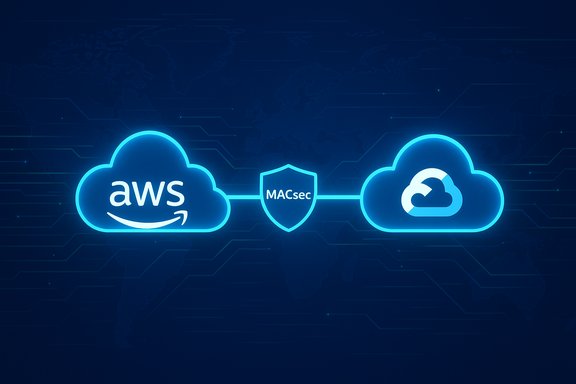
- Preview availability with explicit technical claims: on‑demand provisioning in minutes, bandwidth starting at 1 Gbps in preview and scaling toward 100 Gbps at GA, and MACsec encryption between provider edge routers.
- Roadmap signal that Microsoft Azure is expected to join an implementation based on the published specification in 2026, expanding the potential to three major clouds.
Technical deep dive — how the product works
Architecture and control model
At a high level the solution abstracts the physical interconnect into a managed cloud resource that vendors pre‑stage in paired edge locations (points of presence, or POPs). Customers interact through familiar console or API flows to:- Specify the target cloud provider and destination region or VPC.
- Choose a bandwidth attachment from pre‑built capacity pools.
- Receive a single logical attachment that represents the cross‑cloud capacity and routing object.
Security — MACsec and cryptographic posture
Both vendors state the interconnect uses MACsec on the link between the provider edge routers to provide link‑level confidentiality and integrity. That addresses an often‑cited weakness of public internet transfers and avoids the need for customers to operate their own encrypted overlay in many common cases. However, MACsec protects the physical segment; customers are still responsible for end‑to‑end encryption, key management and access controls for application data.Performance and scale
Google’s public announcement frames preview bandwidth at 1 Gbps with a roadmap to 100 Gbps at GA, while AWS highlights pre‑staged capacity pools and a single logical attachment model to represent capacity. The vendors claim the arrangement reduces latency and jitter compared with internet paths, making it suitable for replication, analytics ingestion and latency‑sensitive inference. Practical throughput and real‑world latency will vary by pair‑of‑POPs, peering fabric and customer topology; the previews are designed to let customers benchmark that performance.Resilience and monitoring
The design emphasizes quad‑redundancy across physically separate interconnect facilities and routing devices, combined with provider‑side continuous monitoring and triage. In other words, the providers are building redundancy into the underlay — but they cannot remove higher‑level service coupling or control‑plane failures that may originate within a single cloud’s managed services. That distinction is critical for architecture and procurement.What this delivers — immediate practical benefits
- Faster provisioning: Organizations can move from multi‑week carrier projects to minutes of provisioning in the cloud console or API, drastically lowering project timelines for migration and burst compute scenarios.
- Deterministic networking: Lower jitter and predictable bandwidth make cross‑cloud replication, database synchronization, and high‑throughput data pipelines more reliable.
- Simplified operations: Removing the need to manage a separate carrier or colo procurement and custom routing scripts reduces operator toil and human error in configuration.
- Security hardening on the link: MACsec encryption reduces exposure on the provider edges compared to the public internet, which simplifies compliance for certain regulated workloads (subject to end‑to‑end controls).
Important limits and caveats — what it does not fix
- Control‑plane coupling remains: Private underlay links do not change each provider’s control‑plane semantics (DNS, managed service APIs, resource quotas or global orchestration). A private link will not prevent a provider’s internal service outage from affecting dependent managed services. Designing for control‑plane failure requires separate fallbacks and governance.
- Not a panacea for vendor lock‑in: While networking friction is reduced, higher‑layer lock‑in (managed databases, serverless platform APIs, identity systems) remains. The interconnect reduces the cost of moving bytes — it does not automatically make services portable at the application level.
- Pricing and billing complexity: Egress, partner resale fees, and preview‑vs‑GA billing treatments may vary by route and region. Vendors have used “no data transfer charges” language for certain contexts in other announcements, but procurement must verify exact fees, partner markups and tax treatments with worked examples. Don’t assume fee elimination without contractual confirmation.
- Operational SLAs for cross‑provider incidents: Joint monitoring reduces finger‑pointing in theory, but customers must scrutinize remedies and whether SLA credits or contractual indemnities cover complex, cross‑provider failure modes. Real outages often involve cascading interactions that require coordinated debugging across multiple organizations.
Implications for WindowsForum readers — practical guidance for Windows admins and architects
Windows environments remain a core enterprise workload, and this announcement has specific impacts for common Windows deployment patterns.Where deterministic cross‑cloud networking helps Windows shops
- Hybrid Active Directory topologies and cross‑tenant trust links benefit from predictable latency and throughput, accelerating directory replication and reducing authentication jitter across clouds.
- Windows‑centric RDS/VDI and Remote Desktop traffic can achieve lower jitter for latency‑sensitive remote sessions when using private interconnects for backend services or session hosts spread across clouds.
- SQL Server replication and hybrid database architectures (e.g., using AWS RDS + Google Cloud analytics) can reduce replication lag and improve consistency windows.
Recommended checklist for pilots and procurement
- Validate GA status and POPs — get a map of supported regions and proof of capacity at your target colo/POP.
- Run an isolated failover test that includes identity and token flows (Azure AD, AD FS, certificate renewals).
- Request worked billing examples and include partner/resale fees in TCO models.
- Confirm encryption responsibilities — if you require customer‑managed keys or application‑level encryption, document who controls what.
- Map observability: ensure logs and metrics from the joint fabric appear in your SIEM/APM and that joint incident escalation paths are contractually explicit.
Security, compliance and data sovereignty considerations
Private interconnects tighten the transport security posture, but they also concentrate audit trails and legal exposures. For regulated data, moving information across jurisdictions via private links still triggers data sovereignty questions and lawful access obligations. Legal teams must approve cross‑border routes and ensure that movement complies with sector regulations (HIPAA, GDPR, FedRAMP where applicable). Operationally:- Maintain tenant‑side encryption and limit privileged network flows to minimize blast radius.
- Treat the interconnect as an additional trusted transit and include it in network segmentation and egress policies.
- Require runbook exchange clauses and post‑incident reporting in procurement to ensure transparency after incidents.
Cost and procurement: read the fine print
Faster provisioning does not translate to lower lifecycle costs. A multicloud strategy that uses private interconnects can increase recurring costs (dedicated bandwidth, partner fees, egress and cross‑product licensing). Procurement and finance teams must:- Build worked scenarios with representative traffic patterns to compare public internet, carrier private peering, and the new managed interconnect options.
- Include testing windows and pilot discounts in early contracts and insist on explicit commitments for capacity and POPs.
- Negotiate operational transparency: post‑incident reports, runbook exchange, and escalation SLAs should be part of any meaningful agreement.
Market and competitive analysis — why this matters
This cooperation is strategically significant for several reasons:- It signals hyperscalers accept that multicloud is normative and that removing friction increases cloud consumption overall. For Google, partnering with AWS lowers sales friction when enterprises treat Google as “the third cloud” for select services. For AWS, it’s a de‑escalation that can broaden enterprise comfort with mixed vendor architectures.
- The move raises the bar for other cloud providers — Oracle, smaller public clouds, and network providers — to either adopt the open spec or provide compatible options. Public comments from analysts expect pressure on rivals to support the open API or risk being excluded from enterprise procurement flows that demand plug‑and‑play interconnectivity.
- For regulators, the open‑spec framing can be a double‑edged sword: it’s a welcome sign of interoperability, but the centralization of interconnect controls into cooperative vendor relationships will draw scrutiny over how openness is enforced and whether pricing remains fair and transparent.
Risks and potential unintended consequences
- False sense of security: Teams may over‑rely on private links as a catch‑all resilience tactic and underinvest in control‑plane fallbacks, runbooks and offline admin access.
- Contractual complexity: Early preview terms and partner resale models can lock customers into ambiguous billing at GA.
- National security and compliance scrutiny: Private cross‑cloud corridors will attract regulator interest in some jurisdictions, especially where national‑security or critical‑infrastructure concerns are present.
- Fragmentation risk: If the spec is adopted inconsistently or if major providers implement incompatible extensions, the intended interoperability benefit may be diluted.
Practical next steps for WindowsForum readers and IT teams
- Map your critical dependencies: Identify which services absolutely require deterministic networking and which can tolerate internet variability.
- Pilot with representative workloads: Use a time‑boxed pilot to measure replication lag, RDS/Cloud SQL behaviour, AD replication and RDP/VDI performance under load.
- Negotiate procurement protections: Ensure testability, measured performance SLAs, and clarity on billing for preview traffic when moving to GA.
- Improve control‑plane resilience: Implement secondary identity paths, local token caches and emergency admin channels that don’t depend on a single cloud provider.
- Update runbooks and drills: Test real control‑plane failure scenarios — not just network outages — and incorporate lessons into vendor contracts.
Final analysis — strengths, tradeoffs and the bottom line
The AWS–Google multicloud interconnect is an important, pragmatic step toward making multicloud patterns operationally feasible for latency‑sensitive, regulated and AI workloads. It reduces a meaningful barrier — the network provisioning and unpredictability that historically made multicloud expensive and fragile — and does so with solid technical primitives (pre‑staged capacity pools, MACsec, quad‑redundant underlay). Both AWS and Google have documented the capability and published initial specifications, which makes the claims verifiable in preview. However, the product is not a universal cure for cloud concentration risk. It addresses transport determinism, not service heterogeneity, API lock‑in, or the complexities of cross‑provider control‑plane failure modes. Buyers must treat it as one tool in a layered resilience strategy that includes contractual protections, control‑plane fallbacks, and disciplined architecture. Pricing and GA feature sets remain to be proven; early pilots and negotiated contractual guarantees will separate useful, cost‑effective deployments from expensive experiments.For Windows administrators, the announcement offers practical opportunities: lower‑latency AD replication, improved SQL Server hybrid replication, and more predictable VDI backends. But the work begins after the marketing: test, measure, inscribe the agreements into procurement, and harden control‑plane fallbacks.
This cooperation is also a bellwether: hyperscalers are now willing to codify cooperation to remove friction for customers, and that will reshape buying patterns, procurement negotiations and regulatory conversations in 2026 and beyond. The immediate advice is pragmatic — test early, require contractual transparency, and design multicloud resilience with the same rigor applied to single‑cloud architectures.
Conclusion
The joint AWS–Google multicloud interconnect is a practical innovation that materially lowers the operational barrier to building cross‑cloud systems, especially for AI, analytics and latency‑sensitive workloads. It is neither a panacea nor a new layer of lock‑in by itself — instead, it is a strategic tool that should be tested, measured and negotiated into procurement. Windows teams stand to gain from improved determinism and simpler operations, but they must retain a disciplined focus on control‑plane resilience, billing transparency and legal compliance to convert the promise of minutes‑to‑provision into reliable, auditable production practice.
Source: CIO Dive AWS, Google link up to ease multicloud deployments
