

Overview
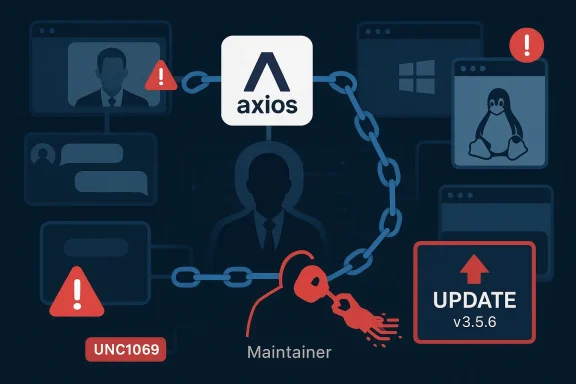
Axios sits in a particularly sensitive place in the JavaScript ecosystem. It is not a niche utility that only a small number of teams touch; it is a dependency that shows up in countless web and Node.js applications, which means any compromise can scale extremely fast. Reports on the incident said the malicious versions were published on March 31 through the maintainer’s compromised npm account and quietly installed a remote access trojan across macOS, Windows, and Linux using a fake dependency. That cross-platform reach is important because it collapses the old assumption that endpoint diversity alone is enough to reduce risk.
The most alarming part is that the attackers did not need to break npm’s signing model or find a deep technical flaw in package publishing. They simply convinced or tricked a trusted maintainer into surrendering access, then used that access to distribute malicious code as if it were a normal update. GitHub warned back in 2023 that North Korea-linked actors were using social engineering and malicious npm dependencies in exactly this way, and the pattern has repeated often enough to become a recognizable playbook rather than a one-off event.
Google’s attribution to UNC1069 matters because it places the Axios incident inside a known operational pattern. In February 2026, Google described UNC1069 as a financially motivated North Korea-linked group that had been active since 2018 and had already adopted AI tools, deepfakes, fake Zoom calls, and Telegram lures to improve its social engineering. That suggests a campaign that is evolving, not static, and one that is increasingly optimized for convincing human beings rather than defeating purely technical controls.
Why Axios became such a high-value target
Axios is one of those packages that developers install almost without thinking. Its weekly download count is enormous, and that ubiquity means even a brief malicious publication window can create a wide blast radius before defenders realize something is wrong. Supply-chain attacks work precisely because developers trust dependency updates as routine maintenance, not as a high-risk event.
The practical lesson is that popularity itself becomes a liability. A package with hundreds of millions of weekly downloads is not just a success story; it is an attractive delivery mechanism for attackers who want to maximize return on a single compromise. In that sense, Axios is not unique, but it is emblematic of the modern open-source economy. Trust is a feature, but at scale it also becomes an attack surface.
The difference between exploitation and persuasion
What makes this incident especially unsettling is that the weak point was not code quality but human judgment. The maintainer reportedly described the intrusion as a well-known collaboration-themed social engineering lure, which aligns with a broader pattern seen in prior campaigns: fake recruiter contacts, phony collaboration requests, and short-lived trust-building conversations that end with credential theft or malicious code execution. In other words, the attacker’s first payload was not malware but a convincing narrative.
That distinction matters because it changes the defense model. Traditional software security can scan artifacts, detect suspicious binaries, and block known indicators, but it is far harder to automate the evaluation of whether a message in Slack, Telegram, or email is psychologically manipulative. The more attackers move into relationship-based compromise, the more security becomes a blend of identity assurance, process discipline, and human skepticism.
Background
Open-source ecosystems have spent years optimizing for speed, collaboration, and frictionless distribution. That has been a tremendous advantage for developers, but it also means that many projects rely on a handful of maintainers who hold unusually powerful publishing rights. When those accounts are taken over, the attacker inherits the project’s trust relationships instantly.
This is why supply-chain attacks have become so attractive to advanced threat actors. They do not need to compromise every downstream victim individually if they can compromise one upstream maintainer and let the ecosystem do the distribution work for them. The same logic has been visible in previous npm-related incidents, including the September 2025 compromise of Chalk and Debug after a phishing attack on a maintainer account. That continuity shows the ecosystem is not dealing with isolated events but with a repeatable economic model for attackers.
The North Korea connection also fits a broader set of observations from Google and Microsoft over the past few years. Both companies have warned that North Korea-linked actors use social engineering to target developers and tech firms, sometimes posing as recruiters or collaborators, and sometimes combining fake repositories with malicious npm packages. The enduring appeal of these tactics is obvious: they scale cheaply, they are difficult to attribute in real time, and they exploit the social norms of open-source work.
A particularly important evolution is the use of AI-assisted social engineering. Google’s reporting from February 2026 said UNC1069 was using deepfakes, fake meetings, and messaging-app lures to impersonate trusted parties more convincingly than before. That does not mean AI is the root cause of the threat, but it does mean attackers can now create more believable pretexts at lower cost and with less manual effort. The bar for a convincing impersonation keeps falling while the consequences of trusting the wrong message keep rising.
A long-running pattern, not a novelty
The Axios case is best understood as part of a familiar arc. First comes reconnaissance, then a social pretext, then the theft of credentials or session access, and finally a malicious publish to a trusted ecosystem. This same broad sequence has shown up in earlier GitHub and npm incidents, which is why defenders have been warning about it for years.
The uncomfortable truth is that these attacks often succeed not because the defenders are unaware, but because the attacker only needs one person to lower their guard once. Even organizations with strong security policies can be exposed if a maintainer’s personal account, device, or workflow falls outside central controls. That gap between organizational security and individual developer habits is where many of these compromises begin.
Why maintainers remain vulnerable
Maintainers are expected to be approachable, responsive, and open to contribution. Those are excellent community traits, but they also create pressure to trust strangers who present themselves as potential collaborators, sponsors, or interviewers. Attackers exploit exactly that combination of openness and urgency.
The result is a threat model that looks almost mundane from the outside but becomes devastating at scale. A compromised maintainer can publish a legitimate-looking release, preserve the package’s normal structure, and rely on automated update mechanisms or developer habits to spread the malicious code. That is a much easier path than building a brand-new malware distribution network from scratch.
The Attack Chain
The published descriptions of the Axios compromise point to a classic account-takeover operation rather than a sophisticated exploit chain. The maintainer said he was tricked by a collaboration-themed social engineering approach and then cleaned up by formatting systems, resetting accounts, and changing his security posture afterward. That kind of remediation is sensible, but it also tells us the initial access likely happened outside the package registry itself, at the human and identity layer.
Once attackers had publishing access, the rest of the operation became much simpler. They pushed two compromised versions of Axios, and those versions reportedly delivered a remote access trojan through a fake dependency. Because the payload was distributed through a trusted project, downstream users were exposed through ordinary update behavior rather than by visiting a suspicious site or opening an obvious malware file.
From trust to execution
This chain is effective because each step borrows legitimacy from the previous one. A maintainer account is trusted, a package update is expected, and a dependency is often allowed through security tools with minimal friction. Attackers abuse those assumptions to turn a routine software maintenance event into a malware delivery event.
That also means the attack can survive in environments that would easily block a standalone trojan. Endpoint controls may flag the final payload if they see it in isolation, but if the code enters through a signed-looking update process, the initial trust signal can override suspicion. In practice, that gives attackers a short but extremely valuable window.
Why cross-platform payloads matter
The reported use of a cross-platform RAT is a major signal of intent. Attackers were not trying to exploit only Windows desktops or only developer laptops; they were trying to maximize compatibility across the heterogeneous environments where npm packages are commonly built, tested, and deployed. That increases the odds of success and reduces the need for environment-specific tuning.
It also complicates incident response. A package that can compromise macOS, Windows, and Linux systems broadens the set of security teams, tooling stacks, and containment procedures that must be coordinated quickly. For organizations with mixed developer fleets, the attack becomes not just a code problem but an operational one.
The role of fake dependencies
Fake or malicious dependencies are one of the oldest tricks in the supply-chain book, but they remain effective because dependency resolution is one of the least visible parts of application behavior. Developers tend to notice direct code changes more readily than a transitive package pull that happens automatically during install. That invisibility is what makes dependency abuse so powerful.
A malicious dependency also creates room for obfuscation. If the main package looks clean, the payload can be buried one layer deeper, making quick review more difficult and automated inspections less reliable. For defenders, that means provenance and dependency hygiene matter as much as signature-based malware detection.
Attribution to UNC1069
Google’s attribution to UNC1069 is significant not just because it assigns blame, but because it ties the Axios operation to a documented cluster with a clear history. The group has been described as financially motivated and primarily focused on cryptocurrency and related targets, which gives context to why software developers and open-source ecosystems are attractive targets. If the goal is access to high-value accounts, assets, or credentials, the software supply chain is an efficient route in.
The February 2026 reporting about UNC1069 also painted a picture of a threat actor that blends old-school social engineering with modern tooling. Google said the group used deepfakes, fake Zoom meetings, Telegram lures, and AI-assisted tactics to push victims into trust decisions that benefited the attackers. That matters because it means the Axios incident should not be dismissed as merely “someone clicked a bad link.” It belongs to a more mature operational pattern.
Why North Korea-linked actors target developers
Developers are uniquely valuable because they sit at the intersection of identity, credentials, source code, and infrastructure. A compromised developer account can expose repositories, cloud tokens, package publishing rights, and internal systems all at once. That makes software engineers an unusually efficient target for threat groups looking for leverage.
North Korea-linked groups have also demonstrated persistence. GitHub’s 2023 warning described low-volume but highly targeted campaigns that used recruiter personas and repository invitations as part of the lure. The fact that these tactics are still working in 2026 suggests the ecosystem has not yet fully solved the identity problem.
The AI layer is an amplifier, not the story
It is tempting to frame every recent cyber incident through the lens of generative AI, but that would oversimplify the problem. In the UNC1069 context, AI appears to be an accelerant for deception, helping attackers create more believable personas and smoother interactions. The core technique remains social engineering.
That distinction is important for defenders because it prevents a false sense of novelty. If organizations focus only on AI-generated phishing text, they may miss the larger issue: a coordinated workflow that combines identity abuse, messaging apps, fake meetings, and dependency compromise. The defense has to be broader than content filtering.
The Maintainer Response
The Axios maintainer’s public response was notable for its simplicity and honesty. He said he had reset all accounts, formatted systems, and planned to adopt a FIDO security key, while also acknowledging that he would be far more suspicious of open-source-related requests in the future. That is an important corrective, because the security lessons here are not abstract; they are operational changes to how one person will interact online from now on.
The decision to move to hardware-backed authentication is especially relevant. Passwords and even software-based second factors can be insufficient when an attacker uses a convincing pretext to capture credentials or session tokens. A physical security key does not solve every problem, but it materially raises the cost of account takeover.
Security hygiene after compromise
There is a reason incident responders often recommend a full reset after account compromise. Once trust has been lost, it is difficult to know exactly what was accessed, copied, or altered before containment began. Rebuilding from a clean state reduces the odds that a lingering token or backdoor remains available to the attacker.
The maintainer’s response also highlights a difficult psychological fact about social engineering: the victim is often acting in good faith right up until the moment they are not. That is why awareness training alone is rarely enough. Security programs need explicit controls that make it hard for a single conversation to turn into a full publishing compromise.
What developers can learn immediately
There are several practical lessons that developers can take from this case. First, treat unusual collaboration requests as high-risk, especially if they move quickly to off-platform chats or meeting links. Second, segment publishing rights and avoid keeping them tied to a single personal account whenever possible. Third, use hardware-backed authentication everywhere it is supported.
Just as important, maintainers should assume that attackers will target the emotional and social dimensions of open-source work. Curiosity, pride in the project, and willingness to help are qualities attackers can weaponize. That is a human problem as much as a technical one.
A short defensive checklist
- Verify collaboration requests through a separate, known-good channel before sharing credentials or joining meetings.
- Require FIDO keys or equivalent phishing-resistant MFA for publish access.
- Split package publishing rights across multiple trusted maintainers where possible.
- Review and minimize transitive dependencies before releases.
- Monitor for unusual package version pushes and publish activity.
- Revoke all active tokens immediately after any suspected account compromise.
Enterprise Impact
For enterprises, the Axios compromise is less about one package and more about the trust assumptions embedded in build systems. Organizations increasingly ingest third-party code automatically, which means an upstream account takeover can become a downstream incident with little or no human approval. That makes software composition management and package provenance central controls rather than optional extras.
Enterprises also need to distinguish between developer convenience and deployment safety. If teams allow unrestricted package updates from the public registry into production pipelines, they may unknowingly turn every dependency refresh into a potential execution path. In that sense, supply-chain defense is not just a security team problem; it is a build-and-release architecture problem.
Identity and publishing controls
Identity is the new perimeter in open source. If a maintainer account can publish to a package used by millions, then access management must be treated with the same rigor as production cloud admin access. Hardware-backed MFA, token rotation, privileged access separation, and publish approval workflows are no longer luxury controls.
The broader implication is that enterprises should assume maintainer compromise is a realistic threat and plan accordingly. That means detection rules for unexpected package changes, alerting on dependency diff anomalies, and controlled staging environments that do more than just install the latest version automatically.
Build pipeline consequences
A malicious dependency can also contaminate artifacts beyond the first machine that installs it. If the compromised package is pulled into CI/CD, it can affect build logs, test systems, developer workstations, and potentially distribution artifacts depending on how the pipeline is structured. That cascading effect is what makes supply-chain compromise so disruptive.
Enterprises should therefore treat package provenance as part of release integrity, not simply as a software procurement concern. The more automated the pipeline, the more important it becomes to insert trust checks at each step. Automation speeds delivery, but it also accelerates compromise when trust is misplaced.
Consumer and Developer Impact
For ordinary users, the Axios story is mostly invisible until it is not. Most consumers never know a dependency package exists, let alone that it was briefly weaponized, but they still inherit the consequences through the applications and services they use daily. That makes this the kind of incident that erodes confidence in the software ecosystem even when the immediate infection count is unclear.
For developers, the impact is much more direct. A compromised open-source package can poison local machines, leak credentials, and create pressure to inspect every install with heightened suspicion. The real cost is not just malware cleanup; it is the loss of the assumption that trusted tooling is safe by default.
Why trust erosion matters
Open source depends on a virtuous cycle of contribution and reuse. When high-profile packages are compromised, that cycle does not break, but it becomes more expensive to participate in. More review, more verification, and more friction are the inevitable result.
There is a trade-off here that is easy to miss. If the ecosystem responds by making collaboration too cumbersome, it risks discouraging maintainers and slowing innovation. If it responds too weakly, it invites more abuse. The challenge is to raise the cost of compromise without destroying the openness that makes the ecosystem valuable.
How this changes day-to-day habits
Developers should expect more malicious impersonation, not less. Fake recruiter messages, collaboration requests, and “quick test” opportunities are now established attack formats, especially when they lead to off-platform communication. A healthy level of skepticism is no longer paranoia; it is basic operational security.
Teams should also review whether their personal accounts are entangled with their publishing rights. The Axios maintainer’s experience shows how one compromised identity can threaten an entire project. Separating personal and project identities, where possible, is becoming a practical necessity rather than a preference.
Strengths and Opportunities
The Axios incident is serious, but it also exposes clear opportunities to strengthen the ecosystem. The good news is that the attack relied on familiar weaknesses, which means defenders already understand many of the countermeasures. The challenge is execution, not awareness.
- Promote phishing-resistant MFA and hardware keys across maintainer communities.
- Add stronger package-publish anomaly detection on registries and CI systems.
- Separate maintainers’ day-to-day identities from release privileges.
- Increase education around social engineering in open-source communities.
- Harden build systems with dependency pinning and provenance checks.
- Encourage rapid incident disclosure so the community can react faster.
- Treat collaboration lures as a security issue, not just a nuisance.
A chance to improve the norm
There is an opportunity to turn this incident into a practical baseline for open-source stewardship. If major projects adopt stronger publishing safeguards, they can reduce the odds that one compromised account becomes a mass distribution event. That would not eliminate attacks, but it would shrink their impact.
The supply-chain community also has a chance to normalize better defaults. Security keys, stronger recovery processes, and more visible publish audit trails can all become expected parts of package maintenance. The point is not to make trust impossible, but to make it harder to abuse.
Risks and Concerns
The biggest concern is that this attack model still works because it exploits people, not just platforms. As long as a single convincing conversation can bypass a maintainer’s caution, attackers will keep returning to the same playbook. That makes the threat durable in a way that purely technical threats often are not.
Another concern is that attribution can create a false sense of closure. Knowing that UNC1069 is responsible does not instantly remove the malicious code from downstream systems, nor does it prevent copycat campaigns. Attribution is useful, but it is not remediation.
Key risks to watch
- Account takeover remains the easiest path into trusted open-source ecosystems.
- AI-enhanced impersonation may make social engineering more convincing.
- Cross-platform payloads widen the infection surface.
- Delayed detection can extend exposure even after the malicious publish is removed.
- Maintainer burnout can reduce the time and attention available for secure operations.
- Copycat attacks may borrow the same lures and infrastructure.
- Enterprise automation may amplify the spread if update controls are weak.
The hidden operational cost
One overlooked risk is alert fatigue. If every package update is treated as potentially suspicious, developers may start to ignore warnings or bypass controls to keep shipping code. That creates a dangerous equilibrium where security becomes a speed bump rather than a safeguard.
Another hidden cost is the burden on volunteer maintainers. Open-source projects already rely on limited time and often unpaid labor, so adding more security responsibility without more support can be punishing. The ecosystem needs better controls, but it also needs better funding and tooling for the people doing the maintenance.
Looking Ahead
The Axios compromise will likely become one more reference point in the long history of supply-chain attacks, but it should not fade into the noise. It demonstrates that adversaries still find maintainers easier to reach than hardened pipelines, and that human trust remains the most exploitable layer in modern software distribution. The response must therefore be layered, boring, and disciplined rather than flashy.
The next few months should reveal whether the ecosystem treats this as a wake-up call or just another headline. If maintainers and enterprises accelerate hardware-backed authentication, tighten publish permissions, and improve provenance checks, the blast radius of the next compromise could be much smaller. If not, we should expect more incidents that look disturbingly similar.
What to watch next
- Whether npm and related registries introduce stronger publish-time verification.
- Whether major packages adopt broader use of FIDO keys and recovery controls.
- Whether Google and other researchers publish more details on UNC1069 tooling and infrastructure.
- Whether downstream enterprises increase package provenance enforcement in CI/CD.
- Whether other maintainers report similar collaboration-themed impersonation attempts.
The most important lesson from Axios is that open-source security is no longer just about code review and vulnerability scanning. It is about identity, persuasion, workflow design, and the willingness to assume that a trusted name can be weaponized. In that world, the strongest defense is not blind distrust, but structured skepticism backed by controls that make social engineering harder to turn into distribution-scale malware.