

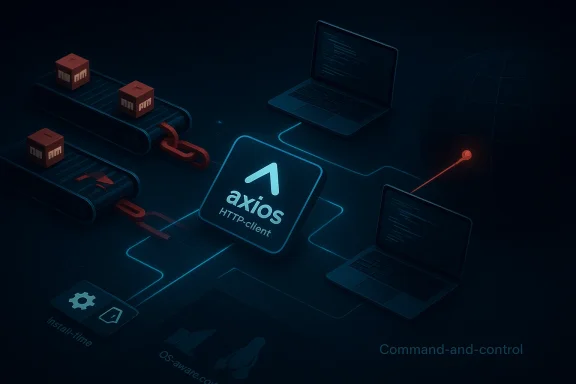
On March 31, 2026, a malicious npm package update turned Axios, one of the JavaScript ecosystem’s most ubiquitous HTTP clients, into the latest reminder that software trust can be weaponized at scale. The compromise was brief, but the blast radius was broad: malicious versions were published, then removed within hours, after which CISA, Microsoft, and the Axios maintainers warned developers to assume exposure if they installed the affected releases during the attack window. In practical terms, this was not just another bad package upload; it was a supply chain compromise that targeted the software distribution path itself, exploiting the fact that modern development pipelines often install dependencies automatically and repeatedly.
The Axios incident fits into a larger pattern that security teams have been warning about for years: attackers increasingly prefer to poison trusted software channels rather than break into every target one by one. That logic is simple and brutally effective. If a package is downloaded millions of times a week, one compromised release can reach developers, build systems, and CI/CD pipelines far faster than a conventional intrusion campaign.
Axios is especially attractive to attackers because it is embedded in the everyday machinery of web development. Microsoft described it as a popular HTTP client for JavaScript with more than 70 million weekly downloads, and that scale alone makes even a short-lived compromise meaningful. The package is widely used by both consumer-facing applications and enterprise services, which means the same malicious dependency can ride into laptops, workstations, test environments, and automated build servers.
The attack also arrived after a year of heightened concern around npm ecosystem abuse. CISA’s earlier npm alert warned that supply chain compromises can spread through dependency trees, cached artifacts, and registry-driven update flows, while its broader supply-chain guidance repeatedly emphasized the need to review dependencies, pin versions, and rotate developer credentials after suspected exposure. That backdrop matters because Axios was not an isolated anomaly; it was a fresh example of a known and recurring threat class.
What made this case especially notable was the apparent combination of account compromise, malicious dependency insertion, and install-time execution. According to the Axios maintainer’s postmortem, the malicious releases were published through a compromised account, and the attacker injected a dependency named
Another reason the story matters is timing. The malicious versions were live for only a few hours, but in software supply chain security, hours can be enough. If an organization’s automation pulls new dependency versions continuously, then a compromise with a short dwell time can still contaminate a large fleet of developer machines and ephemeral build agents before defenders even notice. That is why CISA and Microsoft both stressed remediation steps that assume the package may already have executed during installation.
The maintainers’ account adds another layer of detail. In the postmortem, Axios reported that
The attack also leveraged the normal trust model of package managers. Developers often expect install commands to be boring, repeatable, and low-risk, yet package lifecycle scripts can still run code at install time. In other words, the package manager becomes the execution engine, which means the security boundary is not the application code alone but the packaging metadata and dependency graph too.
That cross-platform design is significant because developer workstations are rarely homogeneous. Enterprises may run Windows on laptops, Linux in CI, and macOS in mobile or frontend teams. A package compromise that can adapt its payload by platform is therefore much more likely to succeed across a mixed environment than one built for a single endpoint class.
The lesson is uncomfortable but clear: registry security is only as strong as the account security behind it. If an attacker can take over a maintainer session, bypass a weak MFA setup, or trick a maintainer into installing a remote access tool, then package publication becomes a delivery vehicle for malware. The code may be open source, but the signing and release process is still a human trust problem.
Because the malicious behavior happened at install time, standard smoke tests may have missed it. A team could verify that Axios still imports and that API calls still work, while the true malicious payload has already executed once on the build host. This is why dependency review and lockfile inspection matter so much; the compromise may be invisible in functional testing.
The attacker then used a single command-and-control resource with OS-specific responses. Microsoft said the package connected to a Sapphire Sleet-controlled domain and that the same path was used for all platforms, with platform selection conveyed through request bodies. That is a neat operational design because it keeps the client logic small while preserving flexibility on the server side.
The maintenance of persistence is especially concerning. An install-time compromise is bad enough, but if it also establishes a foothold that survives reboot or later package cleanup, then an apparently small dependency incident can become a broader endpoint remediation exercise. That is why Microsoft’s detection list included multiple families of telemetry and not just package-level alerts.
Axios explicitly warned that if the incident happened on a CI runner, any secrets injected during the affected build should be rotated. That is because a pipeline can be both the victim and the exfiltration point. The build environment is not a neutral place; it is often the crown-jewel access layer.
A careful response also requires looking beyond the package manifest. Teams should check build logs, install timestamps, endpoint telemetry, and outbound connections to the reported infrastructure. If a CI runner pulled the malicious release, the absence of a crash does not mean the absence of compromise.
Microsoft also published a detailed mitigation blog, which is significant because vendors can help collapse the time between discovery and remediation. By publishing the malicious versions, the affected dependency name, the C2 infrastructure, and the likely impacted platforms, Microsoft gave defenders actionable intelligence rather than abstract alarm.
The broader lesson is that defense has to happen at multiple layers. Registry removal helps, but it does not clean up installed malware on developer endpoints or revoke secrets already harvested by the attacker. The real response must combine package hygiene, endpoint triage, and credential rotation.
It also strengthens the case for package managers and security vendors that emphasize verification, policy enforcement, and dependency intelligence. If one of the most established packages in the JavaScript ecosystem can be weaponized through a malicious update, then customers will ask harder questions about signature verification, provenance metadata, and automated anomaly detection. Security is no longer just a cost center in the dependency market; it is part of the buying decision.
The industry implication is clear: maintainers need better protections, but they also need better tooling and community support. The attack surface is not just the code repository; it is the maintainer’s email, laptop, phone, authentication stack, and release process. That is an ecosystem problem, not a personal failing.
Axios also underscores that not every compromise looks the same. Some supply chain attacks are worm-like and self-propagating, while others are surgical and targeted. Some seek tokens. Others seek persistence. Still others seek broad infection and downstream leverage. The common factor is the abuse of trust in delivery channels.
Organizations should expect more package-level attacks, not fewer. The economic incentives are simply too strong, and the software supply chain still offers too many high-leverage choke points. The teams that survive this trend best will be the ones that treat dependency intake as a security boundary, not a convenience feature.
Source: CISA Supply Chain Compromise Impacts Axios Node Package Manager | CISA
 Background
The Axios incident fits into a larger pattern that security teams have been warning about for years: attackers increasingly prefer to poison trusted software channels rather than break into every target one by one. That logic is simple and brutally effective. If a package is downloaded millions of times a week, one compromised release can reach developers, build systems, and CI/CD pipelines far faster than a conventional intrusion campaign.Axios is especially attractive to attackers because it is embedded in the everyday machinery of web development. Microsoft described it as a popular HTTP client for JavaScript with more than 70 million weekly downloads, and that scale alone makes even a short-lived compromise meaningful. The package is widely used by both consumer-facing applications and enterprise services, which means the same malicious dependency can ride into laptops, workstations, test environments, and automated build servers.
The attack also arrived after a year of heightened concern around npm ecosystem abuse. CISA’s earlier npm alert warned that supply chain compromises can spread through dependency trees, cached artifacts, and registry-driven update flows, while its broader supply-chain guidance repeatedly emphasized the need to review dependencies, pin versions, and rotate developer credentials after suspected exposure. That backdrop matters because Axios was not an isolated anomaly; it was a fresh example of a known and recurring threat class.
What made this case especially notable was the apparent combination of account compromise, malicious dependency insertion, and install-time execution. According to the Axios maintainer’s postmortem, the malicious releases were published through a compromised account, and the attacker injected a dependency named
[email][email protected][/email] that installed a remote access trojan on macOS, Windows, and Linux. Microsoft’s analysis aligned with that account of the incident and attributed the infrastructure to Sapphire Sleet, a North Korean state actor.Another reason the story matters is timing. The malicious versions were live for only a few hours, but in software supply chain security, hours can be enough. If an organization’s automation pulls new dependency versions continuously, then a compromise with a short dwell time can still contaminate a large fleet of developer machines and ephemeral build agents before defenders even notice. That is why CISA and Microsoft both stressed remediation steps that assume the package may already have executed during installation.
What Happened
The core of the attack was deceptively simple: two malicious Axios npm releases, 1.14.1 and 0.30.4, were published with a hidden dependency that triggered malware download behavior during installation. Microsoft said the malicious versions were identified on March 31, 2026 and that they connected to a known malicious command-and-control domain to fetch a second-stage remote access trojan. The maintainers’ postmortem said the versions were removed roughly three hours later.A dependency with a purpose
The injected dependency,[email][email protected][/email], was the key trick. It was not a legitimate runtime library in the ordinary sense; it existed to execute install-time logic through npm lifecycle behavior. Microsoft described it as a fake runtime dependency that launched automatically in a post-install phase, meaning the malicious code could run without any developer explicitly executing a suspicious file. That design is classic supply chain tradecraft because it hides inside routine package installation.The maintainers’ account adds another layer of detail. In the postmortem, Axios reported that
[email][email protected][/email] had been published first to establish a benign-looking history, followed by [email][email protected][/email], which added malicious install-time logic and a hook that ran node setup.js. That sequencing suggests intentional staging meant to reduce scrutiny and create a more credible package lineage. That is not the sort of thing accidental malware does; it is the sort of thing an operator plans.Why the attack was hard to notice
The malicious Axios releases did not need to rewrite the package’s main application logic to be dangerous. Microsoft noted that the trusted package’s behavior could appear unchanged while the harmful activity happened quietly during install or update events. That distinction matters because many organizations test whether an application still “works” after an upgrade, but they do not always test whether the install step itself is safe.The attack also leveraged the normal trust model of package managers. Developers often expect install commands to be boring, repeatable, and low-risk, yet package lifecycle scripts can still run code at install time. In other words, the package manager becomes the execution engine, which means the security boundary is not the application code alone but the packaging metadata and dependency graph too.
Timeline in brief
The sequence, as described by Axios and Microsoft, is worth keeping straight:[email][email protected][/email]was published on March 30, 2026.- Malicious
[email][email protected][/email]was published on March 31, 2026. - Malicious
[email][email protected][/email]followed shortly afterward. - External detections and community reports surfaced quickly.
- The malicious versions were removed the same day.
Attribution and Threat Actor Analysis
Microsoft attributed the infrastructure behind the attack to Sapphire Sleet, a North Korean state actor, and said the malicious domain and payload behavior matched that actor’s tradecraft. That attribution raises the stakes well beyond an ordinary maintainer-account compromise. It suggests the incident was not merely opportunistic criminal monetization but a more strategic operation aimed at broad downstream access.Why state-actor attribution matters
If the adversary is state-linked, the expected goals change. Instead of immediate extortion, the operator may care about persistent access, credential theft, and lateral movement into development environments that contain secrets, signing keys, or deployment credentials. Microsoft warned that once the second-stage RAT landed, the malicious payload was selected based on the victim’s operating system, including Windows, macOS, and Linux, which implies the campaign was built for cross-platform reach rather than single-target infection.That cross-platform design is significant because developer workstations are rarely homogeneous. Enterprises may run Windows on laptops, Linux in CI, and macOS in mobile or frontend teams. A package compromise that can adapt its payload by platform is therefore much more likely to succeed across a mixed environment than one built for a single endpoint class.
The maintainer-account angle
Axios said the malicious versions were published through the maintainer’s compromised account. The postmortem described a social engineering campaign and RAT malware as the path to the initial compromise, though it also said the team was still investigating the precise entry point. That is an important reminder that supply chain attacks often begin as identity attacks, not code attacks.The lesson is uncomfortable but clear: registry security is only as strong as the account security behind it. If an attacker can take over a maintainer session, bypass a weak MFA setup, or trick a maintainer into installing a remote access tool, then package publication becomes a delivery vehicle for malware. The code may be open source, but the signing and release process is still a human trust problem.
The trust chain problem
The Axios case shows how publisher identity, registry trust, and build automation all interact. A release can be technically valid in the sense that it comes from the expected account, yet still be operationally malicious if that account has been compromised. That creates an uncomfortable middle ground for defenders: the registry may not look broken, but the trust model is already impaired.Technical Mechanics
The technical mechanics of the compromise are what make it so instructive for defenders. This was not a simplistic typo-squatting campaign or a malicious package with obvious runtime malware dropped in the main source tree. Instead, it appears to have been a carefully layered compromise that used dependency insertion, install-time execution, obfuscation, and OS-aware staging.Install-time execution as the pivot
The most important feature was the use of a lifecycle script during install. Microsoft said[email][email protected][/email] launched node setup.js automatically, with no extra user interaction required. That means a normal npm install or npm update could be enough to trigger the first-stage loader. In a modern development workflow, that is a very small action with very large consequences.Because the malicious behavior happened at install time, standard smoke tests may have missed it. A team could verify that Axios still imports and that API calls still work, while the true malicious payload has already executed once on the build host. This is why dependency review and lockfile inspection matter so much; the compromise may be invisible in functional testing.
Obfuscation and first-stage loading
Microsoft’s analysis said the loader used layered obfuscation to reconstruct sensitive strings at runtime, including module names, platform identifiers, file paths, and command templates. That approach serves two purposes. It makes static analysis harder, and it allows the same codebase to determine which platform it is running on before retrieving a matching payload.The attacker then used a single command-and-control resource with OS-specific responses. Microsoft said the package connected to a Sapphire Sleet-controlled domain and that the same path was used for all platforms, with platform selection conveyed through request bodies. That is a neat operational design because it keeps the client logic small while preserving flexibility on the server side.
What the payload did
Microsoft said the second-stage payload was a remote access trojan and that the malicious behavior targeted all three major desktop operating systems. On Windows, the malware dropped a VBScript stager; on macOS, it dropped a native binary and created a persistence artifact masquerading as a legitimate Apple component; and on Linux, the flow was adapted to that environment as well. This is the hallmark of a mature intrusion campaign rather than a one-off proof of concept.The maintenance of persistence is especially concerning. An install-time compromise is bad enough, but if it also establishes a foothold that survives reboot or later package cleanup, then an apparently small dependency incident can become a broader endpoint remediation exercise. That is why Microsoft’s detection list included multiple families of telemetry and not just package-level alerts.
Indicators that mattered
Axios’ postmortem and Microsoft’s guidance both pointed defenders toward specific indicators, including the malicious package versions, the injected dependency name, and network contact with the attacker’s domain and IP on port 8000. They also emphasized checking lockfiles, because a compromised package may linger in project metadata even after the registry has cleaned itself up. This is one of the clearest examples of why software provenance is a security control, not just a supply chain buzzword.Impact on Developers and CI/CD
The Axios compromise was not just a library issue; it was a developer workflow issue. If a machine ran a fresh install during the exposure window, the malicious dependency could execute there, potentially exposing tokens, signing keys, and environment secrets. That makes the incident especially relevant to CI/CD runners, where ephemeral jobs often have broad automated access and little human oversight.Why CI/CD is a soft target
Build pipelines are optimized for speed, which is good for productivity but dangerous for trust. They often pull the newest package versions, cache artifacts, and inject secrets automatically at runtime. If a malicious package is introduced during that flow, the attacker can collect secrets without needing to compromise the application itself.Axios explicitly warned that if the incident happened on a CI runner, any secrets injected during the affected build should be rotated. That is because a pipeline can be both the victim and the exfiltration point. The build environment is not a neutral place; it is often the crown-jewel access layer.
What developers should check
The maintainers provided a straightforward grep-based search to identify whether a lockfile contains the malicious package versions or the injected dependency. That advice is practical because many developers remember to checkpackage.json but forget that lockfiles often preserve the exact compromised transitive paths. The compromised code may already have been removed upstream, yet the lockfile can still point to the dangerous artifact.A careful response also requires looking beyond the package manifest. Teams should check build logs, install timestamps, endpoint telemetry, and outbound connections to the reported infrastructure. If a CI runner pulled the malicious release, the absence of a crash does not mean the absence of compromise.
Enterprise versus consumer exposure
Consumers are not completely out of scope, but the enterprise risk is higher. Individual developers may have a single machine at stake, while organizations may have hundreds of laptops, dozens of runners, and shared artifact caches all pulling from the same dependency graph. That multiplication effect is what turns a short-lived package compromise into a significant operational event.How the Ecosystem Responded
One encouraging aspect of the Axios compromise is that the ecosystem responded quickly. The malicious versions were removed within hours, community members flagged the issue early, and the maintainer published a postmortem with concrete remediation steps. In a field where supply chain compromises often linger unnoticed, rapid community triage is a real advantage.The value of quick disclosure
Axios’ postmortem did not try to minimize the incident. It said the compromise happened through unauthorized access to the maintainer’s account, listed the publish timeline, and admitted that certain parts of the investigation were still ongoing. That candor matters because teams can only defend themselves if they know what to look for. Vague warnings are less useful than precise timelines and indicators.Microsoft also published a detailed mitigation blog, which is significant because vendors can help collapse the time between discovery and remediation. By publishing the malicious versions, the affected dependency name, the C2 infrastructure, and the likely impacted platforms, Microsoft gave defenders actionable intelligence rather than abstract alarm.
Detection and blocking
Microsoft said it had detections in place that alerted and protected customers, and that it implemented additional protections to detect and block malicious components. Those kinds of defensive controls are increasingly important because organizations cannot manually review every dependency change in real time. Automated detection, package reputation checks, and outbound network blocking all help reduce exposure windows.The broader lesson is that defense has to happen at multiple layers. Registry removal helps, but it does not clean up installed malware on developer endpoints or revoke secrets already harvested by the attacker. The real response must combine package hygiene, endpoint triage, and credential rotation.
Competitive and Industry Implications
Axios is not just another package; it is a dependency used across the JavaScript ecosystem, which means the incident reverberates through a huge swath of web application development. When a package with that kind of reach is compromised, security leaders have to think beyond the immediate fix and ask what it means for software distribution trust more generally.What it means for rivals and alternative stacks
For rival HTTP libraries and adjacent tooling vendors, the incident is a reminder that trust is now a product feature. Teams choosing libraries will care not only about performance and API design, but about release engineering, account security, provenance, and whether maintainers use immutable publishing workflows. In that sense, security posture can become a differentiator.It also strengthens the case for package managers and security vendors that emphasize verification, policy enforcement, and dependency intelligence. If one of the most established packages in the JavaScript ecosystem can be weaponized through a malicious update, then customers will ask harder questions about signature verification, provenance metadata, and automated anomaly detection. Security is no longer just a cost center in the dependency market; it is part of the buying decision.
The open source maintainer burden
This incident also renews attention on maintainer burnout and account security. Open source maintainers often operate with limited staff, public identities, and very high leverage over downstream software. That makes them attractive targets for phishing, token theft, and social engineering. The Axios postmortem explicitly said open source maintainers with high-impact packages are active targets and that vigilance is needed both on the registry and in personal environments.The industry implication is clear: maintainers need better protections, but they also need better tooling and community support. The attack surface is not just the code repository; it is the maintainer’s email, laptop, phone, authentication stack, and release process. That is an ecosystem problem, not a personal failing.
Historical Context
This Axios compromise belongs to a long line of software supply chain incidents that have taught the same painful lesson in different ways. SolarWinds showed that trusted updates can be trojanized at massive scale. XZ Utils showed that a nearly successful upstream compromise can hide in plain sight for a long time. Recent npm ecosystem incidents have shown that package managers themselves can become the attack surface.A pattern, not an outlier
What makes these incidents so difficult is that they exploit normal development behavior. Developers are supposed to trust signed or published updates; build systems are supposed to install dependencies automatically; and maintainers are supposed to ship quickly. Attackers do not need to invent new technology if they can turn the software factory’s existing efficiency against itself.Axios also underscores that not every compromise looks the same. Some supply chain attacks are worm-like and self-propagating, while others are surgical and targeted. Some seek tokens. Others seek persistence. Still others seek broad infection and downstream leverage. The common factor is the abuse of trust in delivery channels.
Why the timing matters
The April 2026 alert lands after repeated public guidance from CISA on dependency review, MFA, secret rotation, and repository hardening. That means the warning is not new, but the urgency is. Each fresh compromise demonstrates that the control gap is still real, especially in environments where package updates are consumed automatically and provenance checks are weak or inconsistent.Strengths and Opportunities
The most important positive takeaway is that the Axios response shows the security community can detect, attribute, and clean up a compromise quickly when telemetry and communication are strong. The event also creates an opportunity for organizations to harden package ingestion, improve developer account security, and modernize release workflows before the next incident arrives. The broader market may also accelerate adoption of provenance and immutable publishing controls.- Rapid community reporting limited the exposure window.
- Public postmortems gave defenders concrete timelines and indicators.
- Microsoft’s analysis provided cross-platform detection guidance.
- The incident reinforces the value of lockfile reviews and dependency pinning.
- It creates momentum for OIDC-based publishing and immutable release workflows.
- It gives security teams a real-world case to justify stronger MFA and secret rotation policies.
- It highlights the value of supply chain monitoring as an operational control, not just a compliance checkbox.
Security Process Improvements
The clearest opportunity is to make “trust but verify” operational rather than aspirational. Teams that review dependency graphs, isolate build environments, and watch outbound traffic from CI runners will be better positioned the next time a trusted package turns hostile. That is especially true for organizations with heavy JavaScript usage.Risks and Concerns
The most troubling part of this incident is that a very short compromise window can still infect a large number of downstream environments. The attack also highlights how much trust organizations still place in package managers, maintainers, and automated update paths. If that trust is abused, the result can be credential theft, persistence, and silent exposure across developer fleets.- Auto-update behavior can spread malicious releases before human review.
- CI/CD runners may leak secrets during a compromised build.
- Lockfiles can preserve exposure long after the registry removes a bad version.
- Cross-platform payloads broaden the impact across heterogeneous environments.
- Maintainer-account compromise remains a weak link in the open source model.
- Install-time scripts can execute even when application logic looks unchanged.
- Credential rotation and endpoint cleanup can be costly after the fact.
Operational Exposure
The greatest operational risk is false reassurance. If a team sees the malicious versions disappear from npm, it may assume the problem is solved. In reality, any machine that installed the package during the exposure window still needs triage, and any secrets touched during that session should be considered suspect.Looking Ahead
The Axios incident will likely accelerate demand for stronger publishing protections, better package provenance, and more aggressive dependency screening across enterprise pipelines. It may also push maintainers and platform vendors toward workflows that reduce the chance of single-account compromise leading directly to malicious releases. For defenders, the immediate challenge is less about reacting to this one incident and more about converting it into durable policy changes.Organizations should expect more package-level attacks, not fewer. The economic incentives are simply too strong, and the software supply chain still offers too many high-leverage choke points. The teams that survive this trend best will be the ones that treat dependency intake as a security boundary, not a convenience feature.
- Audit all projects that installed Axios during the exposure window.
- Search lockfiles for
[email][email protected][/email],[email][email protected][/email], andplain-crypto-js. - Rotate developer, CI, and deployment credentials that may have been present on affected systems.
- Review outbound traffic for connections to the reported infrastructure.
- Harden package publishing with phishing-resistant MFA and OIDC.
- Reduce or isolate automatic dependency updates where operationally feasible.
- Add policy controls for install-time scripts and suspicious dependency changes.
Source: CISA Supply Chain Compromise Impacts Axios Node Package Manager | CISA
